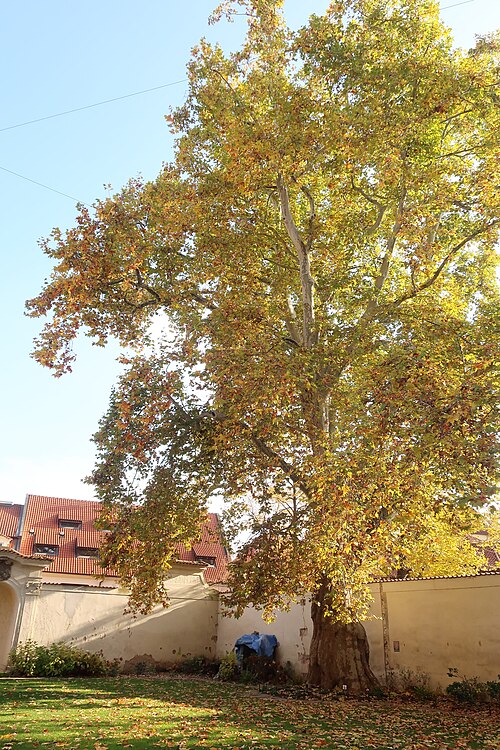
The thickest protected tree in Prague has a trunk seven and a half metres around, and its most famous story is almost certainly false.
Photo: Balaban (CC BY-SA 4.0)
Platanus x acerifolia
The London plane is a tree that a city adopted and then named after itself. We map 267 of them, in 112 cities.
It is a hybrid, a cross between the American sycamore and the Oriental plane that appeared in Europe in the 1600s and turned out to be almost indestructible in a dirty city: it shrugs off soot, tolerates brutal pruning, and sheds its bark in patches to slough off pollution. That made it the default street tree of industrial London, and from there of Paris, Amsterdam and half the capitals of Europe. The oldest specimens are now three centuries old and enormous, and because the tree was planted everywhere, the remarkable ones hide in plain sight: a churchyard in the City of London, a Mayfair square, a riverside suburb. These are the London planes mapped on the site so far, oldest first.
The thickest protected tree in Prague has a trunk seven and a half metres around, and its most famous story is almost certainly false.
Photo: Balaban (CC BY-SA 4.0)
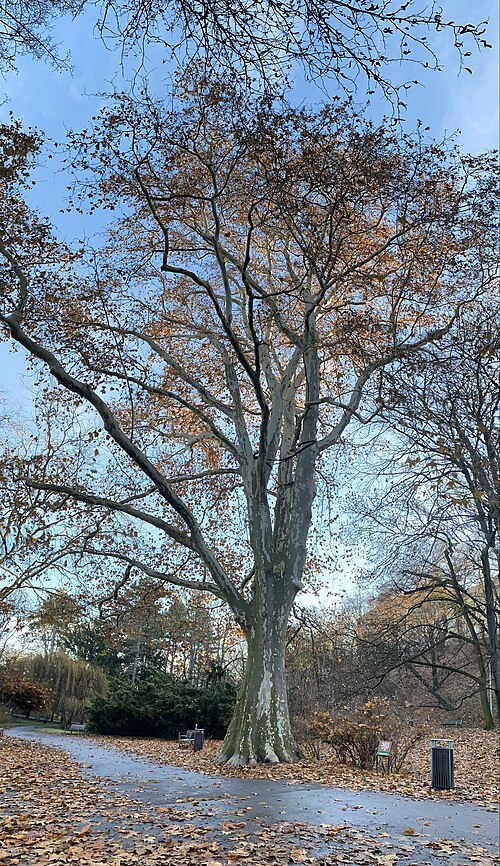
The park came second.
Photo: Kalokagathia123 (CC BY-SA 4.0)
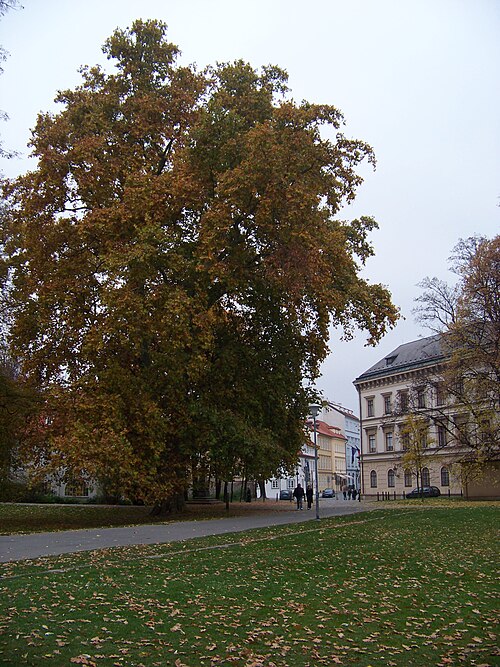
A countess planted this tree in 1813 to dress up her family's riverside garden with something exotic, and it has outgrown every other reason anyone remembers her.
Photo: SJu (CC BY-SA 3.0)
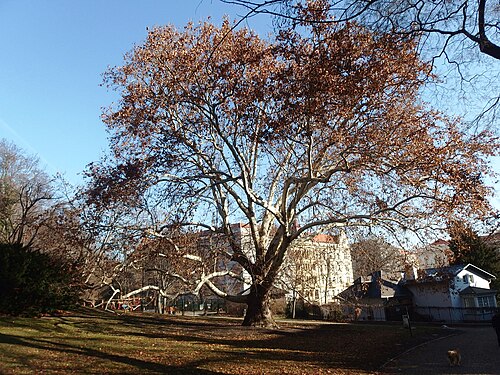
The largest tree on all of Petrin hill also lost its own sculpture to theft.
Photo: Palickap (CC BY-SA 4.0)
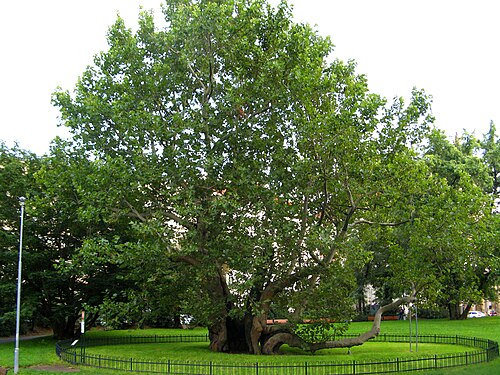
Prague's most photographed memorial tree earned an unprintable nickname for the shape of one branch.
Photo: Yekaterina Borisova (CC BY-SA 4.0)
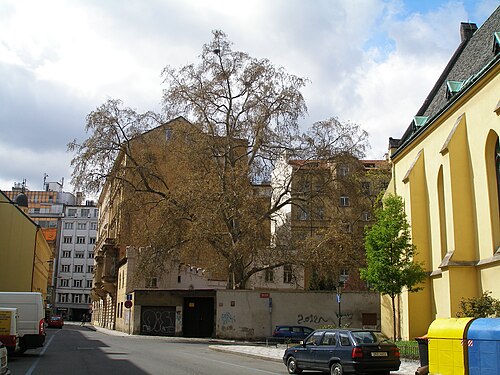
The London plane is an accident.
Photo: Jan Polák (CC BY-SA 3.0)
The second thickest tree in this park ranks ninety eighth of its species across Brussels, which says more about the city than about the tree.
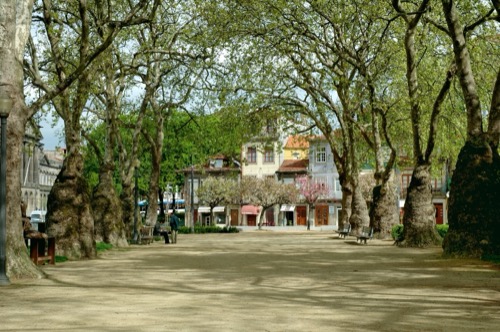
Thirty-seven plane trees line one avenue in the Jardim da Cordoaria, and every one of them stands on what looks unmistakably like an elephant's foot.
Photo: Paulo V. Araujo, Dias com Arvores
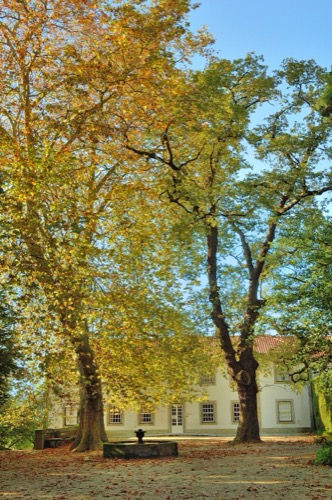
A house dedicated to a dead king's exile keeps its own protected tree in the garden outside.
Photo: Paulo V. Araujo, Dias com Arvores
At 6.4 metres around, this plane carries one of the thickest trunks measured anywhere in Porto.
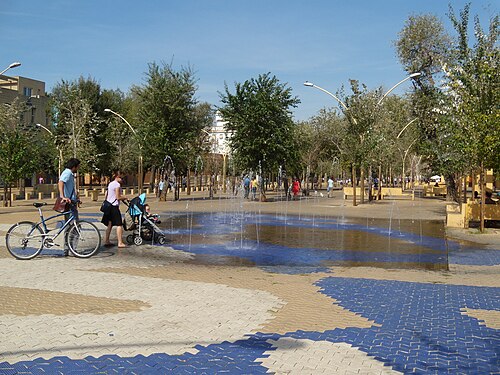
Seville's oldest public promenade was built on a swamp, and it takes its name from the trees planted to drain it.
Photo: Gzzz (CC BY-SA 3.0)
The longest surviving stretch of Seville's twelfth century wall has a plane tree growing against it.
This plane's girth runs to 4.42 metres at chest height and 5.02 at the base, wider than the more famous plane this site already lists on the Macarena wall, though shorter at 25 metres than that one...
At 4.70 metres round, this is the widest plane in Seville's survey of its singular trees, wider than either the Macarena wall plane or the Glorieta de Juanita Reina plane already published on this...
The city decided to plant this wood in 1607, which makes it older than most of what Europeans think of as parks.
De Rijp was a whaling and herring town on an island in a lake, and it got rich enough that the merchants' warehouses still stand.
Bastion, water, plane tree.
This plane arrived half a century late for its own park.
Twenty-six metres tall and 26 metres across, which is what a plane tree looks like when it has never had to compete for anything.
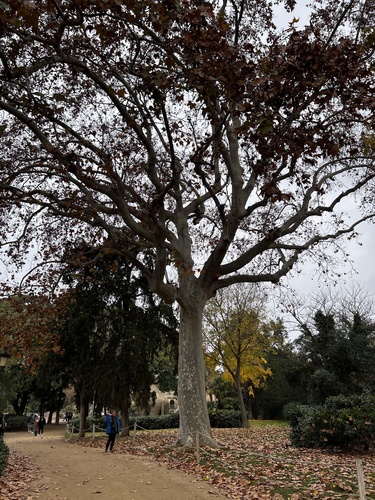
The city register lists 273 plane trees under a single entry for the Rambles.
Photo: Clifton Ladd, C.W.B (CC BY)
A trunk five and a half metres around is a great deal of plane tree for a Paris street.
This plane tree is older than the park around it.
Square Montholon has two enormous plane trees and the city has written down the history of only one of them.
Four metres ninety of trunk, in a square you can cross in twenty paces.
The sculptures are the newcomers.
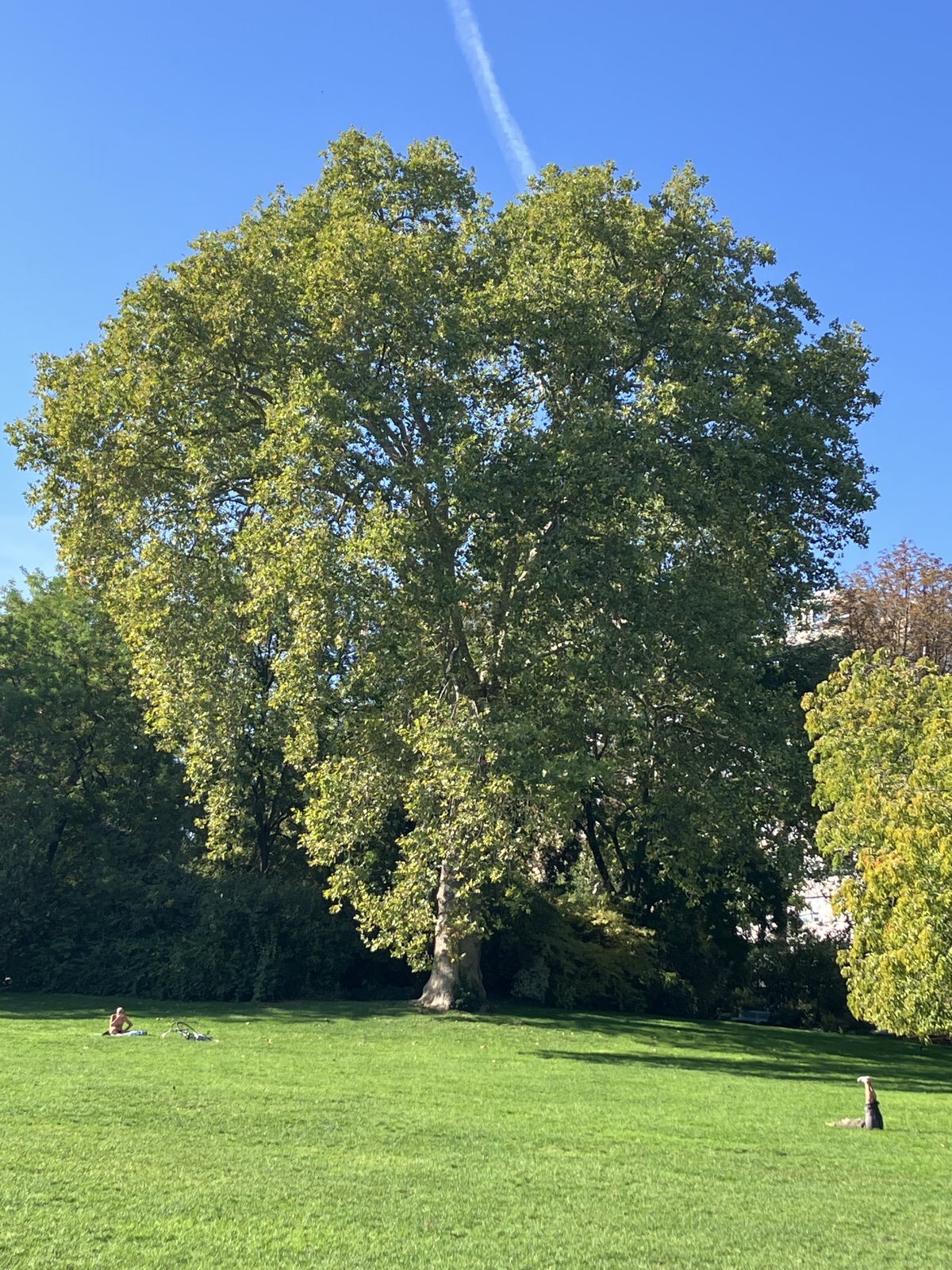
A reader sent us this plane, and the photograph makes the case for it: a London plane at the edge of the great lawn of Parc Montsouris, its crown so full and even that it reads as a heart against t...
The national register puts this plane tree at 364 years old.
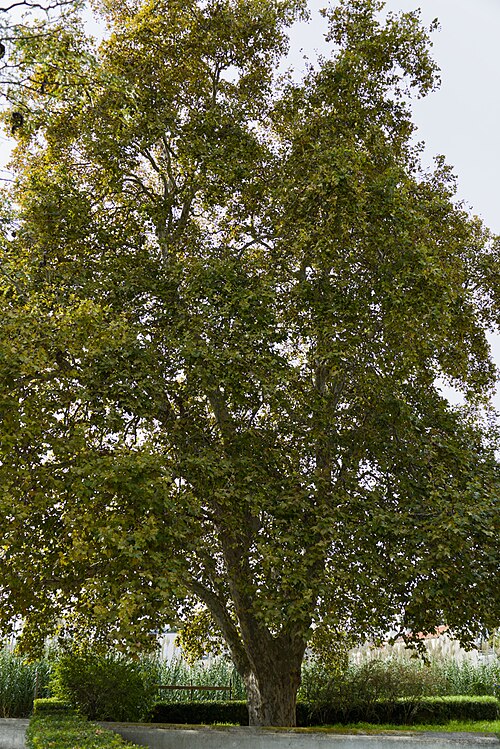
Two minutes from the queue at the Torre de Belém, on a back lane most visitors never turn into, stands a plane tree 29 metres tall.
Photo: Vampiregrave (CC BY-SA 4.0)
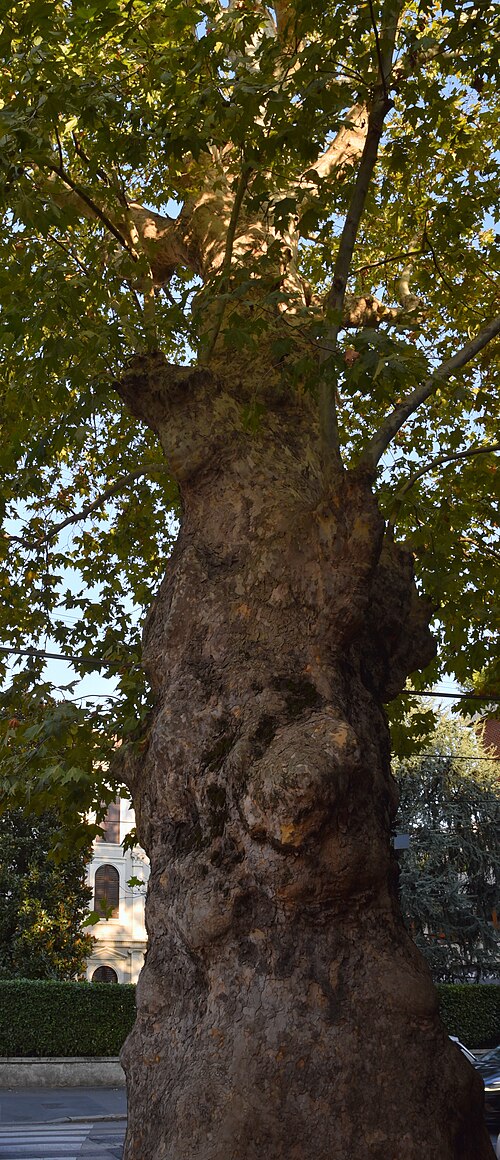
Every Milanese from Affori knows this tree simply as la Pianta, the Plant, as if there were no other, and local legend insists Napoleon is the reason it stands where it does: supposedly planted to...
Photo: Alberto Panzani (CC BY-SA 4.0)
Two plane trees grew close enough together here that they stopped being two.
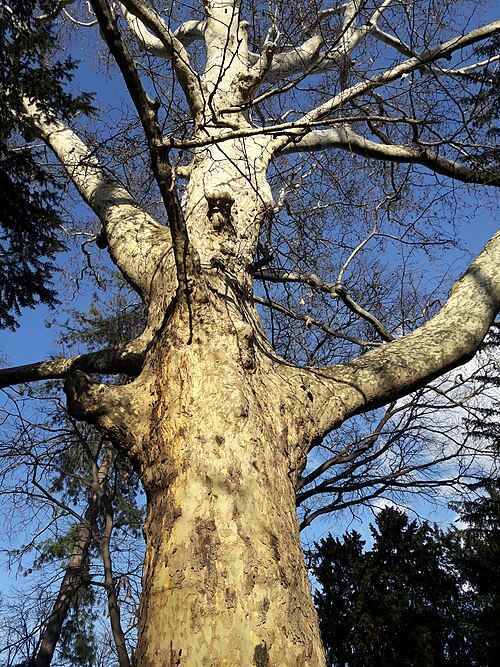
The largest plane tree in Milan does not grow tall so much as it grows sideways, in every direction at once.
Photo: Ugodiamante (CC BY-SA 4.0)
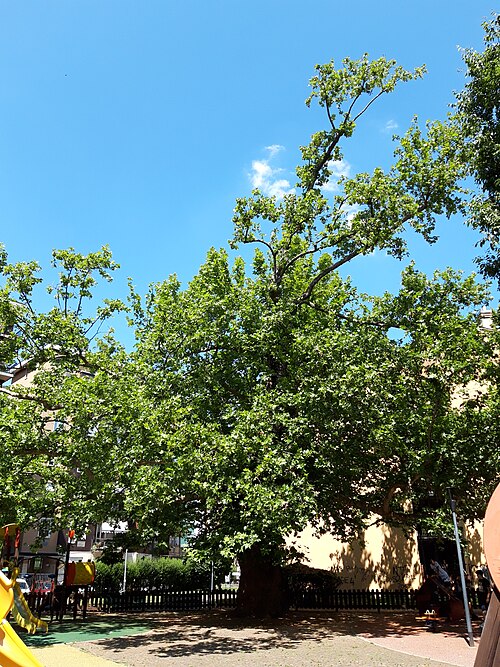
The garden is named after the two men who invented Adelphi, and the tree is the only thing in it older than the publishing house.
Photo: Ysogo (CC BY-SA 4.0)
Milan's monumental-tree register calls this one simply the platano grande, the big plane, and at 6.25 metres round it is among the widest trunks the city has measured in any park.
Depending on which document you trust, this is either one of the two tallest trees in Milan or simply one of the taller ones.
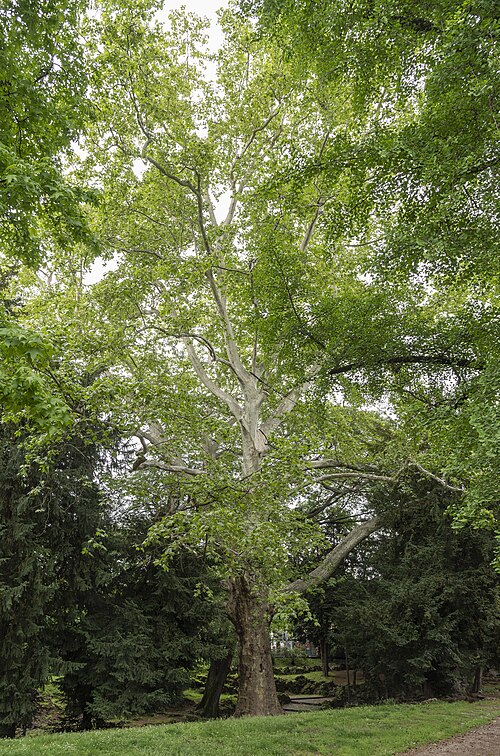
Milan picked one plane tree in this park and started counting what lives on it.
Photo: Sordelli (CC BY-SA 3.0)
This plane tree joined Italy's national register of monumental trees in November 2025, which makes it one of the newest protected trees in the country and one of the taller ones in Milan.
Parco Sempione is the most walked park in Milan, and this tree only entered the national register of monumental trees in November 2025.
A newspaper survey of Milan's monumental trees once put the city's ceiling at 34 metres.
Milan's best known plane trees stop at 34 metres.
A story went round Milan in 2018 that the big plane on Viale Vittorio Veneto, growing in the old tram-line median near Porta Venezia, had dried out and been cut down.
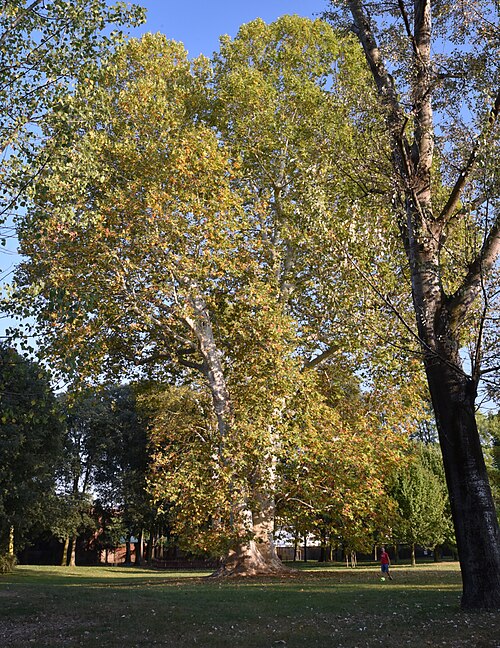
Two plane trees stand twelve metres apart in Villa Litta Modignani park, and Italy's national monumental-tree register puts the larger at 43 metres, which would make it the tallest tree on this pag...
Photo: Alberto Panzani (CC BY-SA 4.0)
This plane carries a name nobody has explained.
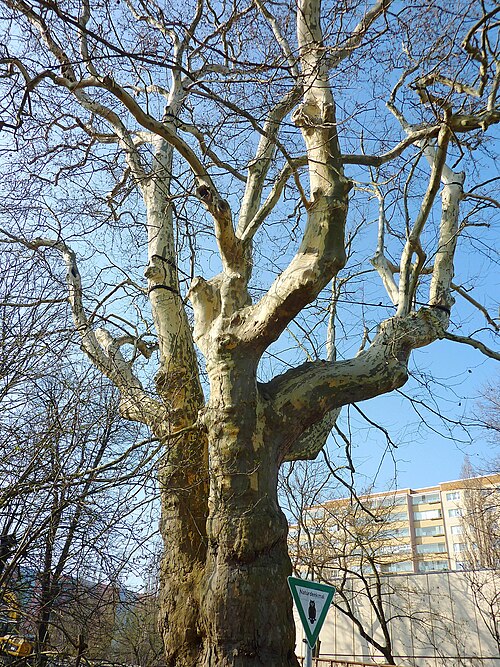
The oldest tree at Berlin's Tierpark predates the zoo around it by roughly two centuries.
Photo: Lotse (CC BY-SA 3.0)
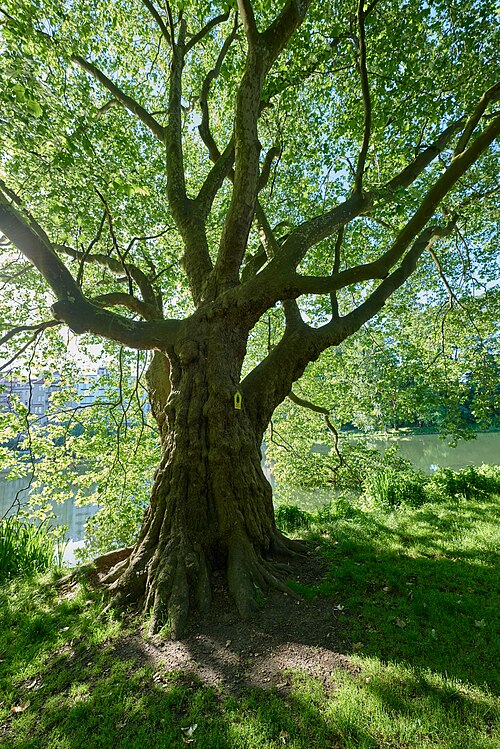
This plane added 43 centimetres to its waistline in ten years.
Three of Pfaueninsel's protected oaks require a ferry ticket.
This plane tree grows on Bebelplatz, the square where the 1933 book burning took place, and nobody has recorded whether it was already standing there to see it.
On the night of 15 January 1919, Freikorps soldiers shot Karl Liebknecht in the dark beside the Neuer See and reported that he had been killed trying to escape.
The London plane may not be from London at all.
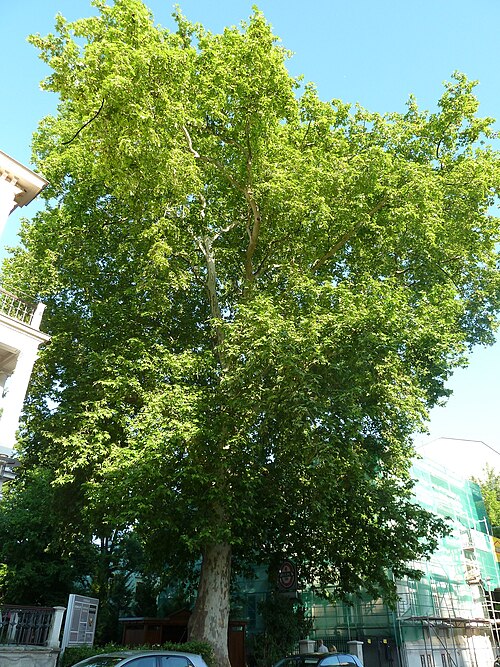
The trunk of this plane stands flush with the street edge on Leibnizstrasse, so the pavement walks right past a pale, flaking column you cannot miss.
Photo: Edlerin (CC BY-SA 4.0)
Lyon's street-tree database holds over 100,000 records, and barely more than half of them carry a planting date at all.
The most recent evidence that this tree is standing is from 2012.
A tree with more than one trunk is hard to age by the usual rule of thumb, and that uncertainty is most of this one's story.
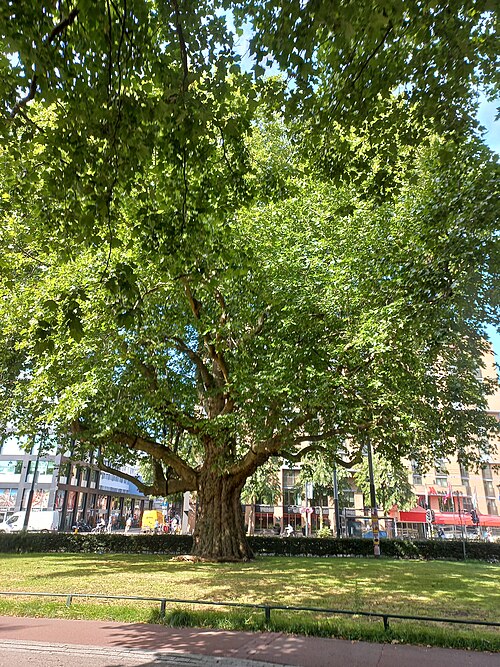
When the city needed to widen a bridge in 1925, Amsterdam moved two fully grown plane trees rather than fell them.
This is the oldest tree in this group and the register has nothing to say about it.
Five metres of trunk in a hundred and twenty-five years is quick work.
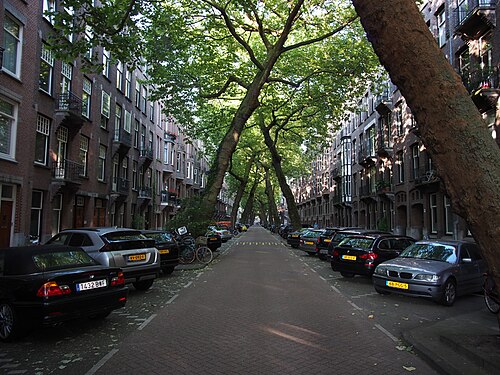
Nobody designed the tunnel of trees on Lomanstraat.
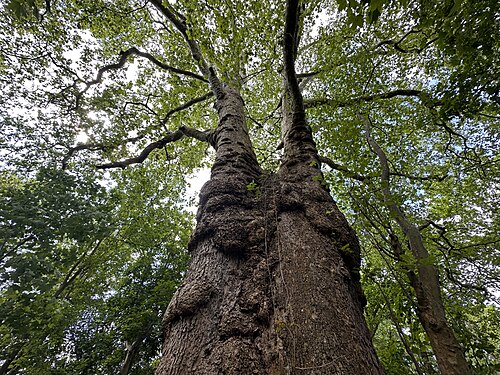
The biggest London plane in the city is a tree most Londoners have never heard of.
Photo: Matt Brown (CC BY 4.0)
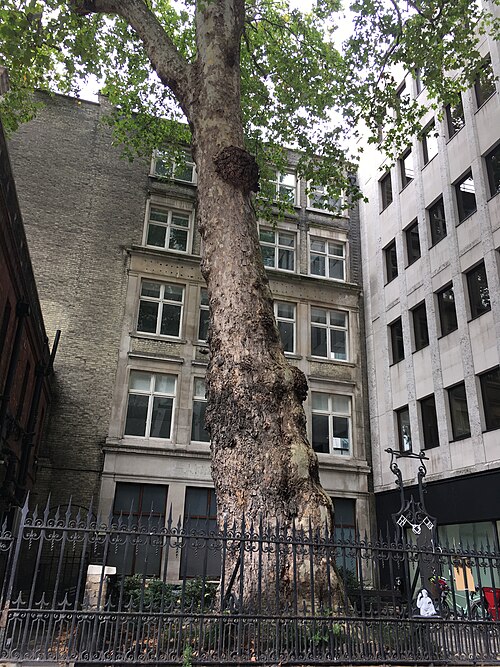
The only Great Tree of London still standing inside the Square Mile grows out of a churchyard that no longer has a church.
Four planes stood on the north side of St Paul's churchyard until the Great Storm of 1987 took one of them down.
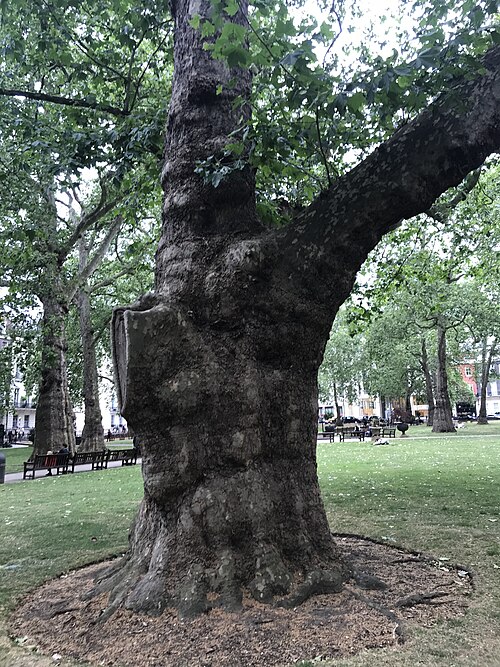
In 2008 a valuer put a price on one of the plane trees in Berkeley Square: 750,000 pounds, briefly the most valuable tree in Britain, a number that says more about Mayfair real estate than about th...
Photo: Hopefully Acceptable Username (CC BY-SA 4.0)
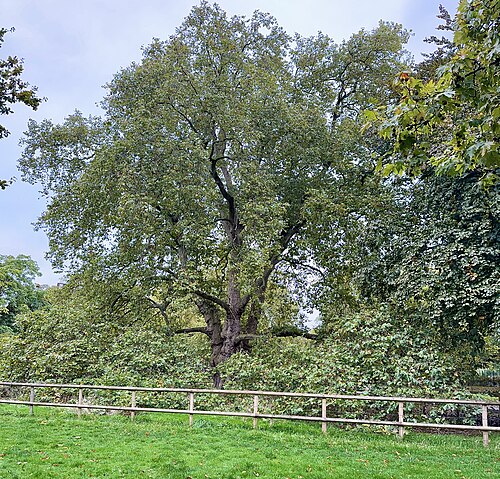
This plane was planted for orphans.
Photo: Matt Brown (CC BY 2.0)
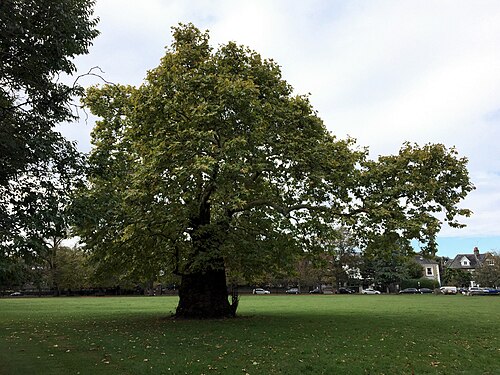
A virus is the best explanation anyone has for the shape of this tree.
Photo: Paulitzer (CC BY-SA 4.0)
George Fox, who founded the Quakers, was buried on this ground in 1691, and the plane trees standing over it are nowhere near old enough to have seen it.
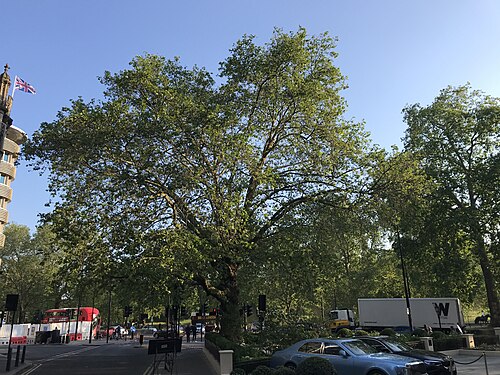
One of the Great Trees of London stands at the front door of a hotel where a night costs more than most people's monthly rent, and you can walk up to it for nothing.
Photo: Hopefully Acceptable Username (CC BY-SA 4.0)
This is a park where the tree is most of the park.
Two London planes stand twenty metres apart at Ballard Playground, and the city measures them as near twins: trunks 76 and 75 inches across at chest height, each close to 20 feet round.
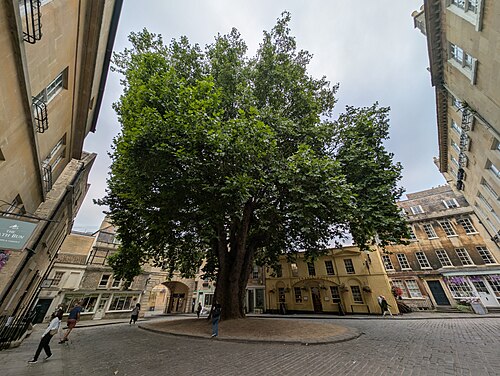
Abbey Green is a small paved square tucked into the medieval streets just south of Bath Abbey, and a single giant London Plane fills nearly all of it, its canopy reaching over the surrounding Georg...
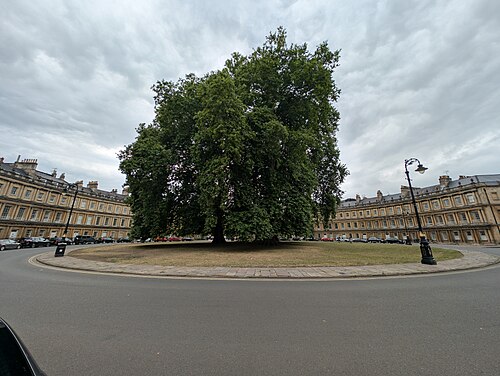
The Circus is three curved terraces of Grade I listed townhouses arranged into a full circle, John Wood the Elder's answer to the Colosseum and one of the defining images of Georgian Bath.
This plane is older than the building it fronts.
South of a 19th-century country villa in Groningen's smallest urban forest grows the tree that gives Park Groenestein its scale: a plane tree large enough to anchor an entire estate's landscaping a...
This plane and the weeping beech nearby went into the ground the same year, 1876, on the same patch of former university botanical garden, and one of them has grown into one of the tallest trees in...
Noorderplantsoen used to be a fortress moat.
Grey herons nest in the tops of these trees.
The register gives this cemetery two separate plane entries, and they stand half a kilometre apart inside the same walled ground.
London planes were the tree Victorian cities planted when they wanted something that could stand the air, and they manage it by shedding their bark in plates, taking the grime off with it.
Via del Fosso has a canal running down the middle of it, open to the sky, and this plane grows on the bank.
Lucca's Renaissance walls are planted almost entirely as a single ring of trees, but the register singles out only three individuals along the whole circuit, and this plane, growing on the ramparts...
The neighbourhood had this tree scanned.
Rome's second-thickest registered plane does not grow in a villa garden.
This plane tree was already standing when father-and-son landscape architects Jan David and Louis Paul Zocher began designing het Park around it in 1852, which means the tree came first and the cel...
This plane was likely planted in 1851 in the garden of the Coolsingel hospital, and it was still there in May 1940 when German bombing destroyed most of Rotterdam's city centre in a single night, t...
This plane tree has been standing since 1860, older than the Westersingel canal that now runs beside it, and it survived the one event that erased almost everything else nearby: the German bombing...
Moving a mature tree across a street sounds like a euphemism for felling it and planting a new one, but Rotterdam actually did it: sometime in the 1960s, engineers transplanted this plane tree bodi...
This London plane stands at a junction most people pass through rather than stop at, where the Westersingel canal crosses the Mauritsweg and Witte de Withstraat, planted sometime around 1900 to 191...
Sintra's park changed its name overnight and this tree didn't notice.
The register lists this plane as a landmark rather than a specimen: it is how you know you have reached the second-to-last bend on the climb to the cemetery.
Rich families from The Hague and Delft spent the 17th and 18th centuries building country houses along the Vliet, and this plane went into the ground while that fashion was still running.
Huijgenspark carried an uglier name for most of its early life, Bogt van Guinea, until a murder in the neighbourhood in 1873 gave the city reason to rename it after Constantijn Huygens, the Hague-b...

These two London planes grow on what used to be a graveyard, the register's own note for the site reading simply planted on the former churchyard, a detail that explains why open lawn survives at a...
Photo: Qwertzu111111 (CC BY-SA 4.0)
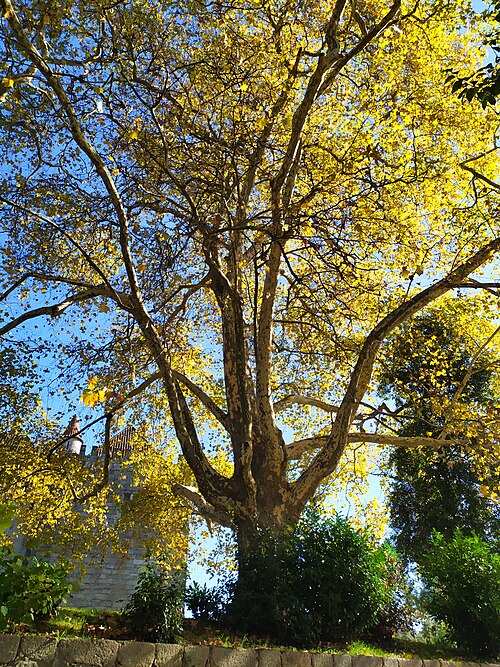
Most of what you see is younger than what grows beneath it.
Photo: Vanbasten 23 (CC BY-SA 3.0)
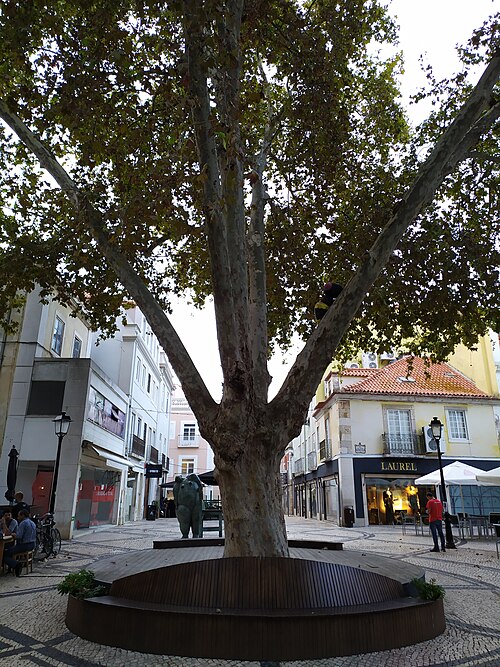
This tree is not a specimen you look at, it is the ceiling of a small square in the old town.
Photo: Vanbasten 23 (CC BY-SA 3.0)
Trinity College's own estates team cannot quite agree on how old their most impressive tree is.
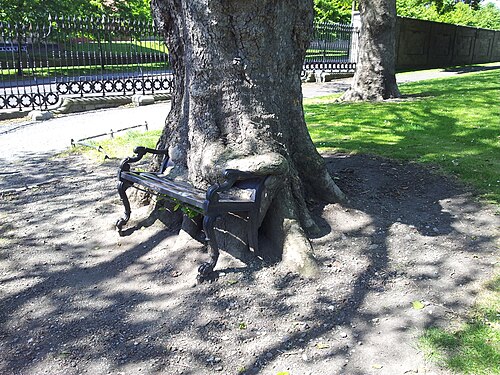
A cast iron bench has been disappearing into this tree for decades, and the tree is winning.
Photo: Declan Maher, via Geograph Britain and Ireland / Wikimedia Commons (CC BY-SA 2.0)
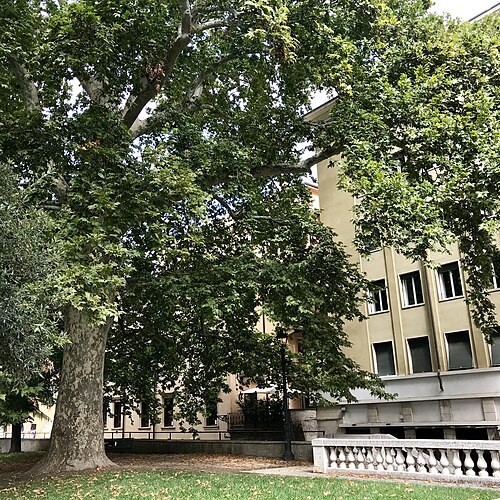
One tree fills most of the garden at the centre of Piazza Indipendenza, a trunk 505cm around supporting a canopy 35.5 metres tall, official measurements that make it, by height, one of the largest...
Photo: Mauzzan (CC BY-SA 4.0)
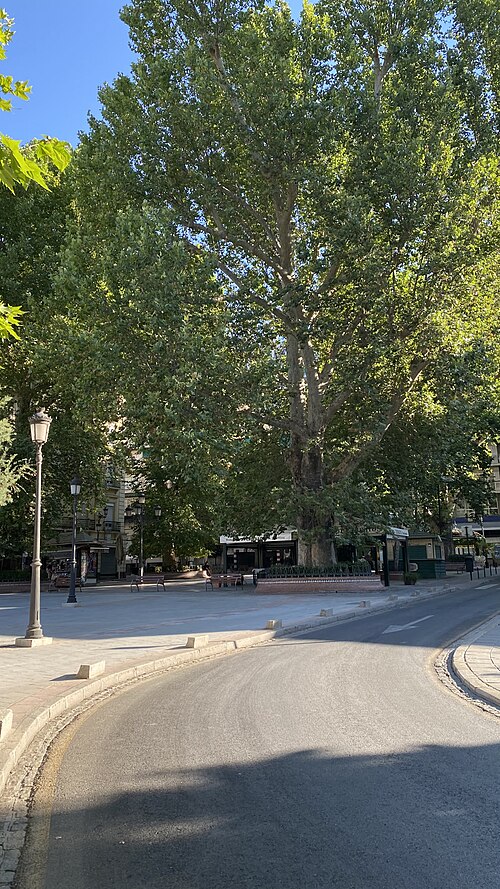
Four enormous plane trees give Plaza del Campillo its identity, ringing a baroque stone fountain whose own history is less certain than the trees that shade it.
Photo: Iblancasa (CC BY-SA 3.0)
Krakow protects ten London planes on the Planty ring, and this is the one that dwarfs the other nine.
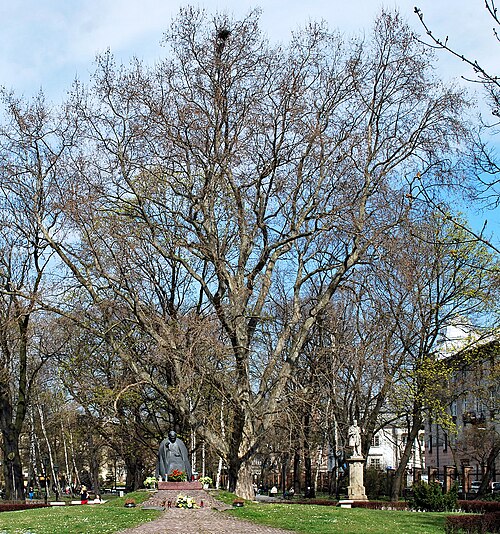
Krakow's main railway station has an old plane tree for a neighbour, 420 centimetres round, standing in a park most arriving passengers walk straight past.
Photo: Zygmunt Put (CC BY-SA 4.0)
Krakow's biggest registered plane, on the Planty by the Philharmonic, measures 520 centimetres round.
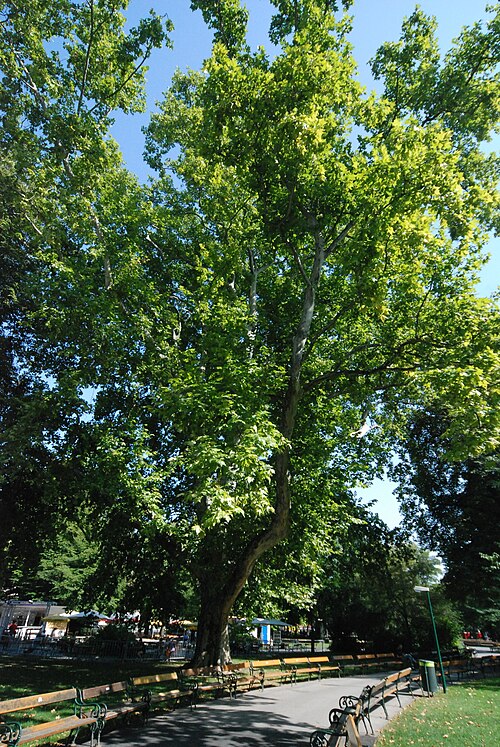
The oldest tree in front of Vienna's City Hall is older than the building itself by exactly one century.
Photo: GuentherZ (CC BY 3.0)
The thickest tree in the Venediger-Au-Park was protected only in 2012, when it was already more than a century and a half old.
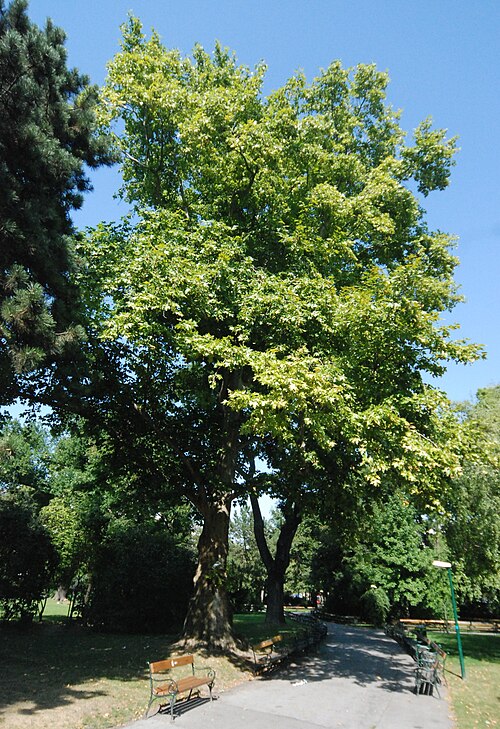
Vienna's tree register says this plane was planted in 1873.
Photo: GuentherZ (CC BY 3.0)
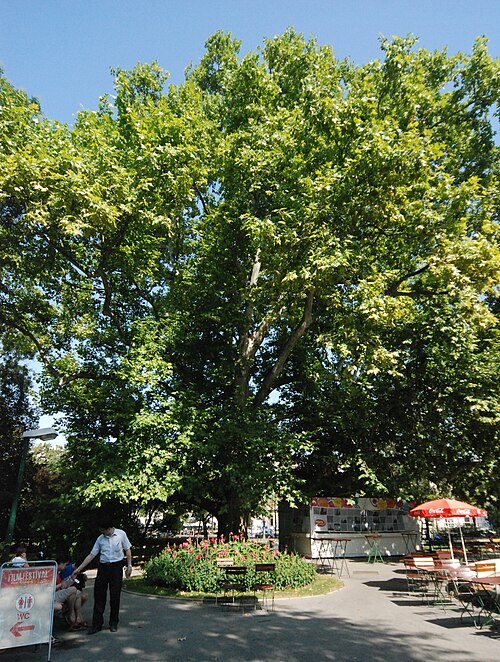
Rathauspark's plane trees carry three separate protection orders, all granted the same day in 1973, and this is the last of the set to make it onto this page.
Photo: GuentherZ (CC BY 3.0)
A protected plane on Alser Strasse has stood for about a century and a half without ever making it into the walk Vienna's other planes did.
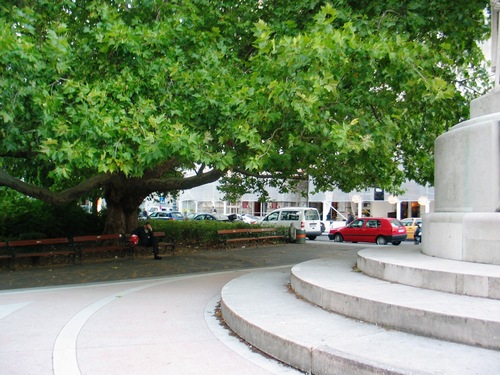
Planted in 1928, and already four metres thirty-four around the trunk.
Photo: Flora_DUMO (CC BY)
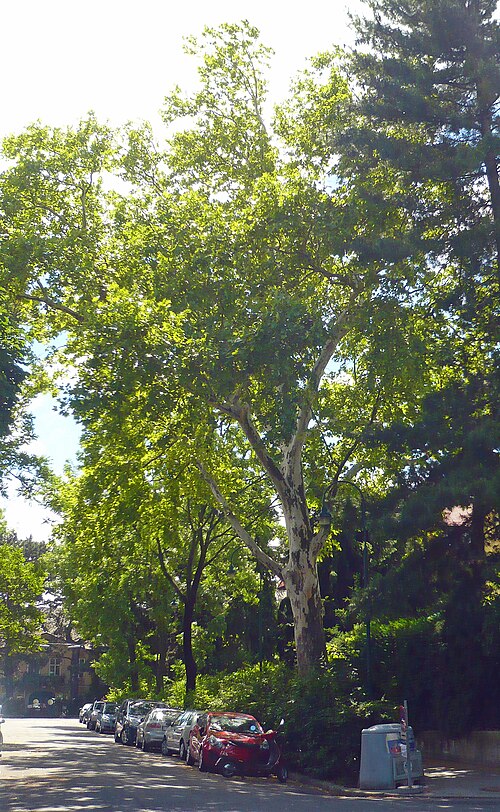
Most of the protected trees in this corner of Vienna stand in private courtyards.
Photo: HeinzLW (CC BY-SA 3.0 at)
Vienna protected this plane in 1969 for a reason few trees are given: it shapes the look of its street.
No tree in this garden throws a bigger shadow.
Archduke Joseph, Palatine of Hungary, planted this plane tree with his own hands in 1823 on what was then his private island retreat, two years before Count Istvan Szechenyi founded the Hungarian A...
Everything else on this square went.
This tree is not the one its name first belonged to.
On the night of 28 July 2022 three teenagers set this tree on fire.
This plane stands more than twenty-four metres tall and you cannot see it from the street.
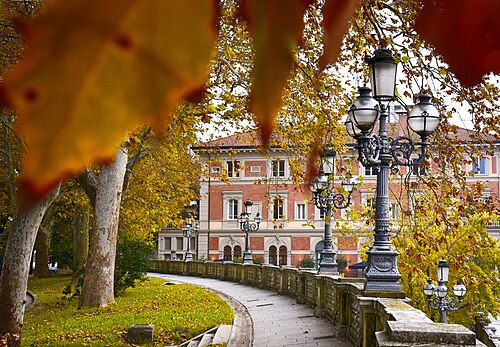
Bologna's first public park started as a rubbish tip.
Photo: Aneta Malinowska (CC BY-SA 4.0)
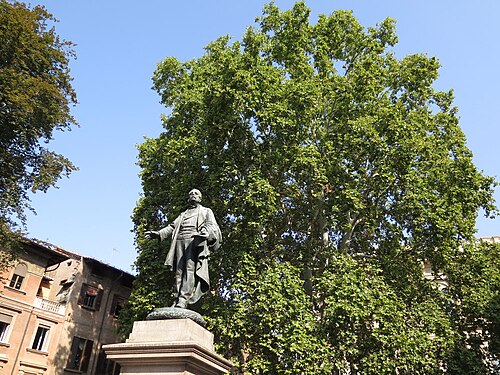
At 39.5 metres, this plane is the tallest of any monumental tree catalogued anywhere in Bologna's province, rising directly behind the bronze statue of the 19th century statesman Marco Minghetti th...
Photo: GennaroBologna (CC BY-SA 4.0)
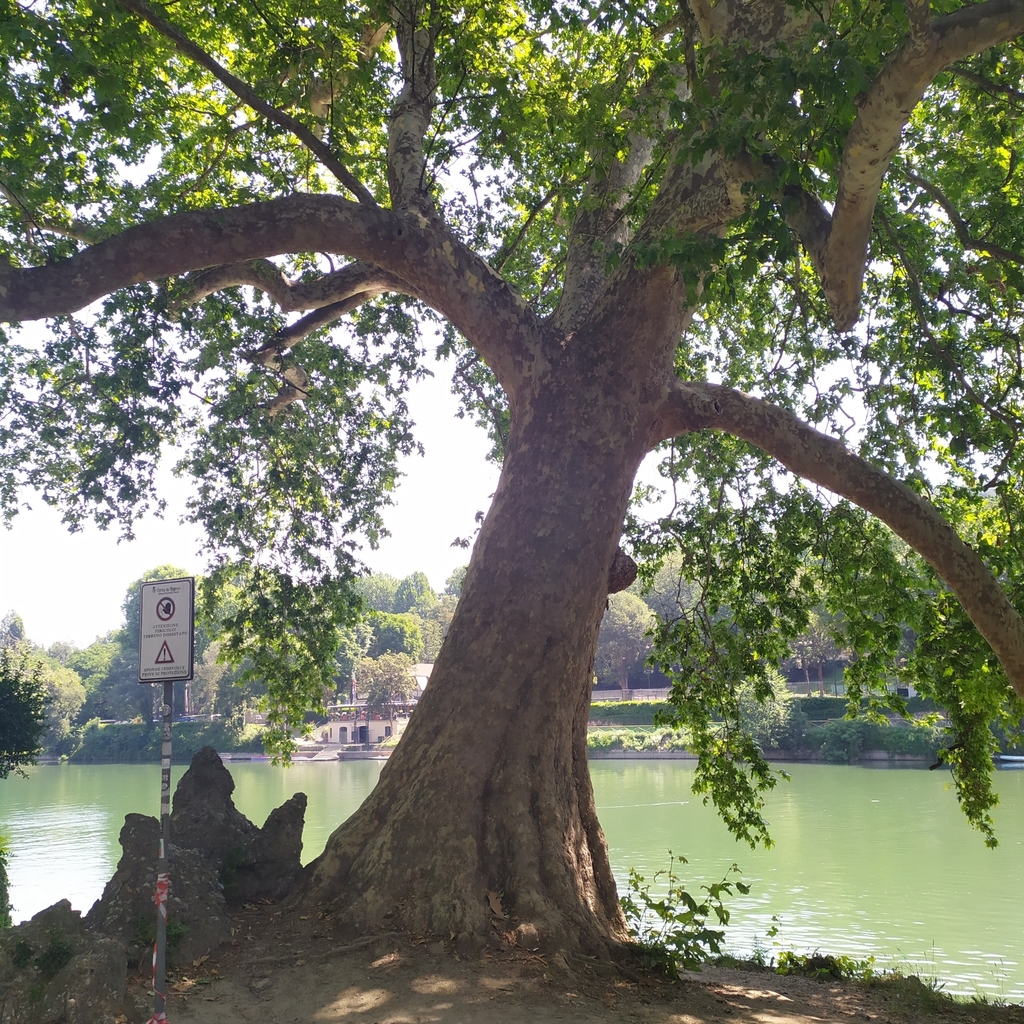
Six metres round, and it is the widest trunk in the park.
Photo: Maria G (CC BY)

Forty metres, and nothing in Turin is taller.
Photo: Emmanuelbaltasar (CC BY-SA 4.0)
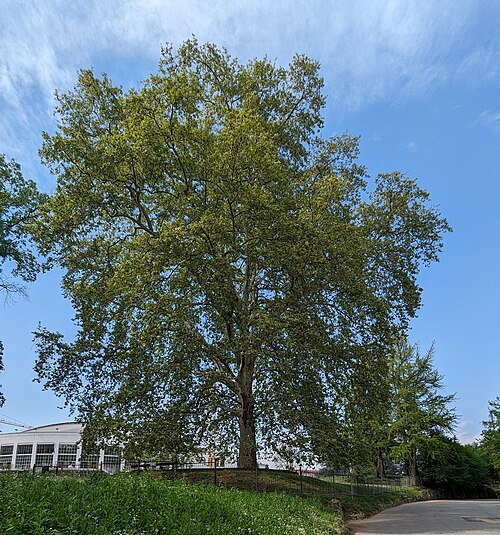
The medieval village beside this tree was built in 1884 and there is nothing dishonest about it.
Photo: Ivan Ruggiero (CC BY-SA 4.0)
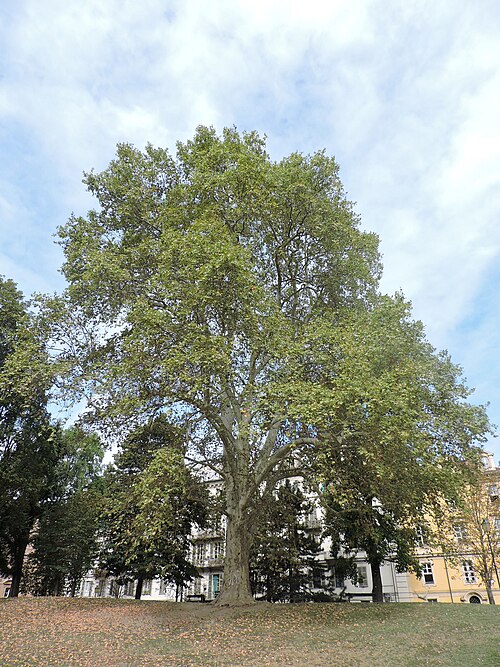
This garden is built on the rubble of Turin's defences, and the humps you walk over are the evidence.
Photo: Pampuco (CC BY-SA 4.0)

Turin calls it il nonno, the grandfather, and at six metres sixty-five around it holds the widest trunk on the city's monumental tree register.
Photo: Pampuco (CC BY-SA 4.0)
A photograph from the 1940s shows these plane trees already standing clear of the five-storey buildings around them.
Trieste's oldest tree stands on a traffic roundabout.
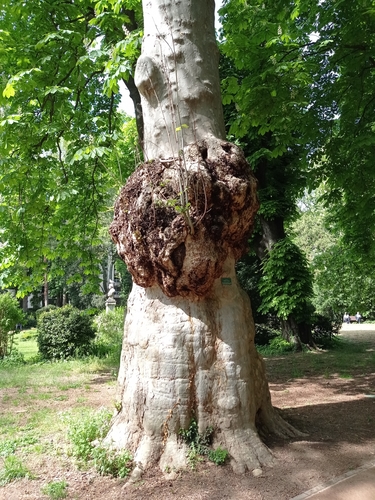
The city dug up the pavement around this tree and threw it away.
Photo: Andrea Adelfio (CC BY)
Seventeen centimetres of girth separate this plane from the garden's biggest.
Two of the thickest trees in Trieste stand about twenty metres apart in this garden, and this is the smaller by five centimetres.
This plane stands among the garden's horse chestnuts rather than with the heavyweights of its own kind.
On the regional register's figures, the tallest tree in the Giardino Pubblico is not its biggest.
The ground under this plane was meant for a church.
This plane is more than a metre slimmer than the garden's runner-up and two metres taller.
Nineteen metres from the garden's biggest plane stands this one, and it spends its life being compared.
Two registers agree on this plane to the centimetre and disagree about which street it stands on.
This plane was already about seventy years old when the Kaiser's builders turned up next door.
Before Poznan gave these four planes legal protection, it listened to them.
This tree carries a professor's name because a district council asked for it.
One of the four protected planes on Plac Wolnosci is named after the man who coined the word phytosociology.
Plac Wolnosci has four legally protected trees and all four are the same species.
Four hundred and eighty four centimetres of trunk for a tree the city puts at only about a hundred years old is a startling ratio, thick enough to raise a real question about whether the age is right.
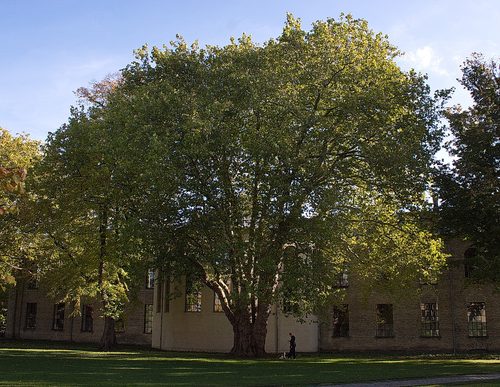
The zelkova a few hundred metres away measures more, but that figure counts four stems grown together.
Photo: Hans Erik Lund
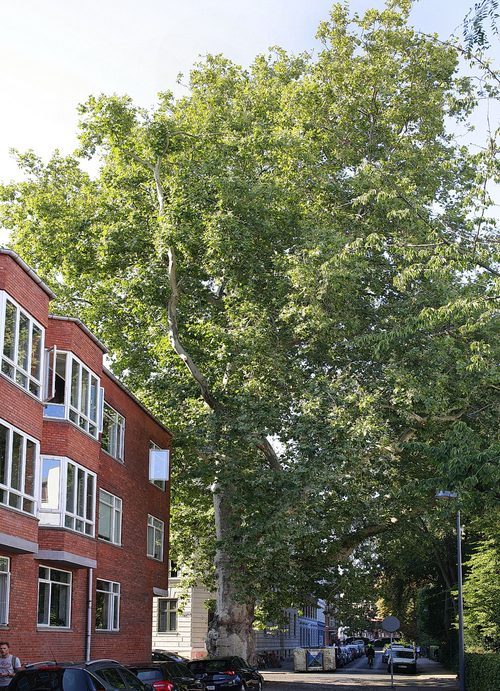
A tree standing on the pavement in Østerbro has grown as tall as the five-storey blocks around it.
Photo: Hans Erik Lund
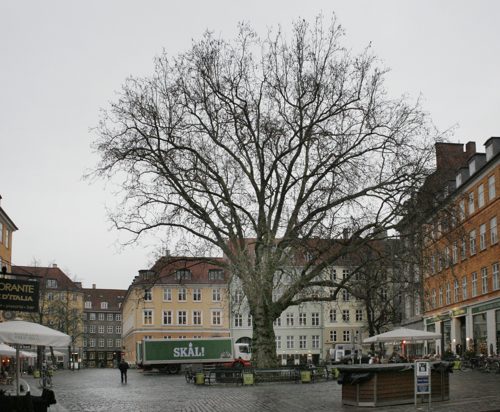
This plane tree was already famous enough in 1995 to go into a book called Berømte danske træer, famous Danish trees.
Photo: Hans Erik Lund
Three plane trees grow in a row beside Van Heylerhofflaan on Stadspark's edge, planted together around 1870, and one of the three has since measured 39 metres tall, the tallest plane tree ever reco...
Maastricht's most famous plane tree, the tallest in the Netherlands, stands about 240 metres from these three, and nobody has ever put an age on it.
The legend, recorded in the Middle Ages by Henric van Veldeke, has Saint Servatius striking the ground here with his staff on his way home from Rome, and a spring rising where it landed.
In 1835, the landscape architect Jan David Zocher jr began replacing the demolished defensive ring around old Utrecht with a chain of parks, the Singelplantsoen, that still follows the city's medie...
Zocherpark is not one park but a chain of them: Zonnenburg, Servaasbolwerk, Lepelenburg, Hieronymusplantsoen and Wilhelminapark, roughly three kilometres of bastion parkland laid out where Utrecht'...
The city wrote down the year this plane went into the ground: 1835.
Two dates exist for this plane, and the register that tracks it admits as much rather than picking one.
These two planes were planted to hide an execution scaffold.
This London plane was already forty years old, well established on the Lucasbolwerk, when Utrecht's city theatre went up facing it in 1941.
Forty-eight metres.
Nobody has dated this tree.
This plane tree lives on a traffic island.
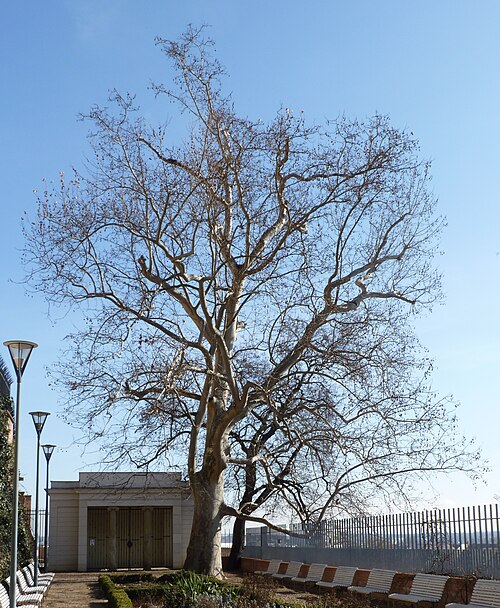
One of Brno's protected trees keeps seasonal hours.
Photo: Michal Klajban (CC BY-SA 3.0)

The biggest tree on this walk is not in a park.
Photo: Michal Klajban (CC BY-SA 3.0)
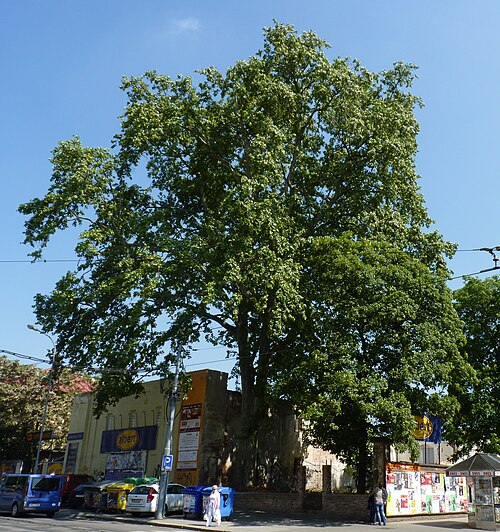
A professor put this tree on the record by complaining about everything around it.
Photo: Michal Klajban (CC BY-SA 3.0)
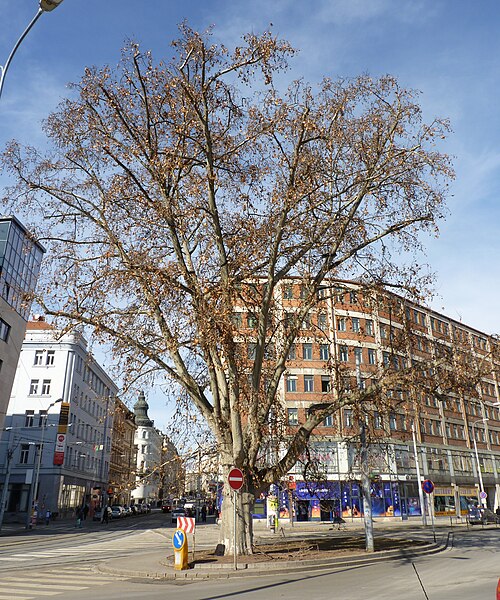
This plane outlasted a bus station.
Photo: Michal Klajban (CC BY-SA 3.0)
Italy has exactly one nationally registered monumental plane tree in Sicily, and it stands in the private grounds of Villa Tasca on the ring road toward Monreale, not in the historic centre most vi...
A London plane cannot be much older than about 350 years, because the hybrid did not exist before roughly 1670.
London planes shed their bark instead of quietly laying down new rings underneath it, sloughing off patches through the year to show paler wood beneath, which is why an old plane looks mottled and...
In 2018 a growth-site study commissioned by the municipality reached a conclusion about one of these two plane trees: it could not be sustainably preserved through the rebuilding of Tilburg's town...
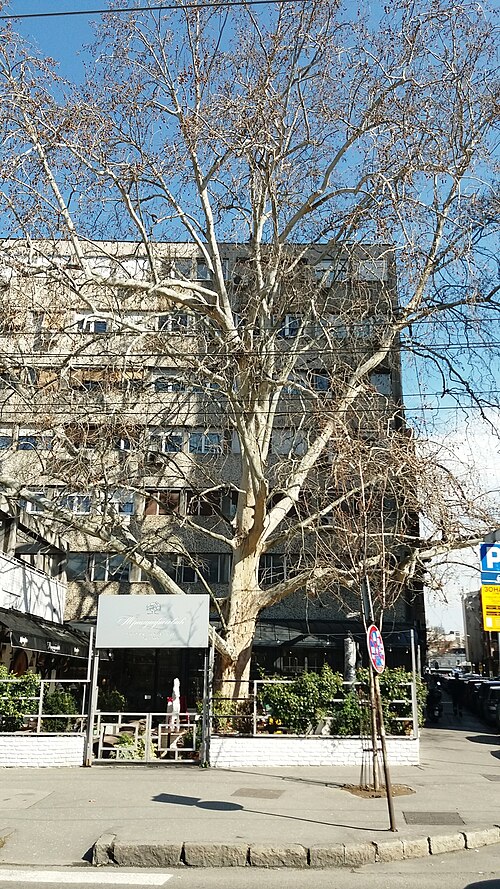
A restaurant grew up around this plane tree, not the other way round.
Photo: Ljiljana Sundać (CC BY-SA 4.0)
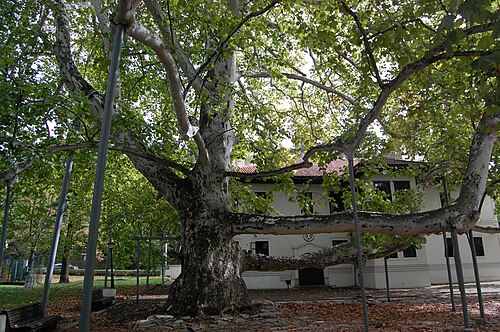
Seventeen iron posts have held up the crown of Belgrade's largest tree since 1881, propping branches that would otherwise have snapped under their own 49 metre spread a century and a half ago.
Photo: Andy Mabbett (Pigsonthewing), CC BY-SA 3.0 (CC BY-SA 3.0)

Wroclaw's Civil Registry Office sits fifteen metres from a plane tree the city calls Swiadek, the Witness, and the name is not an accident: everyone who has married or registered a birth at that bu...
Photo: Fry72 (CC BY-SA 4.0)
In 2018 a municipal crew digging a trench for park lighting cut through two of the main support roots of Cișmigiu's oldest tree, and within two years a full quarter of its crown had dried out and d...
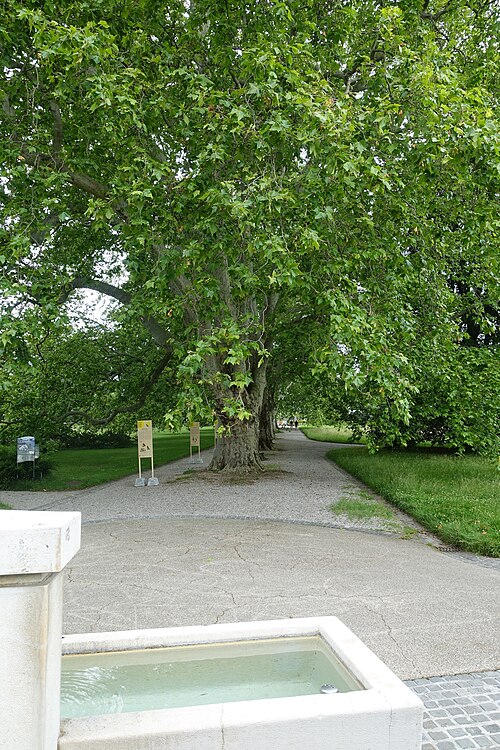
Five plane trees in Geneva's botanical garden were already mature enough to appear on a cantonal cadastral map in 1728, nearly two centuries before the garden itself moved onto the land they stand on.
Photo: MHM55 (CC BY-SA 4.0)
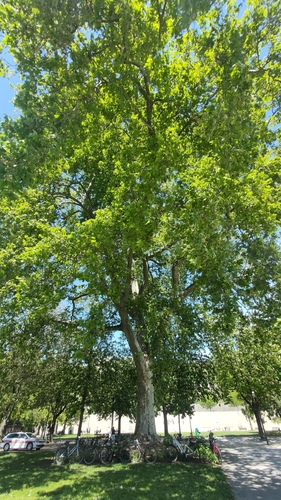
This plane did not grow here.
Photo: Andrii Khokhlov (CC BY)
Thirty-eight metres of plane tree stands in a green space off the Avenue de France, and the harder question is which green space.
The largest plane tree in downtown Geneva grows in the middle of one of its busiest intersections, and the reason it got that big is buried under the pavement.
Platzspitz is Zurich's second-oldest public park, laid out on the wedge of land where the Sihl and Limmat rivers meet, and its own conservation survey has tagged its plane trees by planting year wi...
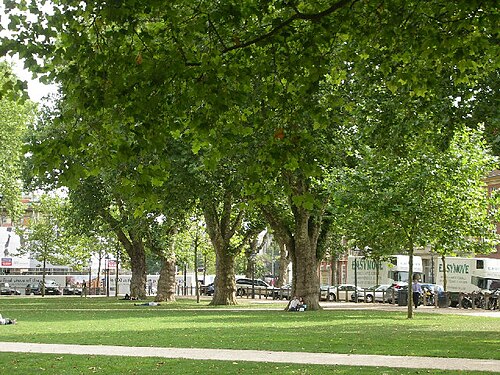
Bristol's city council built Queen Square between 1699 and 1720 on reclaimed marshland, selling plots to the city's merchants for grand townhouses around a formal green, one of the largest and earl...
Photo: michael, via Geograph/Wikimedia Commons (CC BY-SA 2.0)
Nothing else on this stretch of the Oude Delft comes close: seen from above, the plane tree at the Botterbrug is one broad round crown spreading over the canal edge, the largest along the water here.
The whole recorded history of this plane tree is one line in the national register: it was planted during the renovation of Delft's city ramparts.
Three plane trees went into Kalverbos around the years Delft finished the red-brick water tower that still looms over the park.
At 47 metres this plane is the tallest tree recorded anywhere in Emilia-Romagna, taller than any specimen in a region with no shortage of old parks and avenues.
This courtyard was built by a man with a reputation problem.
The estate was laid out around 1635 and was then called the Torensteedje.
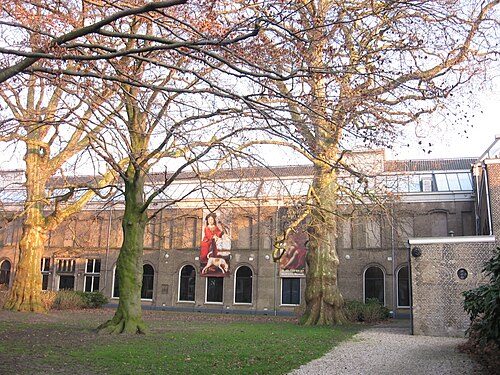
Three plane trees in the museum's garden have outlived every renovation the building around them has had, because they arrived first.
Photo: Michiel1972 (CC BY-SA 4.0)
The museum that owns this plane and the national register that protects it are twenty years apart on when it went into the ground.
The national tree register knows the decade this plane was planted and admits it knows nothing else.
A plane of this age on a Dutch street corner is a tree that has survived every plan anyone has had for the ground.
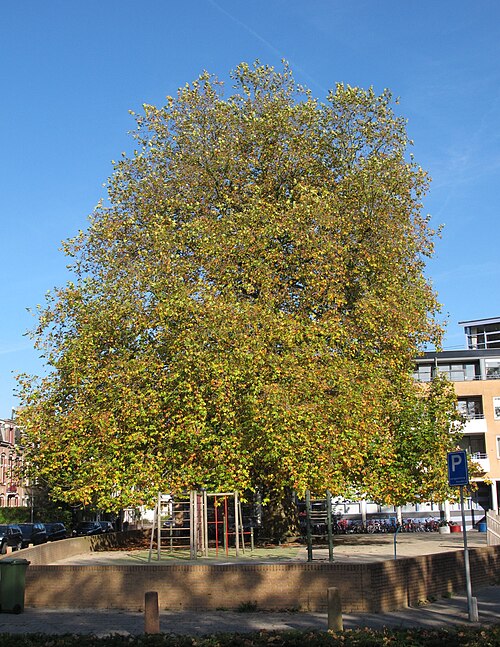
When the Sint Jorisschool went up in 1910 this plane was already seventy years old, and the builders left it where it was.
Photo: WeeJeeVee, CC BY-SA 4.0 (CC BY-SA 4.0)
This plane stands in the south-west corner of Amersfoort's Catholic cemetery on the Utrechtseweg, tall enough now to be visible over the cemetery wall from the street outside.
This plane's bark comes away in patches the size of a hand, which is not disease.
The street is named after the thing that happened to it.
This plane tree was already standing before the park around it existed.
The London plane is a hybrid nobody set out to make.
A ship loaded with gunpowder exploded here in 1807 and flattened much of this part of Leiden.
Leiden's monumental tree register counts this plane and the one at the Garenmarkt gate as two separate entries.
A grand hotel once stood where an apartment courtyard is now, and two of its trees are the only things that survived the change.
Haarlem's thickest tree grows in the garden of the province's own seat of government, a plane tree with a trunk six metres around, measured at chest height, which takes several adults linking hands...
Three London planes stand together near the start of Kenaupark, planted in the opening years after the Zocher family laid the park out in 1865 over the demolished line of Haarlem's old city fortifi...
Five and a half metres around the trunk and twenty four metres up, on a scrap of green between a busy junction and the Houtplein bus stops.
Arnhem is redesigning its busiest square around this tree rather than the other way round.
When Arnhem drove a road tunnel past this plane, it did not cut the roots.
Three separately registered monumental trees stand within 150 metres of each other behind Arnhem's concert hall, and this plane is the one nobody mentions.
The last time anyone put a tape around this plane it came to four metres, and that was before 2006.
There was a country house here called 't Zwik and there is a street pattern instead.
The garden this tree belonged to is gone.
Six metres and twelve centimetres around the trunk, and no other tree on this page comes within a metre of it.
Boom en Bosch, the local tree-protection group, calls this the largest and perhaps the most beautiful plane tree in the city.
Thirty three point six metres tall, and a trunk seven point one nine metres round.
The register says this plane was already standing when the tea house opened.
A cyclone tore this tree in half and it is still twenty-four metres tall.
At thirty-seven metres this is the tallest tree in Cordoba's own catalogue of singular trees, and it stands in the city's oldest public garden, opened on the first of March 1811 by a mayor who had...
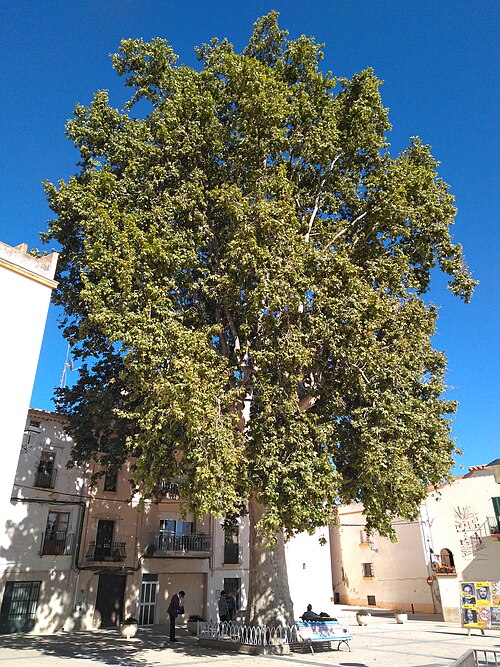
This tree is the square.
Photo: Jordi Gili (CC BY-SA 4.0)
The water this plane tree was planted beside is gone.
This plane tree once did a second job as a utility pole.
The thickest trunk on this page belongs to a street tree rather than to anything growing in a park or a palace garden.
This tree is too small to qualify and the register listed it anyway.
Caserta's monumental register credits only one tree in the entire city with a wider trunk than this one, the cedar of Lebanon at the far end of the same garden.
Caserta's monumental register now credits this garden with three London planes, and this one is the third thickest tree in the whole city register regardless of species, five metres sixty around an...
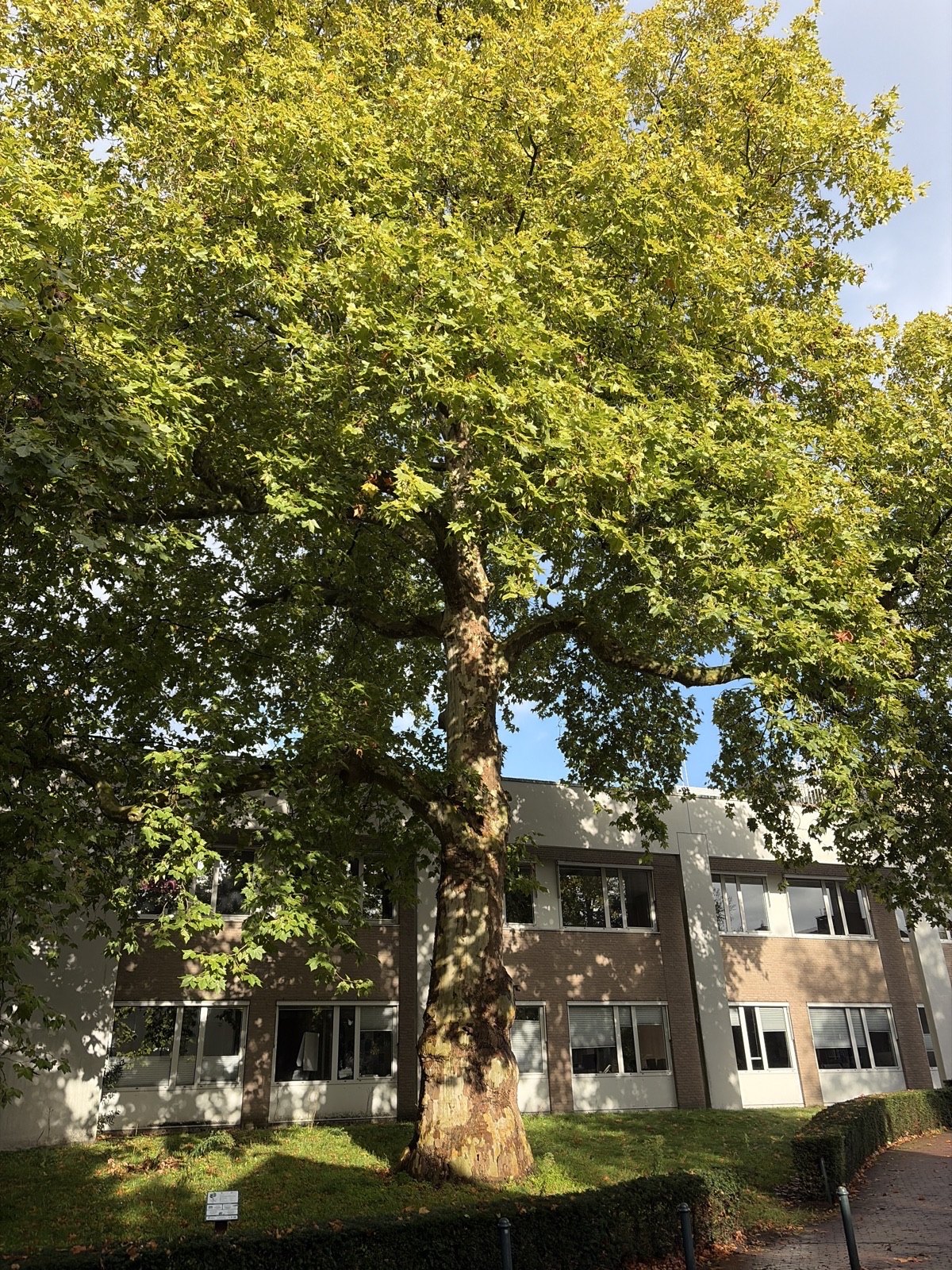
Over four and a half metres round and roughly 130 years old, the plane on the lawn at Stationsweg 18 is a century older than the town hall it stands in front of.
A London plane in a Drenthe village is a stranger, and that is the interesting part.
Lake Geneva has exactly one natural island, it is roughly the size of a large living room, and the single tree standing on it is one you are not allowed to reach.
Local legend says horses that died on the Dzieduszycki estate were buried at the foot of this plane tree, feed for the roots of something that was already old when the story started.
Bute Park has fifty British-champion trees and more than 3,000 catalogued specimens, and this London plane earned its own designation in 2022: Glamorgan Champion, the largest of its kind recorded i...
In 2011 the earthquakes took the buildings around Cranmer Square and left the trees.
After the earth shook on 22 February 2011, Latimer Square became a field hospital under its own trees.
Victoria Square used to be Christchurch's market place before it became a park for a queen's anniversary.
The biggest-girthed tree found in this pass of Cologne stands in a hospital car park, more or less.

Piazzale Camerlata is where Como's traffic converges, and a plane tree with a trunk four and a third metres around stands in the middle of it.
Photo: FrangeCe (CC BY-SA 4.0)
A plane tree about forty metres tall stands in the gardens of one of Europe's best-preserved medieval monasteries, and most visitors photograph the cloister instead.
Seven metres and thirteen centimetres around the trunk, measured in October 2025.
At 38 metres this London plane is the tallest protected tree in Freiburg, by a margin nobody has bothered to measure the runner up against.
Five streets meet at the Prudens Van Duyseplein, and when the square was laid out in 1883 it was laid out around this plane.
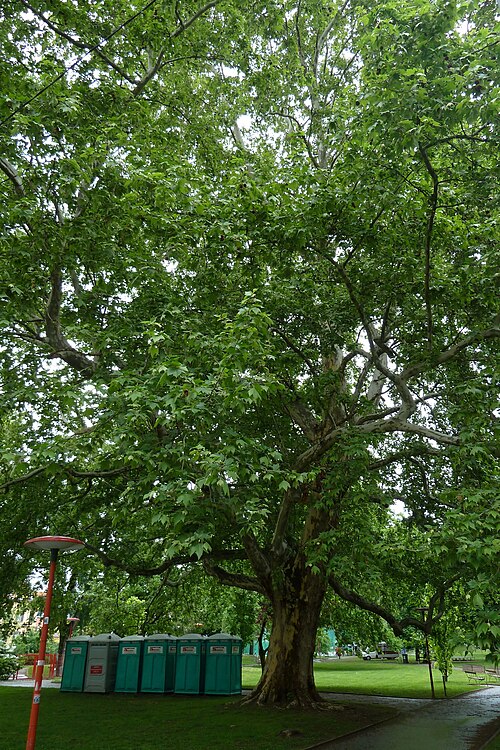
A dated photograph on Wikimedia Commons, filed under this exact tree's own protection number, shows this plane still standing in the Volksgarten years after its formal designation, one of the small...
Photo: Gerdsch (CC BY-SA 3.0 at)
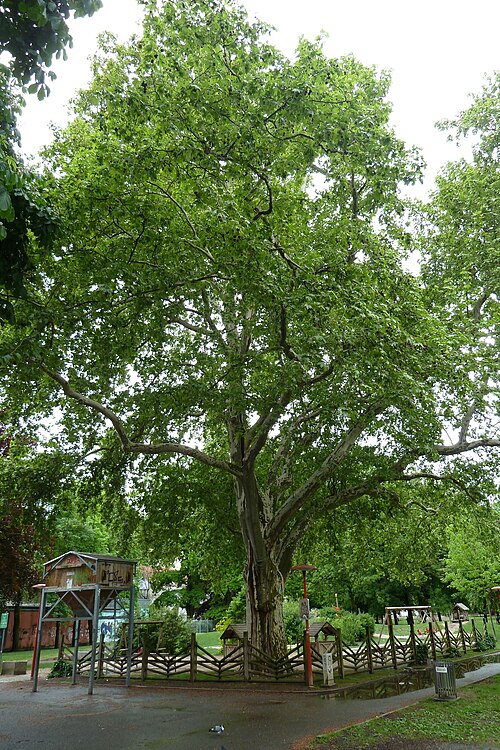
Registers occasionally list the same tree twice under two addresses, a real problem elsewhere on this site, and this plane is a genuine check against exactly that mistake: it stands on a separate l...
Photo: Gerdsch (CC BY-SA 3.0 at)
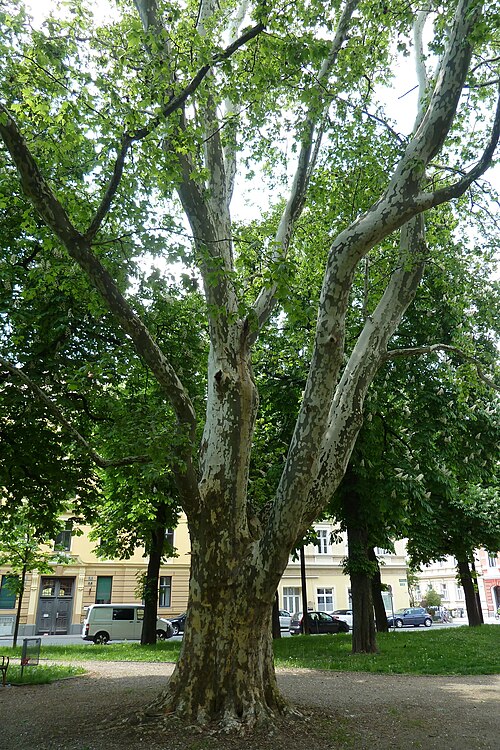
A photograph taken on the second of May, 2014, and filed on Wikimedia Commons under this tree's own protection number, is the kind of small dated proof this project values: it shows the tree alive...
Photo: Gerdsch (CC BY-SA 3.0 at)
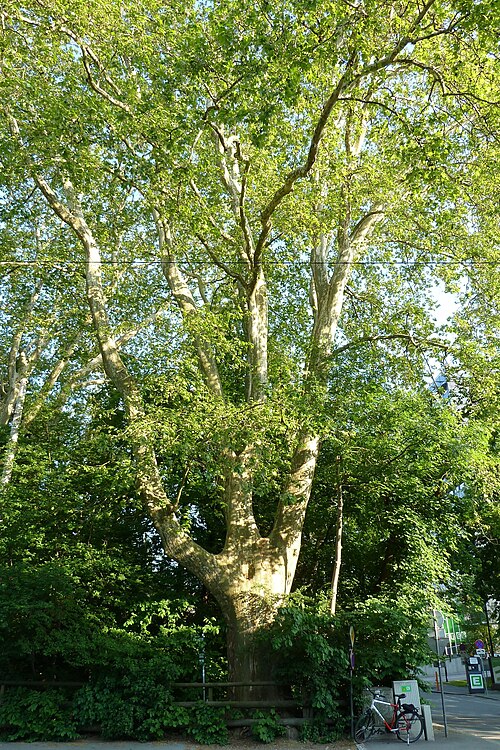
This plane has held Naturdenkmal status since 1979, one of the first wave of trees Graz ever protected, its number a round one: Steirisches Naturdenkmal 1000.
Photo: Gerdsch (CC BY-SA 3.0 at)
Locals use this plane tree to navigate by.
Most old trees are dated by argument.
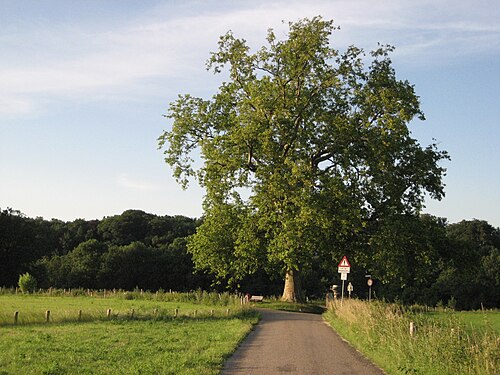
Everyone in Heerlen calls this tree the Eik van Terworm, the Oak of Terworm, and it is not an oak.
Photo: Rene Bongard (CC BY-SA 3.0)
Four metres of trunk and nowhere to put it.
This plane stands behind the aviary in the Oosterplantsoen, out of the way of the street, and it has grown accordingly: a trunk of over four metres round and, in the register's words, a perfect tree.
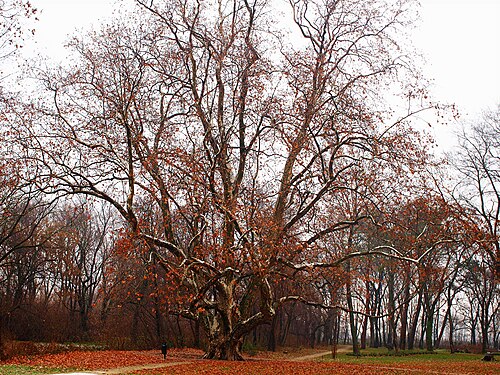
Nine metres and thirty centimetres round, and a good deal of that bark is carved with initials.
Photo: Ekopolis Foundation (CC BY-SA 4.0)

One tree beat out roughly 480 others growing right beside it to become Poland's tree of the year.
Photo: Klub Gaja & Tomek Pikuła (CC BY-SA 4.0)
For centuries the people of Letenye have used one plane tree as the place to meet, to court, to quarrel and to settle business.
This plane is on the drawing.
A bicycle rack stands inside this tree, or did when Flanders' heritage agency last reported on it.
Tradition says a king heard mass on this spot in 1287.
The oldest plane tree in Modena stands in a flowerbed in the middle of a coach station, and the last person to put a tape around it did so in 1986.
The London plane is not much older than this tree.
City foresters plant planes because they are difficult to kill, and this one has had the chance to prove it.
Six individually protected trees stand on 1.7 hectares here, which is a great deal of legal attention for one small park.
These two planes stand five metres apart and the law counts them as separate monuments.
Germany protects individual trees the way other countries protect buildings.
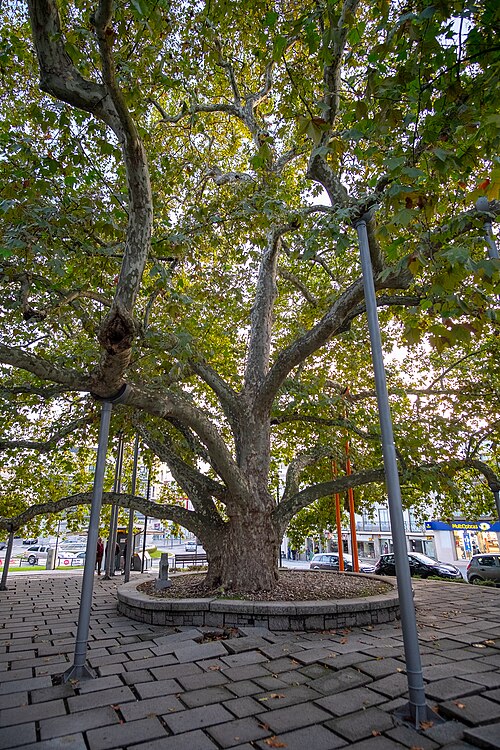
A single tree from 1838 now needs twenty steel props just to hold itself together.
Photo: João Martins (CC BY-SA 4.0)
The house this tree was planted to shade is now a parking lot.
Two London planes stand one behind the other outside the same address, and the city registered them as a pair in 2005, recording one as the north tree and one as the south.
Three planes at one address on Overlook Boulevard, 5.4, 4.8 and 3.9 metres round, and the largest throws a crown thirty one metres across on a tree only twenty one metres tall.
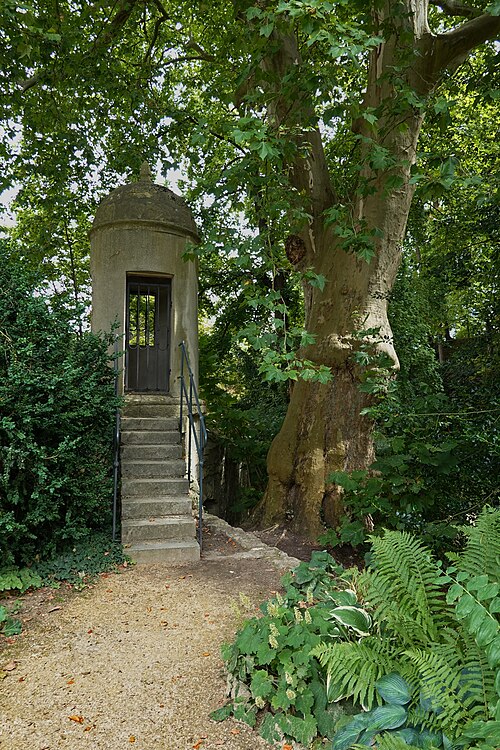
This plane shares a lawn with a medieval gate tower and is the newcomer of the two by centuries.
Photo: Asio otus (CC BY-SA 3.0)
This plane grows on a market place the Romans laid out around 175 AD.
The entry that protects this tree gives no address, only a corner.
This London plane stands at the front of the same Burgerhoutsestraat building whose southwest corner holds a registered catalpa, banded by the national register to a planting around 1870, roughly 1...
The national tree register describes this London plane by the tree behind it.
The biggest London plane in Utah stands north of the tennis courts in Liberty Park, and it is five metres round.
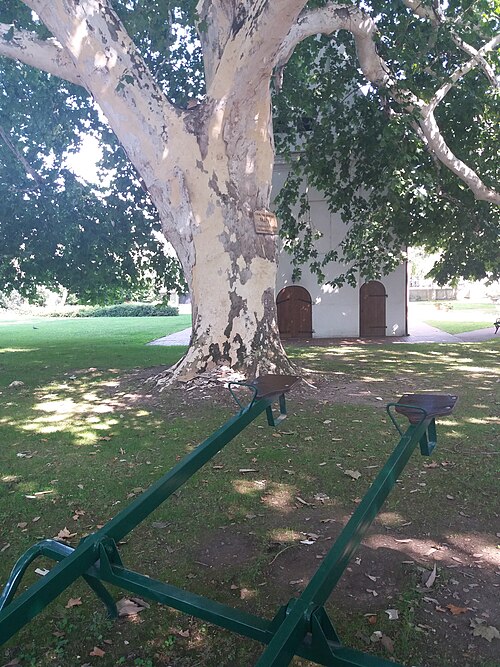
Local memory in Sremski Karlovci says this plane began life as a sapling carried in from Vienna, planted in the churchyard soon after the building beside it went up.
Photo: Miljan Simonović (CC BY-SA 4.0)
Alsace's regional register dates this plane to the 1730s, which would make it older than the park it stands in.
Napoleon's spymaster bought a meadow here in 1806 and called it Meine Aue, my meadow.
A trunk five metres around is a park tree's measurement.
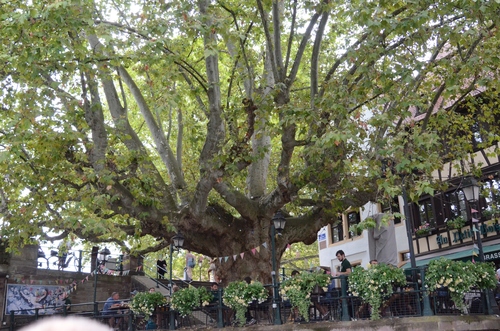
Postcards and travel listings will tell you this plane tree was planted in 1667.
Photo: Micha Baum (CC BY-SA)
Duke Carl Eugen of Wuerttemberg planted this plane in 1779, tradition says as a gesture toward the woman who would become his wife.
Toulouse's register calls this tree Platanus x hispanica and this page calls it Platanus x acerifolia, and both are right.
The plane avenues of the Canal du Midi are being cut down.
Trento's oldest tree went into the ground in 1835, and the city only made it official in 2024.
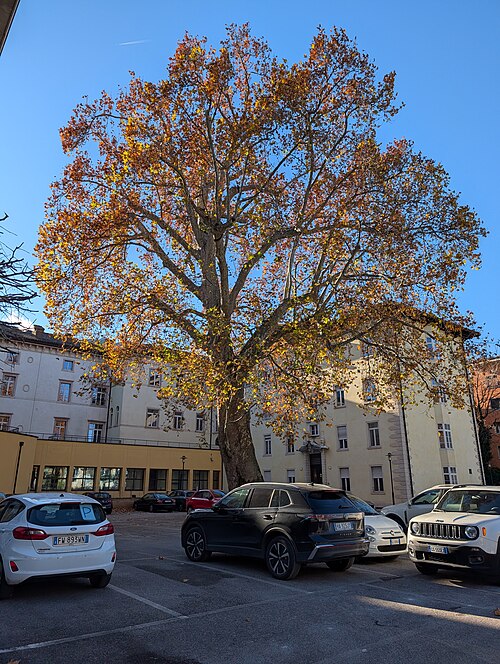
This plane belongs to a garden it no longer stands in.
Photo: Ivanbranco (CC BY-SA 4.0)
A plane tree handles dirty air by taking its skin off.

Two planes stand at the southwestern corner of Budatín Castle's wall with their roots grown into each other.
Photo: Fry72 (CC BY-SA 4.0)
Explore by city: Prague · Brussels · Porto · Seville · Alkmaar · Barcelona · Paris · Lisbon · Milan · Berlin · Leipzig · Lyon · Melbourne · New York · Amsterdam · London · Seattle · Bath · Groningen · Leeuwarden · Lucca · Rome · Sintra · Sorrento · The Hague · Guimaraes · Setubal · Dublin · Verona · Granada · Krakow · Vienna · Valencia · Budapest · Eindhoven · Bologna · Turin · Bilbao · Trieste · Copenhagen · Maastricht · Utrecht · Padua · Dresden · Brno · Palermo · Istanbul · Nijmegen · Tilburg · Belgrade · Wroclaw · Geneva · Zurich · Bristol · Delft · Parma · Dordrecht · Amersfoort · Breda · Leiden · Salzburg · Haarlem · Arnhem · Enschede · Den Bosch · Zwolle · Cordoba · Helmond · Pamplona · Ferrara · Caserta · Baarn · Emmen · Cardiff · Christchurch · Cologne · Como · Frankfurt · Freiburg · Ghent · Graz · Hamburg · Heerlen · Hoorn · Leuven · Menorca · Modena · Nuremberg · Portland · Regensburg · Strasbourg · Stuttgart · Toulouse · Trento · every city · or browse all species.