Around 1388 Amersfoort built a second city wall, heaviest on the northeast side because that was the direction Gelre would come from. The wall is mostly gone and what is left of it is a park with old trees growing out of the rampart, including a catalpa that flowers hard enough to stop people. The oldest tree in the city is nowhere near it: an oak at a crossroads called the Hertekop, where a hunting lodge hung with antlers became a pub, then a meeting point, and then a motorway junction. The oak is what is left.
0 of 18 visited in Amersfoort
Southern Catalpa (Catalpa bignonioides) · 125-135 years · Binnen de Veste
It is growing on a defensive earthwork built to keep the duke of Gelre out.
Around 1388 Amersfoort put up a second city wall, and put most of the effort into the northeast, because that was the side the trouble was expected from. The wall is largely gone. The bank it stood on is not, and the Plantsoen Oost is what the city made of the remains: a narrow park along the old rampart, planted with big trees whose roots are in six centuries of packed defensive earth.
The catalpa is behind Binnen de Veste 41 and the register singles it out for its flowering, which is fair. Catalpa flowers in late June and early July, weeks after everything else has finished, in upright panicles of white bells with yellow and purple markings inside the throat, and on a mature tree there are hundreds of them at once.
Then it produces the beans. Slender pods up to forty centimetres long hang all winter on the bare tree, which is where the name Indian bean tree comes from, and why this is worth a look in January as well.
Huge heart-shaped leaves, and it comes into leaf later than anything else in the park.
Pedunculate Oak (Quercus robur) · 225-275 years · Hertekop
Everything at this crossroads has been replaced except the tree.
It was called the Hertekop after a hunting chalet built here with deer antlers fixed to it. The chalet became an inn. The inn became one of those places everyone in a town knows, where people arranged to meet and where walks and outings started from. Then a southern ring road was laid around Amersfoort, and later joined to a new trunk road running in from Utrecht, and the place changed out of all recognition. The chalet went.
What is here now is a slip road off the A28 and a junction of the Arnhemseweg and the Dodeweg. What is also here is an oak the register bands 1750 to 1800, which was already a substantial tree when the chalet was a going concern, and which is the oldest living thing in Amersfoort.
It is not a beautiful setting and that is exactly the reason to go. Two and a half centuries of a place reorganising itself around a fixed point, and the fixed point is a tree that nobody decided to keep so much as never quite got round to removing.
Park on the Dodeweg rather than trying to stop on the Arnhemseweg.
Copper Beech (Fagus sylvatica f. purpurea) · 185-195 years · 't Zand
The church went up between 1881 and 1883. The beech was already about fifty years old when the first stone was laid.
That is worth pausing on, because the natural assumption at any church with a big tree beside it is that somebody planted the tree to go with the building. Here the register is explicit that the order runs the other way: banded 1830 to 1840, the beech predates the church by half a century, and whoever chose this plot chose a plot with a mature beech on it.
The register also gives it a health note, which is the sort of thing worth passing on. It calls the tree reasonably good for its age and for its position in an urban area, which is faint praise and honest. City copper beeches have a hard time of it: shallow feeding roots under paving, salt, and no leaf litter left to rot back into the soil.
Copper beech is not a species. It is a purple-leaved mutation of the common beech that turns up occasionally in the wild and is then propagated by grafting, so almost every one you meet was chosen by somebody.
In October the purple burns through to copper, and it is the best week to come.
London Plane (Platanus x acerifolia) · 185-195 years · Bergkwartier
A plane of this age on a Dutch street corner is a tree that has survived every plan anyone has had for the ground.
The register bands it 1830 to 1840, which puts it here before the villa quarter around it, before the Utrechtseweg was the road it is now, and before almost any of the buildings it stands among. It has spent nearly two centuries on the corner of the Snouckaertlaan while the city rearranged itself.
Planes get this job because they take punishment better than anything else their size. Compacted soil, roots cut for cables, salt, exhaust, and hard pruning: a plane shrugs at all of it and regrows. The species is a hybrid, probably of the oriental plane and the American sycamore, and it first appeared in European gardens in the seventeenth century as an accident of two exotic trees being planted near each other.
The bark is the giveaway and the reason it works in a city. It sheds in irregular plates, taking whatever has settled on it with it, so the trunk is a camouflage of cream, olive and grey that never blackens.
The seed balls hang on all winter, on stalks, like small hard fruit.
Silver Lime (Tilia tomentosa) · 185-195 years · Schothorst
This tree carries two different kinds of leaf and you can find both from where you stand.
It is a grafted weeping lime. The weeping form, 'Petiolaris', cannot be grown from seed and is joined onto an ordinary lime rootstock, which means the tree is really two plants sharing a trunk. Above the graft the branches arch out and hang down, carrying leaves on unusually long stalks that let each one swing and show its white felted underside. Below the graft the rootstock keeps sending up its own shoots, and those carry plain lime leaves on short stalks. Look low on the trunk for ordinary foliage and up into the hanging branches for the long-stalked kind.
The register also notes the root flare, which is unusually pronounced and which people walk over constantly, and adds that the tree seems to be standing up to it. That is an honest way of saying it is being slowly damaged and is winning anyway.
It is at the back of Park Schothorst on the edge of the wood, banded 1830 to 1840.
Come in July. Silver limes flower late, and the scent of one this size carries a long way through a wood.
Copper Beech (Fagus sylvatica f. purpurea) · 135-145 years · Centrum
It is at the back entrance of a function venue, which is a demotion, and it is the reason to look.
A copper beech planted between 1880 and 1890 was put in by somebody laying out a garden. Nobody plants a purple beech at a service door. So this tree has been through the usual sequence for a city centre: a private garden, a change of ownership, a building extended over most of the ground, and the tree left standing in the leftover space that the extension did not need, which happened to be by the back door.
It is a common story and it accounts for a striking share of the big old trees in any Dutch city centre. The ones that survive are rarely the ones that were treasured. They are the ones that were standing somewhere nobody wanted to build.
What you get is a full grown copper beech in a small hard space on the Burgemeester De Widtstraat, dark and dense and considerably too large for its surroundings, which is a good look at what the species does when nothing restrains it but paving.
Best in October and, for a different reason, in April, when the new leaves come out a translucent red before they darken.
Copper Beech (Fagus sylvatica f. purpurea) · 135-145 years · Zonnehof
The Zonnehof is a piece of open ground on the edge of the old centre that the twentieth century got hold of, and this beech was standing before any of it.
Banded 1880 to 1890, it belongs to the villa gardens that lined the Utrechtseweg when this was the smart approach to the city rather than a through road. Those gardens have gone. The beech is on the northeast side of Zonnehof 2, behind the building that fronts the Utrechtseweg, which is to say in the gap between two eras of construction.
Standing under a copper beech in a city is a specific experience worth going out of your way for. The leaves are thin and the purple pigment is a filter rather than a coating, so strong light coming through a mature canopy arrives underneath as a deep wine red. Photographs never get it because a camera corrects it away. You have to be under it, and it wants a bright day.
This one is a short walk from the plane on the Snouckaertlaan and from the beech behind the Amershof, so all three fit into twenty minutes.
The fourth week of October, if you want it at full colour.
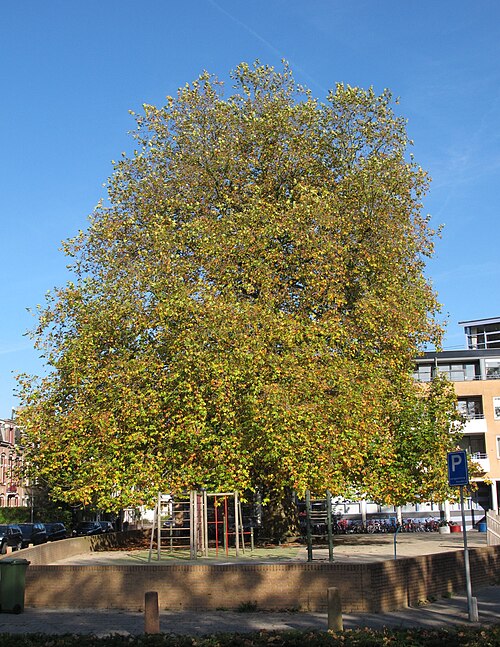
London Plane (Platanus x acerifolia) · 175-185 years · Binnenstad, on the Eem quay
When the Sint Jorisschool went up in 1910 this plane was already seventy years old, and the builders left it where it was. It has stood in a schoolyard ever since.
It was planted between 1840 and 1850, when the site was still a green strip along the quay of the river Eem. The strip was built over in 1910 and the new school opened with four classes on the quay side, with a full grown tree already in front of it. That building came down in 1992 and its replacement went up straight away. The register notes, drily, that the tree was reasonably well protected during the works.
It is close to two hundred years old now, six metres round at chest height and 27.8 metres tall, with a crown twenty-seven metres across, which is wider than the yard it stands in.
Benches used to ring the base for the pupils. At the end of 2021 the paving came out and the yard was resurfaced in wood chips, some of the benches were taken away, and the children moved onto the roots instead. The register's verdict on that, after everything else this tree has absorbed: it seems to cope well.
You can see the whole crown from the quay.
Photo: WeeJeeVee, CC BY-SA 4.0 (CC BY-SA 4.0)
London Plane (Platanus x acerifolia) · 126-136 years · Utrechtseweg
This plane stands in the south-west corner of Amersfoort's Catholic cemetery on the Utrechtseweg, tall enough now to be visible over the cemetery wall from the street outside.
London planes were planted in Dutch cemeteries through the late nineteenth century for a practical reason: the species tolerates compacted soil and heavy shade better than almost anything else that grows this large, which matters on ground crossed with paths and graves. The bark comes away in patches the size of a hand as the trunk outgrows its own skin, leaving a mottled grey, green and cream pattern that is the tree's normal healthy state rather than any kind of damage.
The register bands its planting to the 1890s, putting it just past its first century and a quarter. Cemetery trees like this one are some of the least disturbed in any Dutch town, since nobody prunes a graveyard tree for looking untidy the way a street tree gets cut back.
Free to visit. The cemetery is open during daylight hours, as is normal for a working Catholic burial ground, and a walk between the graves brings you directly under the crown.
Copper Beech (Fagus sylvatica f. purpurea) · 156-166 years · Zonnehof
This copper beech stands where Amersfoort's old public library used to be, on the east side of the Zonnehof, and it has outlasted the building it once stood beside.
Copper beech is not a separate species but a colour form of the ordinary European beech, its leaves carrying a red pigment on top of the usual green, which is why the whole crown reads dark purple-bronze rather than green from any distance. Amersfoort already has more than one of these registered within the town centre, and this is among the oldest.
The register bands its planting to the 1860s, close to a century and three quarters old, which makes it a decade or two senior to the copper beeches at the Amershof and the Zonnehof building nearby.
Free, public green strip in the centre of town, no gate.
October is the month, when the copper deepens toward black just before the leaves drop.
Sweet Chestnut (Castanea sativa) · 116-126 years · Leusderweg
This sweet chestnut grows on what the register itself calls former barracks ground, on the Leusderweg side of what is now Juliana van Stolberg park.
Castanea sativa produces the only true edible chestnut among Amersfoort's monumental trees, distinct from the inedible conkers of the horse chestnuts elsewhere on this page. Its leaves are long, narrow and sharply toothed along the edge, easy to tell apart from any other tree in a Dutch park at a glance, and in October the spiny husks split open on the ground to drop chestnuts a forager can actually use.
The register bands its planting to 1900 to 1910, so it went into the ground while this was still working military land rather than the public green space it later became. A chestnut planted on a barracks ground for shade has quietly outlived the barracks by a century.
Free, public park, open daily.
October is the month, when the husks come down. Gather what falls rather than what is still on the tree, and expect competition from the local squirrels.
Hungarian Oak (Quercus frainetto) · 156-166 years · Randenbroek
Most oaks in a Dutch park are the native pedunculate oak. This one is not: it is a Hungarian oak, native to the Balkans and south-eastern Europe, and its leaves give it away immediately, glossier and more deeply cut than any local oak, with lobes that reach almost to the midrib.
Quercus frainetto was brought into northern European planting for a practical reason: it tolerates poorer, drier soils than the native oak and still grows into a broad, substantial crown. This one stands on what used to be a car park in the Randenbroek neighbourhood, now a green strip on the Rubensstraat, which says something about how a tree this size can outlast several changes of use for the ground beneath it.
The register bands its planting to the 1860s, making it roughly a century and a half old and one of the more unusual species on Amersfoort's register within the town itself.
Free, public green strip, no gate, open at all times.
There is no single spectacular month. The reason to find this one is simply that it is not the oak you already know, standing in an ordinary residential street rather than a grand park.
Horse Chestnut (Aesculus hippocastanum) · 96-106 years · Stationsplein
Amersfoort's registered horse chestnut stands on the station square itself, which means more people probably walk past this tree on an ordinary Tuesday than pass any other tree on this page in a month.
Aesculus hippocastanum is the classic candle-flowered chestnut of European squares and avenues, and this one has done its job in one of the more heavily used public spaces in the city since the 1920s, when the register bands its planting. It has had a harder run than a park tree of the same age: the horse chestnut leaf miner moth, in the Netherlands since around 2002, browns the foliage of nearly every chestnut in the country by late summer, and bleeding canker has killed mature specimens across the region since the 1990s. A century-old chestnut still standing on a station square, with commuters and buses passing under it daily, is a tree that has held up.
Free to see, no ticket, right outside Amersfoort's main railway station.
Come in the first half of May for the white candle-shaped flower spikes, before the leaf miner starts its usual damage later in the summer.
Red Horse Chestnut (Aesculus x carnea) · 136-146 years · Varkensmarkt
This red-flowered chestnut stands between the Onze Lieve Vrouwetoren, Amersfoort's freestanding medieval tower, and the old Varkensmarkt square, which makes it one of the more photographed backdrops in the city without anyone particularly meaning to photograph the tree itself.
Aesculus x carnea is a hybrid between the familiar white-flowered horse chestnut and a smaller red-flowered American species, and the cross keeps the size of the European parent while borrowing the American parent's pink to red flower colour, which is what sets it apart from the plain horse chestnut on the station square nearby.
The register bands its planting to the 1880s, putting it well past its first century, growing in the shadow of a tower that has stood since the fifteenth century and makes even a tree this old look young by comparison.
Free, public street, no gate.
May is the month for the pink candles, timed a week or two alongside the white-flowered horse chestnut by the station, so a short walk between the two shows both colours at once.
Bald Cypress (Taxodium distichum) · 190 years · Muurhuizen, old town
The oldest tree in this garden is no longer in it. A copper beech planted in 1750, counted among the twenty oldest trees in the country by the Bomenstichting, stood behind the Monnikendam until it was felled. The cypress on the far side of the water is still there, and three separate sources agree on when it went in: 1830.
That agreement is worth noting, because it almost never happens. The national tree register, a Wageningen-linked city nature walk and the municipality's own tree-walk booklet all place a Taxodium distichum in this private garden and all give the same planting year, which puts the tree at roughly 190 years.
It is a conifer that behaves like a broadleaf. In its home range, the swamp forests of the American southeast, it stands in standing water and pushes woody knees up through the mud; here it turns rust red in November, drops every needle, and spends the winter looking dead before leafing out again in late spring.
Behind it is the Monnikendam itself, the water gate of Amersfoort's second city wall, built around 1400 and now holding a restaurant. The garden is private and you cannot walk in. You look at the tree from the Zuidsingel or from the bridge, which is exactly how the nature walk describes it: on the left of the water, an old cypress.
Common Lime (Tilia x europaea) · 90 years · Stadsring, old town
Two official sources agree that this lime was planted for the House of Orange and disagree about which occasion. The national tree register lists it as the Juliana-Bernhard wedding tree, for the marriage of Princess Juliana and Prince Bernhard in January 1937. The municipality's own tree-walk booklet, describing the same tree on the same raised stone plateau on this corner, says it went in during 1938 for the birth of Princess Beatrix. Both years fall inside the register's 1930 to 1940 planting band, the two occasions are a year apart, and nothing we found settles which one this tree marks.
The confusion is almost the tree's own fault. It is a Koningslinde, a selection of common lime bred in the Netherlands specifically to be planted at royal occasions, the tree a town council orders when a wedding, a coronation or a birth needs marking in wood. Amersfoort had two of those within thirteen months and put a lime on a plateau at the corner of the Stadsring and Molenstraat.
Whichever event it commemorates, it was in the ground before the occupation and it is still there. Beatrix was born, became queen, reigned for thirty-three years and abdicated in 2013, and the lime has kept its plateau on one of the busiest corners in town throughout.
Common Lime (Tilia x europaea) · 250 years · Westsingel / Zocherplantsoen, old town
This lime is hollow, rotted through the middle, and the last one standing of its row. It still comes into full leaf every spring.
The register entry originally covered a whole line of common limes along the Westsingel, planted somewhere between 1750 and 1800. One is left. The municipality's own tree-walk booklet puts a Hollandse linde at this exact spot by the bridge to Museum Flehite and dates it to 1800, the young end of the register's band, so the honest figure is somewhere between 225 and 275 years rather than a single year anyone can point to. Young limes have since been replanted alongside it, which makes the comparison easy: they are the same species and a fraction of the girth.
The hollowness is not the emergency it sounds like. A lime lives in its outer wood, and the heart can rot away entirely while the tree goes on putting out leaves; pollarding, which is the form the register records for this one, tends to extend that career rather than shorten it.
It stands in front of a museum whose collection includes a painted view of Amersfoort from 1671, made about a century before anybody pushed this lime into the ground. This tree is the last of the avenue that once lined the singel, and it is doing the job of all of them.
Common Lime (Tilia x europaea) · 140 years · Havik / Zocherplantsoen, old town
Every other old lime along this quay was cut back hard and made to grow again. This one was left alone, and it is the tree that still gives the Havik its shape. The national register's own history for the Havik-linde says the two rows that once lined both sides of the water were all rejuvenated at some point, except this one, and that it is in good health.
The water it stands on was a working harbour. Havik comes from Havenwijk, the harbour quarter, and this short canal was where medieval Amersfoort loaded and unloaded before the trade moved on and the quay became a street of houses with a bridge in the middle of it.
The age is where the sources part company. The Bomenstichting register puts the planting between 1880 and 1890, which is the figure we carry, and places the tree beside the Bolle brug. An older city nature walk describes the surviving Havik lime as planted in 1850 and standing opposite Krommestraat 1, a few doors along the same row. Thirty or forty years apart, and possibly not even the same tree: the two accounts may describe one lime dated twice, or two survivors of the same planting. We give the register's coordinate and its band, and flag the rest rather than pick the neater story.