The Hohenheim Love Plane
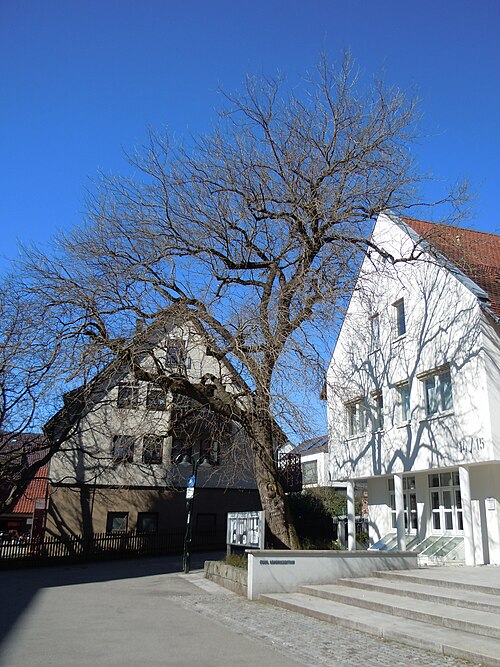
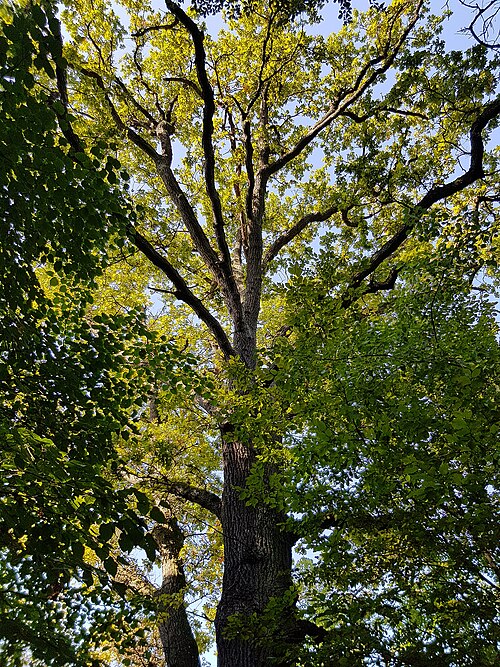
Duke Carl Eugen of Wuerttemberg planted this plane in 1779, tradition says as a gesture toward the woman who would become his wife. About four metres up, the trunk splits cleanly into two, and Hohenheim has read that fork as a love story ever since: two lovers, united at the root, each still their own person in the canopy. Whatever the duke intended, the tree has done well by it. At 34 metres it ranks among the tallest planes in Germany, with a trunk 7.70 metres round measured in December 2022, and in May 2023 the German Dendrological Society named it one of the country's Nationalerbe-Baeume, National Heritage Trees, a list of roughly a hundred. It grows in the Exotic Garden of the university's Hohenheimer Gaerten, open and free every day of the year. Age has not made it decorative. The cavities in that quarter-millennium of wood shelter owls, dormice and bats, and the tree is one of the known German homes of the hermit beetle, a protected saproxylic species that depends on exactly this kind of old, hollowing timber. Arborists inspect it twice a year and carry out whatever care keeps a tree this size and this old standing safely over a public garden. The Hohenheim Liebesplatane, the locals call it. Love plane.
The line is our estimate of how much there is to see, not a measurement. Typical for this species where this tree stands; exact weeks shift with the year.
Exotischer Garten, Hohenheimer Gärten, Universität Hohenheim, Garbenstraße, 70599 Stuttgart-HohenheimYou can recognise it by its trunk, splitting cleanly into two about four metres up. It stands in the Exotic Garden of the Hohenheimer Gärten, at the University of Hohenheim.
In the free, publicly open Exotic Garden of the Hohenheimer Gärten (University of Hohenheim); open year-round, all day, no ticket. Parking on site.
Stadtbahn U3 to Plieningen (terminus), about 300m walk
Sources
Where the facts on this page come from.