Ghent's best tree walk is about a hundred metres long. A weeping silver lime, a ginkgo and a common ash stand together in Muinkpark, and all three belong to the first planting of ground the city's natural history society bought in 1851 to build a zoo on. The zoo went. The planting stayed. Everything else here runs outward from that park: an undated copper beech holding a roundabout in the Zuid, a plane a square was laid out around in 1883, two young trees planted to remember, and a village lime at Massemen voted tree of the year in 2016.
0 of 8 visited in Ghent
Weeping Silver Lime (Tilia tomentosa 'Pendula') · 170 years · Muinkpark
This lime was planted for a zoo. In 1851 the Ghent natural history society bought 3.3 hectares of meadow south of the old city to keep animals on, and Flanders' heritage inventory records this weeping silver lime as belonging to the first planting generation that went into the ground with them. The zoo is gone. The planting outlived it, and a fragment of those grounds is now Muinkpark, a small public park in the university quarter, with three of the original trees still standing within about a hundred metres of each other.
A weeping silver lime is not a wild tree. It is a grafted cultivar of Tilia tomentosa, trained to send its branches back down towards the ground, so the crown reads as a dome you walk under rather than a canopy you stand beneath. The register puts the trunk at over three metres round. The leaves are dark green above and white-felted below, which means the whole tree turns pale and flickers whenever there is wind, and that is the easiest way to pick it out from the ash and the ginkgo nearby.
What the register gives is a generation rather than a year, so the age here is a band of roughly a century and a half and not a measurement. Nobody has counted its rings. If a planting record for Muinkpark exists, we would like to see it.
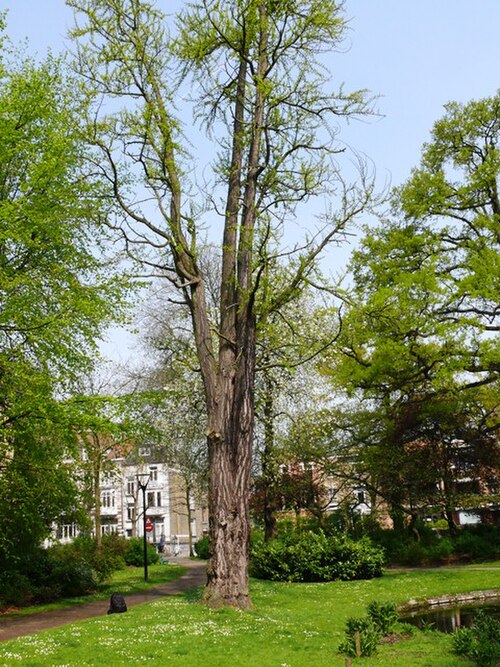
Ginkgo (Ginkgo biloba) · 170 years · Muinkpark
Flanders' heritage inventory still files this tree under its old Dutch name, Japanse notenboom, the Japanese nut tree, which gets it wrong twice. Ginkgo biloba comes from China, and the thing it drops in autumn is a seed, not a nut. The name stuck anyway, which is more or less what happened to the tree. It belongs to the first planting generation of the ground the Ghent natural history society bought in 1851 to build a zoo on. The zoo went. The ginkgo stayed exactly where it was put, and the register records its trunk at over three metres round.
Ginkgo is the last surviving species of an order otherwise known from fossils, with no close living relatives anywhere, and the leaf shows it: a flat green fan with a notch in the middle, unlike anything else growing in this park. For most of the year that is the only reason to look twice. Then late November arrives, the whole crown turns hard yellow at once, holds for a week or so, and comes down almost in a single day.
The register names a planting generation rather than a year, so the age is a band rather than a figure. It stands roughly a hundred metres from the ash and the weeping lime that went into the ground with it.
Photo: Geert Van der Linden (CC BY 4.0)
European Ash (Fraxinus excelsior) · 170 years · Muinkpark
Europe is losing its ash trees, which is what makes a trunk like this one worth the short walk. Ash dieback, a fungal disease that arrived from east Asia and has been moving across the continent since the 1990s, kills young Fraxinus excelsior faster than the species can replace itself. This one measures over three metres round and belongs to the first planting generation of Muinkpark, the ground the Ghent natural history society bought in 1851 and stocked with animals. The register lists it, the weeping lime and the ginkgo as three survivors of the same planting.
Ash is the plainest of the three and by far the most useful. The wood splits clean and bends without snapping, which is why Europe made tool handles, cart wheels and oars out of it for centuries, and why nobody has ever planted one for the view. It is also the last tree in a park to come into leaf and among the first to let go, so for a good stretch of the year you are looking at bare grey branches and hard black buds while everything around it has already turned green.
The heritage inventory dates it to a planting generation rather than a year. Roughly a century and a half is the register's own margin, not ours, and it is as close as anyone has got.
Copper Beech (Fagus sylvatica f. purpurea) · Sint-Annaplein / Zuid
This beech has a trunk 4.26 metres round and no birthday. Two records describe how the square around it was planted, and they do not agree. Flanders' heritage inventory calls it an imposing copper beech standing centrally on Sint-Annaplein and says it possibly still dates from the original layout, the square built between 1841 and 1846 to a design by the city architect Lodewijk Roelandt. The register hedges that itself, because the evidence it leans on is an aerial photograph from 1952 and an Albert Sugg photograph from 1953, both showing the central green already planted. That is proof of trees, not of this tree's age. The Dutch Wikipedia entry on the square records something else entirely: chestnuts planted here in 1869. Chestnut is not beech, and 1869 is not the 1840s.
So the age field stays empty. Neither source dates this individual beech, and joining the square's construction to the tree standing on it would be an answer nobody actually gave.
The trunk is not in doubt. Sint-Annaplein is a traffic roundabout now, with a green centre you can walk onto and a Sacred Heart war memorial raised in 1926, and the beech holds the middle of it, in leaf a deep purple-brown from spring until it drops. If a Ghent planting record settles the date, we would like to see it.
Tree of Heaven (Ailanthus altissima) · ~40 years · Lindenlei / Patershol area
The memorial beside this tree is a drawing of its shadow. The tree went in first, planted in 1988 on the park strip along the Lindenlei; the monument followed ten years later, inaugurated on 8 May 1998, and its floor is black granite laid out in the shape the tree casts on the ground. Daniel Dutrieux designed it. Set into and around that shadow are a copper dreidel two metres across, a Star of David, granite blocks carrying the names of Jews deported from Ghent, and a Hebrew inscription taken from the first chapter of Lamentations.
It is named for Michael Lustig, a rabbi arrested near this spot in 1943 together with his wife and their two children, and deported. Every November since 1999 the city and Ghent's Jewish community have gathered here to mark Kristallnacht.
None of that makes the tree old, and it is not on this list pretending to be. A hemelboom planted in 1988 is young, and Ailanthus altissima is not a species anyone plants for permanence: it grows fast, seeds itself into gutters and railway embankments across Europe, and is usually cut down long before it amounts to anything. This one was left alone, grew, and a sculptor took the shape it throws on the pavement and cut it in stone.
Northern Red Oak (Quercus rubra) · ~110 years · Wondelgem
Wondelgem planted this oak in 1920 and put it between the church and the stone that lists its dead. Flanders' heritage inventory files it as a vredesboom, a peace tree, standing on the Vroonstalledries beside the war memorial, two years after the armistice and while the village was still counting what the First World War had taken from it.
A dries is a village green, common ground a parish kept undivided, and this one still reads as one: hedge-enclosed, open on all sides, with the seventeenth-century Sint-Catharina church and its churchyard along one edge. Against that hedge stand the stations of a pilgrimage route, put up in 1915 while the war was still running, five years before anybody here planted anything for peace.
The tree is a northern red oak, an American species Europe had been planting for well over a century by then. It grows fast and it colours, which is the one promise this entry can make on a fixed date: late October takes the whole crown to scarlet and then rust, and it holds for a fortnight.
At just over a hundred years old this is one of the younger trees on the list, and one of only two here whose age comes from a document rather than an estimate. Wondelgem is a district of Ghent, a few kilometres north of the centre.
London Plane (Platanus x acerifolia) · Gent (Kunstenkwartier/Muinkparkwijk)
Five streets meet at the Prudens Van Duyseplein, and when the square was laid out in 1883 it was laid out around this plane. The tree is what would otherwise be a traffic island. It carries a clear stem of seven to eight metres before the first branch, then a crown that reaches 28 to 29 metres across at its widest, with a radius of eleven.
It is measurably still growing. The Flemish heritage inventory records it at 4.26 metres round in 2006 and 4.49 in 2013, both taken at a metre and a half from the ground, which is 23 centimetres of new wood in seven years.
Nobody has established when it was planted. A date of 1700 circulates, but it appears in none of the heritage records, so the honest answer is that this tree is undated. If you have seen a source that settles it, tell us.
What is documented is the protection, and it runs both ways. The plane has been a monument in its own right since 5 November 2013, and the square around it has been a protected townscape since April 1978. Locally it is not named after anybody. It is simply the tree of the square, which is what happens when a city builds a junction around a plane and then leaves it there for 140 years.
A day trip away
Massemen, 12 km south-east
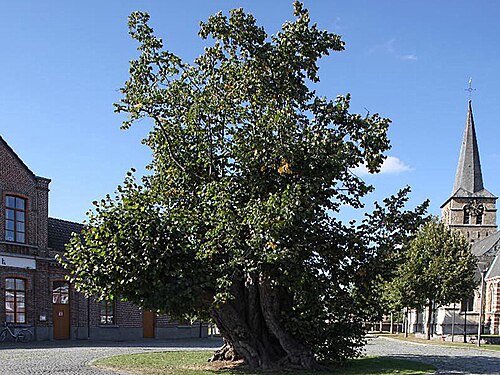
Large-leaved Lime (Tilia platyphyllos) · 400 years · Massemen (Wetteren), Province de Flandre-Orientale
In 2016 the country voted this lime its tree of the year, and the tree it beat into second place is called the Thousand-Year Oak of Lummen. The Summer Oak of Vollezele came third. The winner stands on the village square of Massemen and is 7.19 metres round under a crown only about 12 metres tall, which is a very wide tree on a short frame.
Its age came out of a laboratory rather than a guess. Ghent University dated it dendrochronologically in 2006 and put it between 378 and 440 years old, which places the planting in the second half of the sixteenth century or the very start of the seventeenth. The band is wide because that is what the method returns, and there is no tidier number to give. Either way it was a full-grown tree long before Belgium was a country.
A ministerial decree of 1 February 2001 protects the lime and the square together, as a monument and as a village landscape, so the setting around it is covered as well as the trunk. The measurements above were taken in 2007, so the girth has had nearly twenty years to move since.
It is on the Dorpsplein in the centre of the village, free to walk round, with De Lijn buses serving the village.
Photo: Roel Jacobs, Hugo Baeyens, Benedicte Vispoel (CC BY-SA 4.0)