Graz's city government keeps a live register of protected trees, and sixteen ship here: ten in the city centre, from a Schlossberg maple to a Volksgarten trio, two Panoramagasse oaks and an Elisabethstrasse plane; a paid-entry pine and copper beech in Schlosspark Eggenberg plus a free oak nearby; a storm-broken sweet chestnut and a March-flowering cornelian cherry in the eastern hills; and in Jakomini the city's only protected Oriental plane. Most carry no recorded age, an honest gap stated rather than guessed past.
0 of 16 visited in Graz
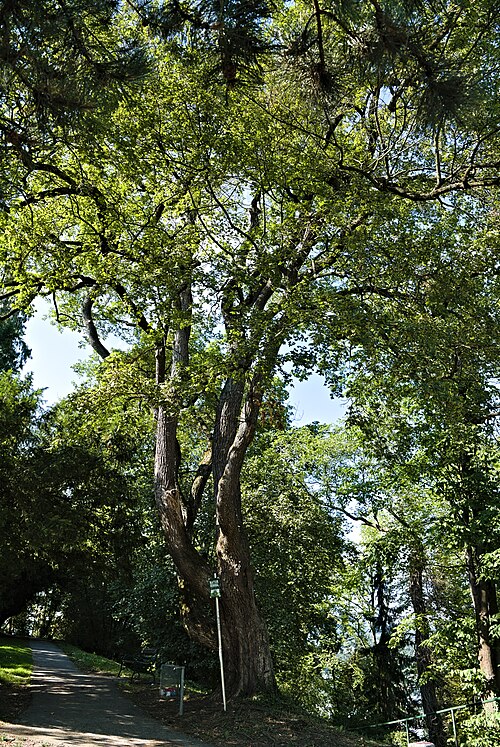
Field Maple (Acer campestre) · Innere Stadt (Schlossberg hill park)
Graz keeps a live public register of its protected trees, and this field maple has held a place on it since the year 2000, growing on the wooded hill above the old town where a fortress once stood and a bell tower still does. Field maples rarely get singled out anywhere: they are the hedgerow tree, the one that fills gaps between grander species rather than anchoring a park on its own. This one earned protection anyway, on a hill whose beech, hornbeam and ash have been managed as a landscape park for centuries around the ruins at its summit. Austria's official record and Graz's own city register agree on the exact spot to within three metres, though neither has ever measured its girth or put a number on its age, an honest gap on an otherwise well documented tree. The Schlossberg itself needs no introduction to anyone who has visited Graz, its clock tower visible across the whole city, and the climb up past this maple is free at any hour, on foot or by the paid funicular that saves the legs.
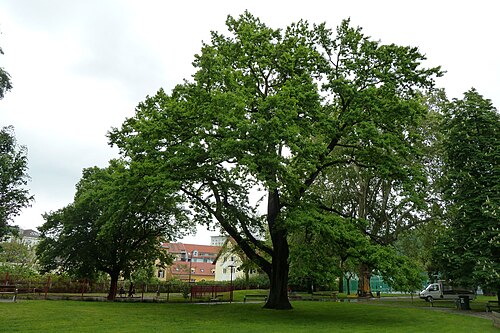
Pedunculate Oak (Quercus robur) · Lend (Volksgarten park)
Three of Graz's officially protected trees stand inside one small park, and this oak is the first of them, rooted near the Muhlgasse side of the Volksgarten. The park's own history records a planted row of oaks running roughly north to south through its centre, seventy to a hundred years old, but no source confirms this particular designated tree is part of that row rather than a separate planting nearby, so the two facts stay separate here rather than joined into a tidier story that nobody actually stated. What both the city's live tree register and Wikipedia's independent list agree on is the spot itself, within two metres of each other, and the protection: this pedunculate oak has held Naturdenkmal status since May 2000. The Volksgarten covers four and a half hectares open on every side, no gate and no fee, a five minute walk from Graz's main station. Two more protected planes grow within a hundred and seventy metres of this oak, making the park itself worth the whole visit rather than a single stop.
Photo: Gerdsch (CC BY-SA 3.0 at)
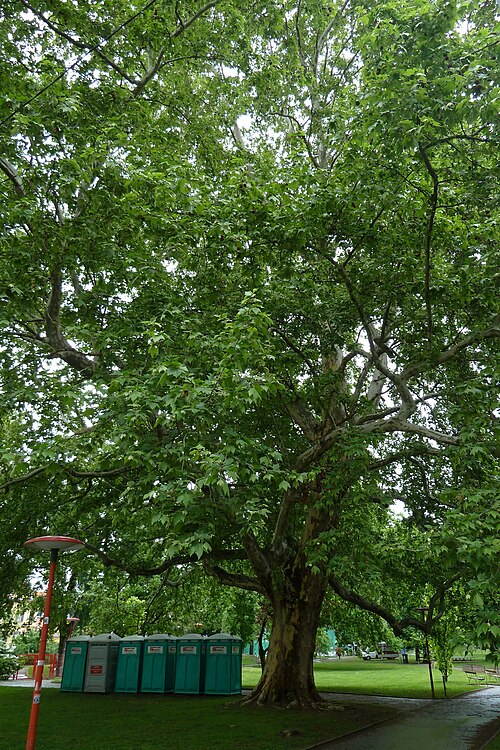
London Plane (Platanus x acerifolia) · Lend (Volksgarten park)
A dated photograph on Wikimedia Commons, filed under this exact tree's own protection number, shows this plane still standing in the Volksgarten years after its formal designation, one of the small proofs this project prefers over a bare database record. It is a London Plane, the hybrid city planners across Europe reach for when they want a tree that shrugs off pollution and poor soil, and this one has done the job here since the year 2000. It grows a few paces from a protected oak and a second protected plane, the three of them forming Graz's tightest cluster of designated trees, all reachable inside one small public park. Neither source gives an age or a trunk measurement, an honest gap on a tree old enough to have earned legal protection on its own merits. The Volksgarten opens on every side with no fee and no closing time, a five minute walk from Graz's main railway station.
Photo: Gerdsch (CC BY-SA 3.0 at)
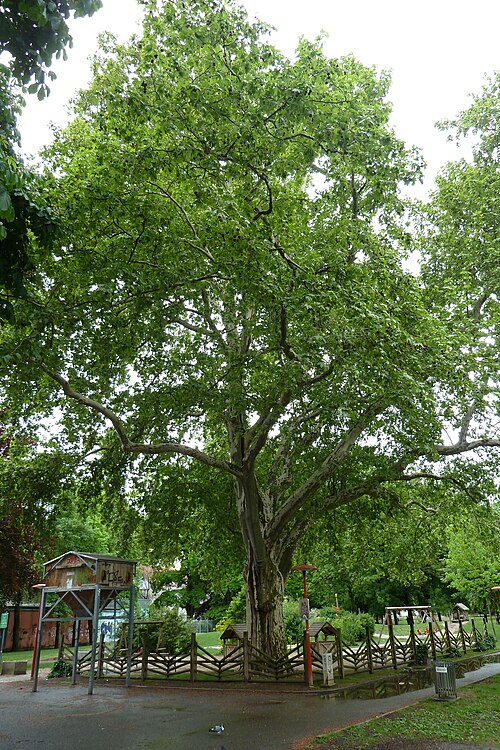
London Plane (Platanus x acerifolia) · Lend (Volksgarten park)
Registers occasionally list the same tree twice under two addresses, a real problem elsewhere on this site, and this plane is a genuine check against exactly that mistake: it stands on a separate legal plot from the park's other two designated trees, a hundred and seventy metres away, protected four months later in a separate 2000 decision. Not a duplicate, a third tree completing the Volksgarten's own small collection of protected specimens. It grows near the Volksgartenstrasse entrance rather than the Muhlgasse side where its two neighbours stand, which means a visitor can enter the park from either street and find a protected tree within a few steps. Graz's city register and Wikipedia's independent list place it within three metres of each other. As with its neighbours, nobody has published an age or a trunk measurement, which any reader with a tape measure could fix in the time it takes to walk the park end to end.
Photo: Gerdsch (CC BY-SA 3.0 at)
Field Maple (Acer campestre) · 70 years · Jakomini, at the eastern edge of the Augarten park
This field maple carries an unusually solid floor under its age. Its formal Naturdenkmal designation dates to 1979, but Wikipedia's own record cites an earlier source, a 1956 survey of Graz's planted broadleaf trees by F. Hanselmayer, which already listed this exact maple as a tree worth protecting, decades before the legal designation caught up. That gives a hard floor of at least seventy years old as of today, derived from a dated citation rather than a guess, with no upper bound stated because nothing sources one. It grows at the eastern edge of the Augarten, a public park in Jakomini, beside a heritage bathhouse building that now houses the Museum der Wahrnehmung. Whether the tree's exact footing sits on the museum's own grounds or on the adjoining public park land was not confirmed by any source read this pass, which is why this entry is flagged rather than stated with full confidence, an honest narrow gap on an otherwise well anchored tree.
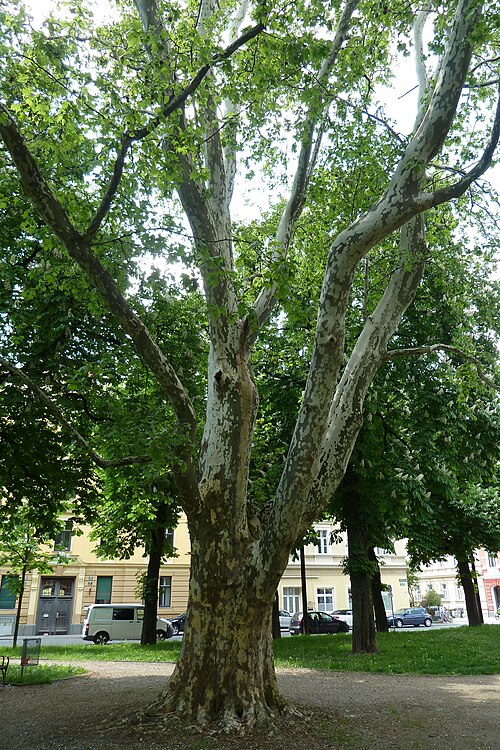
London Plane (Platanus x acerifolia) · St. Leonhard (Schillerplatz square)
A photograph taken on the second of May, 2014, and filed on Wikimedia Commons under this tree's own protection number, is the kind of small dated proof this project values: it shows the tree alive and identifiable twelve years ago, a data point independent of both the city's live register and Wikipedia's own list, which agree with each other on the exact spot to within two metres. The plane has held its Naturdenkmal status since September 1990, growing on Schillerplatz, an ordinary public square in the St. Leonhard district rather than a landscaped park, the kind of protected tree that people cross without a second glance because nothing marks it out from the street furniture around it. No age or trunk measurement has ever been published for it, which is true of most of Graz's protected trees and no reason to hold this one back: it stands on open public ground, reachable by tram or bus directly to the square, free at any hour.
Photo: Gerdsch (CC BY-SA 3.0 at)
Pedunculate Oak (Quercus robur) · 100-200 years · Geidorf (Panoramagasse, Ruckerlberg hillside)
Two pedunculate oaks stand forty metres apart on the same hillside street, protected on the exact same day in July 1979, and this is the smaller of the pair: a trunk measured at 2.80 metres round in a 2015 field survey, against 4.90 metres for its neighbour up the road. No published growth-rate figure for this species was found and verified this pass, so that girth is not converted into an age here rather than turned into a guess dressed up as a calculation. The register lists the tree opposite house number 54 on Panoramagasse, a steep street on the Ruckerlberg hillside in Geidorf that earns its name honestly, climbing above the city with views back over the rooftops. 'Gegenuber', opposite, is the register's own word for the tree's position: on the public verge across from the house, not inside anyone's private garden. Reachable by bus toward Ruckerlberggurtel and a walk up the hill, with its larger neighbour barely a minute further on.
Pedunculate Oak (Quercus robur) · 175-350 years · Geidorf (Panoramagasse, Ruckerlberg hillside)
This oak and its neighbour forty metres down the hill were protected on the same day in July 1979, near-identical paperwork for two trees that turned out nothing alike: a 2015 field survey measured this one at 4.90 metres round, nearly double its neighbour's 2.80 metres, despite an address and a protection date that otherwise read like a matched pair. Nothing in either source explains the gap, whether one was planted decades before the other or simply grew faster on better ground, so this page states the measurement rather than guessing at a reason. It stands opposite house number 56 on Panoramagasse, a hillside street in Geidorf on the Ruckerlberg slope, on the public verge rather than inside any private plot, per the register's own wording. No published age exists for it and none is invented here; a girth this size on an oak usually means real age, but converting one into the other needs a cited growth-rate figure this pass did not have in hand, so the number stays a girth rather than becoming a guess.
Eastern White Pine (Pinus strobus) · Eggenberg (Schlosspark Eggenberg, within the palace grounds)
A field measurement from October 2016, cited by Wikipedia's own list of Graz's protected trees, gives this Eastern White Pine a trunk 3.70 metres round and a height of about 27 metres, figures the city's live register independently confirms exist at the same spot within three metres. It is one of ten designated trees planted together at the entrance to Schlosspark Eggenberg, five plane trees and four more Weymouth pines among them, but this is the only one with its own measurement on record, which is why it stands here alone rather than as part of a group entry: the rest read as one avenue rather than nine separate things worth stopping at individually. Pinus strobus is native to eastern North America, and this specimen has grown large enough on Austrian soil to earn legal protection in its own right, cited in 1979. Schloss Eggenberg is a UNESCO World Heritage palace on the western edge of the city, its park entered on a paid ticket rather than freely, the one exception on this page to Graz's otherwise open-access trees. A copper beech, also protected, grows fifty seven metres away in the same park, making the walk from the gate worth two trees rather than one.
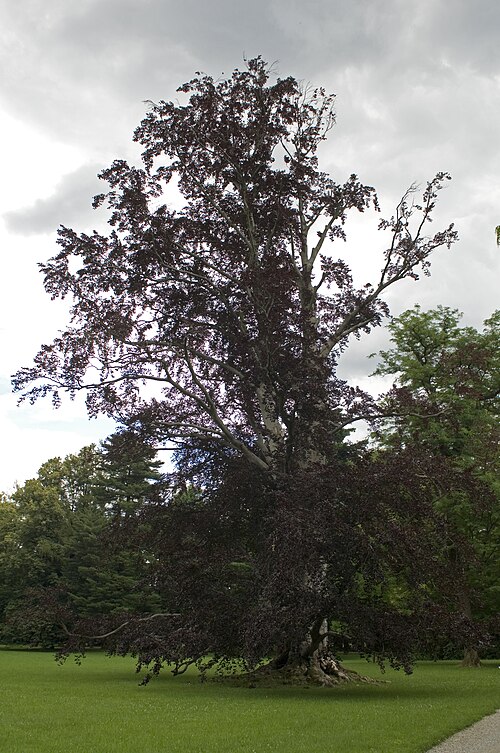
Copper Beech (Fagus sylvatica 'Purpurea') · Eggenberg (Schlosspark Eggenberg, within the palace grounds)
Wikipedia's list places this copper beech at Eggenberger Allee 90 with a set of coordinates that match, to six decimal places, the GPS tag on a photograph taken here in June 2014 and filed on Wikimedia Commons under the tree's own protection number. Two facts agreeing that precisely is about as solid as a location gets on this page, even though the tree carries a smaller shadow of documentation than most of its neighbours: it sits in Austria's national monument register rather than the City of Graz's own separately maintained list, which does not carry it at all, and nobody has photographed or measured it since that one 2014 image. Fagus sylvatica 'Purpurea' is a cultivar bred for its dark red foliage rather than a wild variant, planted widely across European parks precisely for that colour, and this one earned formal protection in 1979 regardless of the missing girth and age figures. It grows inside Schlosspark Eggenberg, the grounds of a UNESCO World Heritage palace on the city's western edge, fifty seven metres from a protected Weymouth pine that shares its address and its 1979 designation date, reachable on the same paid ticket into the park.
Photo: Kulac (CC BY-SA 3.0 at)
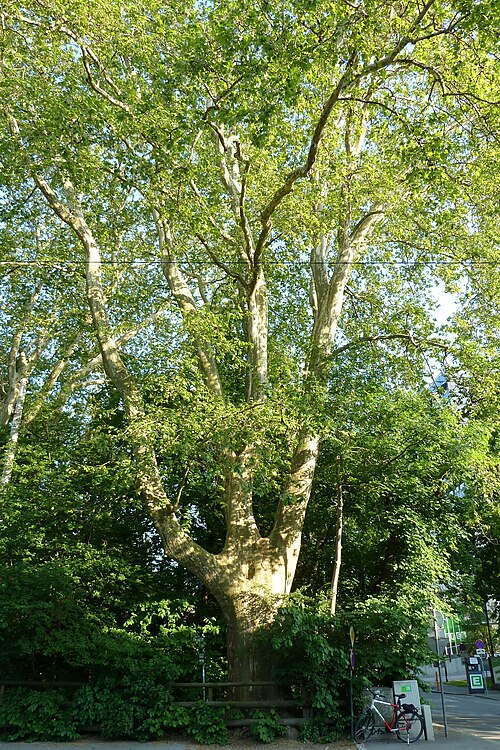
London Plane (Platanus x acerifolia) · St. Leonhard
This plane has held Naturdenkmal status since 1979, one of the first wave of trees Graz ever protected, its number a round one: Steirisches Naturdenkmal 1000. It grows on Elisabethstrasse in St. Leonhard, at the exact spot where OpenStreetMap independently marks a small bridge over a stream, a detail that fits a streamside verge planting rather than confirming any single source's account on its own.
A photograph taken on the 14th of May 2014, filed on Wikimedia Commons and GPS-tagged to the register's own coordinate, shows the tree alive and identifiable twelve years ago. Nobody has photographed it since, so its alive-now status rests on that image plus its current public listing rather than a fresh sighting, an honest gap rather than a certainty.
The city's live register and Wikipedia's separately maintained Naturdenkmal list agree on the location to within four and a half metres. Neither carries an age or a trunk measurement, true of most of Graz's protected trees and no reason to skip this one: it stands on public ground, the register's own owner field reading 'oeffentlich', free to see at any hour, less than a kilometre from the Schillerplatz plane.
Photo: Gerdsch (CC BY-SA 3.0 at)
Oak (Quercus sp.) · Algersdorf (Annaplatz park, Eggenberg district)
Both sources that describe this oak agree on exactly where it stands and neither can say which oak it is. Graz's live tree register and Wikipedia's independent Naturdenkmal list place it in Annaplatz, a small public park in Algersdorf near the Annakapelle chapel, within four and a half metres of each other, and both record its protection, granted in September 1990, without ever naming a species beyond 'Eiche', oak. So it ships here with the species not established, the exact oak an open question for whoever visits next with a decent eye for bark and leaf shape.
Annaplatz itself is unambiguously public: the city's own parks staff maintain it, and it hosts community events, yoga classes among them, the kind of ordinary neighbourhood green space a protected tree can share without any fuss about access. It sits about nine hundred metres on foot from Schlosspark Eggenberg's Weymouth pine and copper beech, close enough to fold into the same outing west of the centre, and unlike those two, standing free rather than behind the palace's ticket. No age or girth has ever been published for it, a gap this page states rather than guesses past.
Hornbeam (Carpinus betulus) · St. Leonhard
Graz protected this hornbeam in 2019, and the register gives it nothing else: no age, no girth, no story beyond a plot number in the cadastral map of St. Leonhard. Most of Austria's monumental trees at least carry a measurement. This one carries only a square.
The tree stands on Tegetthoffplatz, a public square a short tram ride from the Elisabethstrasse cluster, and the only independent confirmation of exactly where is a photograph taken in December 2020, its own coordinates matching the register's point almost exactly. The photographer's caption places the tree against the backdrop of the Seebacher Gymnasium, but the school is only scenery: the hornbeam itself grows on open public ground, not the school's.
Naturdenkmal designation in Austria protects a tree for what it already is rather than for a story attached to it, and Tegetthoffplatz's hornbeam is a case in point: nobody wrote down when it was planted, nobody has taped its trunk, and the closest thing to a document is the 2019 decree that made cutting it down illegal. If you have measured it, or know when it went in, tell us. Until then it stands on its own square, three hundred and fifty metres from its nearest neighbour on this list, waiting for someone to write the rest of its history.
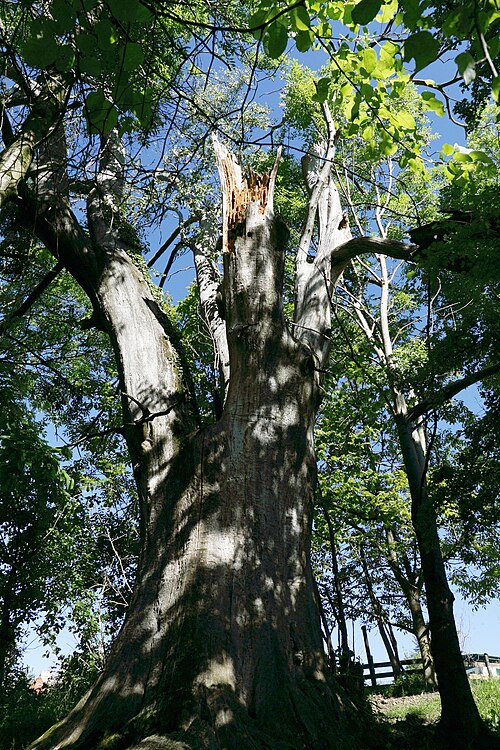
Sweet Chestnut (Castanea sativa) · Waltendorf / Lustbuhel
A storm once snapped the top off this chestnut, and it carried on regardless. The only dated picture of it, taken in May 2014, shows the damage plainly: a very thick trunk, deeply furrowed, a splintered end where the leader used to rise, and a set of younger limbs climbing past the break.
It stands at the edge of a public car park on Waltendorfer Hauptstrasse, at the foot of the Lustbühel, the hill on the eastern side of Graz that is kept under landscape protection. A fence runs behind it, so the trunk may sit on the boundary of a field. You look at it from the car park side, which is close enough to take in the girth.
Styria lists it as Naturdenkmal 1121, which protects it by law, and that is very nearly all the record says: the species, a public owner, a point on the map. No age, no girth, no height, no planting date. The 2014 photograph was taken within a metre of the register's own point, so there is no doubt which tree this is.
What nobody has written down since 2014 is how it is doing, and a tree that has already lost its top is the kind worth checking on. If you have stood in front of it recently, tell us how it looks, and if you have a tape measure, how far it is round the trunk.
Photo: Christian Pirkl (CC BY-SA 3.0 at)
Cornelian Cherry (Cornus mas) · Kroisbach / Mariatrost
The only photograph on record of this tree shows no trunk at all. Taken from underneath on 30 March 2015, it is a crown of small yellow flowers against a blue sky, and nothing else.
That is the cornelian cherry's moment. It flowers between late February and March, among the first trees of the year to do so, and in Austria, where its fruit is the Dirndlbeere, it is far more often met as a hedge or a shrub than as a protected monument. Styria lists this one as Naturdenkmal 997, on public ground beside the service road that runs along the Johannhöhe ridge above Kroisbach, in the hills north-east of the centre. The photograph's coordinates sit about four metres from the register's point.
Beyond that the record is thin. The register names the species and the owner and stops there: no age, no girth, no height. Nobody has measured how big it is, and the 2015 picture is the latest evidence that it is still standing.
Getting there is a steep climb from the bus in Kroisbach; on foot the ridge road is a public way. Go in March, when you will know it by the colour. If you have seen it since 2015, or have put a tape round its trunk, tell us what you found.
Oriental Plane (Platanus orientalis) · Harmsdorf, Jakomini
Graz protects eighteen plane trees as natural monuments, and the register records only one of them as an Oriental plane. This is it, standing beside a roadside car park on Münzgrabenstraße.
The other seventeen are London planes, the hybrid that shades the Volksgarten and Schillerplatz. Platanus orientalis is one of that hybrid's two parent species, and in a central European street it is far rarer than its offspring.
It was listed as Naturdenkmal 1014 on 1 July 1981, on a parcel of about 117 square metres, little more than a square of ground around the trunk. The city's register gives the owner as public.
That is close to everything on record. Nobody has published its age, its girth or its height, and the most recent photograph we know of was taken for Wiki Loves Earth in May 2014. The tree is still on the official list with no note of removal, but we have seen nothing newer that shows it standing. If you pass it, tell us, and if you have a tape measure, a girth would let us put an age on it.
It is a detour of its own rather than part of a walk: about three kilometres south-east of the Hauptplatz in Jakomini, and nearly two kilometres from the nearest of the city's other protected trees, the Schillerplatz plane.