Enschede's old trees were bought by textile money. Van Heek, Blijdenstein, Ledeboer: the families who ran the mills built estates on the edge of town, hired the best garden architects in the country and planted them, and the city later absorbed the results as public parks. One invoice survives. In 1865 D. Wattez billed H. J. van Heek for a Wellingtonia as part of the planting around 't Wageler, and the two men wrote to each other about the price. That giant sequoia is still standing in the Ledeboerpark, which is the closest thing this page has to a receipt.
0 of 13 visited in Enschede
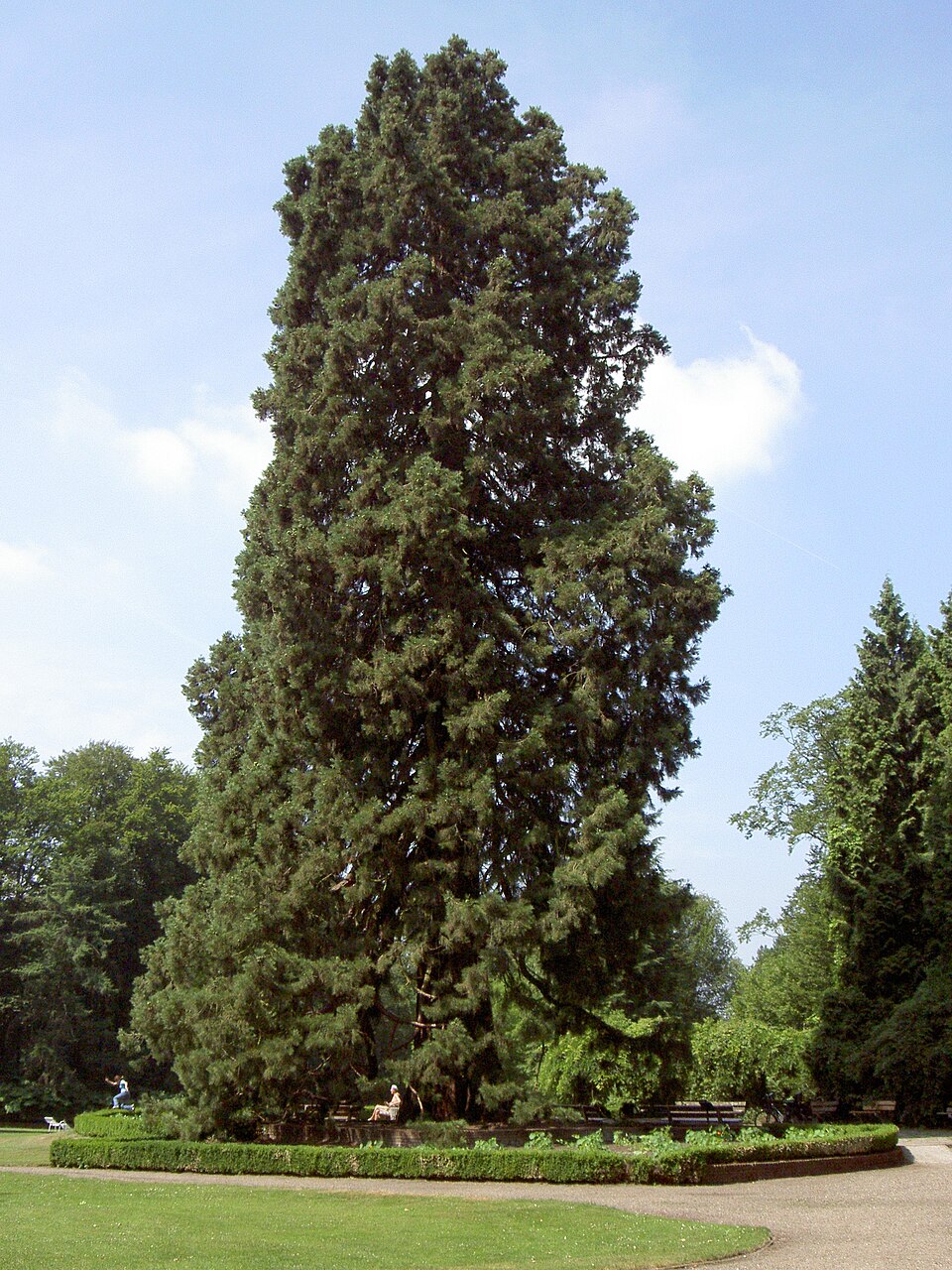
Giant Sequoia (Sequoiadendron giganteum) · 155-165 years · Ledeboerpark
Somebody wrote down what this tree cost.
The register cites a document in the archive of the Twente textile families: in 1866 the mill owner H. J. van Heek and the garden architect D. Wattez corresponded about the price of a Wellingtonia, itemised on an invoice for the planting around 't Wageler in 1865. Wellingtonia was the trade name the British gave the giant sequoia after the Duke of Wellington, and in the 1860s it was the most fashionable and most expensive thing you could put in a garden in Europe. The species had only been introduced to Britain in 1853. Buying one was a way of saying what you were worth.
The park is what became of that estate. Wattez laid it out in the second half of the nineteenth century, the city absorbed it, and the Ledeboerpark on the Hengelosestraat is now open to anyone.
So you can go and stand under an object of Victorian conspicuous consumption that has quietly outlived the mills, the family's fortune and the argument about the price.
It is unmistakable: the thick red-brown trunk with soft fibrous bark, and a straight conical top.
Pedunculate Oak (Quercus robur) · 225-275 years · Lasonder-Zeggelt
The oldest tree in Enschede is not on anybody's estate. It stands in ordinary public planting in a residential district and it has a name anyway, which is usually a sign that people have been walking past it long enough to need one.
The register bands it 1750 to 1800, which makes it two to two and a half centuries and puts its first decades in a Twente of farms and hand looms, before the mills, before the railway, and long before the town around it. Enschede burned almost entirely to the ground in 1862, when a fire took the whole centre in a few hours. This oak was standing well outside it and is one of the few living things in the city that predates that day.
The register gives its position to six decimal places, which is the tell that somebody stood at the trunk with a satellite receiver rather than pointing at a street. That is unusual in this dataset and it means the pin is as good as pins get.
Pedunculate oak, so acorns on long stalks and leaves that sit almost directly on the twig. In October there will be a great many of them underfoot.
Giant Sequoia (Sequoiadendron giganteum) · 115-125 years · Lonneker
The farm this tree stands on was first written down in 1536.
In that year Jan van Borne, steward of the chapter of St Peter in Utrecht, reported on two holdings in the hamlet of Lonneker: Het Bouwhuis and Het Amelink. The Amelink then belonged to the Jonker van Steinfurt, which is to say the count of Bentheim. So the ground has an unbroken paper trail running back close to five centuries, into a landscape of church chapters and minor German nobility, which is roughly four hundred years before anyone here had heard of a sequoia.
The tree is the newcomer, planted somewhere between 1900 and 1910, when a giant sequoia had gone from a spectacular novelty to the standard way of announcing that a country house had grounds.
The register notes that Het Bouwhuis is open to the public and that a good many striking trees stand there, which makes this one of the easier estates on this page to simply walk into.
A hundred and twenty years is nothing for the species. In California this would be a sapling among trees three thousand years old. Here it is already the biggest thing in the field.
Weeping Beech (Fagus sylvatica 'Pendula') · 115-125 years · Lonneker
Go inside it. That is the point of a weeping beech and almost nobody does it.
The branches of a mature one arch out and then fall straight to the ground all the way round, so what you have is a green tent perhaps fifteen metres across with a bare floor and a trunk in the middle. Children work this out immediately. Adults walk past.
Weeping beech is a cultivar, not a species: a mutant form propagated by grafting, so every one is a clone of an original found in Europe in the eighteenth century. The graft union is usually visible as a swelling low on the trunk. It grows the same way a normal beech does except that it cannot hold its branches up, and left alone it will layer, meaning a branch resting on soil roots and becomes a new trunk, so an old one can slowly walk outward across a lawn.
This one stands on the northeast side of the pond at Het Bouwhuis, planted between 1900 and 1910, on ground documented since 1536.
Duck under the skirt on the pond side and look back out at the water through the leaves.
Sessile Oak (Quercus petraea) · 115-125 years · Blijdensteinpark
A dual carriageway runs through this park, and the tree is by a filling station. Both facts are worth stating first, because they are what this place is now.
It began as an estate. In 1855 H. G. Blijdenstein and his wife Ebeling built a villa on the Helweg, the road that later became the Gronausestraat, and laid out grounds around it. Their daughter Johanna Ida Beltman-Blijdenstein was the last person to live there. The Blijdensteins were one of the Twente textile dynasties, and like the Van Heeks and the Ledeboers what they left the city was ground with trees on it.
What happened afterwards is what happens to green space near a growing city. The Boulevard 1945 was driven straight through the park, cutting it in two, and the eastern edge now holds a petrol station.
The oak has been there since around 1900 to 1910 and has watched the arrangement change around it. It is a sessile oak, so the acorns sit tight against the twig and the leaves have a clear stalk, the reverse of the commoner pedunculate oak.
Go on a Sunday, when the road is quiet.
London Plane (Platanus x acerifolia) · 155-165 years · Cort van der Lindelaan
There was a country house here called 't Zwik and there is a street pattern instead.
The city bought the place in 1917 to expand into, and built over it through the 1920s and 1930s, which was the ordinary fate of the smaller estates on the edge of a town whose population was climbing with every new mill. The house went. What survived is planting: this plane, and, sixty to a hundred metres to the west, an oak and a beech that the register also identifies as remnants of the same grounds.
That is a useful thing to know while standing here. Three trees at three points along a street are not a coincidence, they are the last legible trace of a garden, and if you draw a line between them you are walking somebody's approach.
The plane is the easiest of the three to spot: flaking bark in cream, olive and grey, big maple-shaped leaves, and the bristly round seed balls that hang on through the winter.
Planes are the great survivors of city building. They tolerate compacted soil, root disturbance, pollution and hard pruning better than anything else of their size, which is exactly why this one is still here and the house is not.
Hungarian Oak (Quercus frainetto) · 100 years · Oosterbegraafplaats
The register does not only call this oak old, it says which decade of the cemetery it belongs to. Gedenkpark De Ooster opened in 1899, its northern section was added in 1929, and the Bomenstichting dates this Hungarian oak to that extension, which puts it at roughly a hundred years. The register throws in one detail worth having on the walk: the seam between the old ground and the new is still legible in the layout, and this tree stands on the new side of it.
Quercus frainetto belongs to southern Italy, the Balkans and Thrace. In a cemetery in Twente it is a deliberate import, and somebody chose it over the beeches and oaks that would have been the easy answer. It has grown here through everything that has happened to Enschede since 1930: the war, the slow closing of the textile mills that paid for this city, and the rebuilding of a town that had to find something else to be.
The ground around it is a national monument in its own right, protected in part for the park trees along these paths, though that listing praises them as a group and does not name this oak. The tree register does, and it is the only source that does, so read the dating as the register's judgement rather than as a count anybody has taken from the wood.
Sweet Gum (Liquidambar styraciflua) · 90 years · Oosterbegraafplaats
This tree is on the national register for being a good example of its species, not an old one. The Bomenstichting dates the planting to around 1935, give or take five years, and listed it on dendrological grounds: a fine sweet gum, in a country where the species is a garden import rather than a native.
Liquidambar styraciflua comes from the wet bottomlands of the American southeast. What it does in autumn is the whole reason anyone plants it here. The leaves are shaped like five-pointed stars and they refuse to turn one colour: scarlet, plum, orange and green show up on the same branch, sometimes on the same leaf, and the display runs on for weeks after the limes and beeches around it have gone brown and let go.
It stands on the second stretch of the northern main path, in a cemetery that calls itself a memorial park and means it. Gedenkpark De Ooster opened in 1899 and is now a national monument, protected in part for the trees along its paths, which is how an American swamp tree ends up growing old in Twente with nothing much asked of it.
Only the tree register names this specimen individually, so the planting date is its estimate rather than a documented year.
Oriental Spruce (Picea orientalis) · Oosterbegraafplaats
Nobody has dated this spruce, and age is not why it is protected. The Bomenstichting listed it on dendrological grounds: Picea orientalis is a tree of the Caucasus and the mountains of northeast Turkey, uncommon in this corner of the Netherlands, and this is a good one.
It is the easiest spruce in Europe to identify by hand. Oriental spruce carries the shortest needles of any spruce, blunt at the tip rather than sharp, dark and glossy and packed tight all round the shoot, so the whole tree reads denser and blacker than the Norway spruces Dutch planters reached for by default. In its own range it covers the wet Black Sea slopes in forest up to the tree line. Here it stands in a cemetery on the eastern edge of Enschede, about fifty metres from a Hungarian oak, in ground laid out as a memorial park in 1899 and now a national monument.
How it got here is not written down. The register's age field says unknown, and rather than put a number on it we have left it empty: a spruce can look venerable at eighty and ordinary at two hundred, and guessing would be the easy kind of dishonesty.
If you know when this one went in, or have seen a planting record for the northern section, tell us and we will date it properly.
Silver Lime (Tilia tomentosa) · 140 years · Roombeek
A silver lime has held this street corner since the 1880s and nobody wrote down why. The Bomenstichting register puts the planting between 1880 and 1890, which makes the tree roughly 140 years old, designates it monumental, and then leaves its history field blank. It is also the only source that names this tree at all.
Tilia tomentosa is the lime you notice in wind. Its leaves are dark green on top and coated underneath in fine white felt, so a gust turns the whole crown silver and then back again. It also flowers weeks after every other lime in the street, in high summer, with a scent that reaches you before the tree does.
The corner is in Roombeek, the district rebuilt after the fireworks depot went up on 13 May 2000, killing 23 people, injuring around 950 and flattening hundreds of homes. The blast site is roughly a kilometre south of here. What happened on this corner that afternoon is not recorded in anything we have been able to find, and assuming an old tree survived a disaster because it is old and standing is exactly the kind of tidy story that turns out to be wrong. If you were here, or know what this corner looked like that week, tell us.
Sweet Birch (Betula lenta) · 75-175 years · Oosterbegraafplaats
Its twigs smell of wintergreen, sharp and sweet, the same oil that once flavoured birch beer and root beer before chemists learned to make it without bark. That is where the name comes from: Betula lenta is sweet birch, one of the few trees whose common name describes a smell rather than a look.
The Bomenstichting register lists it here on dendrological grounds, the same reason it gives for the Hungarian oak, the sweet gum and the Oriental spruce standing nearby in the same cemetery: a fine, uncommon specimen rather than a documented age. This one carries a substantial trunk for its species, measured at 2.34 metres round and about 18 metres tall, a figure an independent count of the cemetery's trees agrees with. Neither record gives a planting date.
Sweet birch's native range is the Appalachians and the hardwood forests of the eastern United States, where its sap was once tapped and boiled down much like a sugar maple's, for a syrup that tastes faintly of mint. In Enschede it stands towards the back of the northern main path of a rijksmonument cemetery laid out in 1899, the fourth tree from this one corner of ground to earn a place on the national register.
If anyone knows when it was planted, we would like to hear it.
Hornbeam (Carpinus betulus) · ~100 years · Van Heekpark
The beech arbour of Van Heekpark contains no beech.
Its Dutch name, Beukenberceau, translates straight across to beech arbour, and the tree actually doing the work is haagbeuk: hornbeam, Carpinus betulus, a different family altogether. Hornbeam gets the job on temperament. It takes hard clipping year after year and holds an architectural shape for decades, which is why gardeners across Europe reach for it whenever a tunnel has to stay a tunnel.
Roughly a hundred of them stand here in two trained rows, pruned into a green corridor that serves as the main link between G.J. van Heekpark and the Van Lochemsbleekpark beside it.
When it went in is genuinely unsettled. The national register of monumental trees says the park was laid out in 1917 and 1918 and that the berceau was made then. The Rijksmonument description says the berceau was built in 1929, at the south-eastern end of the Van Lochemsbleekpark woods. Nothing establishes whether those are one job described twice or a planting later extended, so both dates stay on the page.
The park came out of the textile boom. Garden architect P.H. Wattez designed it for Gerrit Jan van Heek, one of the mill owners whose factories made the modern city, and van Heek handed it to the municipality in 1918. The mills are long closed. The tunnel is still clipped, and both parks have been a single national monument since 1995.
This is one to walk through rather than stand in front of.
London Plane (Platanus x acerifolia) · 150-165 years · City centre
The garden this tree belonged to is gone. The tree is still standing in the middle of where it was.
The national register of monumental trees records the plane on the Klokkenplas as a remnant of a garden of the van Heek family, and dates its planting to somewhere between 1860 and 1870. A 2026 survey of the city's historic planes by the local heritage foundation puts the group it belongs to at 140 to 160 years, a little younger and clearly overlapping. Around a century and a half is as tight as the two sources honestly get.
That is long enough to have stood through the plot around it turning from private ground into a public square, and through Enschede becoming a textile city and then ceasing to be one.
It has company. The same survey counts it among a small set of monumental planes in the centre, alongside the Bomen van Herman on the Noorderhagen and the plane on the Cort van der Lindelaan, which is itself what remains of a country garden the city built over in the 1920s. Three trees, three vanished gardens, an easy walk between them.
The heritage foundation called its piece on these planes "if trees could talk". This one would spend most of the conversation on things that are no longer here.