Amsterdam's oldest tree is 275 years old, modest against London's millennium-old yews, and that gap says something about the city: built on drained peat and remade repeatedly by fire and war, little here gets left alone for long. What survived did so on purpose, behind a zoo fence, botanical garden glass or a canal-house garden wall. Amsterdam also became one of Europe's great elm cities, and the range runs from the last of thirty elms at Centraal Station to the city's tallest tree, an elm of 35 metres in a university courtyard. Twenty-nine of the thirty-nine are free.
0 of 27 visited in Amsterdam
Pedunculate Oak (Quercus robur) · 275 years · Plantage, Amsterdam-Centrum
Amsterdam's oldest tree spent its first ninety years alone. This pedunculate oak took root around 1750, nearly a century before Artis existed at all, in a patch of land that later became a zoo built around it rather than the other way round. It is the one tree in the park older than the institution itself, a genuine relic wearing a visitor wristband it never applied for. Orangutans once used its lower limbs as a climbing frame during outdoor play, before keepers decided a 275-year-old oak deserved a rest from primates swinging off its branches. It is named after Eli Heimans, the schoolteacher-naturalist who wrote about it in 1903 and helped make unglamorous urban nature a subject worth admiring in its own right. His name stuck to the tree the way ivy sticks to a wall. Two fungi now grow in its trunk, common enough in oaks this age, and arborists check it every year to judge how much longer the trunk can be trusted to stand. Summer oaks can live seven centuries, so at 275 this one is, technically, still young. Amsterdam's ground rarely lets anything get that far.
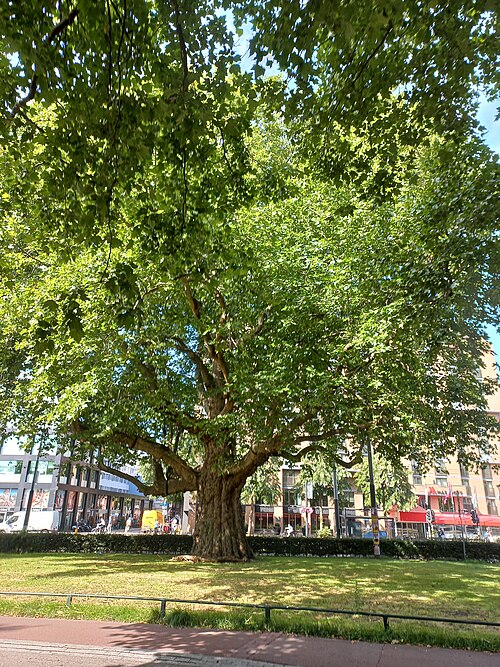
London Plane (Platanus x acerifolia) · 165 years · Leidseplein, Amsterdam-Centrum/West
When the city needed to widen a bridge in 1925, Amsterdam moved two fully grown plane trees rather than fell them. Residents near Leidseplein had objected loudly enough that engineers floated the two trunks on rafts and winched them several meters sideways, roots and all, to clear space for a new roundabout. A century later both trees have more than doubled their girth: each now measures over seven meters around, the thickest trunks in the city. A small wooden woodcutter figure, carved by an anonymous sculptor in 1989, sits astride one tree appearing to saw off the very branch supporting it. When that branch actually needed removing around 2020, city gardeners moved the sculpture to the other tree rather than let the joke become true. Amsterdam has since proposed the pair for national monument status, an unusual honor for something that is, after all, still just two street trees that once got in the way of traffic planning. They stand a two minute walk from Leidseplein's trams and taxis, indifferent to both.
Canadian Poplar (Populus x canadensis 'Serotina') · 145 years · Oud-Zuid, Amsterdam-Zuid
One of the tallest trees in Amsterdam stands on the edge of a bicycle path, not in a forest. Sources disagree on exactly when this Canadian poplar went into the ground, sometime between the park's founding around 1870 and a specifically documented 1885, but either way it has reached roughly 38.5 meters, taller than most buildings in the surrounding Oud-Zuid neighborhood. Its trunk measures 617 centimeters around, the third thickest in the city behind only the two plane trees in Leidsebosje. Poplars grow fast and die relatively young for a tree, rarely making it past 150 years, so this one is closer to the end of its run than the beginning, and unlike an oak it will not get centuries more to look forward to. Vondelpark's own written guide to its old trees singles this poplar out specifically, distinguishing it from an ash of similar age elsewhere in the park that never got nearly as large. Whether anything in the city stands taller is an open question: the elm at the Oudemanhuispoort is the usual rival and we have found no measurement of it we trust, so if you know one, tell us. Cyclists and joggers pass beneath this crown on Van Eeghenlaan every day without registering that one of the tallest trees in a city of canals and gabled houses is a poplar nobody planted to be a landmark.
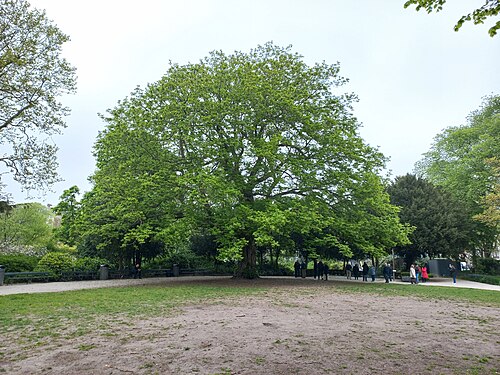
Caucasian Wingnut (Pterocarya fraxinifolia) · 125 years · Plantage, Amsterdam-Centrum
This tree has outlasted the park's own name twice. Wertheimpark was laid out in 1812 and named for the Jewish philanthropist Abraham Carel Wertheim in 1898, a year after his death. In August 1942 Amsterdam's Nazi-appointed mayor renamed it Parktuin to erase the connection, and the wartime name lasted until liberation restored the original in May 1945. The wingnut, a Caucasian species with broad horizontal branches that thicken into plank-like ribs to support their own weight, was already forty years old by the time any of that happened. It now spreads a canopy 24 meters across in a park barely three-quarters of a hectare in size, one of roughly fifteen trees here over a century old. Since 1993 the park has also held Gebroken Spiegels, Amsterdam's memorial to Dutch victims of the Holocaust, and the annual remembrance ceremony takes place within sight of the tree's crown. The municipality classified the wingnut as a monumental tree in 2002, a smaller but no less deliberate act of naming than the ones the park itself went through.
Photo: Ceescamel (CC BY-SA 4.0)
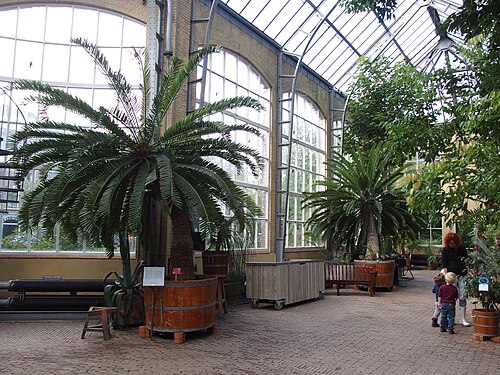
Eastern Cape Giant Cycad (Encephalartos altensteinii) · 300 years · Plantage, Amsterdam-Centrum
This plant was already growing in South Africa when Amsterdam's Hortus Botanicus bought it in 1850, and the two have been growing together ever since. It is an Eastern Cape giant cycad, estimated today at around 300 years old, kept potted under glass in the garden's Palm House for the 175 years it has lived here. Cycads as a group have barely changed in 300 million years and survived two mass extinctions that wiped out most of the plant kingdom around them, which makes one specimen's three centuries look almost brief by comparison. A younger female cycad, roughly 200 years old, grows opposite it, and Hortus staff hand-pollinate the two every year because the specific wasps and beetles that pollinate cycads in the wild do not live in an Amsterdam greenhouse. A few meters further into the same glasshouse stands a specimen of Encephalartos woodii, a cycad extinct in the wild since the early 1900s; every plant of that species alive anywhere today is a clone of a single specimen found in South Africa in 1895. The Hortus has been growing rare and difficult plants since 1638, and this cycad has now been part of that project for nearly half the garden's history.
Photo: Guilhem Vellut (CC BY 2.0)
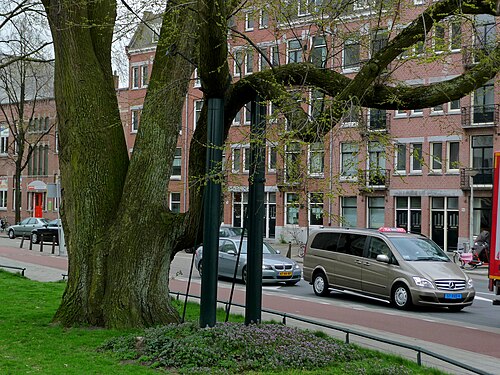
Dutch Elm, 'Belgica' cultivar (Ulmus x hollandica 'Belgica') · 115 years · Zeeburg, Amsterdam-Oost
One branch of this elm grows so low and so heavy that the city built it a prop, and that branch is where the tree gets its name: early residents thought it looked like an elephant's trunk reaching for the ground. Amsterdam planted this twin-stemmed elm on Zeeburgerdijk sometime between 1900 and 1915, according to conflicting municipal and conservation records. The city has tens of thousands of elms, more per capita than almost anywhere else in Europe, a legacy of planting elms along canals for their tolerance of the polluted, waterlogged soil common near open sewers a century ago. Dutch elm disease, first identified and named in the Netherlands in the 1920s, wiped out huge numbers of European elms over the following decades, and Amsterdam's collection survived largely because of an aggressive, decades-long eradication and breeding program that continues today. The Olifantsiep, girth pushing five metres, has outlived that epidemic and the severe storm of January 2018, and still leafs out every spring behind a low fence anyone can lean on.
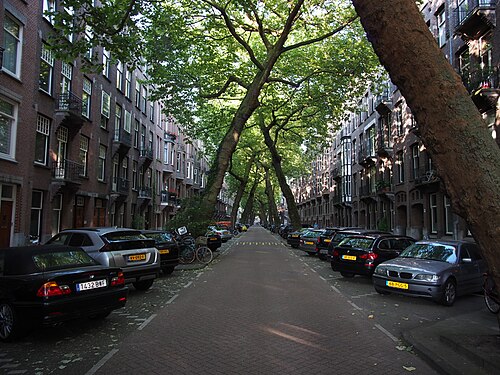
London Plane (Platanus x acerifolia) · 110 years · Willemspark, Amsterdam-Zuid
Nobody designed the tunnel of trees on Lomanstraat. When the street was planted in the early 1900s as part of Plan Zuid, architect Hendrik Petrus Berlage's expansion of the city southward, the trees on both sidewalks simply did what trees flanked by tall apartment blocks do: leaned toward the middle of the street, chasing the light above the buildings. A century of that lean has interlocked their crowns into a continuous green tunnel overhead, and the street is now one of the most photographed in Amsterdam-Zuid, nicknamed the cathedral of trees by people who have walked under it. A persistent local story claims the trees survived wartime firewood shortages because a German office once stood on the street, which is the kind of detail that sounds too tidy to verify and probably is. What is verifiable is simpler: given decades and a narrow gap of open sky, ordinary street trees will find a way to close it, and nobody in Amsterdam-Zuid had to plant a cathedral on purpose. It just grew there.
Olive Willow, likely Russian Olive (Elaeagnus angustifolia) · 78 years · Rivierenbuurt / Amsterdam-Zuid
Despite the name, this tree is not a willow and has nothing to do with olives. The olijfwilg on Amstelkade is an Elaeagnus, a shrub-turned-tree genus with silvery, willow-shaped leaves and small fragrant flowers that ripen into fruit resembling tiny olives, hence a common name that misleads on both counts. Planted in 1948, three years after the Netherlands emerged from wartime occupation, it has grown along the Amstelkanaal into what the city's own tree inventory calls a specimen unique in the Netherlands for its combination of size and age. Nobody has documented a comparable one anywhere else in the country. At under 80 years old it is the youngest tree on this list by decades, included not for age but because Elaeagnus rarely gets the decades of undisturbed growth it takes to reach tree scale, most specimens staying shrub-sized in gardens rather than lining a public street. Amsterdam's official register of notable trees lists it among the city's most distinctive, a quiet distinction for a tree most passersby would assume was an ordinary willow if they noticed it at all.
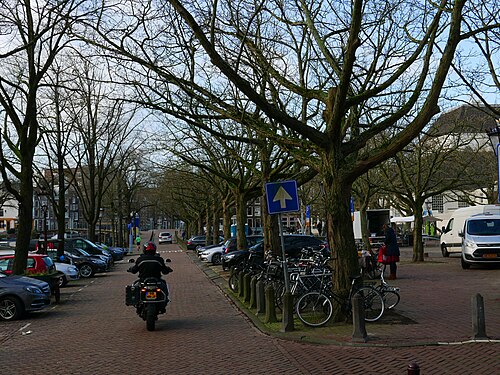
Caucasian Wingnut (Pterocarya fraxinifolia) · 96 years · Amsterdam-Centrum, Grachtengordel
In 2006 the city government tried to cut down 14 of these trees, and lost. The district council issued a felling permit that summer for over a dozen of the square's 46 Caucasian wingnuts, part of a resurfacing plan under an outdated tree ordinance. Two residents filed objections, then a court challenge, then finally an appeal to the Raad van State, the country's highest administrative court, after a district court sided with the city. No tree was felled while the case ran, and by 2010 the dispute ended with the square fully replanted around the surviving wingnuts rather than in place of them. To protect the three oldest, most valuable specimens from a resurfacing project's foot and cart traffic, engineers installed an underground support system to stop the soil from compacting around their roots, an unusually expensive concession for a handful of street trees. The wingnuts' surface roots still push up paving stones around the square often enough that it is a known feature of walking across Amstelveld, not a defect. The market that runs here on Mondays sets up its stalls under the same canopy the city once planned to remove.
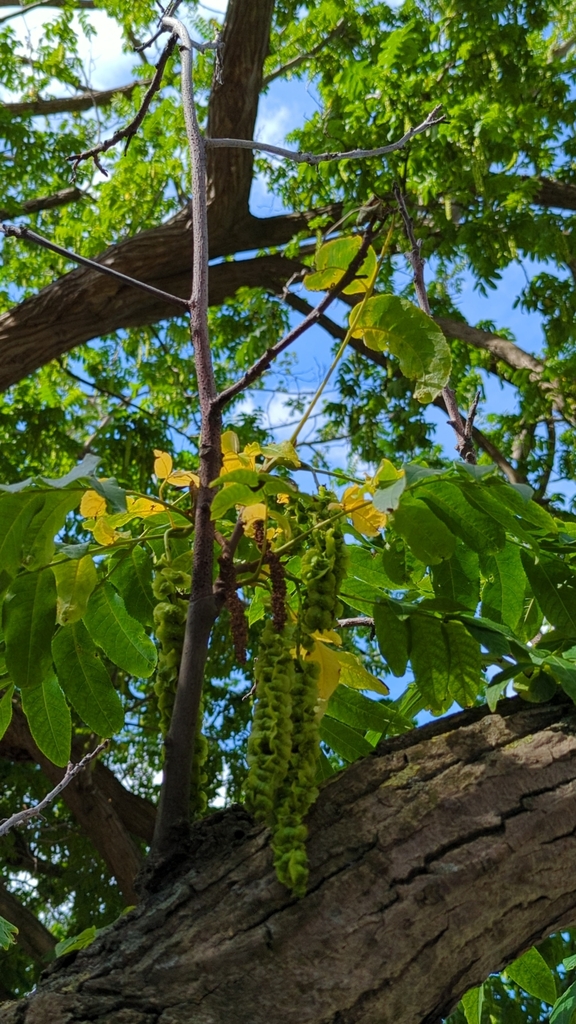
Caucasian Wingnut (Pterocarya fraxinifolia) · 119 years · Museumkwartier, Amsterdam-Zuid
The Rijksmuseum's own architect planted this tree in his own garden design, and it outlived every renovation the museum went through afterward. Pierre Cuypers, who designed the Rijksmuseum building itself, laid out its surrounding gardens between 1884 and 1916 in distinct historical styles, neo-Renaissance parterres beside a wild landscape garden, and planted a Caucasian wingnut near the director's villa in the southeast corner around 1907. By a 2014 survey the tree stood over 19 meters tall with a trunk more than four meters around. When the museum closed for a decade-long renovation completed in 2013, the landscape firm Copijn redesigned the gardens from scratch and could have cleared the site for something new. Instead the wingnut was kept and built around, one of the few mature trees preserved through the entire project. Wingnuts are still uncommon as full-grown specimens in the Netherlands, which puts this tree in the same small company as the ones in Wertheimpark and Amstelveld across town, three separate stands of the same species that all happened to reach old age inside Amsterdam's public gardens rather than getting cleared for something newer.
Photo: Noland Martin, iNaturalist (CC BY)
Turkish Hazel (Corylus colurna) · 230 years · Plantage, Amsterdam-Centrum
Bomenstichting, the Dutch tree foundation, calls this the oldest and thickest Turkish hazel in the Netherlands: planted in 1795, and three metres around today. That makes it two centuries younger than the Hortus itself, which has grown rare and difficult plants since 1638, but older than almost everything else standing in the garden. Turkish hazel is native to Asia Minor and the Balkans, a relative of the small hazel that produces the nuts, built at oak scale instead: pyramidal, broad-crowned, capable of forty metres. This one flowers in January, when its male catkins hang and shed pollen while the rest of the garden sits bare, a small performance almost nobody times a visit around. The 1795 planting date and the 300 centimetre girth both trace back to the tree's own record-keepers rather than an outside survey, so treat the figure as the Hortus's own claim rather than a courtroom fact. It grows a few minutes from the garden's giant cycad, itself pushing three centuries old, so two of Amsterdam's oldest living things now share the same corner of the Plantage. Entry costs a Hortus ticket, same as it always has: rare plants have never been free to see here.
Turner's Oak (Quercus x turneri) · 131-161 years · Plantage, Amsterdam-Centrum
This oak does not drop its leaves in autumn. It holds them, dark and leathery, through the whole Dutch winter, and only lets go in spring when new growth physically pushes the old leaves off the twig. Turner's oak is a hybrid raised in an English nursery in the late eighteenth century, a cross between the evergreen holm oak of the Mediterranean and the pedunculate oak of northern Europe, and it took half its habit from each parent. It grows slowly and stops at around ten metres, which for an oak is nothing at all. The acorns hang on long stalks. The graft union is still visible about thirty centimetres above the ground, the seam where a nurseryman joined this tree to somebody else's roots. When that happened is contested. Amsterdam's register of protected trees says 1865; the Bomenstichting guide to the city's monumental trees says 1895. Thirty years apart, the same tree, and neither shows its working, so read the age as somewhere between 130 and 160 years. Either way it stood here for a century before the University of Amsterdam let go of the garden in 1987 and a private foundation took it on, which is why the register lists this tree's owner as a private party rather than the city. January is the month to come, when the rest of the garden is bare and this one is not. Entry needs a Hortus ticket.
London Plane (Platanus x acerifolia) · 125 years · Plantage, Amsterdam-Centrum
Five metres of trunk in a hundred and twenty-five years is quick work. Amsterdam's register of special trees puts this plane's planting at 1900 and its girth at 500 centimetres; the Dutch Tree Foundation, surveying the same park for its own walking guide to the city's monumental trees, describes a plane here with a trunk of almost five metres. Two institutions, one measurement, no argument.
London planes grow fast when young, and this one had good ground for it. Wertheimpark was laid out in 1812 as Amsterdam's first public park, on the edge of the Plantage, a quarter the city had set aside for gardens rather than housing over a century earlier. The park has stayed small, barely three quarters of a hectare, which packs around fifteen trees over a century old into a two minute walk.
This is the west side specimen, on the Plantage Parklaan flank, a short distance from Jan Wolkers' Auschwitz memorial of 1977: broken mirrors set into the ground so the sky comes back cracked. The plane was already forty years old when the deportations that monument answers to began.
The city files it as beschermwaardige houtopstand, its settled protected class rather than the provisional tier. That guarantees nothing about a tree's health, but it does mean somebody with a clipboard comes back.
Oriental Plane (Platanus orientalis) · 125 years · Plantage, Amsterdam-Centrum
In a bad summer this plane stays green while its cousins go brown. Plane anthracnose, the leaf blight that leaves common planes blotchy and half bare by August, troubles the Oriental plane much less, which is one way to pick this tree out of the group standing along Wertheimpark's water.
Its age is a real disagreement rather than a rounding error. Amsterdam's register of special trees gives a planting year of 1900. The Dutch Tree Foundation's guide to the city's monumental trees dates what reads as the same tree to 1880 or 1890. Nobody has reconciled the two, so the honest answer is somewhere between 126 and 146 years old, and this page is not going to pick a winner for the sake of a tidy number.
The trunk measures 4.42 metres around. Platanus orientalis is the older half of the London plane's parentage, a species from the eastern Mediterranean and western Asia that European gardens have been planting since the sixteenth century, and its leaves are cut deeper, into narrower fingers, than the hybrid lining most Amsterdam streets. In a park this small you can stand under both within two minutes and see it.
It sits in a tight group of five or six registered trees along the water, including two Caucasian wingnuts of roughly its own age, which makes this corner of the park the densest thing of its kind in central Amsterdam.
Norway Maple 'Leopoldii' (Acer platanoides 'Leopoldii') · 106 years · Plantage, Amsterdam-Centrum
The point of this tree happens in April. Acer platanoides 'Leopoldii' opens its new leaves pink and white, streaked and splashed as though someone had flicked paint at them, before they settle into a mottled green for the summer. The cultivar came out of Louis van Houtte's nursery in Ghent in the middle of the nineteenth century, one of a wave of variegated garden forms the Belgian trade sold across Europe, and it is why a fairly ordinary sized maple ended up on Amsterdam's register of special trees.
Ordinary is the right word for the rest of it. The register gives a planting year of 1920 and a girth of 262 centimetres, which for a Norway maple of that age is unremarkable, and the register is also the only document anywhere that names this individual tree. Everything else known about it is known about the cultivar in general.
What it has is position. It stands along the water in Wertheimpark with an Oriental plane eighteen metres away and two Caucasian wingnuts beside them, in a park of three quarters of a hectare holding around fifteen trees over a century old, with Artis on one side and the Hortus a few minutes down the road. Come in late April and it is the one in the group visibly doing something.
Dutch Elm (Ulmus x hollandica) · 135 years · Amsterdam-Centrum
The tallest tree in Amsterdam stands in a courtyard barely wider than it is tall. The Hollandse iep in the Oudemanhuispoort reaches 35 metres, higher than anything else in the city, and the enclosure is the reason. Brick buildings surround the garden on four sides, so a tree here has exactly one direction available to it, and this one took it. The register puts the planting at 1890.
The Oudemanhuispoort was built in the eighteenth century as an almshouse for the city's elderly poor. It belongs to the University of Amsterdam now, and the vaulted passage along one side has carried a second-hand book market for well over a century. Thousands of students walk past the trunk every day on the way to a lecture, which is a lot of foot traffic for a tree almost nobody has heard of.
The species is the other half of it. Dutch elm disease reached the Netherlands in the 1920s and killed elms here by the hundred thousand, and Amsterdam, an elm city by tradition, lost a great deal of its stock. This one was already about thirty years old when the disease arrived, and it is still going.
Go on a weekday, in from the Kloveniersburgwal end, and look into the southwest corner. It is not a tree that announces itself from the street, because from the street you cannot see it at all.
Lime (Tilia sp.) · 128 years · Amsterdam-Centrum
Wilhelmina had been queen for eight years before anyone crowned her. She inherited the throne in 1890 at the age of ten, her mother governed as regent until she came of age, and the inauguration finally happened in September 1898. Amsterdam marked it by planting a lime, and the lime is still standing on the Kalverstraat.
The address is the odd part. The Kalverstraat is the busiest shopping street in the Netherlands, a canyon of chain stores that hundreds of thousands of people walk down in a week, and the coronation tree sits just off it by the Amsterdam Museum, in the complex that was the city's civic orphanage for four centuries.
Commemorative trees are usually the most forgettable objects in a city. They go in at a ceremony, the plaque weathers, and within a generation nobody remembers the occasion. This one outlived its occasion in the most literal way available: Wilhelmina reigned for fifty-eight years, through two world wars and five years of broadcasting to the occupied Netherlands from London, and abdicated in 1948. The tree was fifty. Early in 2025 it was added to Amsterdam's list of two hundred champion trees.
What it is not is old. At around 128 it is younger than half the trees on this page, and limes routinely pass three hundred. We have not established which lime it is; several species and hybrids are planted here under the same name. If you know, tell us.
Copper Beech (Fagus sylvatica f. purpurea) · 130 years · Grachtengordel, Amsterdam-Centrum
The best evidence for this tree's age is a photograph. In Museum Van Loon's own collection sits a picture from 1923 showing the beech as a young tree, which is what puts its planting in the 1890s and makes it around 130 years old now.
It stands in one of the last intact canal-house gardens in Amsterdam. The house at Keizersgracht 672 went up in 1672, its first resident was Ferdinand Bol, who trained in Rembrandt's workshop, and the Van Loon family bought it in 1884. Behind the formal parterres stands a coach house dressed up with a classical front, and the garden between the two survived the century in which most Amsterdam back gardens were built over, subdivided or paved for cars.
A copper beech is not a wild plant in any meaningful sense. It is a colour mutation of the common beech that appears now and then in European woods and was propagated by nurseries because people liked the look of it, so every purple beech in a nineteenth-century garden is there because somebody chose it and paid for it. This one was a wealthy family's ornamental decision, taken when their house was already two hundred years old, and it is still standing exactly where they put it.
The garden opens with a museum ticket. It is small, walled and quiet, in the middle of a canal ring that is neither.
Lombardy Poplar (Populus nigra 'Italica') · 110 years · Museumkwartier, Amsterdam-Zuid
This poplar was planted as architecture. The Rijksmuseum opened in 1885 and the ground around it was laid out as an outdoor annexe of the collection, filled with fragments rescued from demolished Dutch buildings: gateways, doorframes, a pavilion. Early in the twentieth century a line of Italian poplars went in to frame one of those historic gates, and this is one of them.
The choice makes sense the moment you look at the tree. Populus nigra 'Italica' barely spreads. It grows as a narrow column, which is why it was planted in rows across Europe for two centuries to line roads, mark boundaries and give flat country a vertical. In a garden of salvaged stone doorways it does the work of a pilaster.
The register puts the planting between 1910 and 1920, so it is around 110 years old, and for this cultivar that is a considerable age. Lombardy poplars are fast, soft-wooded and short-lived by the standards of the trees on this page, and most of those planted in the same decade elsewhere in Europe are long gone. This one stood through the wartime evacuation of the museum's collection to shelters outside the city, and through the ten-year rebuild that gutted the building and reopened it in 2013, while the garden around it was redesigned more than once.
Free, with the garden. The Jan Luijkenstraat side is the quiet way in.
Canadian Poplar (Populus x canadensis) · 120 years · Weteringschans, Amsterdam-Centrum
Every year Amsterdam inspects this poplar and decides whether it can stay another one. It leans, visibly and considerably, out over the Weteringschans, and a trunk more than five metres round leaning towards a busy road is a question a city has to keep answering. So far the answer has been yes.
The reason it can be is under the pavement. A tree growing off vertical loads one side of its root plate far harder than the other and responds by laying down extra wood exactly where the pull is, thickening those roots into anchors. Leaning is not the same as unstable, and this one has had a century to engineer itself. The city prunes the heavy limbs on the road side to keep the load down, and inspects it annually.
It is a Canadapopulier, a cross between two other poplars that appeared in France around 1750 and was then planted across the continent for its speed. Speed is the point of the species and also the catch: poplars grow fast, get large and are not built for the long term, which makes a specimen of this girth at 116 to 126 years old worth stopping for.
The street it leans over was laid on Amsterdam's city ramparts after they were levelled between 1820 and 1840, and kept the name Schans until 1850. Free, always there, and impossible to confuse with the trees around it.
London Plane (Platanus x acerifolia) · 140 years · Weteringschans, Amsterdam-Centrum
This is the oldest tree in this group and the register has nothing to say about it. Planting: somewhere between 1880 and 1890. Reason for protection: monumental. History: unknown. That is the entire file on a London plane that has stood on the Eerste Weteringplantsoen for around 140 years.
The date is worth holding on to, because of what the ground nearby had just stopped being. The Weteringschans beside it was laid out over Amsterdam's city ramparts after they were levelled between 1820 and 1840. A plane planted here in the 1880s went in while that change was still recent and this whole edge of town was new.
London plane is the standard European city tree, and the reasons go beyond fashion. It sheds its bark in plates and takes the grime with it, which is how it stayed alive and legible through a century of coal smoke that turned other species black. It puts up with compacted roots, hard pruning and drought, and it is why the same tree lines streets from Barcelona to Berlin. Amsterdam has hundreds of them. This one has been at it longer than nearly all of them.
Free, at the quieter end of the plantsoen. The leaning poplar, the wych elm and the ginkgo are each within two minutes on foot, which makes this corner an unusually dense patch of old trees for the middle of a city.
Japanese Pagoda Tree (Styphnolobium japonicum) · 116-136 years · Weteringschans, Amsterdam-Centrum
In August this tree covers itself in white flowers, weeks after every lime and chestnut in the city has finished. The Japanese pagoda tree is a legume from Korea and China, with fine pinnate leaves and a crown that goes wide rather than tall, and late summer flowering is the reason people plant it.
It has the room to spread because a canal was filled in. The Falckstraat was named in 1870 after a prominent Amsterdammer and is unusually broad for the centre, because it was laid over a stretch of the Achtergracht filled in around 1869. A filled canal leaves a generous street, a generous street leaves root space, and root space is how a crown this wide ended up thriving on a corner of the Reguliersgracht.
Its age is genuinely unsettled. The register gives the planting band in two places and gives it differently, once as the 1890s and once as the 1900s, so the honest answer is somewhere between 116 and 136 years. The trunk carries a large wound on its south side, partly grown over, and the city prunes the heavy overhanging limbs on a schedule to keep the crown in balance. A second, smaller pagoda tree stands beside it.
Free, on the street corner, and worth timing. For most of the year it is a good tree with unusual foliage. In August it is the reason to be standing there.
Dutch Elm (Ulmus x hollandica) · 120 years · Amsterdam-Centrum
Around thirty elms were planted in front of Amsterdam Centraal after the station opened in 1889. One of them is still standing.
The rest went to Dutch elm disease, which reached the Netherlands in the 1920s and then killed elms across the country by the hundred thousand. The fungus travels in bark beetles and blocks the tree's own water vessels, so a mature elm can go from healthy to dead inside one summer. Amsterdam's elm stock, one of the largest in Europe, was hit hard. This tree stood through all of it, on one of the busiest pieces of ground in the Netherlands, and surveyors still rate its condition as reasonable.
It is not resting on its history either. When it was last measured in 2022 its trunk was over three metres round, and it is recorded as adding a little more than a centimetre of girth every year, which is a tree still doing business rather than hanging on.
By that same 2022 survey the city had planted young elms on the square around it. If those take, the old view in front of the station slowly comes back and this one stops being the last of anything, which is what everybody involved would prefer.
Free, in the open, straight out of the station's main doors. Trams, bikes and the whole flow of the station pass within metres of it, and almost nobody looks up.
Tulip Tree (Liriodendron tulipifera) · 90 years · Amstelveen
Jakoba Mulder helped design the Amsterdamse Bos, and then somebody planted a tree inside it in her honour. She lived another fifty years to watch it grow.
Mulder was born in Breda in 1900 and worked as an architect and town planner. The forest, originally called the Boschplan, was laid out slowly between 1934 and 1970 on polder ground southwest of the city, and the stretch this tree stands in lies in Amstelveen. The national register puts the planting at around 1938 and records that the tulip tree was reportedly her favourite of the lot. She died in Amsterdam in 1988, by which time the forest was nearly finished and the tree was half a century old.
It has grown into the specimen you would want as a memorial: whole, evenly proportioned, no lost limbs, nothing much wrong with it. Tulip trees come from the eastern American forests, and the leaf gives them away, shaped as though somebody snipped the tip off square. The flowers open high in the crown in June, greenish-orange and genuinely tulip-shaped, and most people pass underneath without once looking up. By late October the whole crown goes clear butter-yellow.
You can see it from the cycle path, south of the Bosbaanweg at the edge of the playing field. Only the register describes it in any detail, so if you know more, tell us.
Horse Chestnut (Aesculus hippocastanum) · 130 years · Amstelveen
The trunk you are looking at carries on about two metres below your feet. When the Amsterdamse Bos was built the ground level here was raised, and the soil around this chestnut was banked up carefully, with rubble, rather than replaced.
She is called De Oude Dame van het Bos, the old lady of the forest, and she has the better claim to the ground than the forest does. The register records her planting in 1895; work on the Bos only began in 1928. In her first decades she stood in the Rietwijkeroordpolder, beside a farmhouse, in a landscape that no longer exists in any form. The polder went under the trees, the farm was pulled down, and the horse chestnut was left standing where it was, with its feet buried.
The years show on her. The register notes a possible bleeding canker on the heavy northwest limb and at the trunk itself, and a large torsion crack running through a damaged branch on the north side. It also notes that she comes into full leaf and is otherwise in good heart. In May the candles go up, white with a red fleck at the throat, and by October there are conkers in the grass.
Find her at the western edge of the Grote Speelweide in Amstelveen, at the treeline near the canoe hire. Only the national register describes this one, so if you know more, tell us.
Lime (Tilia sp.) · 90 years · Amstelveen
This lime went into the ground on 31 January 1938, the day Princess Beatrix was born. The register still lists it as De Beatrix linde.
Dutch towns marked royal births with trees as a matter of course, and this was a birth worth marking: Beatrix was the first child of Juliana, who was herself the only child of Queen Wilhelmina, and the line had been running on a single life for two generations. The baby the tree was planted for became queen in 1980 and stayed on the throne until 2013. The tree has stood on this corner the whole time, including the German occupation that sent the family into exile in London barely two years after the planting.
It has not aged as easily as she has. The register's inspectors record dead wood in the top and along the main limbs, and a flush of young shoots breaking out inside the crown, which is what a stressed lime does when it starts rebuilding itself lower down. They want the ground around the roots examined to turn things around. A street tree in trouble is almost always suffering from what is under it rather than what is above.
You will find it where two through-roads meet at the Veenendaalplein in Amstelveen, in full view, which the register notes with some approval. Nobody has recorded which lime species it is.
Southern Catalpa (Catalpa bignonioides) · 70 years · Amstelveen
Every spring this tree gives its street a fright. The southern catalpa is one of the last trees in Europe to come into leaf, often not until the end of May, by which point everything around it has been green for six weeks and it is still a bare grey skeleton hung with last year's beans.
Those beans are the other thing. The flowers open in July, white and orchid-shaped, freckled with purple and striped yellow down the throat, in upright clusters that a grown tree carries by the hundred. What follows is a crop of thin brown pods up to forty centimetres long that hang on through the winter and give the species its other name, the Indian bean tree. Nothing else on a Dutch street looks remotely like it.
Catalpa bignonioides is a narrow native, from a corner of the American southeast around Georgia and Florida, and it took to European cities largely because it puts up with being boxed in by pavement.
This one grows opposite the houses on the Cleopatralaan in Amstelveen. Nobody wrote down when it was planted. The register reasons that the neighbourhood went up in the 1960s and the tree probably dates from the same work, which places it somewhere in the 1950s or 1960s, and that reasoning is the whole of the evidence. If you know better, tell us.