Salzburg's baroque gardens get the postcards, but most of its oldest protected trees stand on ordinary ground: a farm oak once used to fatten pigs, a riverside poplar from a vanished floodplain forest, a plane and a black pine that outlasted a bombed grand hotel, and four limes planted around 1810 to guard a wayside shrine. These twenty-one run from Itzling to Morzg and Aigen, with Faistenau's hollow dance linden, a lightning-scarred lime at Eugendorf, the young successor to the legendary pear of the Walserfeld and two more beyond the city, plus one import, a Californian sequoia in the Mirabellgarten.
0 of 21 visited in Salzburg
Black Poplar (Populus nigra) · Itzling
A whole floodplain wood once ran along this bank of the Salzach. This black poplar is one of the last pieces of it still standing.
The Land Salzburg register says exactly that in its own entry: a remnant of the Weichholzaue, the softwood riparian forest that used to line this stretch of the river. Softwood there is not a verdict on the timber. It is the word for the willows and poplars that colonise a river's wet edge, the trees that arrive first on new ground and go first when a bank is tidied. That woodland has gone from here. A paved promenade runs in its place, and the poplar stands beside it near the Traklsteg footbridge, about two kilometres downstream from the old town, with the water on one side and Itzling on the other.
The register cites a trunk circumference of over six metres, which is a figure we are passing on rather than one we measured, and Salzburg listed the tree as a natural monument, NDM00173, in 1979. It has ended up with its own category in the Wikimedia photograph archive, seven pictures of one riverside poplar, which is more attention than most trees on that promenade will ever get.
Nobody has dated it. The register carries the year of protection and nothing else, and 1979 is a floor rather than an age. If you know when this poplar went in, or you have put a tape around it yourself, tell us.
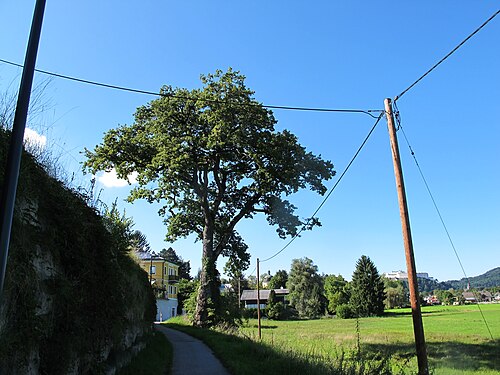
Pedunculate Oak (Quercus robur) · Morzg
No tree in Salzburg has been protected for longer than this one. The oak at the Erentrudishof went onto the Land Salzburg register in 1933 as NDM00019, the earliest designation on the city's whole list, with 95 square metres of ground protected around it.
The register describes a single-stemmed oak once used for Eichelmast: pigs turned out beneath it in autumn to fatten on the acorns it dropped. That is a working relationship rather than an ornamental one, and the setting has stayed working. The Erentrudishof is a farm run by the Stift Nonnberg convent, on the southern edge of the city at Morzg, with an organic shop, weekday opening hours and a self-service raw milk machine that runs around the clock. The oak stands on the yard of a place people still visit to buy milk.
Finding the address takes a moment. The register transcription puts the farm on Gneiserstraße, the photograph archive puts it on Morzger Straße, and both mean the same farmstead. Aim for the Erentrudishof by name and ignore the street. Worth checking before you go: the shop was closed for renovation with a reopening announced for July 2026.
Nobody has dated the tree. The 1933 listing says it was already worth protecting then and nothing more, which makes it a floor rather than an age. If you know when it was planted, or you have measured the trunk, tell us.
Photo: Georg Pflugbeil (CC BY-SA 3.0 at)
Pedunculate Oak (Quercus robur) · 200 years · Morzg
On 15 September 1817 a man stopped and rested under this oak, and Salzburg has been naming the tree after him ever since.
He was Stephan Ludwig Roth, born 1796, died 1849, a teacher and later a leader of the Transylvanian Saxons. The register records the date of that rest, which is the useful part of the story: the oak was already a landmark worth stopping at two centuries ago, or nobody would have written down which tree it was. A Salzburg blog that catalogues the city's notable trees puts the age at over two hundred years, and that is as precise as anyone has been prepared to be, so it is as precise as we will be.
It became a natural monument in 1969, with 490 square metres of protected ground around it, which is a generous piece of Morzg set aside for a single tree. It stands at a woodland edge on the southern edge of the city, a short walk from the tram, on public ground and free to reach.
Go sooner rather than later. The same blog reports a fungal infection in the tree and cites an expectation that it has roughly twenty years left. It is alive and standing now. That is what the sources say today, and a tree in that condition is worth a second look from anyone who passes it: if you see the crown thinning or the trunk opening up, tell us.
Lime (Tilia sp.) · 150 years · Maxglan
The register calls this a 150-year-old lime. It has been saying so since 1963, which is the year the tree was protected and, in all likelihood, the last year anybody looked at it properly. Read the figure as an assessment made more than sixty years ago rather than a fact about the tree today.
That register, kept by Land Salzburg, is the only source we have on it: NDM00069, thirty-eight square metres of protected ground on a residential lane in Maxglan, out on the western side of the city. For a tree the state went to the trouble of protecting, it has left remarkably little trace. The local history record covers the lane itself in detail, down to the terrace slope above the Glanbach that gave the street its name and the 570 metres it runs between Kleßheimer Allee and Norbert-Brüll-Straße. It never once mentions the lime standing on it.
Two open questions, and a reader on that street could settle both. The register writes the species down only as Linde, with nothing after it, so which lime this is has never actually been recorded. And nobody appears to have taped or dated the trunk since the sixties. If you live on the Körblleitengasse, or you have stood under it and looked at the leaves, tell us what you found.
Giant Sequoia (Sequoiadendron giganteum) · Neustadt / Mirabellgarten
The best measurement anyone has of this tree was taken by a geocacher with a tape measure in December 2019: just under six metres around the base. Not a survey, and the only number there is.
It is a giant sequoia, Sequoiadendron giganteum, a Californian tree standing in an Austrian baroque garden. It is not alone in that. A coast redwood grows beside it, so the pair on the right of the path, just before the turn into the Bastionsgarten, are both imports from the far side of a continent and an ocean. Neither of them arrived by accident. Somebody chose them, planted them and then let them do the one thing a formal garden is not otherwise for, which is grow upward without being cut back.
Nobody wrote down when that happened. No planting date and no age has surfaced for either tree, which leaves the sequoia the least documented thing in a garden people cross all day long. If you have found a record of when they went in, send it and it goes on the page.
Getting there is the easy part. The Mirabellgarten is public and open daily, a few minutes from Mirabellplatz, and the turn to the Bastionsgarten is now a children's playground. Our pin comes from the geocache waypoint rather than a survey mark, which in a garden this size still puts you within a few metres of the right trees.
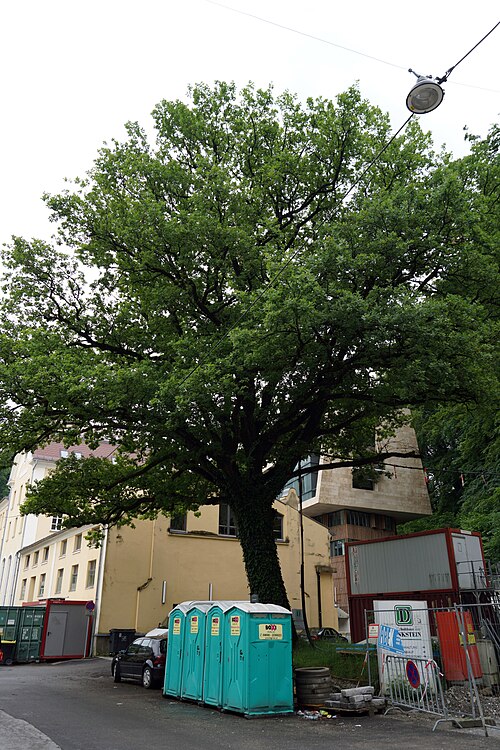
Pedunculate Oak (Quercus robur) · Riedenburg
On Steinbruchstraße in Riedenburg, an oak has been growing ivy for longer than the street's newest residents have been alive. The street takes its name from a stone quarry that once cut into the nearby Rainberg, the same hillside quarried for stone that went into Salzburg Cathedral, though no record ties this particular tree to that history: it is simply the ordinary oak that happens to stand where the quarry road once ran.
Salzburg listed it as a natural monument in 1984, NDM00196, protecting 352 square metres of ground around it. The register's whole description is short: the trunk splits into several strong branches about five metres up, and ivy has climbed most of the way up it. That is what a 1984 designation buys you, a floor rather than a biography, and nobody has recorded when the tree was planted.
It stands on an ordinary residential pavement, no gate and no ticket, in the western Riedenburg district a short walk from Salzburg's centre. The most recent photograph anyone has put online of it is from 2014, over a decade old now, so if you walk past and it still looks the way the pictures show, or looks different, that itself is worth telling us. Its age, like its exact place in Riedenburg's quarry history, is an open question rather than a guess we are prepared to make.
Photo: Microble (CC BY-SA 3.0 at)
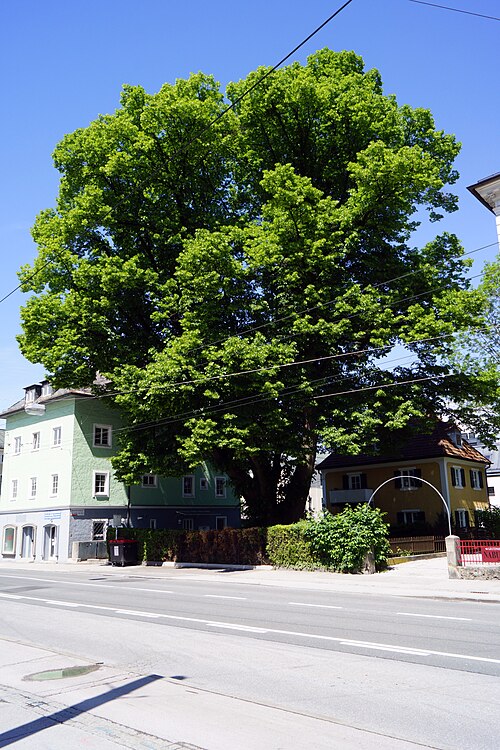
Lime (Tilia sp.) · Riedenburg
A lime with more than one trunk stands at a street corner in Riedenburg, visible enough that the register itself calls it out: it stands widely visible at the edge of its property, right where Neutorstraße meets Hübnergasse and Leopoldskronstraße.
That multi-stemmed shape is the whole of what the record says about it. Salzburg designated the tree a natural monument in 1987, NDM00215, protecting 240 square metres of ground, but the register carries no planting date and no species beyond "lime", so which of Europe's limes this actually is remains a question for whoever next stands under it and looks closely at the leaves.
The corner is ordinary, a residential junction in western Salzburg's Riedenburg district with pavement on every side and nothing between the street and the tree. The newest photograph anyone has published of it dates to 2014, which is old enough that a fresher one, or a firm answer on the species, would genuinely add something nobody currently has. If you know which lime this is, or have stood on that corner recently, tell us.
Photo: Microble (CC BY-SA 3.0 at)
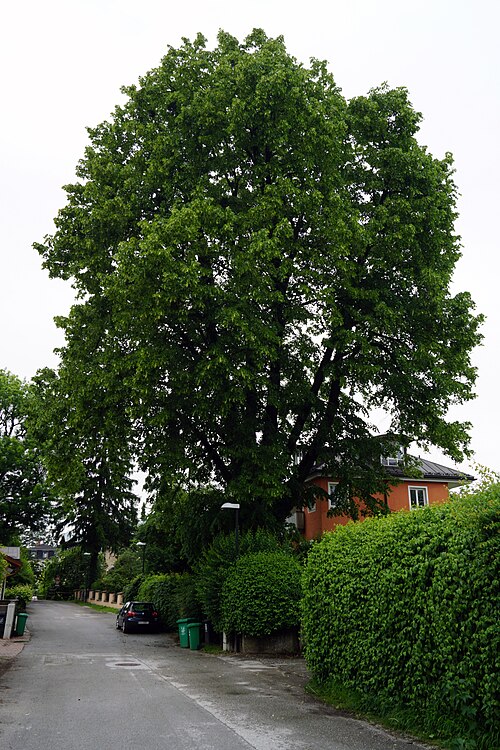
Lime (Tilia sp.) · Riedenburg
This lime once stood inside the grounds of a baroque manor. The Mölckhof, a country house built around 1757 for the court chancellor Felix Anton von Mölck, expanded its park at some point after that, and the tree the register still describes belonged to it.
That is as far as the connection goes, and it is worth being precise about the gap: the manor's 1757 build date is well documented, but nothing ties this specific lime to that year, only to a later, undated expansion of the grounds. Guessing an age from the house would be a neater story than the evidence supports, so the tree's age stays unknown rather than borrowed from its neighbour's history. Salzburg protected it in 1991 as NDM00232, 226 square metres, and its only other recorded feature is a trunk that splits into several branches about four metres up.
The Mölckhof still stands on Gärtnerstraße in Riedenburg, and the lime is nearby on the same street, reachable on foot with nothing barring the way. The most recent photographs online are from 2014, over a decade old, so a current one would be useful. Which lime this actually is has never been recorded past the genus: if you can name the species, or know anything about when it was planted, tell us.
Photo: Microble (CC BY-SA 3.0 at)
London Plane (Platanus x acerifolia) and Black Pine (Pinus nigra) · 88-161 years · Elisabeth-Vorstadt
A grand hotel once stood where an apartment courtyard is now, and two of its trees are the only things that survived the change. The Hotel de l'Europe operated from 1865 to 1938, was bombed and stood empty until cleared around 1949, and the housing blocks of the Fordhof estate went up on the same ground in 1953. Everything about the hotel disappeared except a plane tree and a black pine, both registered as natural monuments, both still growing in what is now a residential courtyard.
The plane went onto the register in 1964, the pine in 1973, each protecting 113 square metres, and both entries say the same thing in the same words: this is one of two surviving trees from the hotel's park. That claim is the whole basis for an age. If either tree was planted right at the end of the hotel's run, it is about 88 years old; if it dates from the 1865 opening, it is 161. Nobody has narrowed that further, and neither should we.
This is the least garden-like setting on Salzburg's list: an ordinary 1953 housing estate off Rainerstraße, a short walk from the main station, with public footpaths running through the courtyard between the blocks. Nothing gates it, but it takes a moment to believe two centuries-old natural monuments are sitting in someone's car park. If you know which end of that date range is closer to true, or have measured either trunk, tell us.
Hornbeam (Carpinus betulus) · 200 years · Nonntal
This hornbeam is all that is left of a villa garden, and for years it was the tree outside Salzburg University's biology department. The villa on Freisaalweg dates from the Gründerzeit, the building boom around the turn of the last century, and it later housed the university's Institute of Biology until 1986, when the biologists moved to the new natural sciences building nearby.
That same year, on 23 January 1986, the city declared the hornbeam a natural monument. The register entry calls it notably symmetrical and mighty, and the local Wikipedia article on Freisaal singles out its strikingly round, globe-shaped crown. It grows on several stems rather than one trunk.
Its age is an estimate and stays one: the Freisaal article puts it at more than 200 years, and nobody has published anything sharper. No source says whether it was planted for the villa's garden or was already standing when the villa went up.
Today its neighbour is the Akademiestraße car park, 220 spaces of asphalt, an unglamorous address for a protected tree. The most recent dated sighting we found is a photograph from May 2014, so if you walk past, a new photo or a word that it still stands would help. The same goes for its girth, which no source records: a tape measure answers that in a minute. It is a 15 to 20 minute walk south of the Altstadt.
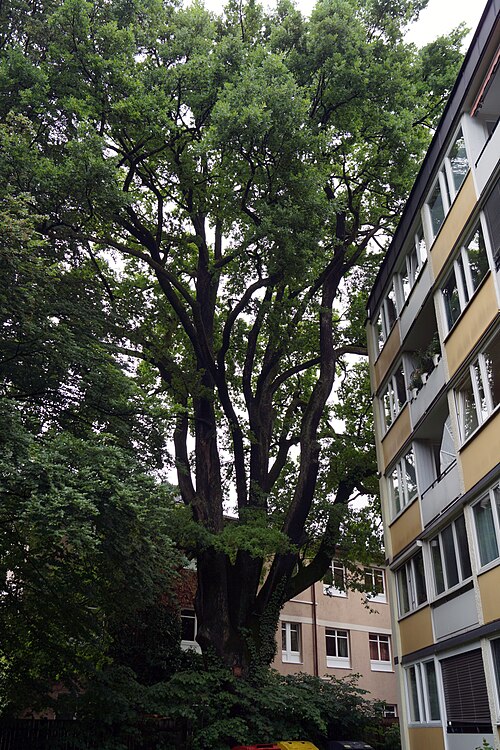
Pedunculate Oak (Quercus robur) · Aigen
Salzburg protected this oak in 2005, and it went on the list standing in the courtyard of a block of flats. The city's own register entry anticipates the obvious question and answers it: the tree stands in the inner courtyard of several apartment blocks at Aigner Straße 9, and it is nevertheless accessible without restriction. You may walk in and look.
It is one of the more recent additions to Salzburg's list of natural monuments, and the register's description is about its build. Somewhere between 2.5 and 4 metres up, the register says, the trunk breaks into several strong limbs, rather than carrying its crown on one straight stem.
How long it has stood here, no source records. The register gives no age for any of its trees and no girth for this one, and it names the tree simply as Eiche, oak, without a species. We list it as a pedunculate oak, like the other oaks we map in Salzburg, but that is our reading rather than the register's: a photograph of a leaf or an acorn would settle it, and a tape measure around the trunk would give us a basis for estimating its age.
The most recent dated photograph we found is from May 2014. If you pass through Aigen, tell us it still stands. It is a short walk from Salzburg Aigen station.
Photo: Microble (CC BY-SA 3.0 at)
Pedunculate Oak (Quercus robur) · Morzg
This oak is protected as a leftover of a landscape that no longer exists. Salzburg's register calls it a Kulturrelikt, a cultural relic: the last trace of the open, thinly wooded meadows that once spread near the Hellbrunner Allee, before this corner of Kleingmain and Morzg was built up.
It was declared a natural monument in 1986, and the register's reason is not its size or its shape but what it remembers: the ground here was once meadow with scattered trees, and this oak is what remains of it. The street it now stands on was only named in 1941, after the Buchholzhof.
No source gives its age, and nobody has published its girth, so we will not guess. The register's framing implies it was here long before 1986, but it puts no number on that. If you have measured it, tell us, and we can at least estimate.
The species stands on firmer ground: the register says only Eiche, oak, but a geotagged photograph on Wikimedia Commons from August 2014 is filed as Quercus robur. That photograph is also the most recent sighting we found, so a word that it still stands would help. As far as we can tell the northern stretch of Buchholzhofstraße is now a footpath and cycle path running toward the Hellbrunner Allee; it is about a 20 to 25 minute walk south of the Altstadt.
Pedunculate Oak (Quercus robur) · Maxglan
Where Salzburg's city streets give out and the Untersberg moor begins, one oak stands at the northern end of Sebastian-Kneipp-Straße, and it is there because of what used to surround it. The register of Land Salzburg describes it as a relic of the old moor litter meadows, the damp fields that were mown for bedding straw, at the edge of the Untersberger Moor and its oak woodland. The meadows are houses now. The oak is what remained of that landscape, and the province protected it as a natural monument in 1980.
It is a pedunculate oak, a species that keeps a rounded crown when it has room, and this one has: the entry in the photo record describes a spherical crown, about 24 metres tall, with a trunk some four metres round at chest height. Those figures come from the description attached to a 2014 photograph that quotes the monument text, so treat them as approximate. Nobody has written down an age, and we will not guess one.
What the oak offers is a clear view of a vanished kind of ground. Stand at the end of the street, look up into the crown, then look at the housing around it, and the order of events is easy to read. The tree was here first. If you have a tape measure or know its age, tell us.
Oak (Quercus sp.) · Itzling
Above the traffic of Itzlinger Hauptstraße, an oak stands on a high embankment, and for decades it has been one of the things that gives this stretch of Itzling its look. The province of Salzburg made it a natural monument in 1987, and the official description is short and to the point: the tree shapes the view on the steep bank west of the Goethe-Siedlung, the housing estate beside it.
That is the whole of what the register says, and it is honest to leave it there. We know it is an oak, but the record names no species more closely than the genus Quercus, and nobody has published an age, a girth or a height. What can be said is where it stands: on a slope above a busy street served by the trolleybus, beside a housing estate.
That contrast is the reason to look. Lifted above the road on its bank, the crown is read against the sky. Stand on the pavement below and look up. You can see it from the street; the embankment itself is not a place we can promise you can enter. If you know its species or its girth, a message to us fills a gap the register left open.
Oak (Quercus sp.) · Morzg
A boundary tree is a plain job: it marks where one man's land stops and the next begins. This oak at Flurweg 19 in Morzg once did that for the old Davidengut, a farm of the district, and when the fields around it were turned into building land it was left standing at the edge of them. In 1989 the province of Salzburg protected it as a natural monument. The register entry for the tree is the oldest kind of record in the city, a plot reduced to a few dozen square metres around a single trunk.
The list of Salzburg's natural monuments calls it widely visible, and that is how you should plan to meet it: from the public road, looking at the tree at the point where the building land begins. The plot at Flurweg 19 is most likely private, so this is a tree to see from the street and not to walk up to.
We do not know its species beyond oak, and nobody has recorded its age, girth or height. A tree that was a boundary marker for a farm is likely to be old, but likely is not a fact, and we will not print a number. What we have is a firm location, a documented purpose and a protection that has held for over thirty years. If you know more, tell us.
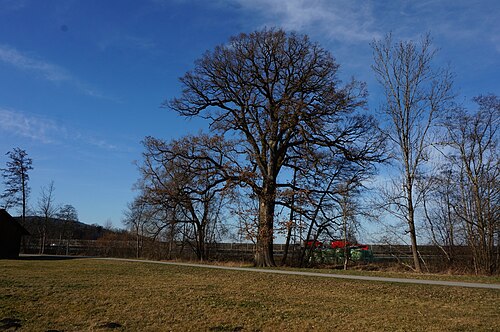
Pedunculate Oak (Quercus robur) · Gois, Wals-Siezenheim
The Tofferl Oak's crown is nearly as wide as the tree is tall. The province's register gives it a good 25 metres in height, a crown 20 to 25 metres across and a trunk five metres round, which is the shape a pedunculate oak takes when nothing has ever crowded it.
It stands in the Goiser Wiesen, open meadow at Gois in Wals-Siezenheim, about seven kilometres west of Salzburg's old town and not far from the A1 on its way to the Walserberg. That is a neighbouring municipality rather than the city, and no other tree on this page is within walking distance.
Land Salzburg protected it as a natural monument on 26 November 1985 and lists it in the Salzburger Naturschutzbuch, the province's record of protected nature, as a tree that shapes the landscape around it. SalzburgWiki gives the same measurements, probably taken from the same register, so read them as one source rather than two.
Nobody has published an age for it, and we will not invent one. If you know how old it is, or where the name Tofferl comes from, tell us.
Two geocaches are hidden at the tree, so people clearly find their way to it. What we have not established is whether the trunk stands on public ground or beside a public path, so plan to see it from the edge of the meadow. Go in winter if you can: with the leaves down, the whole frame of that crown shows.
Photo: Flanierer (CC BY-SA 4.0)
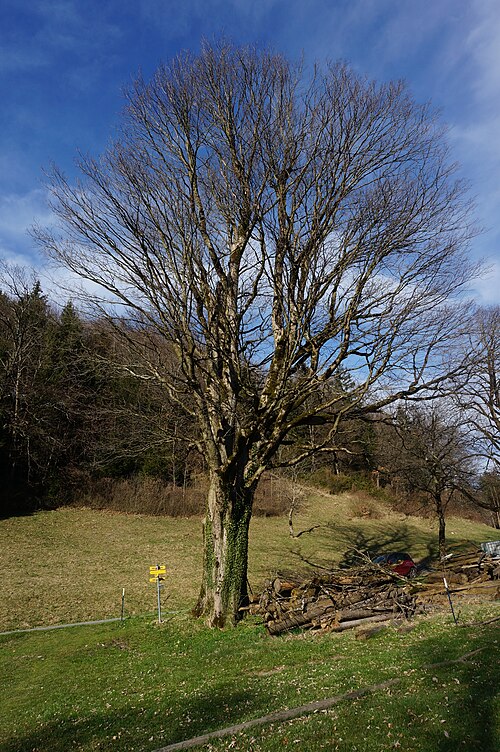
Sycamore (Acer pseudoplatanus) · Thurnberg, Puch bei Hallein
The protection on this sycamore does not stop at the bark. When Land Salzburg made it a natural monument on 7 December 1990, the order covered a circle reaching 20 metres out from the trunk in every direction, across three plots of farmland belonging to the Schartenbauer farm.
What sits at the centre of that circle is a big tree by any measure. The monument text records a height of 25 metres, a crown 18 to 20 metres wide and a trunk 4.20 metres round at chest height, dividing into its main limbs about three metres up. Those are the figures from the day it was surveyed. In German it is a Bergahorn, a mountain maple, and this one grows where the name says, on a slope below the woods.
It stands in a sloping meadow at Thurnberg, in Puch bei Hallein, about ten kilometres south-east of Salzburg's old town, with woodland behind it. That puts it well outside the city and a long way from any other tree on this page. Ivy climbs the lower trunk, and a yellow hiking signpost stands at its foot, because a waymarked trail runs right beside it.
That trail is how to meet it. The meadow is farmland, and we have not established whether you may walk into it, so look from the path. Nobody has published an age for the tree either. If you know how old it is, tell us.
Photo: Flanierer (CC BY-SA 4.0)
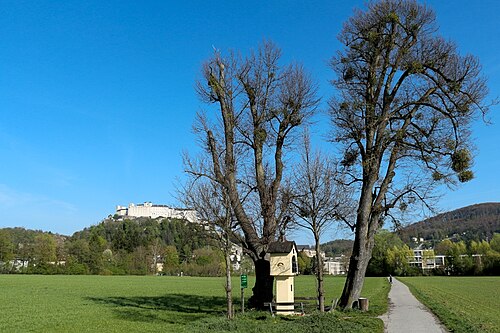
Lime (Tilia sp.) · ~220 years · Nonntal
Four limes were planted around 1810 to stand guard over a roadside image of the Virgin Mary, and more than two centuries later they are still at their post. The register of Land Salzburg records both the date and the reason: the trees were set along the Freisaalweg around an old Marian wayside shrine as a symbolic protection for it. Most old trees leave their purpose to guesswork. These four had theirs written down.
They went in the year Salzburg passed from Austrian to Bavarian rule, and they were already standing when it returned to Austria six years later. The province protected them as a natural monument in 1972.
The path runs from Akademiestraße across an open meadow to Schloss Freisaal, and it is public and free, with no gate to pass. Stand by the shrine and the whole arrangement is in front of you: four big trunks, the small shrine between them, and the Hohensalzburg fortress on its hill behind. The Hornbeam of Freisaalweg is about 380 metres away on the same ground, so the two make an easy pair.
What the register does not say is which lime these are. It names them only as Linden, and nobody has published a girth or a height. If you can tell small-leaved from large-leaved by the leaves, or have a tape measure with you, tell us what you find.
Photo: Eweht (CC BY-SA 3.0 at)
European Pear (Pyrus communis) · 40 years · Walserfeld, Wals-Siezenheim
Charlemagne, the legend says, sleeps inside the Untersberg, and when he wakes he will ride out to a pear tree on this field and fight the last battle between good and evil. The tree has had to be replaced rather often while it waits.
A pear on the Walserfeld is on record from 1564. Chamisso wrote a ballad about it in 1831, and in 1848 King Ludwig of Bavaria tried to buy it from the farmer who owned the field. On the night of 30 April 1872 somebody sawed into it, and a storm brought it down a week later. Its successor, planted in 1875, fell to another storm in 1883. The pear planted in 1887 outlived a Nazi recasting as a Germanic assembly tree and an American plan to fell it after the war, dropped, Wikipedia records, once they saw how unimposing it was. Fungus finished it, and it came out on 7 December 2015.
The tree standing now is a replacement, and a young one: a perry pear of the Rote Pichlbirne variety, bought from an Upper Austrian nursery years in advance and already about thirty when it went in late in 2015, roughly 300 metres from the old spot. It is not a protected monument. It holds a post that has outlasted every tree appointed to it, and it is on the municipal coat of arms. It stands opposite the monument to the 1800 Battle of the Walserfeld.
A day trip away
Eugendorf, 12 km north-east
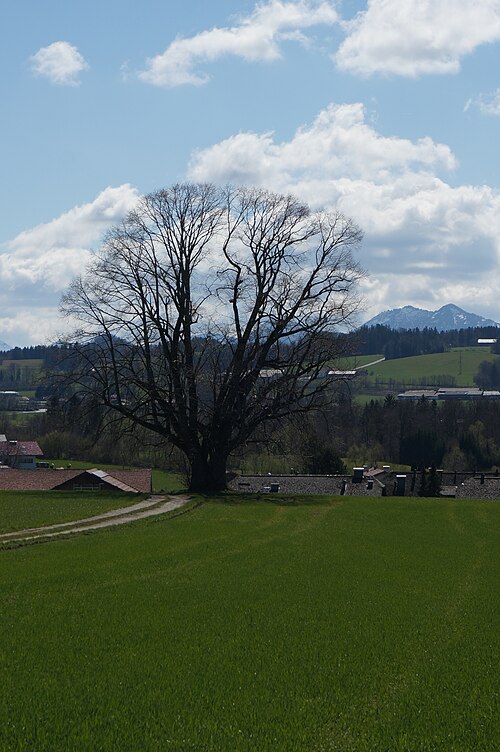
Lime (Tilia sp.) · Eugendorf (Flachgau)
Lightning has hit this tree more than once, and the bark still carries the marks. The Land Salzburg register, which protected the Gschirrnlinde as a natural monument in 1985, describes it as a single tree that dominates the landscape, standing completely free on a gentle meadow hill, and records the lightning scars on its bark. A lone lime on a rise is what a storm goes for, and this one has kept standing anyway.
It takes its name from the Gasthof Gschirrnwirt beside it, and the spelling wanders: Gschirrnlinde, Gschirnlinde and Geschirrnlinde all turn up.
The setting does most of the work. The tree has its grassy rise to itself, with a farm track running past and the Alps behind, and from the track the whole broad, rounded crown reads at once. It stands in a farm meadow rather than a park, and nobody has told us the grass is open to walk on, so look from the track. A photograph taken in April 2025 shows it still standing.
Eugendorf is about 12 km north-east of Salzburg, roughly half an hour by regional bus, then a short walk to the inn.
Almost nothing else is on record. Nobody has published its age, its girth or its height, and the register calls it only a Linde, without saying which lime. If you pass with a tape measure, or can tell the leaves of a small-leaved lime from a large-leaved one, tell us what you find.
Photo: Flanierer (CC BY-SA 4.0)
Faistenau, 15 km east
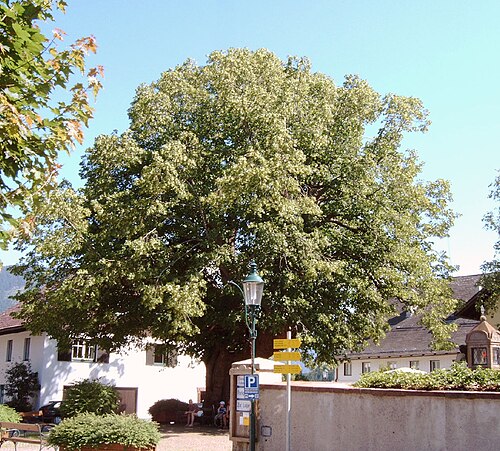
Large-leaved Lime (Tilia platyphyllos) · 400-1000 years · Faistenau (Flachgau)
For nine days in the autumn of 1863, a preacher stepped out of the inside of this tree to speak. During the Jesuit mission of 25 October to 2 November, 19 of its 26 sermons were given from a pulpit built at the linden, the preacher climbing out of the hollow trunk on nine steps. Its hollow west limb is still called the Predigtstuhl, the pulpit.
It began as a Tanzlinde, a dance linden, grown so that a round platform could be built into the crown and the village could dance in a ring up among the branches. The square around it was once a burnt clearing in the forest. A newly ordained priest said his first mass under it in 1900, the tree sits at the centre of Faistenau's coat of arms, and every three years the village stages its own Jedermann beneath it, most recently on summer weekends in 2025.
Everyone calls it the thousand-year linden. That is a name, not a measurement. The province's register, which has protected the tree since 1933, says plainly that its true age cannot be determined, because the trunk is hollow and most of its annual rings are gone. Round the hollow stem it measured 9.10 metres in 2008, and 20.5 metres tall.
Faistenau is about 14 km east of Salzburg, roughly forty minutes by regional bus. Whether the hollow can still be entered today, we have not been able to confirm.
Photo: Heinz-Peter Deska (CC BY-SA 3.0)