Rome's noble families turned trees into status symbols the way they turned villas into galleries. Cardinal Scipione Borghese's gardener planted a grove of oriental planes in the 1600s that foresters now call the oldest living trees in the city; the Pamphilj and Mattei families each planted cedars of Lebanon nearby, one per hilltop garden, as a shorthand for permanence. Rome has 65 trees registered as monumental under Italian law, more than any other city in the country. The trees here range from a 425-year-old plane to a Mexican desert palm, and all but two are free to visit.
0 of 31 visited in Rome
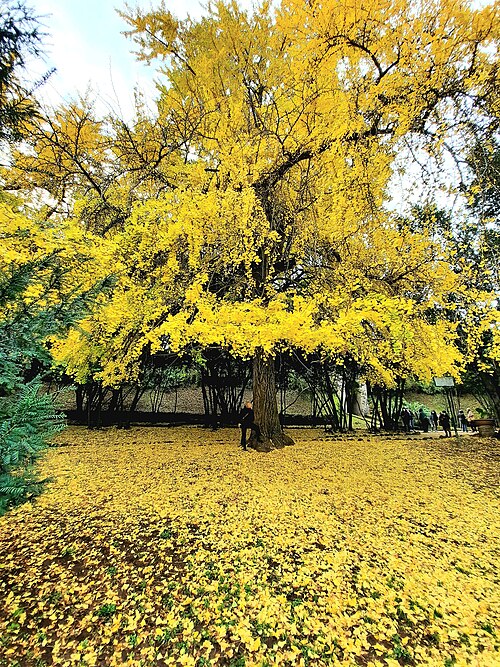
Ginkgo (Ginkgo biloba) · 120 years · Monteverde / Trastevere
Rome's most famous old trees are cedars and planes, planted by cardinals and popes on grand estates. This ginkgo belongs to a very different Roman: George Washington Wurts, an American diplomat who bought this hillside property in 1902 and spent the rest of his life filling it with plants gathered from wherever caught his interest. He had the ginkgo planted in the early 1900s, one of the first established in the city, a species Europe had only known for about two centuries at that point, brought over from temple gardens in China where it had grown essentially unchanged since before the dinosaurs went extinct. Rome's own environment department now lists it among the city's roughly twenty official monumental trees, qualifying on three separate grounds at once: age and size, landscape value, and simple botanical rarity, since ginkgos remain genuinely uncommon in Roman parks even a century after Wurts planted his. The trunk has thickened to just over three metres around and the crown now reaches 25 metres, taller than most of the villa's own follies and fake ruins built around the same period. Wurts died in 1928 without seeing what came next: his widow, the American heiress Henrietta Tower Wurts, gave the whole seven and a half hectare estate to the Italian state in the early 1930s, on condition it stay a public park. Every November the tree does what ginkgos do everywhere, turning uniformly gold within days rather than fading gradually like its neighbours.
Photo: Carlo8688 (CC BY-SA 4.0)
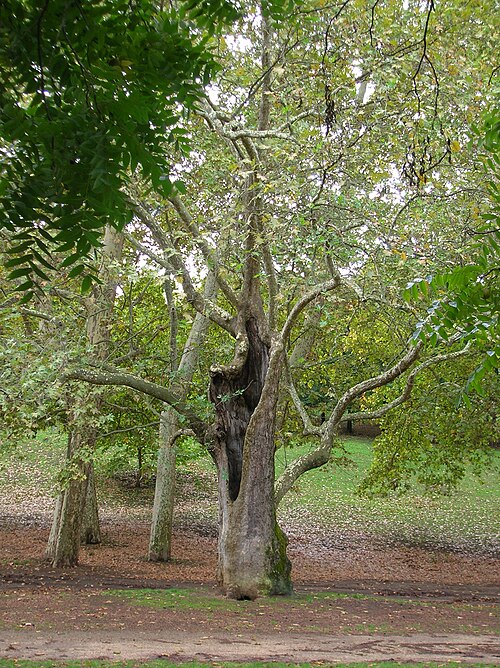
Oriental Plane (Platanus orientalis) · 425 years · Villa Borghese, Pinciano
Nine trees are what remain of the eleven Cardinal Scipione Borghese planted here four centuries ago. Adonis is the largest survivor: a vast, hollow-trunked oriental plane at the entrance to what is now called the Valley of the Plane Trees, planted in the early 1600s by the cardinal's gardener, Domenico Savini da Montepulciano. At around 425 years old, it and its siblings are described by Italian foresters as the only urban stand of ancient oriental planes left in the West, and the oldest living trees in Rome. In 2021 the garden cloned it, growing a sapling from a single leaf found sprouting on the fragile trunk. The clone, planted nearby as Adonis Junior, is genetically identical to a four-hundred-year-old tree despite being six years old at planting. It was a hedge against the inevitable: Adonis is hollow and propped, and a nearby oak from the same era, nicknamed the Quercia del Lupo for a wolf-shaped burl on its trunk and already documented in a memoir of the villa's gardens by the 1650s, collapsed in a storm in 2018 after three to five hundred years standing, accounts differ. Adonis is still leafing out every spring in the hunting park a cardinal built long before anyone thought to call it a public garden.
Photo: Patafisik (CC BY-SA 3.0)
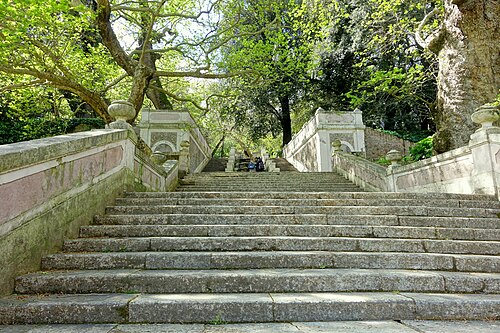
Oriental Plane (Platanus orientalis) · 350 years · Trastevere, at the foot of the Gianicolo
Two oriental planes here are older than the university that now owns them. Rome's Botanical Garden became a state institution in 1883, but the ground itself was a private garden of the Corsini family from 1660 onward, and these two trees, flanking Ferdinando Fuga's 1742 cascade of eleven fountains, were already mature when the last Corsini cardinals walked past them. Foresters place their age at over 300 years, among the oldest confirmed trees in Rome after Villa Borghese's plane grove. The staircase they frame, the Scalinata delle Undici Fontane, sends water down five stone basins toward eleven separate jets, an 18th-century flourish built as a backdrop for planting that already existed. The garden today holds 345 centuries-old specimens across 130 species, cork oaks, Himalayan cedars and Turkish oaks among them, but the two planes at the fountains remain the postcard image, framing water and stone the way they have for three centuries, regardless of which family or which state held the deed to the land around them.
Cork Oak (Quercus suber) · 226 years · Trastevere, at the foot of the Gianicolo
This cork oak has been measured twice in three years, and it grew in the interval: 5.00 meters around in October 2021, 5.30 meters by January 2024, still adding girth at an age Italy's national monumental tree registry puts at 226 years. It grows near the Orangery in Rome's Botanical Garden, one of several cork oaks the university lists among its monumental specimens, alongside Turkish oaks and a pair of Himalayan cedars near the old riding school. Quercus suber is farmed across the western Mediterranean for its bark, stripped every decade or so to make wine corks and flooring without killing the tree, and this specimen's deeply fissured, spongy trunk still shows the scars of past harvests even though nobody has stripped it in living memory. It predates the garden's official 1883 founding as a state institution by nearly a century, rooted here since the grounds still belonged to the Corsini family. Visitors tend to walk straight past it toward the garden's showier Japanese section and its cascading fountains, but few trees anywhere in the city are still visibly getting bigger.
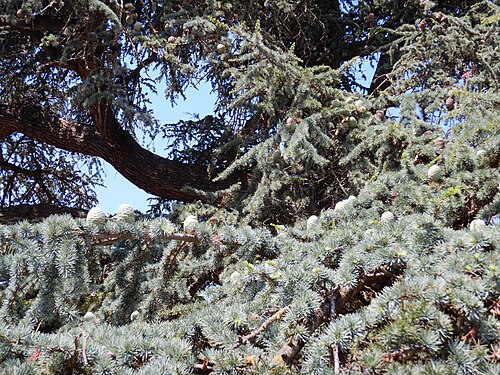
Cedar of Lebanon (Cedrus libani) · 150-320 years · Monteverde
Sources disagree by a century and a half on how old this cedar is, and the disagreement is the most honest thing anyone can say about it. One detailed study of Villa Doria Pamphilj's tree collection places its planting in the 1600s, when the Pamphilj family first laid out the estate, which would make it over 300 years old. The tree's own entry in Italy's national monumental tree registry gives a calculated age closer to 150 years, with a trunk 4.6 meters around and a height of 30 meters. Both figures describe the same cedar, shading the belvedere terrace above the Lago del Giglio in Rome's largest public park. What is not disputed is the setting: Villa Doria Pamphilj was a private hunting and pleasure ground until the Italian state expropriated it in 1965, and this cedar, whichever planting it dates to, has shaded cardinals, princes and now Sunday joggers from the same terrace above the same ornamental lake. It is listed as the only individually registered monumental tree in a park that otherwise counts its history in family names rather than tree ages.
Photo: Albarubescens (CC BY-SA 4.0)
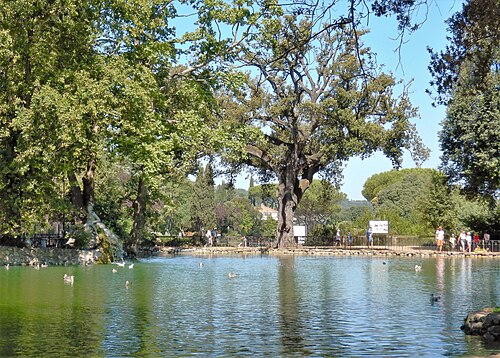
Holm Oak (Quercus ilex) · 176-300 years · Villa Borghese, Pinciano
Marcantonio IV Borghese tore out six hundred holm oaks in 1784 to build an English-style garden around Villa Borghese's lake, and one tree, by luck or design, was left standing. This is that leccio, growing at the water's edge in what locals once called the Piano dei Licini, the holm oak plain, before the prince's landscapers decided a lake and a temple suited fashionable taste better than a forest. Italy's national tree registry measures its trunk at 4.3 meters around and calculates an age of 176 years from growth data, a figure that would place its planting after Borghese's makeover rather than before it. Older estimates, based on the site's documented history rather than direct measurement, put it closer to 300, arguing it is one of the few survivors of the original grove. Both cannot be right. This page gives both rather than pick a side. What both agree on is the tree's stature: 19 meters tall, its dense evergreen crown reflected in the artificial lake that replaced six hundred of its relatives two and a half centuries ago.
Photo: Albarubescens (CC BY-SA 4.0)
Cedar of Lebanon (Cedrus libani) · 146 years · Gianicolo
This cedar shares its hillside with the dead of a revolution. It grows between the Fontana dell'Acqua Paola and the Mausoleo Ossario Garibaldino, the 1941 monument holding the remains of those killed defending Rome's short-lived Republic in 1849 and fighting to make the city Italy's capital between 1860 and 1870. Officially measured for the national monumental tree registry, it stands about 20 meters tall with a trunk 5.74 meters around, and its documented age of roughly 146 years puts its planting in the 1870s, soon after Rome became the capital of a unified Italy in 1871 and this hillside turned from battlefield into a place of civic memory. Cedars of Lebanon are not native anywhere near the Gianicolo; Roman nobility, and later the new Italian state, planted them across the city's hilltop gardens as a shorthand for permanence and old-world grandeur, the same reasoning that put cedars in half the noble villas on this list. This one has outlasted the reasoning: nobody plants status symbols on a war memorial today, but the tree stayed, and it is now the memorial's oldest living feature.
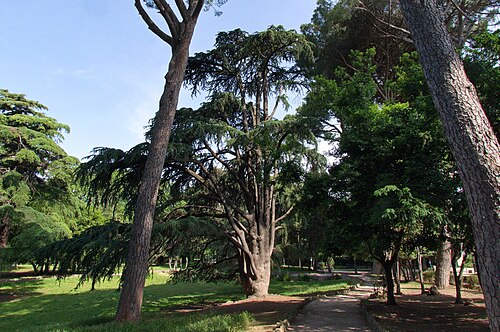
Cedar of Lebanon (Cedrus libani) · 100-150 years · Celio
A few meters from Villa Celimontana's Aleppo pine grows its opposite in almost every way: straight where the pine leans, dense and dark where the pine is sparse, native to a mountain range a thousand kilometers further east. This cedar of Lebanon is one of two of Rome's officially monumental trees inside the villa, both standing along Viale Cardinale Francesco Spellman near the main entrance at Piazza della Navicella. Ciriaco Mattei began turning the site's vineyards into an ornamental garden in 1572, and cedars of Lebanon, prized in noble Roman gardens for their biblical associations with endurance, show up across the city's hilltop villas from the 1600s onward. No record fixes the year this particular tree went into the ground, only its registry status as a monumental specimen for its age, dimensions and form, so this account treats its age as undocumented rather than claim a number it cannot back. The villa passed to the Italian Geographical Society in 1926 and became public parkland in 1928, and the cedar, whatever its exact age, has outlasted every institution that has owned the ground beneath it.
Photo: Beatrice (CC BY-SA 4.0)
Aleppo Pine (Pinus halepensis) · 100-150 years · Celio
Villa Celimontana keeps two of Rome's officially monumental trees within a few meters of each other, and this Aleppo pine is the more unusual of the pair. Pinus halepensis is a Mediterranean coastal species, more at home on the cliffs above Aleppo or along the Ligurian shore than on the Caelian Hill, and its presence here fits the exotic-planting habit of the Mattei family, who turned a vineyard into this garden starting in 1572. The tree stands along Viale Cardinale Francesco Spellman near the villa's main entrance at Piazza della Navicella, its twisting, wind-shaped canopy a contrast to the straighter cedar growing almost beside it. No source gives the pine a precise planting date, only the national registry's designation as monumental for its age, dimensions and form, so this account states it as undocumented rather than invent a number. What is certain is the company it has kept: Renaissance nobles, then the Italian Geographical Society, which held the villa from 1926, and now Sunday footballers on the grounds nearby, all under the same slanted pine.
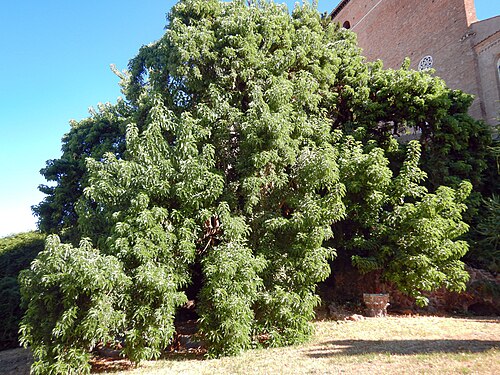
Ombu (Phytolacca dioica) · 115 years · Capitoline Hill
Rome's most improbable street tree is originally from the Argentine pampas, and it owes its spot on the Capitoline Hill to a 50th birthday party. Prince Baldassarre Ladislao Odescalchi planted it in 1911, the year Italy marked half a century since unification, at the foot of Michelangelo's Cordonata staircase beside the church of Santa Maria in Aracoeli. It is a Phytolacca dioica, called ombu in its native South America, a fast-growing evergreen with a swollen, buttressed trunk that looks more sculpted than grown. At roughly 115 years old it is the youngest tree on this list by a wide margin, but nothing else on the Capitoline canopy touches its scale: its crown now shades a stretch of the climb toward Piazza del Campidoglio, competing for attention with the ancient temple platform the hill was named for. Tourists photograph the she-wolf statue and the Michelangelo-designed piazza above; the tree that actually shades their walk up rarely gets a caption. It is one of Rome's officially registered monumental trees despite being, in local terms, barely out of its youth.
Photo: Albarubescens (CC BY-SA 4.0)
Himalayan Cedar (Cedrus deodara) · 100-140 years · Monteverde / Trastevere
Two official registers disagree about this trunk by nearly two metres. Italy's national list gives it as five metres around; the Lazio regional list, which is where the national one gets its Roman entries in the first place, says 3.3. Both are describing the same deodar standing beside the villa's main house, and neither has ever put a date on it. What the regional list does say is unusual: of the 65 monumental trees inside the comune of Roma, this is one of only three designated partly for architettura vegetale, vegetal architecture, the surveyor's term for a tree whose shape is itself the built object. Not its age. Not its girth. Its form. Cedrus deodara grows wild at 1,500 to 3,000 metres in the western Himalaya, where its Sanskrit name means timber of the gods and its wood built temples. This one arrived by way of a rich American's shopping habit. George Washington Wurts bought the hillside in 1902 and spent 26 years filling it with plants from wherever caught his attention, the ginkgo 130 metres downhill among them. The house behind the cedar became the Italian Institute of German Studies in 1931, three years after Wurts died, and the tree has been institutional property ever since.
Willowleaf Podocarp (Podocarpus neriifolius) · 100-130 years · Monteverde / Trastevere
Most trees earn a place on Italy's monumental register for being old or enormous. This one is on it for being strange. The Lazio survey gives its reason as a single letter, d, botanical rarity, and lists no other qualifying criterion at all: not age, not size, not landscape value. At two metres around and 18 metres tall it is a decent tree in a city full of far bigger ones, and the state protects it anyway, because there is essentially nothing else like it growing in Rome. Podocarps are a mostly southern conifer family that split off long before pines existed and never adopted the cone. Instead the seed sits on a swollen fleshy stalk that turns purple and gets eaten by birds, which is why Podocarpus neriifolius spread from the Himalayan foothills to New Guinea and why Buddhist communities planted it around temples across that whole range. Rome's own city government calls this specimen splendid and enormous. It stands on Viale Adolfo Leducq roughly 20 metres from the ginkgo, both of them bought by the same American collector in the same decade, which makes this stretch of path the most botanically improbable 50 metres in the city.
London Plane (Platanus x acerifolia) · 120-160 years · Trastevere
The neighbourhood had this tree scanned. Volunteers in Trastevere paid forest agronomists to run a tomography on the trunk, reading the internal soundness of the wood the way a hospital reads a body, because the tree stands directly over the square's children's play area and nobody wanted to guess. At 5.65 metres around it holds the thickest plane trunk on Rome's monumental register, thicker than the celebrated planes of Villa Borghese, and it grows not in a cardinal's garden but in a working piazza with a morning market, a football pitch's worth of parked scooters and a tenth-century church. The square was open pasture until the 1880s, the Prati di San Cosimato, grazing land outside the tight medieval lanes. When Rome became the capital and Trastevere was rebuilt, the fields became a triangular market square, and the plane either survived that or was planted into it; no document says which, and its 2013 addition to the register recorded size without age. Platanus x acerifolia is itself an accident, an eighteenth-century hybrid of the eastern and American planes that turned out to tolerate city air better than either parent. Rome planted thousands. This is the one the neighbours look after.
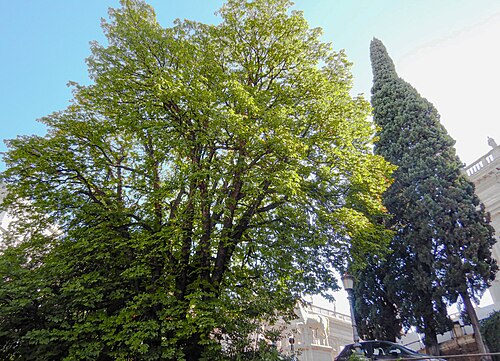
Horse Chestnut (Aesculus hippocastanum) · 100-160 years · Capitoline Hill
A Balkan mountain tree has no business being this large on a Roman hill. Aesculus hippocastanum grows wild in a handful of ravines in the mountains of northern Greece, Albania and North Macedonia, where the summers are cool and the soil stays damp; western Europe only met it in the 1500s, through Constantinople, and planted it everywhere as an avenue tree. Rome is close to the edge of what it tolerates, which is why the city has exactly one on its monumental register and why a trunk 3.45 metres around here counts for more than the same figure would in Vienna. It stands on Via delle Tre Pile, the ramp cars take up the Capitoline, on the right-hand side of Michelangelo's Cordonata as you climb. Roma Capitale registered it for size and for landscape value, meaning the view it belongs to rather than the tree alone. Almost everyone who photographs the staircase stands in its shade to do it. Fifty metres away on the other flank of the same climb grows the ombu from Argentina, so the two flanks of Rome's most famous stair are held by a Balkan mountain tree and a South American pampas tree, and neither is Roman at all.
Photo: Albarubescens (CC BY-SA 4.0)
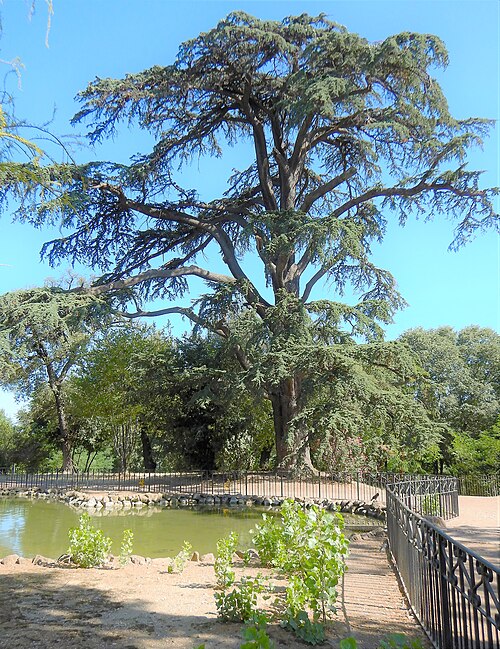
Cedar of Lebanon (Cedrus libani) · 120-200 years · Villa Borghese, Pinciano
Rome's own list of monumental trees does not describe this cedar on its own. It describes it as accompanied by a monumental holm oak, and the two really do stand 70 metres apart at the same water. That phrasing is the giveaway: this tree was never meant to be looked at as a specimen. When Marcantonio IV Borghese remade the grounds in the 1780s he was buying a painting, not a collection. His architects Antonio and Mario Asprucci dug an artificial lake, put an island in it, built a small Ionic temple to Aesculapius on the island in 1786, and planted around all of it to make the view from the bank look like a landscape that had always been there. The cedar is scenery, and it is doing the job two and a half centuries later: 4.1 metres around, 22 metres tall, a flat candelabra crown leaning out over the rowing boats. Cedrus libani was the prestige tree of that generation of Roman gardens, planted in half the noble villas on this list, but most of those sit on lawns and terraces. This one has water under it, which is why it is the one people photograph.
Photo: Albarubescens (CC BY-SA 4.0)
Coast Redwood (Sequoia sempervirens) · 100-160 years · Pincio, Villa Borghese
Thirty metres is a good height for a tree in Rome and a failure for this species. Sequoia sempervirens is the tallest living thing on earth, passing 110 metres in the fog belt of northern California, and it gets there by drinking the fog directly through its leaves during a rainless summer. Rome offers it a rainless summer without the fog. So the redwood on the Pincio has grown thick instead of tall, 4.2 metres around, and still ends up among the five tallest trees on the city's entire monumental register, which says more about Rome's trees than about this one. It grows on Giuseppe Valadier's terrace, laid out between 1809 and 1814 during the French occupation as a public promenade above Piazza del Popolo, at a moment when Roman gardening was swinging from clipped geometry to imported curiosities. Nobody has published when it was planted or by whom. It reached the national register late, in the batch of Roman trees added after the well-documented ones, and that entry is the only document about it that exists: species, girth, height, a coordinate. Everything else anyone tells you about this tree is a guess, including the ones that sound confident.
Southern Magnolia (Magnolia grandiflora) · 275 years · Trastevere
Rome's oldest magnolia does not stand in a garden. It stands on the pavement of Via Corsini, outside the wall of the palace whose garden it was planted for, around the middle of the eighteenth century and roughly 275 years ago. The Orto Botanico next door, the obvious home for a tree like this, only became a public institution long after it was already in the ground.
Southern magnolias had reached Europe from the American southeast only a few decades earlier, which made this one a collector's purchase rather than a street tree. It grew accordingly. The trunk measures 290 centimetres around and the crown reaches 18 metres, closer to a forest tree than to the clipped courtyard shrub the species usually settles for in Italy. Italy's monumental register lists it for age and for size, and for a magnolia that pairing is rare.
What it has watched is mostly the boundary in front of it changing hands: a cardinal's private grounds turning into a state botanical collection, and Trastevere turning from the edge of the city into the middle of it. Surveyors looked it over in late 2025 and recorded its health as good.
In May and June it does the thing the species was imported for, opening cream-white flowers the size of a spread hand, high up and out of reach, and heavy enough with scent that most people smell it before they look up.
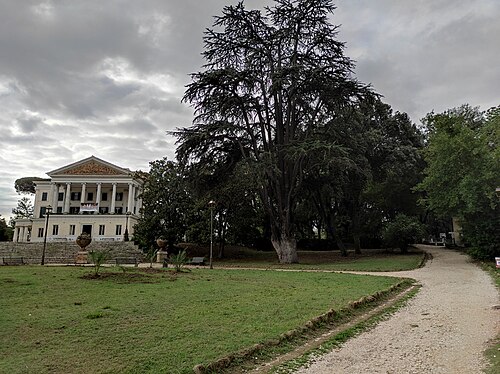
Cedar of Lebanon (Cedrus libani) · 150-220 years · Nomentana / Villa Torlonia
No cedar on Rome's monumental register is thicker than this one. Six metres around the trunk, 28 metres up, standing beside the staircase Giuseppe Valadier designed for the Casino Nobile. The surveyor who wrote its entry reached for the word guardiano.
Nobody knows when it was planted, and that is worth saying plainly, because the register carries a girth for it and no birth year at all. What exists instead is the estate's history. The Torlonia family bought the grounds in 1797, and the English-style landscaping that brought ornamental conifers into Roman villas came later in the nineteenth century. That puts the cedar somewhere between 150 and 220 years old, which is an inference from the garden rather than a date from a document.
Its neighbours have been unusual. The park holds a pink granite obelisk the cedar now rivals for height, a mock-medieval house covered in owls, and from 1925 to 1943 Mussolini, who rented the whole estate as his private residence for a token sum. The villa was occupied, then left to fall apart for decades, then repaired and opened as a public park. The cedar came through all of it standing where it stands now. Roma Capitale's own description of the villa calls it colossal, which for once is not municipal enthusiasm. It was measured again in March 2026 and found in good health.
Photo: Byus71 (CC BY-SA 4.0)
Willowleaf Podocarp (Podocarpus neriifolius) · 80-130 years · Esquilino
Italy put this tree on its national monumental register in October 2025 for one reason: it should not be here. Podocarpus neriifolius grows wild in the forests of the Himalayan foothills and southeast Asia, and Rome holds very few of any size. This is one of the largest, 230 centimetres around and 20 metres tall, in the public garden inside Piazza Vittorio Emanuele II.
Its age is not known. No planting record survives and neither register that lists it carries a date, so a century, give or take, is as precise as anyone can honestly be. The square around it was laid out in the 1880s for the new capital's civil servants, in an arcaded Turinese style that still makes this corner of Rome look imported from somewhere else, and a garden of exotic trees was exactly what that decade planted.
It has stood through the more restless version of Rome. The square's ruined fountain, the Trofei di Mario, sits a few steps away and predates it by seventeen centuries. The food market that filled the arcades for a hundred years packed up and moved around the corner in 2001. The neighbourhood became the most polyglot in the city. The podocarp, evergreen and unbothered, looks much the same in February as in August. Its health was recorded as good in November 2025.
Chir Pine (Pinus roxburghii) · 85-110 years · Esquilino / Colosseo
The roots of this pine have grown into Nero's palace. It stands on Colle Oppio directly above the Domus Aurea, and somewhere below it in the dark they have worked into the nymphaeum of Ulysses and Polyphemus.
It is not a Roman tree in any sense. The Chir Pine belongs to the Himalayan foothills, and this one was carried back from there by Giuseppe Tucci, the Tibetologist and Mussolini-era envoy who spent the 1930s travelling in Tibet and Nepal. It was already standing when the Colle Oppio garden was inaugurated in 1936, which makes it at least ninety years old and one of the very few of its species in the city. Italy's monumental register added it in October 2025 on the grounds of botanical rarity alone: 290 centimetres around, 20 metres tall.
The caveat is real and belongs in the same breath. Those roots are a genuine problem for the ruin underneath, and plans to redesign the garden above the Domus Aurea have been reported as intending to take out the tall trees over the excavation for exactly that reason. The press had already written this tree off as dying once. The register's most recent check, in late 2025, found it alive and in good health. Both things hold: it is doing well, and it is standing on ground where the archaeology has the stronger claim.
Mediterranean Cypress (Cupressus sempervirens) · 235 years · Villa Borghese, Pinciano
Eighteen cypresses once ringed Piazza di Siena when the arena was laid out in 1789, part of the original hedge and tree enclosure designed by architect Antonio Asprucci for what is now Rome's international horse show. Seventeen of those eighteen are gone. This one, according to the conservation group Amici di Villa Borghese, is the sole survivor, still standing along the same oval perimeter the arena has kept since the eighteenth century. Rome's own municipal history of the piazza confirms the original planting scheme, a boxwood hedge, eighteen cypresses and two pine groves, without naming which tree is the last of the batch, so the survivor claim rests on the advocacy group's word rather than a dendrologist's ring count. What isn't in dispute is the arena itself: it has hosted the Concorso Ippico Internazionale, Rome's showjumping event, every year since 1922, riders and horses circling the same green oval a two centuries old cypress has watched from the sidelines the whole time. The letter naming this tree was written in 2024 because Villa Borghese was losing historic specimens faster than anyone wanted, including a well loved pine on the nearby Pincio that was felled around the same period. This cypress is what the campaign wanted people to notice before it went the same way.
Mediterranean Hackberry (Celtis australis) · 300-400 years · Villa Borghese, Pinciano
A hackberry in the holm oak wood behind the Museo Carlo Bilotti carries a nickname rather than a certificate: locals call it il bagolaro del Seicento, the hackberry of the 1600s, though nobody has run the rings to prove it. What is measured is its girth, about four metres around, matched almost exactly by a second trunk growing beside it, close enough that Italy's citizen tree registry logs them as a twinned pair rather than argue over which is which. Both stand in the Lecceta, a stretch of holm oak forest between the old citrus house, now a museum holding a de Chirico and Warhol collection, and the Muro Torto, the Aurelian era wall that has marked this edge of Rome since the third century. Villa Borghese holds roughly 350 trees and only a fraction have any official monumental status; a 2024 letter from the conservation group Amici di Villa Borghese named this hackberry as one of about 30 still waiting on the paperwork that would protect it. No source gives it exact coordinates, only a location inside the wood, so finding it means wandering the Lecceta rather than following a pin. That is true of most of Villa Borghese's older trees: the park has outlived several rounds of formal cataloguing without ever finishing one.
Holm Oak (Quercus ilex) · 125 years · Della Vittoria (RAMI's own field note says quartiere Flaminio; the piazza sits on the boundary, so give both if the writer wants to hedge)
The children who climbed this holm oak gave it its name. From the top they would shout "Anvedi da quassù se vede tutta Roma", Roman dialect for look, from up here you can see the whole of Rome, and the tree has been Tutta Roma ever since. They were doing it around 1919, so the oak was already climbable then; the register's own reckoning puts its planting at about 1900.
That shout is now on file. When Italy added the tree to its national list of monumental trees in 2025, the criteria included historical and cultural value alongside form and bearing, which is unusual in Rome, where most entries are listed for size alone. And this is not a giant: 2.80 metres around the trunk, 18 metres tall, measured in November 2025 and found in good health.
It stands in Piazza Perin del Vaga, a residential square in Della Vittoria on the edge of Flaminio, north of the centre near the Tiber and a fair way from anything a visitor would otherwise be walking to. Which is more or less the point of it. Nobody built a monument here. A tree went into the ground around the turn of the last century, a generation of local children went up it, one of them said something worth repeating, and a hundred years later the Italian state wrote it down.
Mediterranean Hackberry (Celtis australis) · 100 years · Via Appia / Porta Latina, near the Aurelian Walls
Two official surveys measured this hackberry and agreed on its waist to within a centimetre: four metres around. They do not agree on its height. Italy's national monumental tree register records 20 metres. The Appia Antica park authority, in its own catalogue of notable trees, says 15. Both figures are current, neither has been withdrawn, and there is no way from here to tell which tape was right, so take the tree as somewhere between the two.
It is about a hundred years old, which makes it younger than nearly everything around it. The Parco degli Scipioni is laid out over the tomb of the Scipios, burial vault of the family that produced the general who beat Hannibal, with the columbarium of Pomponius Hylas a few steps away and the Aurelian Walls along the edge. The park in its present form is the work of Raffaele de Vico, who designed it around 1929, and this hackberry went in as part of that design: a piece of 20th century landscaping now the largest living thing in a park built on third century BC ground.
The park authority calls it one of its most important specimens, for its size, its bearing and the balance of its crown, and rates its health as good.
A second hackberry, slightly stouter, stands about a hundred metres off against the Aurelian wall itself. It is on the register too. So far nobody else has written it down.
London Plane (Platanus x acerifolia) · Montesacro
Rome's second-thickest registered plane does not grow in a villa garden. It stands on Viale Jonio in Montesacro, six kilometres north of the centre, on a road with traffic lights and a bus lane, and it measures five metres fifty-three around with thirty-two metres above it. Only the plane on Piazza San Cosimato in Trastevere beats it, and that one has the advantage of a famous square.
Montesacro was farmland until the 1920s, when Rome laid out the Citta Giardino Aniene on the far side of the river Aniene: low houses, gardens, planted avenues, a whole quarter designed at once for people pushed out of the centre. The avenues came with trees. This is what one of them looks like after a century in which the houses around it were steadily replaced by apartment blocks and the tree was not.
Two sources record it, the national monumental register through the Lazio list and a notice from the Comune di Roma itself. Neither gives an age. The suburb's own dates suggest a tree that went in with the streets, but no document says so, so it stays a suggestion.
Metro B1 to Conca d'Oro leaves a short walk. It is a long way from anything else a visitor to Rome is doing that day, and it is a genuinely enormous tree.
Chir Pine (Pinus roxburghii) · Tuscolano
Rome's monumental register lists exactly two Himalayan pines in the whole city. One stands on the Colle Oppio above the Colosseum. This is the other, a couple of kilometres east in a neighbourhood park of nine thousand square metres, with a trunk 2.97 metres round and eighteen metres above it.
Pinus roxburghii grows wild on the dry outer ranges of the Himalaya, from Kashmir across to Bhutan, where it is tapped for resin the way other trees are tapped for rubber. The needles come in threes and run to thirty centimetres, long enough that the crown hangs rather than bristles, and the cones are woody, hand sized things.
The ground under it stopped being farmland in July 1930, when Rome's Governorate bought the last of the Fiorelli family's land on the exclusive condition that it be used as a public park. The old manor house came down that September. Raffaele De Vico laid out the garden that replaced it in 1931, and the Tuscolano quarter's blocks of flats went up around the edge.
Two gaps worth stating. Italy's register has no age field, so nobody has dated this pine. And the city's own account of what grows in the park names walnuts, carobs, plums, a ginkgo and silk trees, without mentioning a pine at all.
Black Poplar (Populus nigra) · Montesacro
Making a monument of a black poplar is a bet against the species. Populus nigra grows fast on soft wood, hollows early and starts shedding limbs while an oak of the same age is still filling out, which is why few of them get old anywhere and fewer still on a city street. This one is 4.05 metres round with twenty metres above it, at the junction of Via Conca d'Oro and Via Val d'Ala.
Rome's register carries three black poplars. The other two sit 14 and 25 kilometres out, one towards the coast at the Risaro and one in Ostia, which leaves this the only one a visitor is likely to reach.
Montesacro was farmland until the 1920s, when the city laid out a garden suburb across the Aniene and planted its avenues. Nothing records when this poplar went in, and the Italian register has no age field to put it in even if something did.
One caution. The Lazio regional list still carried the tree in its November 2025 edition, and that list keeps a separate sheet for trees struck off it, with the reason each was removed, which is the closest thing this country has to a public check that a monumental tree is still standing. Nine months is a long time in the life of a poplar.
Mediterranean Hackberry (Celtis australis) · Appio Latino, along the Aurelian Walls
Rome's register carries two Mediterranean hackberries and they stand a hundred and twenty metres apart. The one inside the Parco degli Scipioni has a park authority's catalogue entry, a health rating and an age estimate. This one, thirteen centimetres thicker at 4.14 metres round, has a line in a spreadsheet.
It grows at the corner of Viale delle Mura Latine and Via Latina, along the Aurelian Walls. Italians call the species bagolaro, and also spaccasassi, stone splitter, after its habit of rooting into walls and rock and refusing to be shifted. The wall beside it went up between 271 and 275, nineteen kilometres of brick faced concrete thrown around the city in four years by an emperor who had stopped assuming Rome was safe. The Porta Latina is a few steps south.
The register puts the tree at twenty metres and records what earned it the designation: its size, and its form and bearing. It gives no age, and hackberries thicken quickly on good ground, so four metres round here does not mean the two centuries the same measurement would suggest in an oak.
One source only, the national register through the Lazio list. The Appia Antica park's own catalogue of notable trees describes its neighbour in detail and does not mention this one.
Mexican Blue Palm (Brahea armata) · Gianicolo / Monteverde
A palm from the canyons of Baja California sits on Rome's monumental register, and the register is blunt about why: botanical rarity. No age, no history, no famous planter. Just a Brahea armata standing twenty metres up on the Janiculum, which the state counts as reason enough on its own.
It is a desert plant. In Mexico it grows in dry rocky ravines behind the Pacific coast, and its fronds are the colour the name promises, a stiff waxy blue grey that reads as metal rather than leaf from any distance. Once a year it sends out flower spikes that arch clear of the crown and hang several metres below it, longer than the fronds they came from.
Villa Sciarra reached the public through an American. George Washington Wurts bought this hillside in 1902 and spent the rest of his life filling it with whatever caught his eye, and his widow Henrietta Tower Wurts gave the whole estate to the Italian state in the early 1930s on the condition that it stay a park. Whether this palm was one of his, no document says.
The register gives 2.94 metres round and twenty metres tall. Palms lay down no growth rings, so the age here is not merely undocumented, it is unknowable.
Tasmanian Blue Gum (Eucalyptus globulus) · Roma 70 / Ardeatino, Municipio VIII
This eucalyptus stands on the grounds of a fort built to defend Rome, and it only joined the national monumental-tree register in late 2025, one of 211 trees added nationwide in a single update. It grows in what the register calls a residual eucalyptus wood, rooted in and around Forte Ardeatino, a defensive fort raised in 1879 as part of the ring of forts that once circled the capital.
The species explains the wood. Eucalyptus was planted around many of Rome's forts and along its drained lowlands in the early twentieth century, valued for how fast it grows and how efficiently it pulls water from waterlogged ground. This one has done exactly that: 4.9 metres round and 18 metres tall, on a species that can put on that kind of girth in a fraction of the time a native oak would need. Nobody has recorded when it was planted, and the girth alone does not settle it, not on a tree this quick to grow.
The fort itself, restored in 2006, sits inside what is now folded into the wider Tormarancia and Appia Antica park system. Its interior stays closed. The eucalyptus wood around it, this tree included, does not.
Almond (Prunus dulcis) · 125-250 years · Montesacro
Locals call it the Mandorlo di Nerone, Nero's Almond, after the emperor said to have died at this address. The villa belonged to Faonte, a freedman, and ancient sources place Nero's final hours in Faonte's house in 68 CE, fleeing an army that had already declared him a public enemy. Whether this exact tree stood there is unknowable; what the name records is that people have been telling that story about this ground for a long time.
What can be measured is a trunk 3.6 metres round, thick for an almond, a species usually kept pruned low in orchards rather than left to grow into a park specimen. Italy's national monumental-tree register put its height at about 20 metres. The registry's own note calls the tree a witness to the site's ancient vineyard cultivation, a claim that reads more like local colour than anything documented, so treat the vines as tradition rather than fact.
The park around it, Parco di Villa di Faonte, reopened to the public in April 2026 after roughly a decade shut. The archaeological ruins the villa is named for stay closed; the open ground where the almond grows does not. A second, smaller almond stands about 110 metres away, registered separately and still unnamed.