Catalonia has protected individual trees by law since 1987, and cutting one is simply forbidden. There are 299 declared monumental trees in the region and three of them stand within reach of Tarragona on ground anybody can walk onto: a plane filling a village square, a pair of cypresses in a town hall courtyard beside a Cistercian monastery, and a wild pear on a track in the Prades mountains. The rest of the trees on the register near here stand on private farms, which is why this page is short.
0 of 3 visited in Tarragona
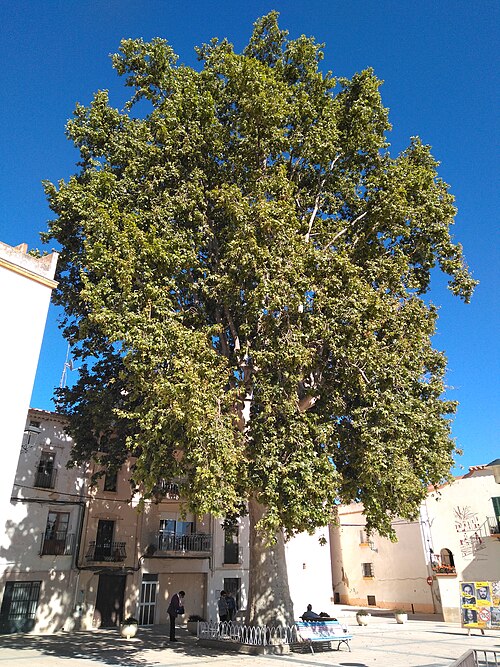
London Plane (Platanus x acerifolia) · La Riera de Gaia
This tree is the square. La Riera de Gaia is a small town inland from the coast north of Tarragona, and the plane standing in its Placa de la Vila takes up most of it, which is the way these things went in Catalan villages: a plane was put in the square because it grows fast, casts dense shade by June and can be pollarded hard every few years without complaint, and then it outlived the reason and became the thing the square is named for. Catalonia declared it a monumental tree in 1992, which makes cutting it illegal. It is one of the trees selected for the book Arboles singulares de Espana, where it takes a two-page spread. The register lists it as being in normal condition and puts it at 23 metres tall, but gives no trunk girth at breast height, so this page cannot tell you how thick it is, only that Catalonia thought it worth protecting and that a national survey of Spain's singular trees agreed. If you have measured it, tell us.
Photo: Jordi Gili (CC BY-SA 4.0)
Mediterranean Cypress (Cupressus sempervirens) · Santes Creus
Two cypresses in a courtyard at a Cistercian monastery, and the courtyard now belongs to the town hall. Santes Creus was founded in the twelfth century and is one of the three great Cistercian houses of Catalonia, with the kings of Aragon buried in its church; the abbot's palace beside it passed into secular hands after the monasteries were dissolved in 1835, and the local council occupies part of it. The two cypresses stand in its patio, 18 metres tall on trunks 3.37 metres round with crowns only 9.1 metres across, which is the shape of the species: Cupressus sempervirens grows as a dark green column and almost nothing else, which is why it has been planted at monasteries and cemeteries around the Mediterranean for two thousand years. Catalonia has them on its monumental tree register as a pair. The status listed is that the declaration is pending rather than complete, so they are on the list and protection is still working its way through. Nobody has published an age.
Almond-leaved Pear (Pyrus spinosa) · 75-150 years · Prades
Catalonia protects 299 trees and one of them is a wild pear, which tells you something about how the list was made. Pyrus spinosa is a thorny scrubby thing of dry Mediterranean hillsides, usually a bush and rarely worth a second look, and this one is 10.5 metres tall with a trunk just under two metres round and a crown 16 metres across, which for the species is enormous. It stands at Cap del Plans above Prades, on the right of the track, in the Prades mountains where the ground is red sandstone and the villages sit above 900 metres. It was declared a monumental tree in 1991. The register puts its condition as normal. What makes it worth the drive is not size in absolute terms, since almost every other tree on this site is bigger, but the fact that this is the species performing at the top of its range: a hedgerow shrub that got left alone long enough to become a tree. The register itself gives no age, as with every Catalan entry; the 75 to 150 years shown here is judged from the girth.