Stuttgart's designated trees are scattered across the whole city rather than clustered in one district, from a churchyard lime in Rohracker to a 6.72-metre ash at Schloss Solitude and three swamp cypresses beside a former gravel-pit lake. The oldest by measurement is the Solitude ash, put at roughly 250 years by a dendrological register. All are protected natural monuments, free and open at any time, each its own short outing rather than one connected walk.
0 of 6 visited in Stuttgart
Small-leaved Lime (Tilia cordata) · 150 years · Rohracker
The church was already three centuries old before anyone planted the tree in front of it. Rohracker's Bernhardskirche was built after 1447. The parish's own history says the lime in its garden went in around 1870, which makes it about 150 years old and comfortably the younger of the pair.
Stuttgart designated it a natural monument in 2003 and gave two reasons: its character, and the animals living in it. The register is a little confused about the tree and carries it twice, under two numbers at identical coordinates. The city's own ordinance settles it by naming exactly one lime at Rohrackerstraße 257, so this is one tree with two entries rather than two trees.
What it has witnessed is not a battle or a duke, and that is rather the point. It has stood through the whole of modern Germany in a working village churchyard on Stuttgart's eastern slopes, doing the job churchyard trees have always had: making a patch of shade people sit in. The parish still describes its garden exactly that way, as somewhere to linger, with this lime as the reason it works.
Come in the last week of June or the first of July. Small-leaved limes flower then, the scent carries across the whole garden, and the crown fills with enough bees to hear from the bench underneath.
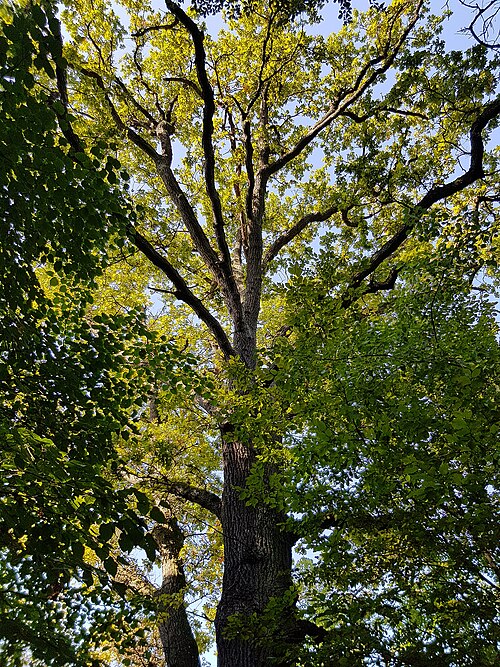
Oak (Quercus sp.) · Vaihingen
On 7 May 1515 Duke Ulrich of Württemberg took his stable master out hunting in this forest and killed him. The dead man was Hans von Hutten, and the quarrel is usually told as a matter of the duke pursuing Hutten's wife. By the tradition attached to this spot, Ulrich then hung the body from an oak, and the oak standing here carries the name.
Be careful about what that does and does not mean. No source claims the tree you walk to is the same individual that stood here in 1515; the story belongs to the place, and this tree inherited it. Two independent accounts, an encyclopedia entry and a walkers' trail note, tell it the same way, which is about as far as a five-hundred-year-old rumour can be corroborated.
Nobody has dated this oak or measured its girth, and we would rather say so than invent a number. If you know its age, tell us.
It is not on Stuttgart's list of 89 official natural monuments, so it stands here on its history rather than on any designation. The city did put up a signboard naming it in the forest in January 2013, which is how most walkers find it at all.
One honest warning about the walk. The pin marks the point our sources give, and a visitor's note puts the trunk roughly 130 metres southeast of the signpost, off the marked path. Expect to hunt for it a little.
Photo: Ziegler175 (CC BY-SA 4.0)
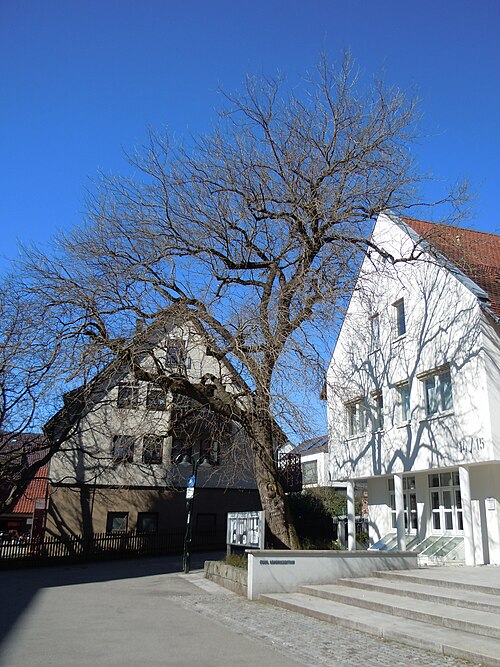
Mulberry (Morus sp.) · Möhringen
Stuttgart protects this mulberry for three reasons, and one of them is culture. The city's register normally gives a tree character and habitat value and leaves it there. This one was designated in June 2003 for its character, its rarity and its cultural significance, a combination that says the register is protecting the kind of tree as much as the individual trunk.
It stands on the Oberdorfplatz, the square of the old village centre of Möhringen, which is now a Stuttgart district with trams running through it. Nobody has written down who put the tree there or why, and mulberries have been planted in Europe for two reasons, their fruit and their leaves, which feed silkworms. What is on record is that this one has watched the village around it stop being a village.
Two things we cannot tell you. Nobody has published an age or a girth for it, so we are not going to invent one. And no source says whether it is a black mulberry or a white one, which is a thing you could settle standing in front of it: white mulberry leaves are glossy, black mulberry leaves are rough as sandpaper. Tell us which you find.
The last photograph we can point to was taken in March 2017, and it names the tree by its exact register number.
Photo: Friedi13 (CC BY-SA 4.0)
Bald Cypress (Taxodium distichum) · Bad Cannstatt
Three swamp trees from the American south, standing in a German spa park, protected by law for being unusual. Bald cypresses belong in the floodplains of the Mississippi and the Carolinas; Stuttgart designated this group a natural monument in June 2003 for its character and its rarity, which is the register admitting outright that these do not grow here by themselves.
They are also the conifer that breaks the rule about conifers. A bald cypress drops its needles every winter, and before it does, the whole crown turns a rust orange that nothing else in a German park does. In wet ground the roots send up woody knees around the trunk, so look down as well as up.
The Kurpark is Bad Cannstatt's spa park, and its tree stock dates largely from the nineteenth century. That stock is being renewed a few trees at a time, which is the ordinary fate of a maintained park.
Here is what we cannot confirm. The most recent evidence we have that these three are standing is a photograph from May 2017, tagged with their exact register number, and nothing since names them. They are almost certainly fine, and we would rather tell you that than pretend to a fresher check. If you walk past them, tell us what you find. No age or girth has ever been published for them.
European Ash (Fraxinus excelsior) · 250 years · Solitude / Stuttgart-West
A German tree register measured this ash in May 2026 and got 6.72 metres around the trunk, taken low at 60 centimetres. European ash does not usually reach that. The same visit recorded it 23 metres tall and, in the register's own word, vital: a thick old tree in good condition rather than a monument being propped up.
The register puts its age at 250 years. That is the register's own estimate and nobody has counted rings, so we carry it as a band, somewhere between 200 and 300 years; the tree is the same either way. It stands on the lawn in front of Schloss Solitude, the baroque hunting lodge on the ridge west of the city, whose grounds are now free and open at any hour. Only the rooms inside need a ticket.
Stuttgart protects it, but not alone. The city's ordinance designates one monument here, a group: this ash plus two sycamore maples, listed together in June 2003 for their character and as habitat. No source has measured the two maples, so the ash is the documented one and the other two are its company.
Its trunk forks low into a wide, many-branched crown, which is worth seeing bare. Come in January or February and the whole frame is legible from the grass.
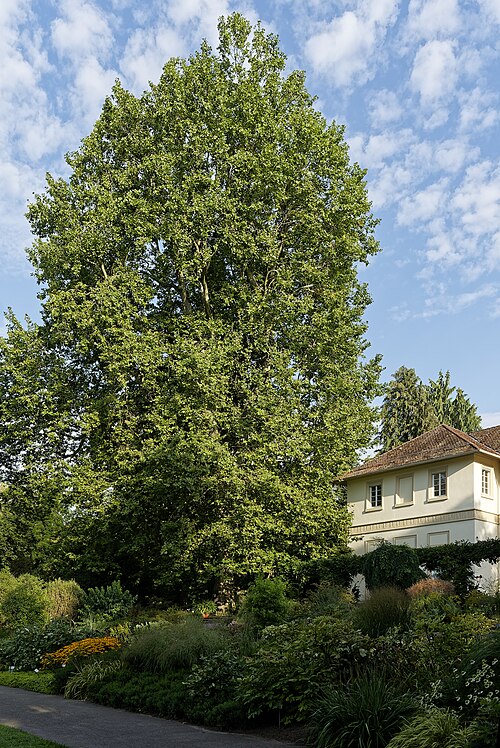
London Plane (Platanus x acerifolia) · 245 years · Hohenheim / Plieningen
Duke Carl Eugen of Wuerttemberg planted this plane in 1779, tradition says as a gesture toward the woman who would become his wife. About four metres up, the trunk splits cleanly into two, and Hohenheim has read that fork as a love story ever since: two lovers, united at the root, each still their own person in the canopy.
Whatever the duke intended, the tree has done well by it. At 34 metres it ranks among the tallest planes in Germany, with a trunk 7.70 metres round measured in December 2022, and in May 2023 the German Dendrological Society named it one of the country's Nationalerbe-Baeume, National Heritage Trees, a list of roughly a hundred. It grows in the Exotic Garden of the university's Hohenheimer Gaerten, open and free every day of the year.
Age has not made it decorative. The cavities in that quarter-millennium of wood shelter owls, dormice and bats, and the tree is one of the known German homes of the hermit beetle, a protected saproxylic species that depends on exactly this kind of old, hollowing timber. Arborists inspect it twice a year and carry out whatever care keeps a tree this size and this old standing safely over a public garden.
The Hohenheim Liebesplatane, the locals call it. Love plane.
Photo: Zinnmann (CC BY-SA 3.0)