Leipzig protects 148 trees as Naturdenkmale, Saxon state law's highest tier for an individual tree. Two restored villas on Karl-Heine-Strasse in Plagwitz hold a ginkgo, an elm, a bald cypress, a copper beech and a pagoda tree within 150 metres, with a fern-leaved beech and an oak a short walk east. Across the city stand a lime the painter Adolf von Menzel drew, an oak above the Pleissemuehlgraben, two Lindenau street oaks, Wahren's peace oak, a great plane, a Lebanon oak and number 1 on the city's list, a medlar-leaved oak on the ring.
0 of 19 visited in Leipzig
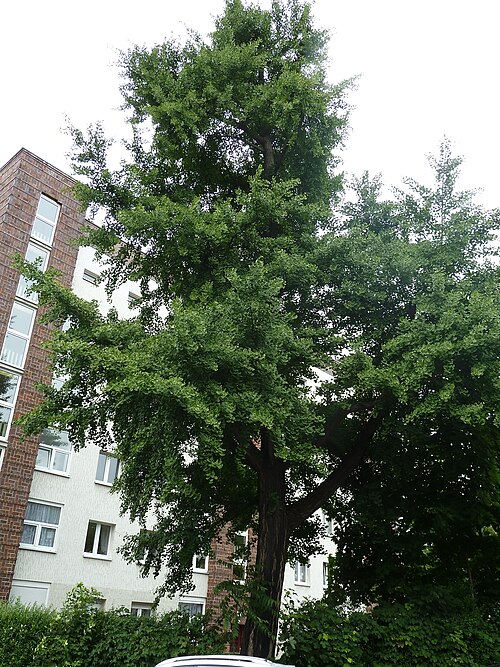
Ginkgo (Ginkgo biloba) · Plagwitz
A female ginkgo stands at the corner of Karl-Heine-Strasse in Plagwitz, one of 148 trees Leipzig protects as a Naturdenkmal, Saxon law's strongest individual-tree designation. The city's own record gives it a number, ND 30, a protected root radius of 18 metres, and the resolution that made it official in 1996. It gives no age and no planting date, which is typical of the German Naturdenkmal system: protection does not require a documented history, only a tree worth keeping.
Ginkgo biloba survives as a single species from a lineage otherwise known only from fossils, and female trees like this one carry a reputation the male trees down the street do not: come autumn, the fallen seed coats smell distinctly of rancid butter, which is why most street plantings today are male clones. This one was left as it grew.
It shares its stretch of Karl-Heine-Strasse with four more protected trees within about 150 metres, an elm, a bald cypress, a copper beech and a pagoda tree, all named on this page.
Photo: Edlerin (CC BY-SA 4.0)
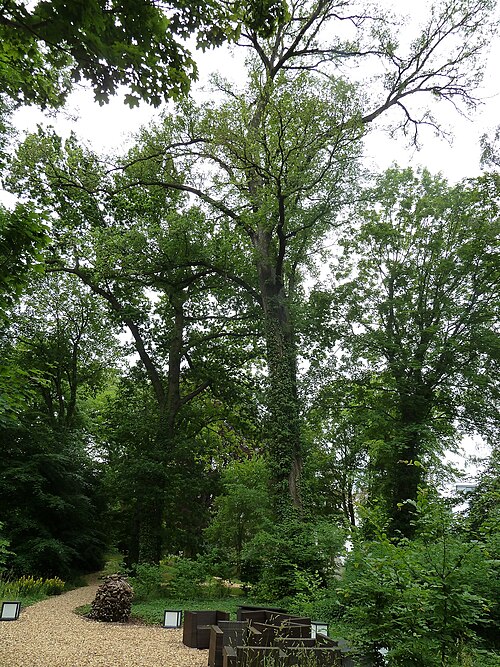
European White Elm (Ulmus laevis) · Plagwitz
European white elm is the one native elm that mostly shrugged off Dutch elm disease, because it favours damp ground the beetle that spreads the fungus rarely bothers with, and this specimen has grown large enough on a Plagwitz street corner to earn Leipzig's Naturdenkmal protection, the city's strongest legal status for an individual tree.
It stands directly beside a bald cypress the city protected under the same designation, an odd pairing: a European elm built for damp lowland and an American swamp conifer, sharing one small stretch of pavement outside number 2.
Leipzig's public Naturdenkmal register has not yet caught up with a written entry for this specific tree beyond its own designation record, so treat the identification as solid and the documentation as thin. The species is easiest to tell apart from the more common field elm by its leaf base, distinctly lopsided where the blade meets the stalk, and by its fruit, a papery samara fringed with fine hairs rather than smooth-edged. If you know more about when it was planted, tell us.
Photo: Edlerin (CC BY-SA 4.0)
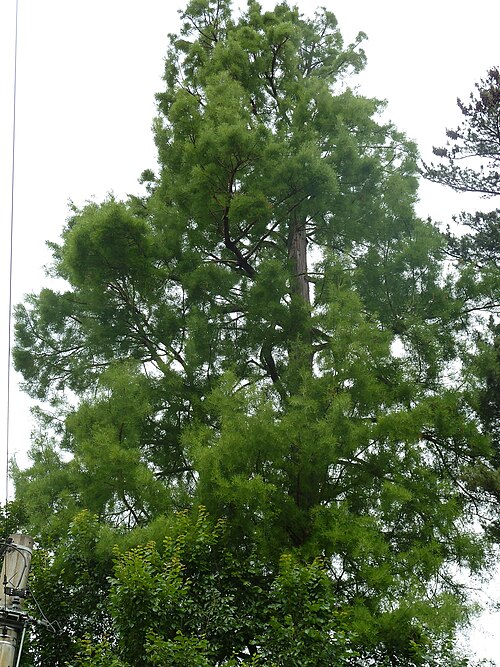
Bald Cypress (Taxodium distichum) · Plagwitz
A bald cypress on a Leipzig pavement is a long way from home. The species grows wild in the swamps of the American southeast, where its roots throw up woody knees through standing water; on a dry Plagwitz street it has none of that, just a straight trunk and the soft, feathery foliage that turns copper before dropping in autumn, unusual for a conifer.
The city protects it as a Naturdenkmal, standing directly beside a European white elm under the same designation. Neither the planting date nor the girth is in the record we could find, only the fact of its protection.
Four more protected trees stand within about 150 metres along the same street: a ginkgo, a copper beech and a Japanese pagoda tree among them, an unlikely collection of species for one short block. Bald cypress is also one of the few conifers that drops its foliage entirely for winter, needles and all, rather than staying evergreen, which is why the street looks bare under it by December where the ginkgo down the road has already dropped its own leaves weeks before.
Photo: Edlerin (CC BY-SA 4.0)
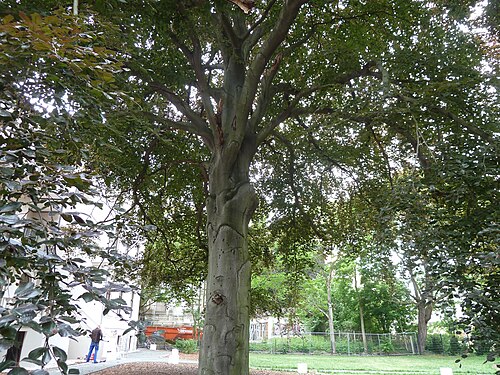
Copper Beech (Fagus sylvatica 'Purpurea') · Plagwitz
Copper beeches were a fashionable planting across nineteenth century Europe, their near-black foliage a deliberate contrast to the ordinary green beech beside them, and this one has grown large enough on Karl-Heine-Strasse to earn Leipzig's Naturdenkmal protection in its own right.
The colour comes from anthocyanin pigments masking the leaf's green chlorophyll, strongest in spring and fading toward a duller bronze by late summer as the pigment breaks down faster than the tree replaces it. It is the same genetic trait behind every copper beech anywhere, a single mutation propagated by grafting and cutting for centuries rather than a distinct species.
It stands a few doors from a Japanese pagoda tree under the same 1996 protection order, one of five Naturdenkmal trees within about 150 metres of each other on this stretch of street. Like any beech it carries smooth grey bark its whole life rather than developing the deep furrows of an oak or a plane, which is part of why beech trunks end up carved with initials more than most other species: the bark simply shows the cut and keeps it.
Photo: Edlerin (CC BY-SA 4.0)
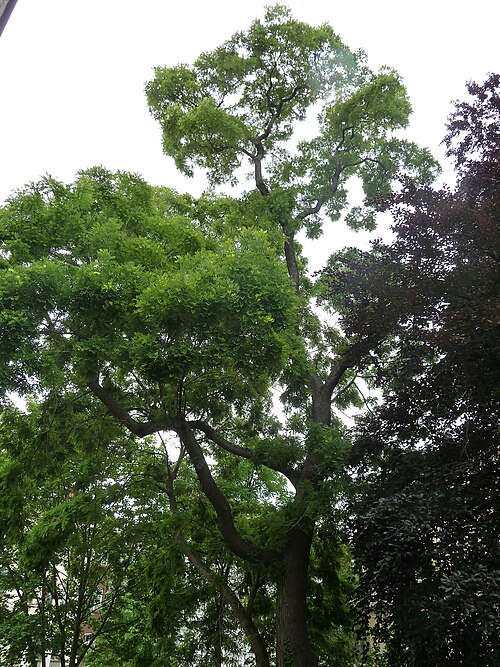
Japanese Pagoda Tree (Styphnolobium japonicum) · Plagwitz
Despite the name, the Japanese pagoda tree is native to China, not Japan; it reached Europe through Japanese trade ports in the eighteenth century and kept the misnomer. This one has grown large enough on a Plagwitz street to be protected as a Naturdenkmal, Saxony's strongest legal status for an individual tree.
It flowers late for a tree of its size, creamy white clusters in August when most other street trees have finished for the year, which is usually the detail that gets a pagoda tree noticed at all outside of botanical collections.
It stands a few doors from a protected copper beech, the last of five Naturdenkmal trees packed into roughly 150 metres of Karl-Heine-Strasse: a ginkgo, a European white elm and a bald cypress complete the run. In its native range the pagoda tree's unopened flower buds are harvested by the ton for rutin, a plant compound used in dyes and in vitamin supplements, a use this single street tree in Plagwitz will never see put to work.
Photo: Edlerin (CC BY-SA 4.0)
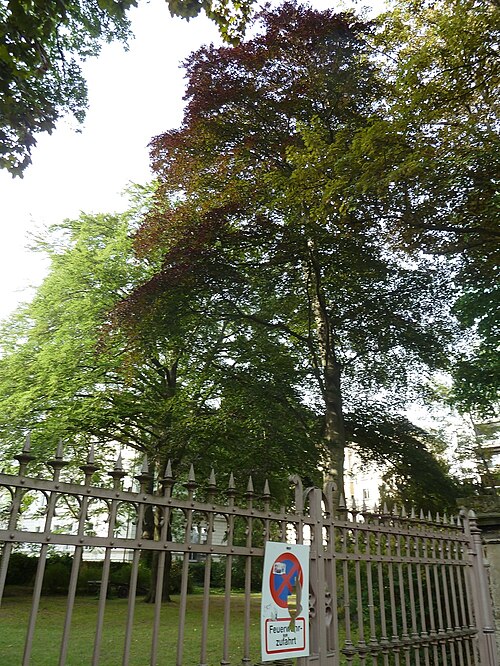
Fern-leaved Beech (Fagus sylvatica f. asplenifolia) · Leipzig
A fern-leaved beech carries leaves so deeply cut and narrow they barely register as beech foliage at all, a naturally occurring form of the common European beech that nurseries have propagated by grafting since the eighteenth century rather than a separate species. Leipzig protects this one under the same 1996 resolution that covers six other trees on this page, with a protected root zone 25 metres across, the largest of the three the city's own list records in detail.
It stands about a kilometre east of the Karl-Heine-Strasse cluster, on its own rather than part of a run of protected trees, on a residential street near Leipzig's inner ring.
No age or girth survives in what we could find, only the fact and date of its protection. The cut-leaf form was already being grafted and sold by German nurseries in the eighteen hundreds as an ornamental novelty, prized for a silhouette lighter and more open than an ordinary beech's dense dome. If you know more about this tree's history, tell us.
Photo: Edlerin (CC BY-SA 3.0)
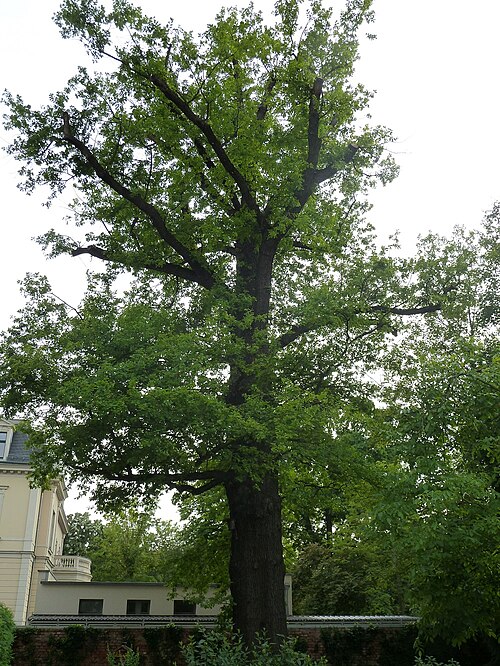
Pedunculate Oak (Quercus robur) · Leipzig
A pedunculate oak on Kaethe-Kollwitz-Strasse, named for the Leipzig-connected printmaker and sculptor, carries Leipzig's Naturdenkmal protection under the same 1996 resolution as six other trees on this page. Its protected root zone runs 23 metres across, evidence of real size even without a recorded girth or age.
Pedunculate oak is the common oak of northern European streets and parks, named for the short stalk, the peduncle, that carries its acorns clear of the twig, unlike the stalkless acorns of its close relative the sessile oak. Under German municipal protection it will now outlive the street around it by design rather than by accident.
It stands about a kilometre northeast of the Karl-Heine-Strasse cluster, close enough to fold into the same outing. A pedunculate oak this size is also feeding a small ecosystem nobody sees from the pavement: the species supports more insect life than almost any other tree native to Britain and central Europe, from gall wasps that shape its acorns into hard, marble-sized growths to the moth caterpillars that keep every tit and warbler in the neighbourhood fed each spring.
Photo: Edlerin (CC BY-SA 3.0)
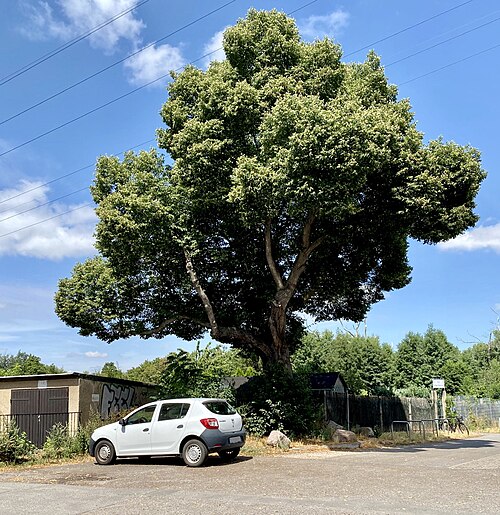
Small-leaved Lime (Tilia cordata) · 200-300 years · Schönefeld
Adolf von Menzel drew this lime into his sketchbook, and it is still standing on the corner where he found it. The study is titled "Alt-Schoenefeld Villa Lazarus": Menzel came here as a guest of the philosopher Moritz Lazarus, whose summer house stood on the plot now taken by the Schoene Heimat allotment gardens. Theodor Fontane, Paul Heyse and Clara Wieck are among the other visitors recorded at that house. Menzel noted something a visitor can still check in July: bee swarms working the flowering crown.
The tree carries his name now. It is a small-leaved lime about 15 metres tall, with a crown 14 metres across and a trunk 3.50 metres round. Its age is an estimate of 200 to 300 years, and it will stay an estimate, because the trunk has no heartwood left inside it and there are no rings to count.
It has been patched, not pampered. After a lightning strike an iron ring was fitted around it, a repair the local story attaches to Lazarus's time, and the bark has since grown over the metal. Today straps and iron rings brace the main limbs of the crown.
Leipzig protected it as Naturdenkmal number 55 in 1996, with a protected zone 16 metres across. A sign stands at its foot, which is the easiest way to be sure you have the right tree.
Photo: Caisare (CC BY-SA 4.0)
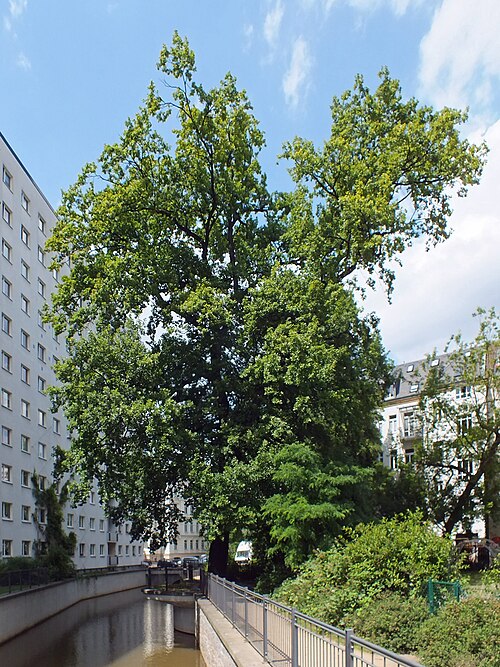
Pedunculate Oak (Quercus robur) · Zentrum-Sued
Leipzig keeps a protected zone around every one of its natural monuments, and this oak's is 33 metres across, as wide as any on the city's list. That number is the register's way of saying how far the roots and crown are judged to reach, and here it means a canopy that fills the whole gap between two apartment blocks.
The oak stands beside the Pleissemuehlgraben, one of the narrow mill canals that carried the river Pleisse's water through the city, with a public footpath and a railing along the bank. From the path you see it at its best: a broad, many-limbed pedunculate oak rising out of a channel lined with concrete and housing, the one thing in the view that is not a right angle.
The city designated it Naturdenkmal number 46 in the late 1990s. Beyond that the record is thin. The register gives no height, no girth and no age, and nobody we know of has published a measurement. A tree this broad in a dense inner district is unlikely to be young, but unlikely is not a date, and this page will not pretend otherwise.
So it is a question rather than a number. If you pass it with a tape measure, the trunk's circumference at chest height would tell us more than any guess. Send it to us and the page will carry it.
Photo: Martin Geisler (CC BY-SA 3.0)
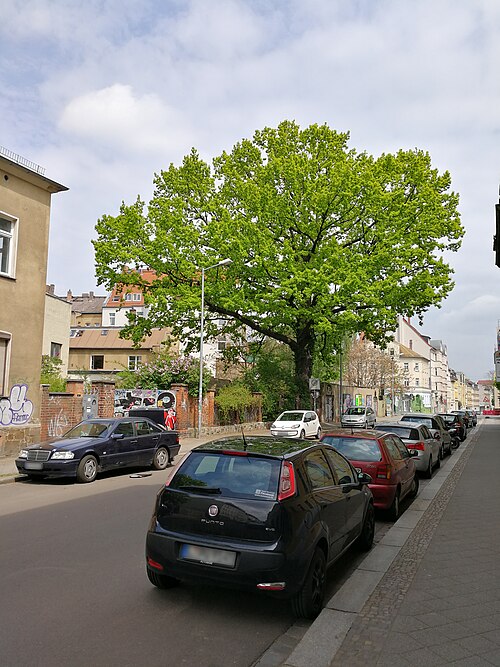
Pedunculate Oak (Quercus robur) · Lindenau
Lindenau has two protected oaks within 150 metres of each other, and this is the one that hangs over a brick wall. Its crown spreads across Demmeringstrasse and above the parked cars, wide enough that in May, when the new leaves are still the acid green of spring, it is the brightest thing in the street.
Leipzig listed it as Naturdenkmal number 7 under resolution 601/96, the same 1996 decision that protects the villa trees of Karl-Heine-Strasse. The register draws a protected zone 20 metres across around it. That is all the paperwork holds: no girth, no height, no age.
The setting does the rest. This is a street of tenement blocks, parked cars and graffiti, and a single oak with a crown that size turns it, for one stretch, into something closer to a village lane. A pedunculate oak can live for many centuries; how much of that this one has used up is not recorded.
It makes a short walk with its neighbour on Karl-Ferlemann-Strasse, round the corner to the north-west. A third protected tree, a wych elm at Demmeringstrasse 77, stands on a plot close by, possibly behind a fence, and has its own entry on this page.
Nobody has dated this oak. If you know when it went in, or have measured the trunk, tell us.
Photo: Pixelkaktus (CC BY-SA 4.0)
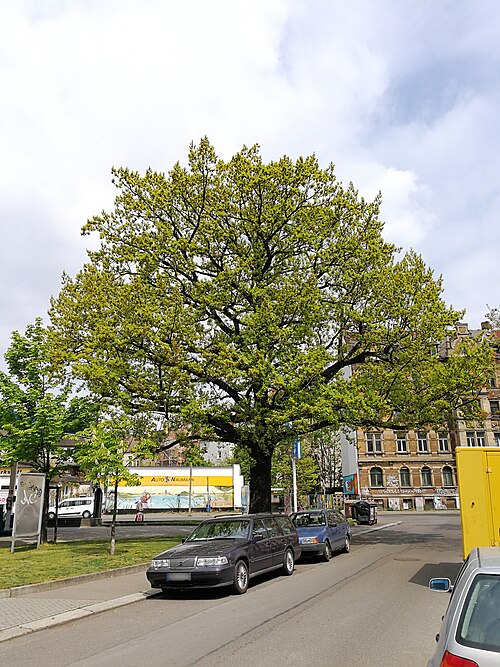
Pedunculate Oak (Quercus robur) · Lindenau
Of Leipzig's protected street oaks, this is the one with room to be seen. It stands on an open corner of Karl-Ferlemann-Strasse with a strip of lawn beside it and open ground around it, so the crown has grown the way an oak grows when it is left alone: broad, round and almost symmetrical, on a single dark trunk.
That matters more than it sounds. Several of the protected trees on this page stand behind villa railings or garden walls, and you see them in pieces. Here you can stand back across the street and take in the whole tree in one look, which is the closest thing in Lindenau to the field oak of a village green.
Leipzig listed it as Naturdenkmal number 8 in 1996, under resolution 601/96, with a protected zone 20 metres across. The register stops there. It gives no girth, no height and no age, and no other source we have found fills the gap.
The second protected oak of this short walk stands about 150 metres away on Demmeringstrasse, its crown hanging over a brick wall: two oaks, two very different settings, five minutes apart on foot.
Nobody has dated this tree. If you know its history, or measure the trunk at chest height, tell us.
Photo: Pixelkaktus (CC BY-SA 4.0)
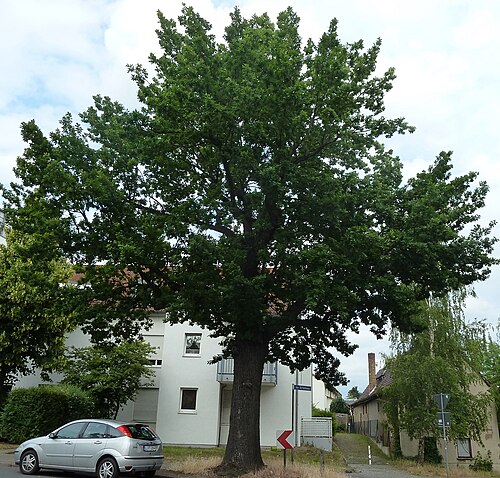
Pedunculate Oak (Quercus robur) · Wahren
Leipzig's register calls this tree the Friedenseiche, the peace oak, and then says nothing about which peace. German towns and villages planted peace oaks to mark the end of more than one war, usually on a square or at a crossroads where everybody would pass them. This one stands exactly there, at the junction of Am Hirtenhaus and Rittergutsstrasse in Wahren, but the city's list gives no planting year and no occasion, and we will not supply one.
The street names do some of the remembering. Am Hirtenhaus means at the herdsman's house, and Rittergutsstrasse is named for a manor estate: the vocabulary of the village Wahren was before Leipzig absorbed it in 1922. The oak now stands among apartment blocks, signposts and a parked car or two, tall and upright on a single straight trunk, the oldest-looking thing at the crossing by a distance.
The city protects it as Naturdenkmal number 92, with a zone 21 metres across. There is no recorded girth, height or age, so its title is the only history on file.
That makes it the most answerable question on this page. Somebody in Wahren may know when the peace oak went in and what it was planted for, from a parish chronicle, a plaque that has since gone, or a grandparent. If that is you, tell us, and the page will say it.
Photo: Edlerin (CC BY-SA 4.0)
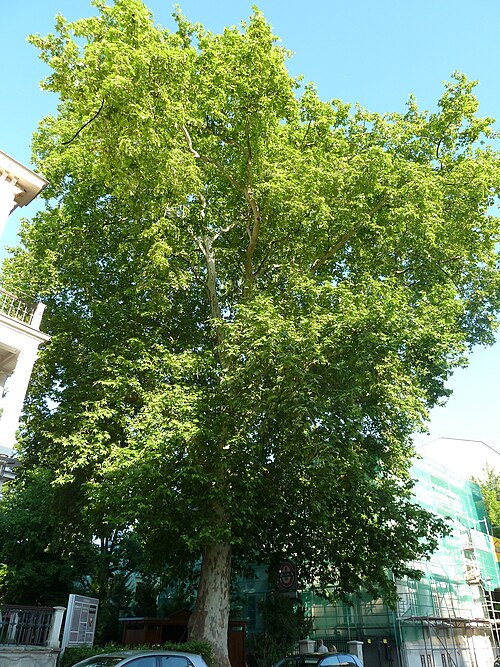
London Plane (Platanus x acerifolia) · Nordvorstadt (Gohlis-Sued border)
The trunk of this plane stands flush with the street edge on Leibnizstrasse, so the pavement walks right past a pale, flaking column you cannot miss. Look up and the crown keeps going: it rises above the villa roofline on both sides, and Leipzig's register gives it a protected zone 27 metres across, one of the wider zones any plane on the city's list is granted.
Planes are the great survivors of nineteenth-century streets. They tolerate compacted soil, cut roots and soot, and they shed their bark in plates, which is why the trunk reads as a patchwork of cream, olive and grey. Those are the habits that keep a tree like this going on a street where the villas beside it are still being scaffolded and restored.
The city designated it Naturdenkmal number 138 in the late 1990s. The record says nothing about when it was planted, how tall it is or how big the trunk has grown.
It has company. A second protected plane, number 131, is listed about 65 metres to the west at Gustav-Adolf-Strasse 19. We have not confirmed that it can be seen from the street, so look for it on the way rather than counting on it.
The trunk itself stands at the front of a private property: view it from the pavement and do not go in. If you measure its girth, tell us.
Photo: Edlerin (CC BY-SA 4.0)
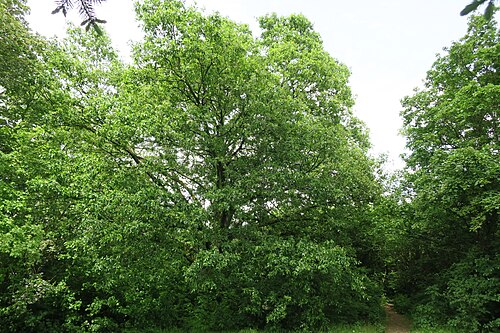
Lebanon Oak (Quercus libani) · Schoenau
Lebanon oak belongs on the slopes of the Levant and the Taurus mountains, not on the western edge of Leipzig. Yet here it is, a natural monument in Schoenau, standing in a green corridor beside a footpath, and an unusual name to find on a German city's list of protected trees.
Up close it does not look like the oaks you know, and the leaves are why. Instead of the rounded lobes of a pedunculate oak, Quercus libani carries long, narrow leaves edged with small bristle-tipped teeth, closer at first glance to a sweet chestnut than to anything a German child would draw as an oak. Its acorns take two summers to ripen rather than one.
Leipzig protects it as Naturdenkmal number 91, with a protected zone 18 metres across. The city's list says nothing about who planted a Levantine oak on this spot, or when, and it gives no girth or height either. A photograph taken in May 2024 shows it in full leaf, which makes it the most recently confirmed tree of this group.
It is also the outlier: out on the city's western edge, kilometres from the Plagwitz villa trees, so this is a separate trip rather than part of the walk. Look at the leaves first, then at any oak you pass on the way back, and the difference is obvious.
If you know how this tree got here, tell us.
Photo: Vinaceus (CC BY-SA 4.0)
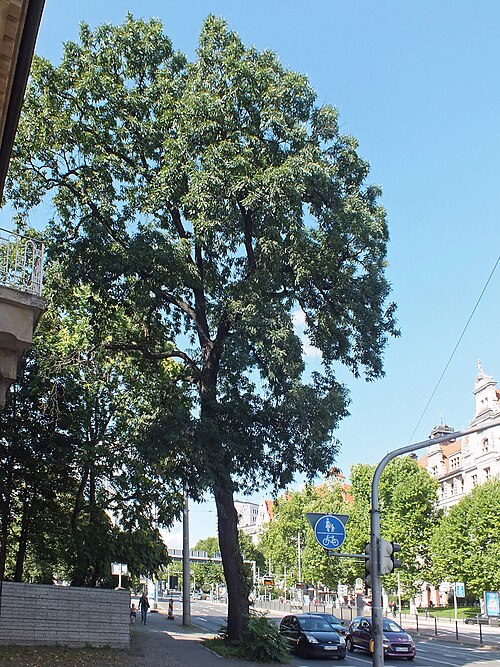
Sessile Oak "Mespilifolia" (Quercus petraea "Mespilifolia") · Zentrum
Number 1 on Leipzig's list of natural monuments is not a giant in a park. It is a street tree on the inner ring road, a few hundred metres from the Markt, with trams and traffic running past its roots.
It is also stranger than it looks from the kerb. The register records it as Quercus petraea "Mespilifolia", a cultivar of the sessile oak whose leaves are long and narrow, shaped more like a medlar's than an oak's, with little or none of the lobing that makes an oak leaf an oak leaf. Seen from the pavement, the crown looks finer and lighter than an ordinary oak's. We have taken the cultivar from the register; nobody we know of has checked it leaf in hand, and if you do, tell us what you find.
The road it stands on carries history of its own. Leipzig's Ring is the road the Monday demonstrators of autumn 1989 made famous, tens of thousands of people walking the circuit of the old town week after week. Nobody has dated this oak, so whether it was already standing that autumn is a question the record cannot answer.
The city protects it with a zone 14 metres across, small beside the 33 metres of the Dufourstrasse oak, which is what a pavement leaves room for. Its girth and height are unrecorded. A tape measure would settle the first.
Photo: Martin Geisler (CC BY-SA 3.0)
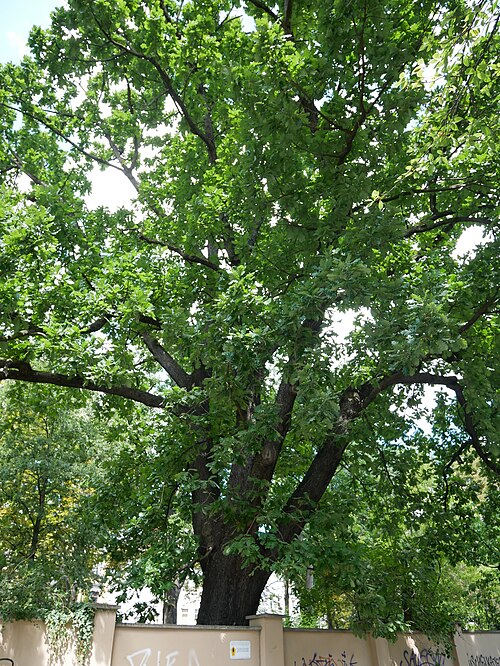
Hungarian Oak (Quercus frainetto) · Plagwitz
The tallest tree in Leipzig's register of natural monuments is not a native. It is a Hungarian oak, a species from south-east Europe, and the city lists it at 33 metres.
No beech, plane or lime on that list is given a bigger figure. And it does not stand in a park or a villa garden. It stands at an ordinary street address on Erich-Zeigner-Allee in Plagwitz, the canal-cut district west of the centre that Leipzig built for its factories. The city protects it as natural monument number 59, under council resolution 601/96.
Hungarian oaks are rare this far north, and the leaves give one away: big, and cut into many deep, regular lobes, nothing like the small rounded leaves of the oaks Saxony grew up with. It was photographed in August 2022, and an observation was logged at the spot in October 2025, so as far as anyone has recorded, it is still up there.
What it has lived through, we cannot honestly tell you. Nobody has published its age or the size of its trunk. If you have stood beside it with a tape measure, or know when it was planted, tell us.
One caution on the pin. It marks the register's point and has not been checked against aerial imagery. Whether the trunk stands on public ground or in a yard behind number 43a is not established either, so look from the street and stay out of private yards.
Photo: Vinaceus (CC BY-SA 4.0)
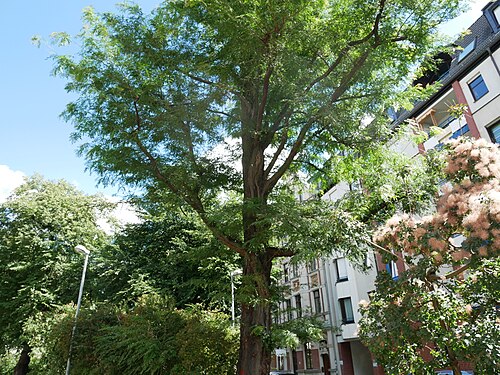
Honey Locust (Gleditsia triacanthos) · Plagwitz
Outside the old town hall of Plagwitz, Leipzig protects a tree from the other side of the Atlantic: a honey locust, a North American species that arms its trunk with branched thorns.
It is not a giant. The city's register gives it 13 metres, well under half the height of the tallest tree on the same list. It is natural monument number 66, protected under council resolution 601/96. What it has instead is an address. The former Rathaus Plagwitz is a relic of the years when Plagwitz was a town of its own, the industrial suburb that grew up along the canals west of Leipzig before the city absorbed it. The tree stands on Alte Strasse beside that building, on the pavement side as far as the register's description goes.
Nobody has recorded when it was planted, so whether it saw the council of an independent Plagwitz come and go is anybody's guess, and we will not pretend otherwise. No girth has been published either. If you know its story, tell us.
The leaves are the thing to look at up close: fine and feathery, split into dozens of small leaflets, so the crown throws a light, broken shade rather than the solid shadow of a lime. It was photographed in 2022 and logged again at the spot in April 2024.
It also makes an easy start to a short walk. The copper beech and the Japanese pagoda tree on Karl-Heine-Strasse are about 250 metres away.
Photo: Vinaceus (CC BY-SA 4.0)
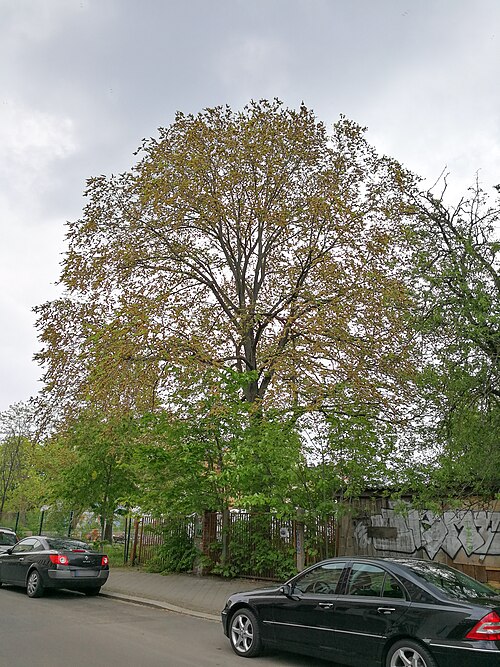
Wych Elm (Ulmus glabra) · Lindenau
Dutch elm disease has been killing Europe's elms since the last century, wych elms among them, which is why a living, protected one in a Lindenau street is worth the detour.
Leipzig lists it as natural monument number 6, on the plot at Demmeringstrasse 77, under council resolution 601/96. The register gives it 14 metres and nothing else: no girth, no age, no reason recorded beyond the designation itself. So we will not invent one. How old it is, and whether it was already standing when the epidemic swept through, nobody has published. If you know, tell us.
What we can say is that it is alive. It was photographed in full leaf in May 2017, and an observation was logged at the spot in August 2025.
Wych elms are the elms of hillsides and riverbanks, and they are easy to tell apart once you have handled a leaf: big, rough as fine sandpaper on top, lopsided where it meets the stalk, and sometimes ending in a few extra points. In early spring, before the leaves, the twigs carry clusters of flat, papery seeds.
It is also the third tree on a short walk. The Oak of Demmeringstrasse, its crown hanging over a brick wall, and the Oak of Karl-Ferlemann-Strasse both stand about 200 metres away.
The pin is the register's point and has not been checked on aerial imagery. The elm may stand behind a fence, so look from the street.
Photo: Pixelkaktus (CC BY-SA 4.0)
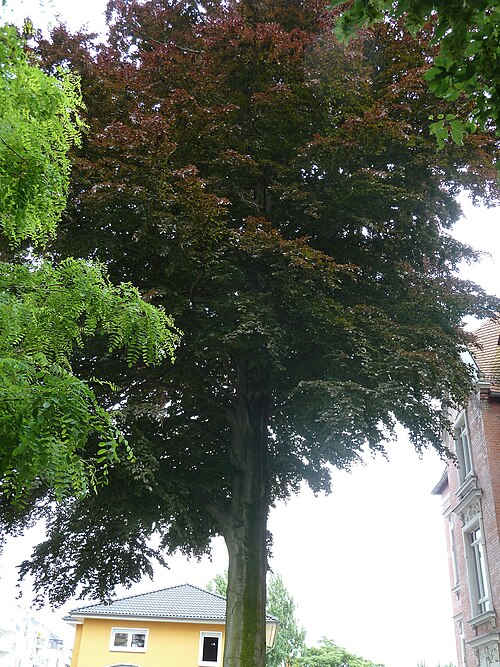
Copper Beech (Fagus sylvatica 'Purpurea') · Moeckern
This copper beech is 23 metres tall on Leipzig's register, and the most recent proof we can find that it still stands is a photograph taken in June 2015.
That is the honest state of it. The city protects the tree as natural monument number 64, at Kirschbergstrasse 48 in Moeckern, under council resolution 601/96. The register gives a height and nothing more: no girth, no age, no date of planting. And nobody seems to have photographed or logged it since. Beeches are not immortal, and a decade is a long silence. If you walk past, tell us whether it is still there, and if you know how old it is, tell us that too.
Moeckern is a name in the history books. On 16 October 1813, on the first day of the Battle of Leipzig, Prussian and French troops fought over the village street by street, and it changed hands several times. Nobody claims this beech saw it, and with no age on record nobody could.
What it would show you is colour. A copper beech is a European beech with purple leaves, and at 23 metres this one is a big example of a tree people usually plant for the effect: the leaves open a translucent red in spring, darken almost to black by summer and turn copper before they fall.
The pin is the register's point only, and whether the tree stands on public ground or inside the plot is not established. Look from the street.
Photo: Edlerin (CC BY-SA 4.0)