In September 2020 the city of Dordrecht worked out how old the black locust in Park Merwestein actually is, and came back with 300 to 325 years. That makes it one of the few trees in the country with a municipal investigation behind its age instead of a guess. The rest of this page is a plane in a charity courtyard built in 1625 by a man trying to fix his reputation, a beech where a synagogue used to stand, and a tree of heaven surviving on nothing but paving.
0 of 17 visited in Dordrecht
Black Locust (Robinia pseudoacacia) · 300-325 years · Merwestein
Somebody actually checked. In September 2020 the municipality investigated this tree and put it at 300 to 325 years old, which is a far better answer than almost any tree on this site can offer, and it agrees with the national register's independent band of 1700 to 1750.
What makes the number remarkable is the species. Black locust is North American, from the Appalachians, and it reached Europe at the start of the seventeenth century, named after Jean Robin, the French royal gardener who is credited with planting the first one in Paris. A specimen planted in Dordrecht around 1700 belonged to the first wave of them in this country, when the tree was still an expensive curiosity rather than the roadside coloniser it later became.
It has aged the way black locusts do, which is dramatically. The bark on an old one turns into deep, twisting, rope-like ridges, the trunk usually leans or forks, and the wood is so rot-resistant that the tree keeps standing in a state that would have finished anything else.
In late May and early June it hangs with white pea flowers that smell strongly of honey. Three hundred years and it still does that every year.
London Plane (Platanus x acerifolia) · 205-215 years · Centrum
This courtyard was built by a man with a reputation problem.
Arend Maartenszoon was known in Dordrecht as a money-grubber. In 1625 he put up 38 dwellings for the poor of the city and attached his name to them, which is the oldest form of reputation management there is and, four hundred years later, has worked: the Arend Maartenshof is still standing, still housing, and still called after him.
The plane came much later, banded 1810 to 1820, so it went in when the court was already nearly two centuries old. That is the usual pattern for an almshouse yard. The buildings come first, the tree arrives when somebody decides the middle of the square ought to have something in it, and then it grows to be the thing everyone actually remembers.
A hofje with a big tree in it is one of the best small spaces the Netherlands produces: low houses on four sides, a gate off a busy street, and a sudden drop in noise. This one is a working example rather than a museum, so go quietly.
The bark flakes in cream and olive plates, and the seed balls hang through the winter.
Silver Maple (Acer saccharinum) · 125-135 years · Weizigt
It was standing in a field for half a century before anyone made a park around it.
The Weizigtpark grew out of the country estate of the same name, but the corner this maple occupies was not part of the designed grounds at all. It was grazing land, and it was only laid out as park in about 1947. The register bands the tree 1890 to 1900, which puts it in the meadow, decades ahead of the paths and the planting.
That explains its shape if you look. A tree that grows up in open ground with nothing crowding it spreads low and wide and keeps its bottom branches, while a tree grown in a plantation is drawn up tall with a narrow crown and a clean trunk. The old meadow trees in a Dutch park are usually the broad ones.
Silver maple is worth knowing for two things. The leaf is cut into five narrow lobes and is bright white underneath, so the whole crown flickers pale in wind. And it flowers in March, before any leaf, in small red and yellow tufts directly on the bare twigs, weeks before anything else in the park does anything at all.
Copper Beech (Fagus sylvatica f. purpurea) · 165-175 years · Centrum
The name of the square says what happened here: a pig market, and a lively livestock trade for a long time. Near this tree there was also a synagogue, which was pulled down in 1965.
So the beech is standing in a piece of Dordrecht that has been comprehensively emptied of its old uses. The animals went, the congregation's building went, and the courtyard by number 70 is now a quiet interior space with a very large purple tree in it.
The register makes a point about this one that it rarely makes: it is growing in a natural rooting position, and its trunk base and the ground around it are unrestricted. That is close to unheard of for a mature beech in a city centre. Almost every urban beech is slowly strangled by paving over the root plate, so a big one with open soil around its flare is a tree that has had what it needed, and it shows in the size.
Worth seeing in April as much as in October. Copper beech opens its leaves a translucent red that darkens to purple within a fortnight, and in an enclosed courtyard the light through them is extraordinary.
London Plane (Platanus x acerifolia) · 175-185 years · Dordwijk
The estate was laid out around 1635 and was then called the Torensteedje. At the entrance there is still a castle farm, part of which dates from that founding period, which is close to four hundred years of the same buildings being used for the same purpose.
The plane is nothing like that old. Banded 1840 to 1850, it belongs to the second half of the estate's life, when Dordwijk was being reworked the way most Dutch country places were in the nineteenth century: the formal geometry of the seventeenth century replaced with lawns, clumps and winding approaches, and single specimen trees planted where they would be seen from the house.
That is what this tree is. Not part of an avenue and not part of a wood, but a chosen thing placed in a view, near the house called Sorghvliet.
Planes were the fashionable choice for exactly that role: fast, huge, and with bark that keeps a pale flaking pattern all year, which makes one visible from a long way off across grass in any season.
The register records the estate as visitable, but it is private ground south of the city, so it is worth checking access before you go.
Tree of Heaven (Ailanthus altissima) · 115-125 years · Centrum
Nobody plants these on purpose any more, which is why the oldest one in Dordrecht is worth going to look at.
Tree of heaven came from China, arrived in Europe in the eighteenth century as an ornamental, and was planted hard in cities because it grows faster than anything else and does not care about bad soil, drought or fumes. Then it turned out that it seeds prolifically, suckers aggressively through paving and cellars, and poisons the ground against competitors with a chemical in its roots. It is now one of the most unwanted plants in Europe.
This one predates all of that argument. Banded 1900 to 1910, it is the oldest of its kind in the city, and the register makes a point of saying it holds up well in its very stony surroundings, which is the whole nature of the species in one sentence.
You reach it through a small street behind the Botgensstraat, which is exactly the sort of leftover urban gap it thrives in.
Enormous compound leaves up to a metre long, and in late summer dense bunches of papery winged seeds that often turn a rusty red. Crush a leaf and it smells unpleasant. That is diagnostic.
Large-leaved Lime (Tilia platyphyllos) · 165-175 years · Louter Bloemen
This small park is all that is left of a country place, and it reads like one the moment you walk in: dominated by tall beeches, with the light already gone by the time it reaches the ground.
The lime is one of two standing close together. This one is a large-leaved lime and beside it is a big small-leaved lime, which is a useful accident, because those two species are the parents of the common lime planted everywhere in this country and are far less often seen themselves.
The difference is easy in the hand. Large-leaved lime has bigger, softer leaves with fine hairs on the underside and on the stalk, and it flowers first, in June. Small-leaved lime has smaller, hairless, bluish-backed leaves with rusty tufts in the vein angles, and flowers two to three weeks later. Standing between the two of them is the cheapest botany lesson in Dordrecht.
Both are banded to the middle of the nineteenth century, which puts them in the estate planting rather than in anything the city did later.
Go in late June, when the large-leaved one is out and the whole park smells of it and hums.
Pond Cypress (Taxodium ascendens) · 125-135 years · Weizigt
A swamp tree from the American South is quietly thriving by a Dutch park entrance, more than a century after somebody decided a cypress relative was worth the gamble.
The pond cypress standing near the old coach house at Weizigtpark went into the ground somewhere between 1890 and 1900, making it over 125 years old and, according to the tree registry that tracks it, genuinely rare in the Netherlands: few pond cypresses here have had this long to grow. Unlike its swamp-dwelling relatives back home in Florida and the Carolinas, it needs no flooded ground to get through a Dutch winter, just ordinary parkland soil by the entrance path.
The coach house behind it, built in 1886 to serve the estate that later became this park, is older than the tree by only a few years, so the two have effectively grown old side by side.
About 350 metres away, the park's Silver Maple already stands on this list, so Weizigtpark now holds two entries from two different continents, planted decades apart by people who evidently liked their trees unusual.
Pedunculate Oak (Quercus robur) · 195-205 years · Weizigt
Nobody has counted this oak's rings. The national monumental tree register dates it to between 1820 and 1830, and it reached that band by counting the rings of the tree that stood beside it, one of the same generation, after that one was felled. The oak's age, roughly 195 to 205 years, is inherited from a neighbour that is no longer there.
It grows in the wooded strip that runs along the railway at the edge of the Weizigtpark, about five hundred metres from Dordrecht station. The city rebuilt Weizigt in 2024, redoing the paths, the water and the banks, and the strip along the tracks still carries its mature trees. That makes this oak the third stop on a walk that already had two: the silver maple stands about 170 metres away and the pond cypress about 265, all three inside the same park and all three on the register.
Pedunculate oaks of two centuries are common enough in the Netherlands that one rarely gets a plaque. What is uncommon here is the paperwork. The register does not pretend to a measurement it never made; it writes down whose rings were counted, and that the tree they belonged to is gone. Nobody has examined this oak in its own right, so the age stays a band rather than a year.
Common Lime (Tilia x europaea) · 86-96 years · Spuiboulevard
This lime has been spared once already. When the apartment blocks went up on the Spuiboulevard in 2004 the tree was kept, and the national register records that in one line: bij de bouw van de appartementencomplexen in 2004 is deze boom behouden. It was planted between 1930 and 1940, so it was about seventy then and is roughly 86 to 96 now. The Dutch call the species Hollandse linde; it is the hybrid that lines half the country's canals.
The boulevard is being rebuilt again. In January 2026 the city lifted 28 mature limes off the east side of the street near the Dordthuis and replanted them at four other sites around Dordrecht, which is an expensive way to keep a tree and better than the usual alternative. Those 28 are described as about thirty years old, planted in the 1990s, so they are a different generation from this one entirely. Whether this tree still stands because someone decided again to leave it, or because the works have not reached its side of the road yet, no source says outright.
It is on the canalside verge opposite number 250, one of a row of mature limes, on public ground with nothing between it and the pavement. Recent aerial photography still shows the row standing, construction plant working nearby.
Oak-leaved Hornbeam (Carpinus betulus 'Quercifolia') · 166-176 years · Merwestein
Two different leaves grow off the same twigs on this hornbeam: some lobed like an oak's, some plain like an ordinary hornbeam's. That is exactly what the cultivar name says, Carpinus betulus 'Quercifolia', the oak-leaved hornbeam, and it is a genuine grafting curiosity rather than a description anyone exaggerated.
The national register bands its planting to 1850 to 1860, which puts it at roughly 166 to 176 years old. It has spent that whole span beside the path that circles the deer enclosure in Park Merwestein, one of Dordrecht's older public parks. A tree like this is exactly what a Victorian-era planting scheme reached for: something a nurseryman had found doing something odd, worth a spot in a park built for paying visitors to stroll through.
Dordrecht's own walking route, run by the local Bomenridders, stops here as number eight of nine and leads with the same two-leaf trick, which is a good sign the oddity still reads clearly a century and a half on.
No girth has ever been recorded for it. That is unremarkable among Dutch register trees, but worth saying plainly rather than leaving the field blank without comment.
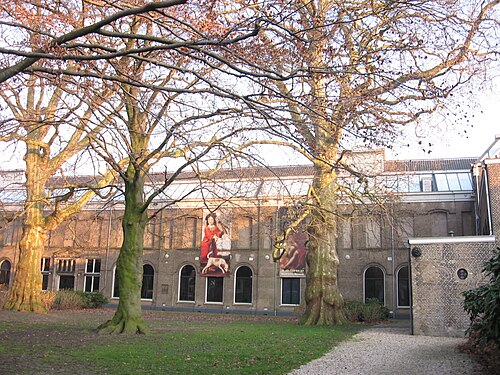
London Plane (Platanus x acerifolia) · 176-186 years · Centrum
Three plane trees in the museum's garden have outlived every renovation the building around them has had, because they arrived first.
The Dordrechts Museum opened in 1842 in the old Boterbeurs, one of the oldest museums in the Netherlands, founded by a group of the city's more public-spirited residents. The national tree register bands the planes to 1840 to 1850, which means they went into the ground within a few years of that opening rather than growing up around an institution already established. The museum's own account of its garden agrees, putting the planes at 100 to 200 years old and crediting them with having watched the whole of that development, and millions of visitors, walk past.
Two later plantings followed: a chestnut avenue leading to the front door, and younger beeches nearer the garden gate (a separate entry on this page). The planes are the ones that were already there before any of it.
No girth is on record for any of the three. Seeing them means buying a ticket: the garden sits inside the museum grounds rather than open to the street.
Photo: Michiel1972 (CC BY-SA 4.0)
Copper Beech (Fagus sylvatica f. purpurea) · 101-146 years · Centrum
Nobody, including the register that lists them, is sure which of these three beeches is the old one.
Two copper beeches and one green beech stand together by the garden gate at the Dordrechts Museum. The national tree register records a 2020 girth of 315 and 300 centimetres for the copper pair and 300 for the green one, and its own history note says one of the three would date from 1880 and the other two from 1925, then adds that nobody has yet tracked down where that claim comes from. That puts the group at somewhere between about 100 and 145 years old, an honest range rather than a tidy number.
The museum's own account of its garden calls the oldest of the three, standing along the fence, a tree with a full, well-shaped crown, and notes that beeches like these can live 200 to 300 years if their shallow, sensitive roots are left undisturbed. That may be exactly why nobody has put a spade near them to settle the dating question.
They share the garden with three older plane trees from the museum's founding years. Reaching them means a museum ticket.
London Plane (Platanus x acerifolia) · 136-146 years · Centrum
The national tree register knows the decade this plane was planted and admits it knows nothing else. Under history, the entry says: unknown.
What it does give is a planting band of 1880 to 1890, which puts the tree somewhere around 136 to 146 years old, that the municipality owns it, and that visitors are welcome. Nobody has ever put a tape around the trunk. There is no girth figure in the file at all, which for a monumental plane in the middle of a Dutch city centre is an odd blank.
It stands in the Willem Kes Plantsoen, the small public square on Sint Jorisweg named after the conductor born in this city, directly in front of the Kunstmin theatre. So it has spent well over a century watching audiences arrive in daylight and leave in the dark, and it has stood through everything the twentieth century sent down this street.
Dordrecht signposts it, which is the useful part. The city's own Bomenridders walking route, the Tree Knights, stops at the theatre at Sint Jorisweg 76 and names this plane alongside the white horse chestnut about 25 metres away. That turns the visit into a two-tree errand on one small green rather than a single stop.
If anyone has measured that trunk, tell us and we will add the number.
Horse Chestnut (Aesculus hippocastanum) · 136-146 years · Centrum
In May this tree puts up its white flower candles directly in front of a theatre entrance, which is about as well staged as a chestnut gets.
The national register lists it as a witte paardenkastanje, a white horse chestnut, planted somewhere between 1880 and 1890 and so roughly 136 to 146 years old. The city owns it, the file marks it as visitable, and the reason recorded for its protected status is simply that it is monumental. Under history the entry is blank, and so is the line where a girth would go. For a tree of this size on public ground in the old centre, that is a gap somebody with a tape measure could close in a minute.
It shares the Willem Kes Plantsoen with a plane of the same planting band, standing about 25 metres away, which makes the two of them a single short errand off the theatre forecourt. Both have been in front of the Kunstmin theatre since the 1880s, through two world wars and every audience that has come and gone in between.
Dordrecht points visitors at it itself. The Bomenridders route, the city's own tree walk, lists the stop in plain words: white horse chestnut, Kunstmin Theatre, Sint Jorisweg 76. Come in May for the flowers, or in October when the conkers come down.
London Plane (Platanus x acerifolia) · 165-185 years · Nieuwe Haven
The museum that owns this plane and the national register that protects it are twenty years apart on when it went into the ground.
The register describes a sizeable tree from 1860, more than four metres round the trunk, with knob-like burrs swelling along the stem and its condition rated fair. The museum's own garden page says the plane, and the maple standing near it, were probably planted around 1840, which would put them here before the Van Gijn family arrived at Nieuwe Haven 30 in 1864. Neither source shows its working, so the age stays broad: somewhere between roughly 165 and 185 years.
Whichever date is right, the tree has spent its entire life inside one walled town garden a few streets back from the water, through the family's fifty-eight years in the house, through two world wars, and through the decades since the place became a museum.
Four metres of trunk is a lot of tree for a garden this size, and the reward for the ticket is unusual. The museum has put a terrace underneath it, so the visit is sitting down and looking up rather than standing at a fence. Adult entry runs to about 14 euro, and the plane is at the back of the house.
Variegated Sycamore Maple (Acer pseudoplatanus 'Variegatum'; exact cultivar not confirmed) · 136-146 years · Nieuwe Haven
This is the tree in the Huis van Gijn garden you can see without buying a ticket. The national register goes out of its way to record that the trunk and crown show from the Hoge Nieuwstraat, the street running along the back of the garden wall.
What the register will not tell you is exactly what it is. The entry says only bonte esdoorn, a variegated maple, with no Latin name attached. The marked leaves point at a variegated form of sycamore maple, and that is as far as the evidence goes; nobody has written down the cultivar. If you can name it, tell us and we will correct the page.
Its age is unsettled in the same way as the plane standing near it. The register gives a planting band of 1880 to 1890. The museum's own garden page groups the maple with that plane and says both were probably planted around 1840. That is a spread of roughly 136 to 186 years, and neither source shows its working.
The register is more confident about the state of it: three metres round, condition good, a fine trunk and a well-developed crown, growing at the edge of the garden along the wall. Under either date it was already here while the Van Gijn family still lived in the house.