Ferrara's five monumental trees stand across a UNESCO World Heritage Renaissance city. A gray poplar over 150 years old grows in the garden of Palazzo dei Diamanti, its diamond-fissured bark echoing the palace's famous facade. A short walk away, Parco Massari holds a hackberry and a ginkgo among the trees on Italy's first official monumental list, and the Biblioteca Ariostea's own ginkgo, first recorded in 1890, draws crowds every November for its colour. The thickest trunk belongs to an ordinary street plane on Viale Po.
0 of 5 visited in Ferrara
Gray Poplar (Populus canescens) · 150 years · Addizione Erculea
This gray poplar has grown in the garden of one of the Italian Renaissance's most recognisable buildings for more than a century and a half, long enough to have watched the palace's stone facade go from a private noble residence to a public gallery. Palazzo dei Diamanti, faced with 8,500 pointed marble blocks cut to look like diamonds, gives its name to the whole Renaissance addition to the city Duke Ercole I d'Este ordered in 1492, a planned extension that later helped earn Ferrara its UNESCO World Heritage listing.
The tree itself, 4.44 metres round and 24 metres tall, is a hybrid of white poplar and European aspen, identifiable by bark that starts pale gray with diamond-shaped fissures echoing the palace's own facade and darkens to brown with age. It was named to Italy's first official list of monumental trees under the 2013 protection law, recognised for both its age and its size.
A 2023 restoration of the garden finally opened the space properly to visitors, so a tree that had spent most of its life screening a private courtyard now grows in ground anyone can walk into.
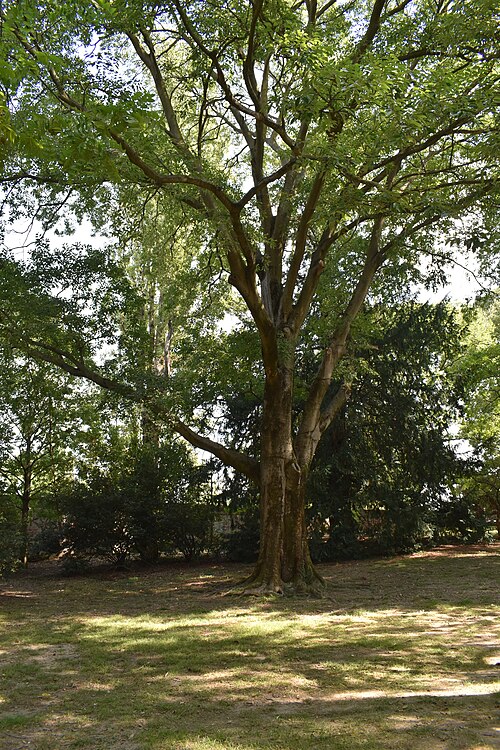
Mediterranean Hackberry (Celtis australis) · 150 years · Corso Porta Mare
Parco Massari has changed hands three times since architect Luigi Bertelli laid it out in 1780 for the Marchese Camillo Bevilacqua: to the Massari counts in the mid-19th century, who remade it as an English-style landscape park, and in 1936 to the city of Ferrara, which still owns it. This hackberry, about 150 years old, was already growing when that last transfer happened.
Its trunk runs 3.76 metres round, straight and fluted under gray bark, holding up a dense, rounded crown on branches wide enough in diameter to have earned it individual protection on Italy's first monumental tree list alongside the park's three cedars of Lebanon. Celtis australis takes its Italian name, bagolaro, from a Lombard word for a tool handle, a nod to timber once prized for exactly that; a second nickname, spaccasassi, rock-breaker, describes its willingness to root in poor, stony ground where softer species fail.
The species can live 600 years by some accounts, which makes a century and a half look like the opening chapter rather than the whole story.
Photo: Nicola Quirico (CC BY-SA 4.0)
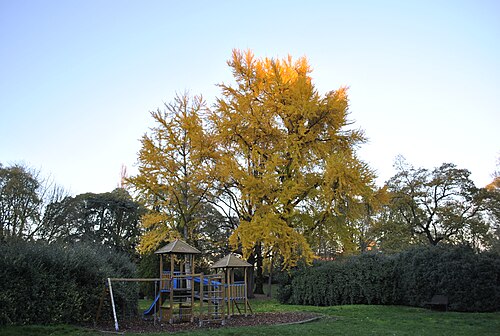
Ginkgo (Ginkgo biloba) · 100-150 years · Corso Porta Mare
Parco Massari's plant list runs long, planes, paulownias, horse chestnuts, magnolias, birches, limes, firs, pines, acacias, but the ginkgo is the one tree in it whose lineage predates the flowering plants surrounding it by tens of millions of years. This specimen, 3.80 metres round and 25 metres tall, grows among the park's other monumental trees, the three cedars of Lebanon and the bagolaro that made Italy's first official protected-tree list together.
Ginkgo biloba is the last living species of an order that once grew across the northern hemisphere and had been reduced, by the time European botanists took an interest, to a handful of cultivated groves in China. It survives poor soil, pollution and pests that would finish off almost anything else, and it turns a hard, uniform gold in autumn rather than the mixed colours most deciduous trees show.
The park itself was laid out in 1780 for a marchese, remade as an English landscape garden by the Massari family in the 19th century, and sold to the city of Ferrara in 1936, so this tree has spent at least part of its life under each of those owners.
Photo: Nicola Quirico (CC BY-SA 3.0)
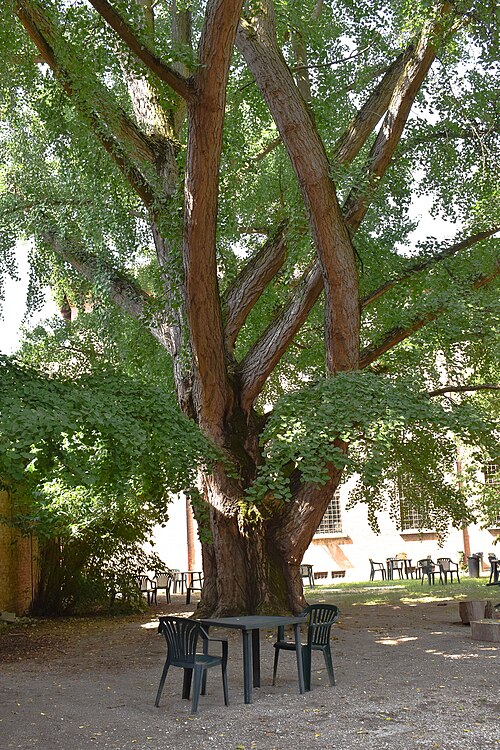
Ginkgo (Ginkgo biloba) · 130 years · Centro Storico
The first written record of this tree dates to 1890, and it did not start out in a library garden. It is a survivor of the University of Ferrara's old botanical garden, once kept in the courtyard of Palazzo Paradiso, the building that now houses the Biblioteca Ariostea, the city's historic public library. When the university's collection moved on, this ginkgo did not go with it.
At 4.65 metres round and about 20 metres tall, with a canopy wide enough to fill the courtyard it stands in, it is a male tree, which means it never produces the strong-smelling fruit that gives female ginkgos their bad reputation, only the fan-shaped leaves that turn a uniform gold every autumn and draw crowds specifically to photograph it. Local papers cover the display most years, treating a single tree changing colour as news, which is a fair measure of how much the city has come to value it.
Ginkgo biloba's lineage runs back some 250 million years, effectively unchanged, a genuine living fossil rather than a marketing phrase. A specimen first recorded in a 19th century university garden and still standing in the 21st is, by the standards of its own family tree, barely middle-aged.
Photo: Nicola Quirico (CC BY-SA 4.0)
London Plane (Platanus x acerifolia) · Viale Po
The thickest trunk on this page belongs to a street tree rather than to anything growing in a park or a palace garden. This London plane on Viale Po measures 5.40 metres round, on a tree 20 metres tall, and the city has nominated it, along with a short list of other exceptional specimens across Ferrara, for protection under the Emilia-Romagna region's safeguarding measures for flora of particular merit.
London planes were planted along avenues across European cities from the 18th century onward for the same practical reasons that still apply on Viale Po: fast growth, tolerance of compacted soil and pollution, and a canopy wide enough to shade a whole street. What sets this one apart from the species doing the same job on a thousand other avenues is simply scale, a girth most street planes never come close to reaching before they are pruned back or replaced.
No individual planting date survives for it, which is ordinary for a street tree rather than a garden specimen with its own record. The register measures it; nobody has dated it.