Seattle logged nearly all of itself and kept pockets of the old forest. Seward Park holds a Douglas fir of 400 to 500 years with an eagle nest; a second old-growth survivor, Sylvia, stands in Kirkland. Most of the rest stand in parks and gardens: a giant sequoia and the city's largest copper beech in Volunteer Park, a Kubota Garden grand fir with two of its pines, a state champion in the arboretum, a poplar from the 1909 world's fair and another among willows on Lake Union. A West Seattle oak is 55 feet wider than it is tall.
0 of 16 visited in Seattle
Douglas Fir (Pseudotsuga menziesii) · 400-500 years · Seward Park
Seattle's oldest known tree still carries the burn marks of two fires, one in 1508 and one in 1701, when the Puget lowlands went up and this Douglas fir did not. The scarred bark is on the trunk, which is about seven feet across. The tree is around 150 feet tall.
How old is a matter of who you ask. Friends of Seward Park, the group that looks after the forest, says 500 years. Seattle Magazine says over 400. Somewhere in that band is the honest answer, and either end of it means this tree was a mature fir before any European saw Puget Sound. Bald eagles have nested in it.
It used to carry a Heritage Tree plaque. The plaque was taken down because the number of people walking in to see it was wearing the ground away over the roots, which tells you both how good the tree is and how to behave around it.
No source publishes where it stands inside the 120 acres of old growth on the Bailey Peninsula, so the pin marks the park rather than the trunk and finding it is part of the afternoon. One warning: the young fir the park's printed tree walk starts with, near the Audubon building, is a different tree and a couple of centuries younger.
Giant Sequoia (Sequoiadendron giganteum) · Capitol Hill
The only measurements ever published about this sequoia are not measurements of this sequoia. The city's own tree walk, which lists it as stop 9 on the north east loop of Volunteer Park, describes it growing to 280 feet with a trunk 26 feet through. Those are the figures for the species, the largest tree on earth by volume, and nobody has put a tape around this particular trunk.
What the leaflet does confirm is the tree: a good giant sequoia standing near East Highland Drive, with the thick spongy bark that is the easiest way to identify one, and the only way to identify one without looking up.
Its age is unrecorded. Volunteer Park was landscaped by the Olmsted Brothers between 1904 and 1912, and it is tempting to date the sequoia from that work, but no source connects this tree to it, so it stays undated here rather than dated by association.
Which means there is a question on this page that somebody in Capitol Hill can answer. If you have a planting record, a nursery receipt, an old photograph of this corner of the park or simply a tape measure and a free afternoon, tell us and we will fill the gap in.
The pin marks the north east corner of the park rather than the tree.
Grand Fir (Abies grandis) · 200 years · Rainier Beach
When Fujitaro Kubota bought this land in 1927 it had been logged, and this grand fir was one of the few trees the loggers had left. Everything else you walk past in Kubota Garden was planted afterwards, around it. The garden is the newcomer.
It now stands 139 feet tall at the base of the Spring Pond, below the Terrace Overlook, and the tree walk that covers the garden estimates it at 200 years old. That figure comes from a single document, the walk produced jointly by the city's Trees for Seattle programme and the Kubota Garden Foundation, and no second source has confirmed it, so read it as a good estimate rather than a settled number. Grand firs live comfortably beyond 250 years, so the estimate sits well within what the species does.
The interest here is the contrast. Kubota spent decades building a Japanese garden out of Pacific Northwest plants, and this fir is the piece of the actual Pacific Northwest forest that was already on the site when he started, a survivor of the original woodland standing over ponds and stone that were arranged much later.
The garden is free and open in daylight hours. The pin marks the entrance rather than the tree, so walk in and head for the Spring Pond below the Terrace Overlook.
Bigcone Douglas Fir (Pseudotsuga macrocarpa) · Madison Valley / Washington Park Arboretum
This fir is about a thousand miles from where its species grows wild. Pseudotsuga macrocarpa is native only to the mountains of southern California, and the largest one known in Washington State is standing in a public arboretum in Seattle.
It was recorded as a state champion in Robert Van Pelt's 2003 survey of Washington's biggest trees, and the University of Washington Botanic Gardens, who run the Arboretum, list it as one of their champions and have been re-measuring it. Both of those threads run back to the same 2003 survey, so the title rests on one original piece of fieldwork rather than two.
The reason to walk out and see it is in the name. Bigcone Douglas fir carries by far the largest cones in its genus, several times the size of the ones that litter every pavement in this part of the world, and a tree that size drops them where you can pick one up. It is a curiosity rather than a giant, and it is the sort of thing an arboretum exists for.
No age or girth has been published for it. It stands on the Upper Trail just south of the Pacific Connections New Zealand Forest Garden, at the south end of the Arboretum; the pin marks the Arboretum itself.
Lombardy Poplar (Populus nigra 'Italica') · 115-120 years · University District
This poplar is a leftover from a world's fair. The Alaska-Yukon-Pacific Exposition of 1909 was held on this part of the University of Washington campus, and the university's own campus tree tour dates this burly trunk to that event, which makes it about 115 to 120 years old and one of the few living things on the grounds that saw the fair.
The building across the street backs the date up. Architecture Hall was built as the Fine Arts Palace for the same exposition, and it and the poplar have stood facing each other on the corner of Stevens Way ever since, one of them looking rather more temporary than the other.
A Lombardy poplar is a narrow upright form of black poplar, grown from cuttings rather than seed, which is why they all look identical and why they turn up in rows along drives and boundaries. This one is not a record holder and does not claim to be: bigger Lombardy poplars have been claimed elsewhere in Seattle. Its distinction is that somebody wrote down where it came from.
Campus grounds are open and free. The pin uses the campus centre, so navigate to the corner of Stevens Way and Grant Lane, opposite Architecture Hall, and look up.
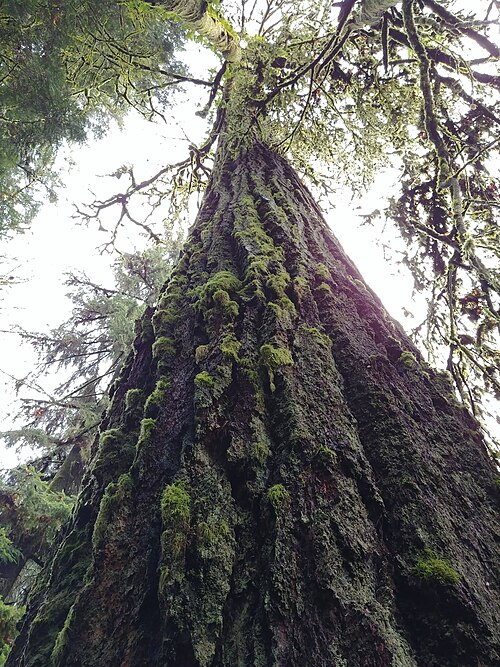
Douglas Fir (Pseudotsuga menziesii) · 600 years · Holmes Point, Kirkland
Sylvia was the biggest tree in King County until the morning of 20 January 1993, when an inauguration day windstorm came up Lake Washington and took her top off. She was 255 feet then. She is a good deal shorter now and still standing, which is the part worth walking for: a Douglas fir about eight metres round, growing here since roughly the time Constantinople fell.
The snapped crown is not damage so much as biography. A Douglas fir that loses its leader does not die, it reorganises, pushing side branches upward into a candelabra of new tops. Sylvia has been doing that for thirty years and the result looks nothing like the clean spire in a forestry photograph.
She stands in what is left of the lowland old growth that once ran unbroken from the lake to the Cascades. O.O. Denny Park keeps about forty acres of it, given to Seattle by the Denny family and now looked after by Kirkland. The trail in from Holmes Point Drive follows a creek under trees that were already large when the first mill opened on the far shore.
We cannot give you a pin on the trunk. Follow the creek trail and look for the one with no proper top.
Photo: Bri (CC BY-SA 4.0)
Japanese Red Pine (Pinus densiflora) · 90 years · Rainier Beach, Seattle
Fujitaro Kubota planted somewhere between fifteen and twenty of these pines along the drive of his garden. This is the only one left.
The early aerial photographs show what he made: a row of tanyosho pines, the umbrella-shaped form of the Japanese red pine, lining the drive closely enough to filter the light into a kind of tunnel. Kubota was a Japanese immigrant gardener who founded the garden in 1927, in what is now Rainier Beach. It became a City Historical Landmark in 1981 and a public park in 1987.
The pines did not all make it. The city's own tree walk puts it plainly: after many winter storms and a changing climate, only one of the original trees, about ninety years old when that guide was written, is still standing. A handful of replacements have gone in over the past twenty years, so the drive is slowly becoming a row again, with one old tree among the young ones.
That old one is the tree worth finding. It stands in the Historic Core Garden near the Heart Bridge, stop eight on the city's Kubota Garden tree walk. Entry is free and the garden is open daily. The pin marks the garden rather than the pine, so bring the tree walk and look for the Heart Bridge.
Japanese White Pine (Pinus parviflora) · 80 years · Rainier Beach, Seattle
Of every tree in the garden he spent his life making, this was Fujitaro Kubota's favourite. The city's own tree walk says so, and it is the kind of detail that changes how you look at a tree.
It is a Japanese white pine, and what caught his eye is still there to see: a white line running along each needle, which, in the guide's words, exudes brightness and light. It has been pruned carefully for more than eighty years, and what the guide praises is not its size but its limbs and lines, which is what that much patient cutting produces.
That pruning is its real age record. Nobody has published a planting date, only that the shaping has gone on for over eight decades, and it cannot be older than the garden itself, which Kubota, a Japanese immigrant gardener, founded here in 1927. So somewhere between eighty and a hundred years is the honest range. If you know when it went in, tell us.
The garden around it became a city landmark in 1981 and a free public park in 1987, and the pine has been tended through all of it. It stands in the Japanese Garden section, stop fourteen on the city's Kubota Garden tree walk. The pin marks the garden rather than the tree.
Northern Red Oak (Quercus rubra) · ~120 years · Admiral, West Seattle
This oak is 55 feet wider than it is tall. When the tree expert Arthur Lee Jacobson measured it for a 2023 newspaper column, he found a crown 133 feet across on a tree 78 feet high, over a trunk 15 feet 8 inches round.
It is a northern red oak, a species from the other side of the continent, and it has spent its life at the edge of a playing field in West Seattle. Hiawatha Playfield opened in 1911, and the whole ground is now a city landmark. One local tree blog says this oak went in that year with the trees around it, when the Olmsted Brothers laid out what it calls Seattle's first playfield. That blog is the only source tying the tree to the opening, so read 1911 as likely rather than proven, which would make the oak a little over a century old.
The city lists it as a Heritage Tree, the programme Seattle runs with the group PlantAmnesty. Jacobson's verdict in 2023 was that it is not even halfway to the 250 years the species can live. Most trees on a list like this are admired for having survived. This one is still growing into itself, mostly sideways.
The pin marks the playfield rather than the trunk. Look toward the school side, and look for the crown first: it is the measurement you can see from a distance.
Japanese Pagoda Tree (Styphnolobium japonicum) · 100-130 years · Capitol Hill
When the Capitol Hill light rail station was being dug, this tree stood just inside the construction wall, and a local reporter wrote in 2015 that it was probably only still standing because it was a Heritage Tree.
That listing, run by the city with the group PlantAmnesty, is the likeliest reason a century-old tree came through the dig. It is a Chinese scholar tree, also known as the Japanese pagoda tree, and the Capitol Hill Historical Society describes it as more than a century old and one of the trees still left from the Olmsted Brothers' design for the park. Nobody has published a planting year, so a century and a bit is as close as the sources go.
The same 2015 article called it the largest of its kind in the Pacific Northwest. No measurement has been published to go with that, so read it as a proud local claim rather than a ranking anybody has checked. If you have a tape measure, the trunk is the one figure this page is missing, and we would like it.
So the tree has seen the park as the Olmsteds planned it and the neighbourhood as it is now, with a train station built right beside it. The pin marks the corner rather than the trunk, but the corner does most of the work: come up out of the station entrance at the northwest of the park and it is right there.
London Plane (Platanus x acerifolia) · Capitol Hill
This is a park where the tree is most of the park. Summit Place Triangle is the scrap of ground left where Belmont Avenue East, Bellevue Place East and Summit Avenue East meet, and a London plane fills it. In 2015 a Capitol Hill reporter described the effect rather than the trunk: it shades the entire space in summer, spreading 100 feet from side to side.
The city takes it seriously. It is an official Seattle Heritage Tree, one of the trees named by the programme the city runs with the group PlantAmnesty, and it is the closing stop on the city's own North Capitol Hill tree walk, which finishes at this triangle.
What nobody has written down is how old it is. There is no planting date, no girth and no height on record. It would be easy to borrow a date from the Olmsted plantings in Volunteer Park, a short walk away, and it would be wrong: that is a different story about different trees, and no source connects this one to it. A blank is more honest than a borrowed number.
So the page asks instead. If you live on Capitol Hill and know when this tree went in, or you pass with a tape measure, tell us and the figure goes here. It stands on public ground, open at all hours, about ten to twelve minutes' walk north of the Capitol Hill light rail station.
Scarlet Oak (Quercus coccinea) · ~100 years · Wedgwood
This oak is held together with hardware rated to 54,000 pounds. A windstorm in March 2016 cracked its trunk, and instead of taking it down, Seattle's street-tree crews cabled and braced it, promised to inspect it every year, and estimated the work could buy ten years or more for what they called an otherwise healthy and vigorous tree.
That effort tells you its standing. It is a scarlet oak growing in the street right-of-way at a Wedgwood corner, which puts it in the city's own care, and it is one of the few such trees named a Seattle Heritage Tree and classed Best in City. It received its Heritage plaque at a ceremony in 2008. Arthur Lee Jacobson's Trees of Seattle counts it among the most outstanding of its kind in the city, and the local history blog that has followed it for years gives its height as 95 feet.
Who planted it is a neighbourhood argument rather than a record. The same blog thinks it likely went in during the 1920s, probably by the family who ran a plant nursery here, while an earlier post floated another family entirely. So call it roughly a century, give or take.
It has seen the corner change around it, most recently a new house going up beside it in 2020. Admire it from the pavement; the lots on either side are private. The pin marks the intersection, and the tree is on its northeast corner.
Copper Beech (Fagus sylvatica f. purpurea) · Capitol Hill
Two measurements taken nineteen years apart put this copper beech at almost exactly the same height: 92 feet when the tree expert Arthur Lee Jacobson recorded it in 2000, and 94 feet when the city surveyed it in 2019. Nineteen years, two feet: this beech was already near its full height when the century began.
The trunk is the bigger number. The city gives the trunk as 71 inches across at chest height, which comes to roughly 18 and a half feet round. A Capitol Hill writer, drawing on Jacobson's records in 2015, called it the largest copper beech in Seattle, and the city lists it as one of its Heritage Trees.
A copper beech is a purple-leaved form of the European beech, so this is an Old World tree grown up on the far side of North America. It stands in Volunteer Park, behind the building that houses the Seattle Asian Art Museum, a short walk from the park's giant sequoia. Its leaves open purple in spring and turn copper before they fall, which is where the name comes from.
What nobody has published is when it was planted. The city's measurements say what it has become and nothing about when it began. If you know, or know who would, tell us, because the age is the one number this page is missing.
Lombardy Poplar (Populus nigra 'Italica') · Eastlake
Lombardy poplars are famous for being narrow, and the city's figure for this one says otherwise: a trunk 81 inches across at chest height, which is about 21 feet round, under a tree recorded at 108 feet tall. For a tree planted almost everywhere as a slim green column along a fence line, that is an unusually heavy base.
It stands in Roanoke Street Mini Park, a scrap of public ground where East Roanoke Street runs out at Lake Union, in Eastlake. In 2010 the city named it a Heritage Tree together with three weeping willows beside it, and treated the four as a heritage grove, which is recorded on a plaque in the south part of the park. So the poplar shares the honour, and the shoreline, with three trees of a completely different shape: one shooting straight up, three hanging down.
The last city survey was in 2019, and naturalists logged the tree on iNaturalist as recently as April 2026. It is a different tree from the University of Washington's world's-fair poplar.
Nobody has published a planting date, and a trunk that thick on a poplar is worth a second look. If you pass with a tape measure, a girth taken at chest height would settle it, and the figure goes on this page.
London Plane (Platanus x acerifolia) · Ballard
Two London planes stand twenty metres apart at Ballard Playground, and the city measures them as near twins: trunks 76 and 75 inches across at chest height, each close to 20 feet round. Then they part company upward. One reaches 80 feet, the other stops at 64.
Both carry Seattle's Heritage Tree designation, and standing between them you see them as one sight: two trunks more than six feet thick, sharing a corner of a neighbourhood playground in Ballard. The city last surveyed them in 2019 and recorded both in good condition.
That survey is close to everything anyone has written down. No planting date has been published, no local history names them, and as far as we can find nobody has photographed them for any public collection. So the age is open, and so is the story: who planted a pair of planes this size beside a playground, and when. If you know, tell us.
The pin marks the larger tree, which sits inside the playground. Its partner stands a short way north, and we have not confirmed whether it is inside the park boundary or just beyond it. The playground borders a school site, so look from the park side and leave the school grounds alone.
Douglas Fir (Pseudotsuga menziesii) · Seward Park
This is the Seward Park Douglas fir you can actually find. The city records it at 125 feet tall with a trunk 70 inches across at chest height, about 18 feet round, and it stands by Lake Washington Boulevard South rather than somewhere deep in the woods.
That matters because Seward Park already has a famous fir, and this is not it. The Big Tree, the 400 to 500 year old survivor of two forest fires, stands a little over a kilometre away in the old-growth interior, in a spot nobody publishes. This one is a city Heritage Tree with a pin that marks the trunk.
The last city survey of it was in 2019, and naturalists recorded it standing on iNaturalist in April 2026. Beyond that the record is thin. Nobody has published its age, and a Douglas fir this size could be a lot of things: a big tree is not automatically an old one, and we would rather leave the number blank than borrow one from its famous neighbour.
So stand at its base and look up 125 feet, then walk into the forest knowing the Big Tree in there is taller still. If you know when this one started, or what it has seen, tell us.