Dutch elm disease never reached Australia, so Melbourne still has elms of a size and age Europe lost, and one of them anchors this page. Sixteen trees here, two separate afternoons. Seven stand within about 1.7 kilometres of each other in the small parks of Carlton North, Fitzroy North and Clifton Hill, three kilometres north of the CBD. The other nine run from Burnley Gardens, a free university botanic garden on the Yarra, out along Yarra Boulevard and on to Madden Grove: eucalypts, a hoop pine, a peppercorn tree and the oldest dated tree in the city.
0 of 16 visited in Melbourne
Moreton Bay Fig (Ficus macrophylla) · 100 years · Carlton North
This park was a hole in the ground, and prisoners dug it. Between 1853 and 1866 the block was a bluestone quarry worked by men from the Collingwood Stockade, and bluestone is the rock Melbourne's kerbs and laneways are still made of. The pit was filled, levelled and planted, and Curtain Square became a square. This fig went in somewhere after that. It is a Moreton Bay fig, Ficus macrophylla, an Australian tree but not a Melbourne one: its home range runs up the east coast around Moreton Bay in Queensland, roughly 1,400 kilometres north, and Victorian gardeners planted it down here anyway for the shade and the ropey buttress roots. It stands 25 metres tall with a trunk of about 4.77 metres round, converted from the 152 centimetres of diameter at breast height the City of Yarra's register publishes, because the register measures across the trunk rather than around it. Local accounts describe a surviving avenue of Moreton Bay figs at the Canning Street entrance, which is where this tree stands. Whether this particular trunk belongs to that avenue is not something anyone has written down. Its age is the register's own band, over a hundred years at the survey in August 2012, and there is no planting date on record. If you know one, tell us.
London Plane (Platanus x acerifolia) · ~110 years · Carlton North
The most recent evidence that this tree is standing is from 2012. The City of Yarra's arborists surveyed Curtain Square in August of that year and recorded a London plane on the Rathdowne Street side of the park: 24 metres tall, 170 centimetres of diameter at breast height, which converts to roughly 5.34 metres of girth, since the register publishes the width across a trunk rather than the measure around it. Only one trunk on this page is heavier, the holm oak in Edinburgh Gardens. The age band on the record is 81 to 100 years, putting the planting somewhere in the decade after the First World War and the tree at roughly a century now. Nothing newer than that survey turned up. Squares here do lose trees: in 2017 Curtain Square's avenue of elms, some of them about a hundred years old, was cut down on safety grounds and replaced with scarlet oaks. That was a different avenue and a different species, and nothing suggests this plane was touched. Still, if you walk through, look and tell us what is there. London plane is a hybrid of an American and an oriental parent, crossed in the seventeenth century, and it turned out to shrug off soot, drought and butchered roots better than anything else, which is why it lines streets on five continents including this one.
Holm Oak (Quercus ilex) · 100 years · Fitzroy North
Edinburgh Gardens has two holm oaks, and the National Trust of Australia has a view about which one to look at. Its Significant Tree Register calls this the finer of the two examples of the species in the gardens, and it is certainly the heavier: the City of Yarra records 177 centimetres of diameter at breast height, which is about 5.56 metres of girth, since that 177 is a width across the trunk and not a measurement around it. That is the thickest trunk here and a record nowhere else: the Trust's own significance statement points to a tree at Talindert, near Camperdown in western Victoria, as the biggest of its kind in Victoria. This one is about 20 metres tall and stands near the bowling club. The same Trust survey, in 2011, recorded its condition as poor and noted that it is overcrowded by nearby elms. Those elms are worth knowing about. Dutch elm disease never reached Australia, and Edinburgh Gardens holds one of the most significant stands of mature elms left in the world, trees of a size Britain and Europe stopped having half a century ago. The oak has been growing up inside all of that. Its age is the register's band, over a hundred years at the 2012 survey, with no planting year on record.
River Red Gum (Eucalyptus camaldulensis) · 100 years · Fitzroy North
Queen Victoria granted this ground to the people of Fitzroy in 1862. The river red gum may have been standing here already. The City of Yarra's register classes it as remnant, the category it uses for indigenous vegetation that was left rather than planted, and tags the same entry outstanding size, particularly old and significant habitat value. What the register does not give is a year. Its age band is the coarse one, over a hundred years at the survey in August 2012, and no independent source names this individual tree, so how much of this site's history it actually saw is an open question. If you know of a heritage citation or an old photograph that dates it, we would like to see it. The measurements are firmer: 28 metres tall, and 138 centimetres of diameter at breast height, which works out at roughly 4.33 metres of girth, since Yarra publishes the width across a trunk rather than the way round it. Eucalyptus camaldulensis is the most widely spread eucalypt in Australia, the tree of inland rivers and creek beds, and it has a habit of shedding heavy limbs in still weather, which is part of what makes an old one in a public park unusual. Most of what grows in these 24 hectares was brought in and planted. This one may not have been.
English Elm (Ulmus procera) · 135 years · Clifton Hill
The English elm barely exists as a mature tree in England any more. Melbourne kept its. Dutch elm disease killed elms across Britain and Europe by the tens of millions from the 1960s on and never reached Australia, which left this city holding elm plantings of an age and size Europe lost. The National Trust of Australia dated this one at about 120 years in February 2011, so roughly 135 now, and calls it an outstanding example of the species. It stands 28 metres tall at the Gold Street end of Darling Gardens, and the City of Yarra's register gives it 154 centimetres of diameter at breast height, which is 4.84 metres of girth: the register's figure is a diameter, so every girth on this page is a conversion from one. The two registers disagree about the name. Yarra records it as Ulmus minor 'Atinia'; the Trust's entry says Ulmus procera. Both mean English elm, and botanists have spent decades arguing over whether they are one tree or two. Darling Gardens was permanently reserved in 1866 and laid out with elms and oaks in the 1890s. The Trust's dating puts this tree's planting in that same decade, which is arithmetic rather than a record: nothing ties this trunk to that scheme by name.
Holm Oak (Quercus ilex) · 100 years · Clifton Hill
Darling Gardens has two trees on the National Trust's register. This is the other one. The Trust names a holm oak of regional significance alongside the elm, and it is much the smaller of the pair: 84 centimetres of diameter at breast height in the City of Yarra's survey, roughly 2.64 metres of girth once converted from the width across the trunk that the register publishes, against the elm's 4.84. It stands 16 metres tall about ninety metres from the elm, nearer the middle of the park than the Gold Street corner. Size is plainly not why it is listed. Quercus ilex is the evergreen oak of the Mediterranean, dark, leathery and dense enough that little grows under it, and it holds its canopy through the entire year. In a Melbourne February that is the difference between shade and no shade, and in July, when the elms around it are bare, it is still in full leaf. Spain and Portugal have grazed pigs on the acorns of this species for centuries, which is the other reason it travelled as far as it did. The age on file is the register's blunt band, over a hundred years at the 2012 survey, with no year and no independent date behind it. If you know when Darling Gardens' oak went in, tell us.
River Red Gum (Eucalyptus camaldulensis) · 100 years · Burnley
The city register gives this tree a hundred years. A local account of the same garden gives one of its red gums four hundred.
The register is the firmer of the two. The City of Yarra surveyed Burnley Gardens on 4 October 2012 and recorded a river red gum of 17 metres and 92 centimetres of diameter at breast height, about 2.89 metres of girth once converted, since the register measures across a trunk rather than around it. It tagged the entry remnant, which is its word for indigenous vegetation left standing rather than planted, alongside outstanding size, particularly old and significant habitat value. The age field is the coarse one: over a hundred years, no year attached.
The other figure comes from a 2015 account of Burnley's Native Garden, which describes a river red gum in the south-west corner believed to exceed 400 years and to predate the European settlement of this ground. Nobody has tied that description to a particular trunk, and the Native Garden may hold more than one old red gum, so both numbers stand here and we pick neither. If you know which tree that account means, we would like to hear it.
What is not in doubt is the setting. The tree stands on a bend of the Yarra, on the sort of ground where Eucalyptus camaldulensis was growing long before anyone laid a garden over it.
Sugar Gum (Eucalyptus cladocalyx) · 100 years · Burnley
Burnley Gardens' best known sugar gum is a table. The heritage-listed specimen on the entrance drive, dated to about 1887, dropped limbs once too often and came down in 2008; its timber was carved and the table unveiled in 2013. This is a different tree, and this one is alive.
It stands further into the grounds, and the City of Yarra recorded it on 4 October 2012, four years after that removal: 22 metres tall, 144 centimetres of diameter at breast height, which works out at roughly 4.52 metres of girth. That 144 is a width measured across the trunk, not a tape run around it. Particularly old, outstanding size, location of landscape context, in the register's own words. The age is the band and nothing more, over a hundred years, with no year behind it.
What says it is still standing is an iNaturalist record from September 2025, research grade, of a living Eucalyptus cladocalyx within about 25 metres of the register's point. Whether that photograph and that survey are the same trunk is inference rather than record, though nothing planted since 2008 could be this thick.
Sugar gums have a local reputation for shedding branches, which University of Melbourne researchers restated as recently as 2024. It is part of why an old one still upright in a public garden is worth the walk.
Yate (Eucalyptus cornuta) · 90-100 years · Burnley
Yate grows wild on a strip of coast in the far south-west of Western Australia and almost nowhere else. This one is 18 metres tall and about four metres round, on the other side of the continent.
Eucalyptus cornuta takes its name from its buds, which taper to a long horn before the flowers open. A tree of this size well outside its range is the kind of thing a university's botanic garden accumulates: Burnley Gardens holds close to a thousand plant species across nine hectares, free to walk into, and the City of Yarra's register lists this one for its outstanding size and its place in the landscape.
Most of the trees on this page carry the register's blanket band of over a hundred years. This one got a narrower reading, 81 to 100 years at the survey on 4 October 2012, which puts the planting somewhere between roughly 1926 and 1945. Somebody looked and made a closer call, which is worth saying, because almost nowhere else on this page did they.
The measurements: 127 centimetres of diameter at breast height, so a girth of about 3.99 metres, converted from a diameter, which is what the register publishes rather than a circumference. Nothing outside that register names this tree. If you can date the Burnley yate, or have watched it flower here, tell us.
Bhutan Cypress (Cupressus torulosa) · 100 years · Burnley
In the Himalaya this species passes 30 metres. Here it stands at 13. Cupressus torulosa, the Bhutan cypress, is a mountain conifer, and the one in Burnley Gardens has had an easier life than its relatives on a Himalayan slope: open ground, no competition for light, and a botanic garden looking after it. The City of Yarra's arborists recorded it on 4 October 2012 at 103 centimetres of diameter at breast height, which converts to about 3.24 metres of girth, because the register publishes the width across a trunk rather than the distance around it. They tagged it rare or localised, and particularly old.
Burnley Gardens is nine hectares holding close to a thousand plant species, run by the University of Melbourne and free to walk into, and some of the oldest trees in the city are in it. This cypress is the sort of thing a register exists for: an unusual species, grown large, in a garden where somebody planted it deliberately and then nobody wrote down when.
That is the honest limit here. Nothing beyond the city's register names this individual tree, and its age is the register's blunt band, over a hundred years at the 2012 survey, with no planting year attached. If you know when the Burnley cypress went in, tell us.
Osage Orange (Maclura pomifera) · 160 years · Burnley / Yarra Bend Park
Yarra Boulevard was built to give men work during the Depression. The tree beside it was already seventy years old. The Victorian Heritage Database's citation for the Boulevard Parklands records an Osage orange north-east of the point where the road meets Swan Street and dates it to the 1860s, which makes it around 160 now. Nothing else here has been dated that far back. The City of Yarra's register lists one at that spot too: 27 metres tall, 169 centimetres of diameter at breast height, about 5.31 metres of girth once converted, since the register gives the width across a trunk rather than the distance around it. Nobody has matched the two records trunk to trunk, but Osage orange is rare enough here that they almost certainly describe the same tree. The height is the odd part. Maclura pomifera is a thorny, low, awkward thing in its native Red River country of Texas and Oklahoma, and it rarely gets far past 20 metres anywhere. This one reached 27 on a river flat in Melbourne. Its wood is so dense and rot-resistant that Osage fence posts routinely outlast the wire stapled to them, which is part of why a tree from a small corner of America ended up on four continents. The road, by comparison, is barely ninety.
River Red Gum (Eucalyptus camaldulensis) · 100 years · Burnley / Yarra Bend Park
This one was probably never planted. The City of Yarra's register tags it remnant, its word for indigenous vegetation left standing rather than put in, and records 22 metres of height and 152 centimetres of diameter at breast height, which converts to about 4.77 metres of girth, since the register publishes the width across a trunk rather than the way round it. Its age is the standard band, over a hundred years at the 2012 survey. The Victorian Heritage Database's citation for these parklands says the remnant indigenous vegetation through the park is mostly river red gums, but it names no individual trees, so for this particular trunk the claim rests on the city's register alone. It stands about 1.4 kilometres along the Boulevard from the Osage orange and marks the far end of the second walk on this page, which begins in Burnley Gardens; the northern parks sit six or seven kilometres away. Eucalyptus camaldulensis is the tree of Australian watercourses, the species that held the banks of the Yarra before there was a Melbourne on them, and the Boulevard is a shared walking and cycling corridor along the river rather than a park you cut across. Come for the river as much as for the tree.
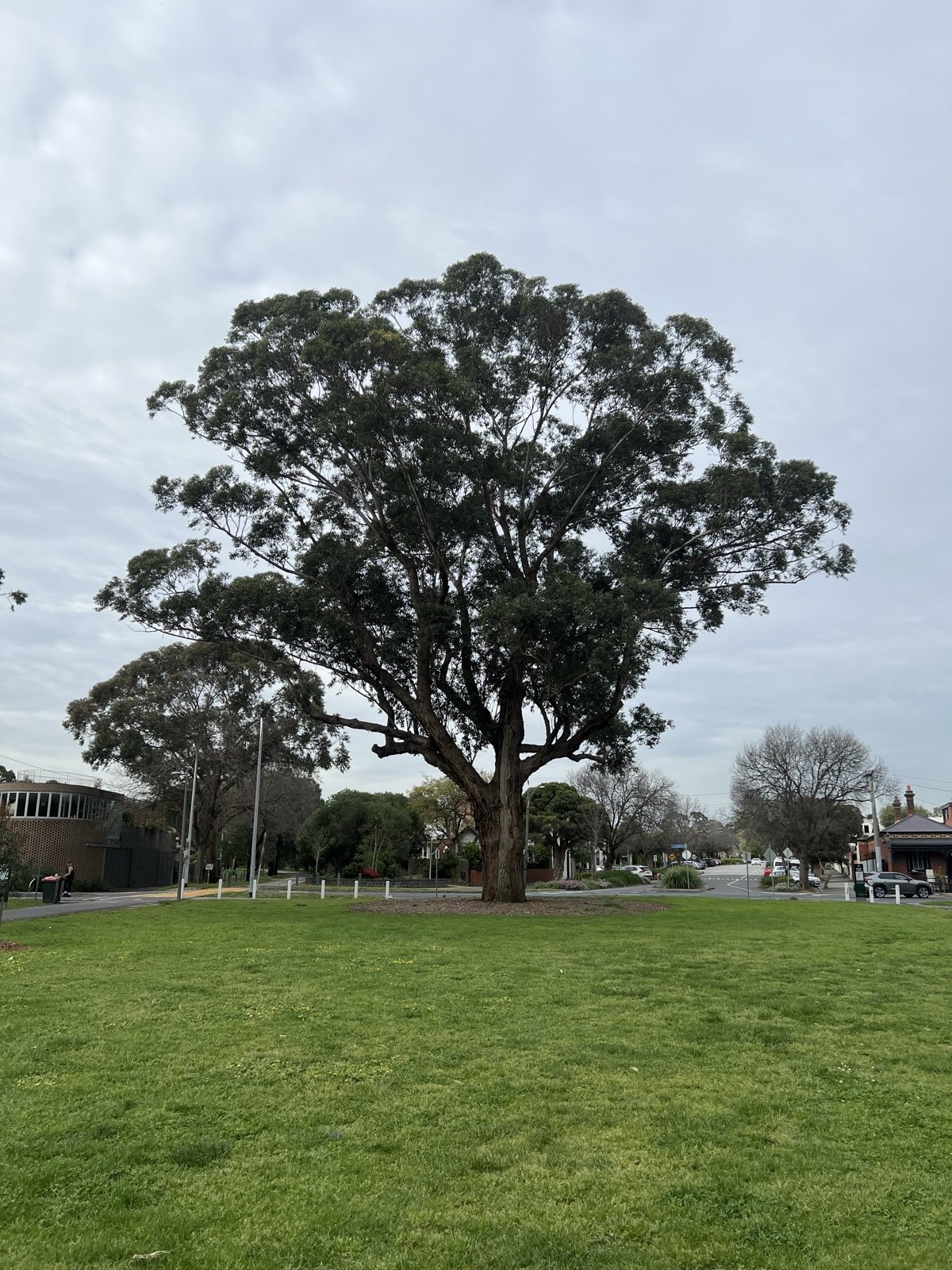
Southern Mahogany (Eucalyptus botryoides) · 110 years · Fitzroy North
This is a beach tree living in Fitzroy North. Eucalyptus botryoides belongs to the sandy, salt-touched country of the south-east Australian coast, behind dunes and around swamp margins, and it does not turn up this far inland on its own. Somebody carried it here and planted it, in a park laid out from 1862 whose heritage citation notes the number of mature specimen trees put in from that period onward. Which of those plantings this one belongs to is written down nowhere we can find.
The City of Yarra measured it in 2012 at 4.34 metres round and 25 metres tall, called it over a hundred years old then, and tagged it three ways on the significant trees register: particularly old, outstanding size, and its standing in the landscape. Over a hundred in 2012 makes it comfortably over 110 now.
It is also the third registered giant on this page within about 250 metres of Alfred Crescent, which is the useful thing to know if you are walking. The river red gum is roughly a hundred metres away and the holm oak a little beyond that, and the council's register lists seventeen more significant trees along the same stretch of grass.
One honest caveat: the register is the only document that names this individual tree. The heritage listing describes the park's tree collection and does not single it out.
Hoop Pine (Araucaria cunninghamii) · 110 years · Burnley
The road this tree is named after was built by men on relief work. Yarra Boulevard was cut through Richmond Park in the 1930s by sustenance labourers, according to the heritage citation for the parkland, and the City of Yarra's register already had the hoop pine beside it down as over a hundred years old when it was updated in 2012. Whether this tree watched the road arrive is an open question. Nobody recorded when it was planted, and nothing ties it to the Boulevard's own avenue scheme, so the two dates sit there side by side without a document to join them.
What is certain: 3.46 metres round, 22 metres tall, in parkland that has been public since 1862, registered as particularly old and of outstanding size.
Araucaria cunninghamii is a rainforest tree from Queensland and northern New South Wales, an emergent that pushes its head above the canopy and holds its foliage in tufts at the ends of the branches, which gives an old one a candelabra look from a distance. It is planted all over southern Australia and is at home in none of it.
It stands about 260 metres from the osage orange already on this page and roughly 550 from the river red gum, so all three make one walk along the Boulevard. Only the register names this individual tree.
Peruvian Pepper (Schinus molle) · 110 years · Richmond
The ground this tree stands on was set aside in 1836, before Melbourne had a name worth arguing about. The Survey Paddock, as it was then, became Richmond Park and has been public land ever since, one of the earliest reservations in the city's history, and the peppercorn in Madden Grove is 3.55 metres round and 16 metres tall on that same ground.
Schinus molle is South American, from the dry Andean foothills, and it is the tree of colonial Australia more than almost any other import. It went in along stock routes, station tracks, rail sidings and school fences by the thousand, because it took drought, poor soil and neglect without complaint, and its weeping grey-green foliage is now so ordinary in the landscape that people assume it is native. It is not.
The City of Yarra's register put this one at over a hundred years old in 2012, which makes it over 110 now, and gave it the fullest set of tags of any tree checked here: particularly old, outstanding size, aesthetic value, and its place in the landscape. A second peppercorn of almost identical girth stands about 200 metres away.
Only the register names this individual tree; the heritage listing covers the park around it. Burnley station is about ten minutes' walk, and the river path brings you here from the Yarra Boulevard trees.
Lemon-scented Gum (Eucalyptus citriodora) · ~110 years · Richmond
Pick up one of the fallen leaves, crush it, and this tree gives itself away: the lemon-scented gum carries so much citronellal in its foliage that the oil is distilled commercially and sold as insect repellent. The smell is sharp, lemony and unmistakable, and it is the fastest identification of any tree on this page.
Corymbia citriodora comes from a modest patch of inland north Queensland, more than 1,500 kilometres from Richmond, and has been planted around the warm half of the world for its trunk: smooth, powdery, pale pink to white, shedding in sheets and clean of branches for most of its height. This one is 21 metres tall and 3.24 metres round, and the City of Yarra's register, which measured it in 2012, put it at 81 to 100 years then. That makes it somewhere around a century now, and the register carries it as particularly old and of outstanding size.
It stands in Madden Grove, on land held as public parkland since 1862 and reserved as the Survey Paddock a generation before that, about 250 metres from the peppercorn already mapped here. The two together make a second stop on the river walk that starts at the Yarra Boulevard trees, about two kilometres away along the river path.
Only the register names this specimen directly. Nobody has published a planting date for it.