Lisbon officially records almost every notable tree in the city: under a 2012 law it holds more classified trees of public interest than any other Portuguese municipality. Its oldest, half an hour away in Loures, is an olive dated at roughly 2,850 years; inside the city it is four hollow olives by a hilltop chapel in Alcântara. Its strangest is a rubber fig that escaped a cracked flowerpot in Mouraria and swallowed a street. Between them sit a bleeding dragon tree, a cypress mistaken for a cedar, and the parliament's private tipu. All but one are free to visit.
- HHugo VeríssimoLisbon ambassador · Quercus Lisboa
0 of 36 visited in Lisbon
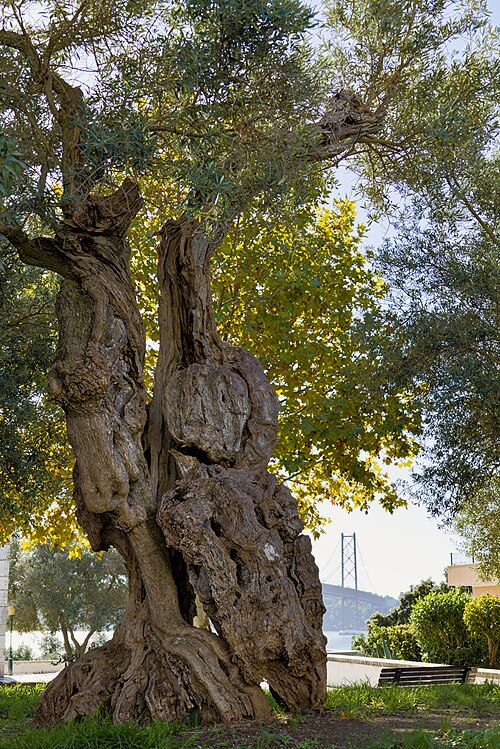
Olive (Olea europaea) · 457 years · Alcântara
Four olive trees outside a small round chapel in Alcântara have outlived every Portuguese king since before the Braganza dynasty existed. By the city's own classification records they are about 457 years old, the oldest documented trees in Lisbon, planted well before the Capela de Santo Amaro beside them took its current circular form in 1549. The chapel has been rebuilt and restored more than once since; the olives outside it have simply kept growing. None of the four is tall, barely six metres at most, but their trunks have hollowed and twisted with age into shapes closer to driftwood than farmland olive stock. City foresters classified them for their cultural, pedagogical and landscape interest, bureaucratic language for what amounts to old age handled well. Olive trees usually mark farmland, not clifftop chapels with river views, and these four have quietly ignored the fact that a working port and, eventually, a 25 de Abril Bridge grew up around them. The hilltop they share is one of the better free viewpoints over the Tagus, and on a typical afternoon the view gets most of the attention, while four of the oldest living things in the city stand a few steps away, propped, gnarled, and largely unbothered.
Photo: Vampiregrave (CC BY-SA 4.0)
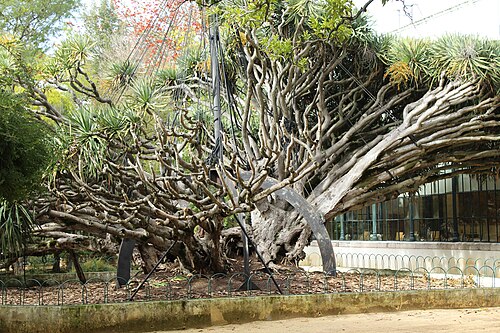
Dragon Tree (Dracaena draco) · 250-400 years · Ajuda
This tree bleeds red. The resin of Dracaena draco oxidizes into a dark crimson sap once prized across Europe as dragon's blood, used in medieval varnish, dye and folk medicine. This specimen was already a mature adult when the Italian botanist Domingos Vandelli transplanted it into Lisbon's first botanical garden in 1768, which makes it at least 258 years old and possibly closer to 400, since dragon trees carry no annual rings and nobody recorded its birth. Its crown once spread nearly 23 metres across, among the largest of its kind in the country, until a rot infection took hold around 2006 and cost it roughly half its size. A steel frame now holds up what remains. The garden, built on the grounds of the royal Ajuda Palace for King José I, treats the tree as its emblem, and cuttings from its offshoots have been propagated into a small nursery of younger dragon trees nearby. Dragon trees grow slowly and can live for centuries once established, so this one, missing half its canopy and still standing, may yet be young for its kind.
Photo: Dguendel (CC BY 4.0)
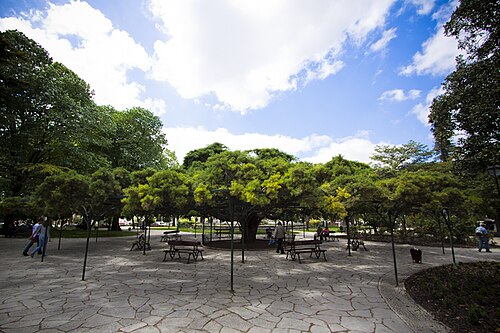
Mexican Cypress (Cupressus lusitanica) · ~150 years · Príncipe Real, Misericórdia
Lisbon's first legally protected tree is not a cedar at all. Everyone calls it the cedro-do-Buçaco, but the tree presiding over Príncipe Real garden is Cupressus lusitanica, a cypress from the mountains of Mexico and Guatemala with a Portuguese name it never earned. In 1940 it became the first tree in the country classified as being of public interest, decades before Portugal had a formal national registry for such things. Its canopy, once a vast gazebo-like dome some 30 metres across, has thinned with age and storms down to about seven metres of visible height, though the trunk still measures four metres around at the base. Portuguese heritage records put it at roughly 150 years old, predating most of the surrounding 19th century garden. One international tree registry claims it instead dates to around 1740, nearly twice that age, a gap nobody has resolved. Locals shelter under its remaining canopy on Saturday organic market mornings, largely unaware they are standing under a tree whose paperwork outranks almost every building in view, and whose exact age is still an open question among the people paid to know it.
Photo: Alatryste (CC BY-SA 3.0)
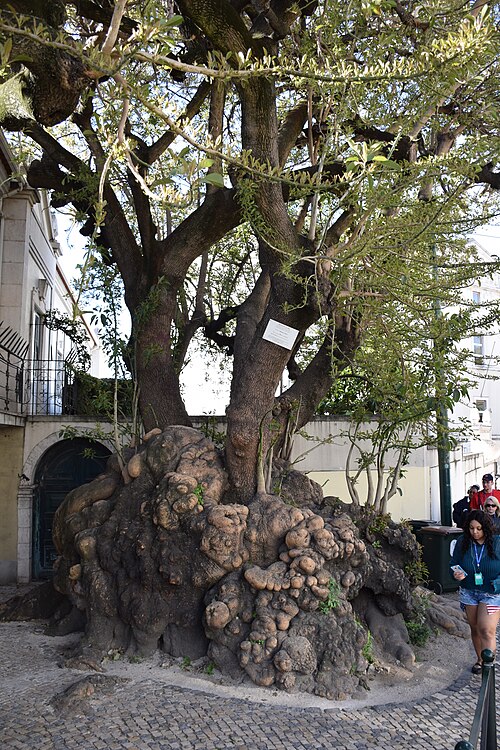
Ombu (Phytolacca dioica) · ~110 years · Alfama
The square is named after a lemon tree that is long gone. What replaced it as the local landmark is an ombú, a South American species with a swollen, fluted trunk that can measure some seventeen metres around at the base, wider than most house facades on the street. It grows against the outer wall of the old Limoeiro prison, a building that held political prisoners for much of the 20th century and now trains judges. Municipal archive photographs show it already a substantial adult tree by 1910, which would put its real age closer to 115 years than the 100 usually quoted. Ombú wood is famously soft and fire resistant, of no real use to carpenters, which may be exactly why this one survived when more useful trees nearby did not. It stands a few steps from the Portas do Sol viewpoint, one of the finest views over the Alfama rooftops to the river, though most visitors walk straight past its swollen trunk toward the railing. True to its local nickname, bela-sombra, beautiful shade, it still throws excellent cover over an otherwise unremarkable stretch of pavement.
Photo: kenward (CC BY 2.0)
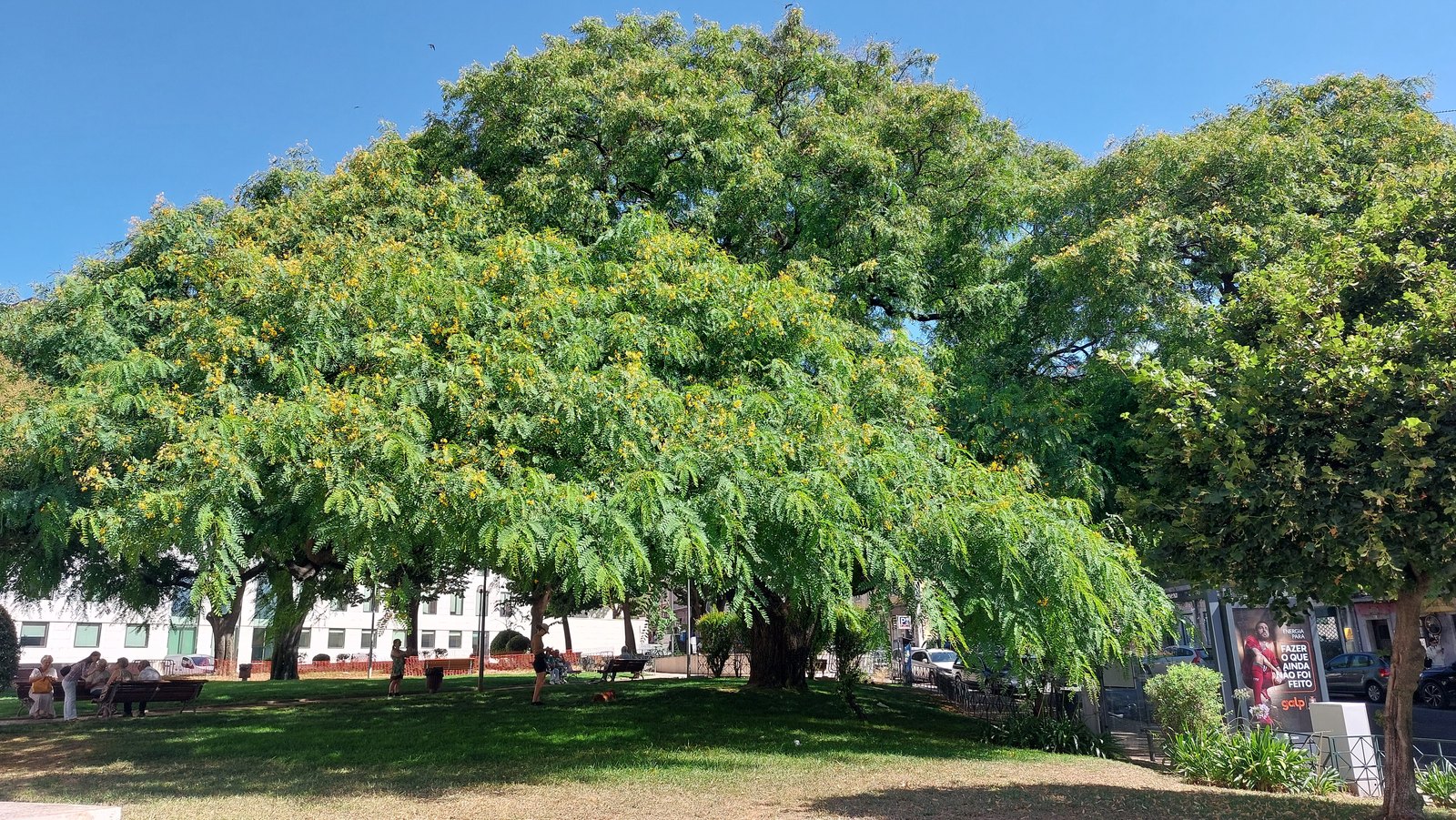
Tipu Tree (Tipuana tipu) · 90 years · São Bento, Estrela
Portugal's parliament keeps a South American tree on its doorstep. This tipu, planted around ninety years ago in the small triangular garden beside the Palácio de São Bento, blooms with orange flowers marked by a brownish red spot at the base of each petal, a native of Bolivia and Argentina with no historical connection to the 16th century Benedictine monastery the palace used to be. The monastery became the seat of the Portuguese parliament in 1834 after the religious orders were dissolved, and the garden beside it has since watched ministers, protesters and the occasional political crisis unfold a few dozen metres from its canopy. The tree is one of Lisbon's officially classified trees of public interest, a status shared by barely two dozen specimens across the entire city. Its timber, tipa, is prized in South America for furniture, though nobody here has any plans to cut this one down for a table. Late winter and spring bring its flowering season, when the garden's modest third of a hectare turns a startling shade of orange directly across the street from where the country's laws get written.
Photo: getLISBON
Cockspur Coral Tree (Erythrina crista-galli) · 100 years · Carnide
Despite the name, this tree has never been near India. Portuguese sailors called the genus Erythrina a coral tree of the Indies after landing in Brazil convinced they had reached Asia, a five century old geography mistake baked permanently into the common name. Two specimens grow on the south side of Jardim da Luz in Carnide, both classified as trees of public interest since 1996 and both about a century old, standing twelve and fifteen metres tall. Each June they erupt in bright red flowers shaped unmistakably like a rooster's crest, the detail behind the species name crista-galli. The garden's formal name, Jardim Teixeira Rebelo, honours the founding director of the nearby Military College, though most locals still call it simply Jardim da Luz after the Baroque church across the square. A metro station sits so close to the garden gate that riders on the Blue Line surface almost directly beneath the coral trees' canopy without noticing. For two South American transplants misnamed after the wrong continent, they have settled into suburban Lisbon without complaint, flowering every summer regardless of what anyone calls them.
Mediterranean Hackberry (Celtis australis) · 86 years · Olivais
One tree remembers the farms that used to be here. Before Lisbon's eastward expansion in the 1940s and 1950s paved over the quintas of Olivais with apartment blocks, this stretch of land was countryside, and a single European nettle tree from that era survived the building work, still standing at what is now the junction of Avenida de Berlim and Avenida Francisco Luís Gomes. Portugal's national registry of public-interest trees measured it in 2015 at 75 years old and 15.7 metres tall, younger than the round century once claimed for it but still older than the apartment blocks around it, with a broad symmetrical canopy that looks deliberately planted rather than accidentally spared, though it was almost certainly the latter. The species produces small sweet fruit that gives it a folk nickname referencing the birds that come to eat it, and its wood was historically valued for tool handles and whip stocks for its flexibility. Officially classified as a tree of public interest under process KNJ1/405, it now stands beside a bronze sculpture called Homem Sucata, Scrap Man, welded from actual car parts in 1993, an odd pairing of the area's rural past and its industrial present sharing the same traffic island. Commuters on the surrounding avenues have an older neighbour than the surrounding tower blocks suggest.
Ginkgo (Ginkgo biloba) · 100-130 years · Penha de França
Ginkgo biloba is often called a living fossil, a species virtually unchanged for over 200 million years and one of the very few plants known to have resprouted near ground zero at Hiroshima, a resilience the species carries in its reputation rather than this particular tree's own biography. Lisbon's specimen in Praça Paiva Couceiro, in the working class Penha de França neighbourhood, is a comparatively young member of an ancient lineage: over a century old and classified as a tree of public interest, though nobody has pinned down its exact planting date. Its fan shaped leaves turn a uniform bright yellow every November before dropping almost simultaneously, a spectacle unrelated to anything else on this list and one that draws a small annual crowd of photographers to an otherwise unremarkable square. Ginkgos are dioecious, male or female, and only female trees produce the notoriously foul smelling fruit; whether this one has simply spared the neighbourhood that autumn hazard, or its sex was never recorded, nobody seems to know. Either way, it is Penha de França's one living link to a genus older than most of the world's mountain ranges.
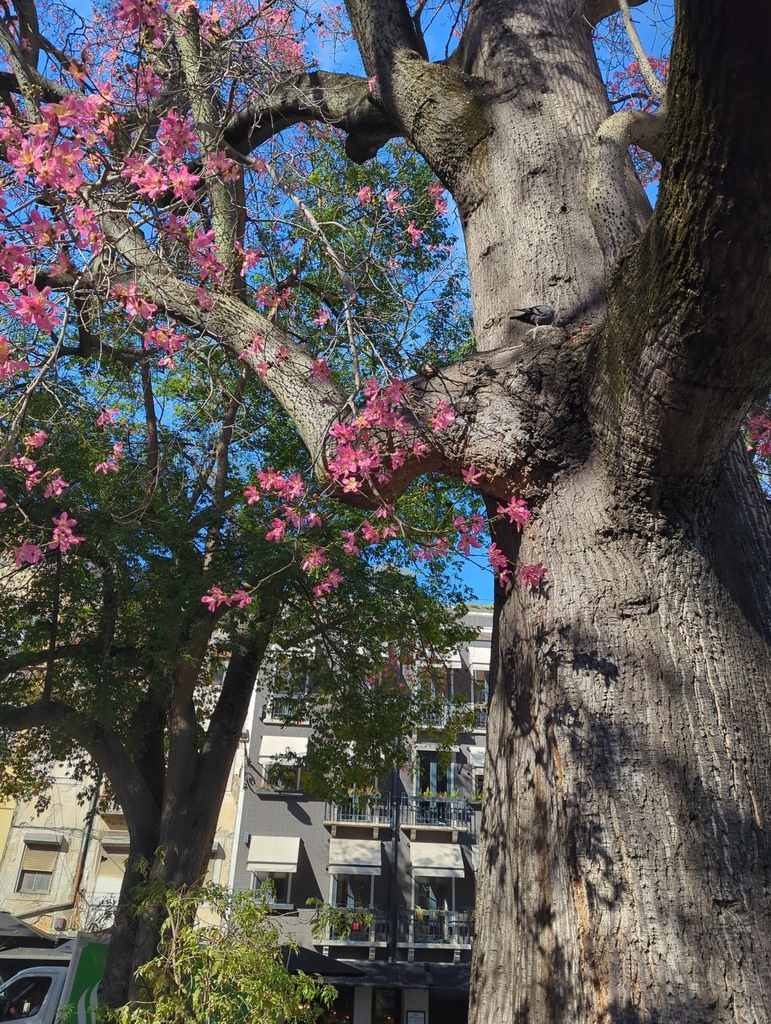
Silk Floss Tree (Ceiba speciosa) · 100-140 years · Praça da Alegria, Avenida da Liberdade
Every October this tree turns a small garden pink. The silk floss tree in Jardim Alfredo Keil is one of six individually classified specimens within a nine tree ensemble that the city declared collectively of public interest in 2017, a South American species whose thorny green trunk and cotton candy coloured blooms have become an unofficial marker of autumn across Lisbon in recent years. The garden itself, laid out in 1882 on the former site of the Feira da Ladra flea market before that market moved to Alfama, is barely large enough to contain the tree's crown, and a bust of the composer Alfredo Keil, who wrote the melody that became Portugal's national anthem, watches from one corner. No source isolates exactly how old this particular paineira is, since the 2017 classification covers the whole collection of trees rather than dating each specimen individually. The fruit that follows the flowers splits open to release seeds wrapped in a silky white floss, once used to stuff pillows and life jackets, a soft, practical footnote to a tree that spends every autumn putting on the loudest show in the neighbourhood.
Rubber Fig (Ficus elastica) · 20-40 years · Mouraria
Nobody knows how this tree got here, and that is most of its appeal. A rubber fig now towers some six metres over a narrow street in Mouraria, its roots having escaped a cracked pot years ago and driven straight into the ground below, its trunk and branches now filling the gap between two building facades on Rua de São Cristóvão as though it had been planted there on purpose. It was not. Plant researchers who have examined it, including the botanist André Mota, can confirm the species and describe its improvised growth, but not its origin story. Unlike the classified trees of public interest elsewhere on this list, this one carries no official age, no protected status and no municipal plaque, just several hundred enthusiastic online reviews and a café that opened next door in 2022 partly because of the foot traffic the tree now draws. It is the youngest and least official entry here, almost certainly under 40 years old, included not for its age but for the fact that a potted houseplant broke loose and quietly became one of the most photographed trees in the neighbourhood.
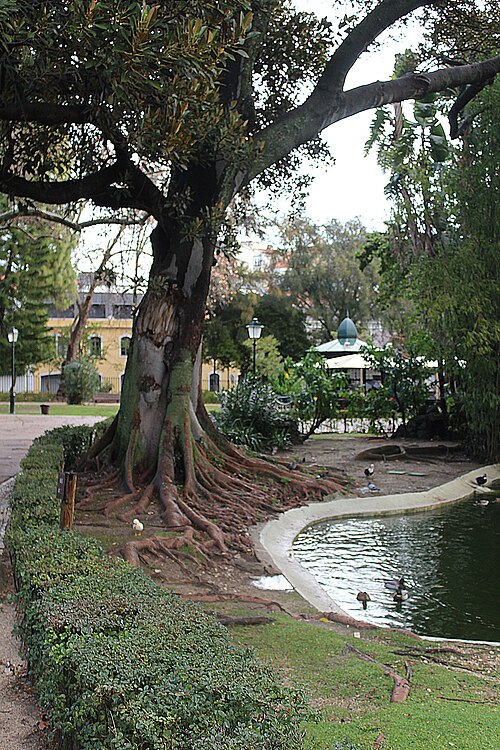
Moreton Bay Fig (Ficus macrophylla) · 150 years · Estrela
Lisbon has bolted a metal plate to this trunk, and where the age should be it says one word: unknown. That is unusually honest for a municipality, and it is also the most interesting thing about the tree. The garden around it opened in April 1852 after ten years of stop-start construction, so the fig cannot be much more than a century and three quarters old, which for something this bulky is the surprise. Moreton Bay figs grow at a speed that makes ordinary trees look idle. The plate arrived in 2020, when Lisbon gave 27,610 of its trees an identity card and hung QR codes on around 750 of them. Look up and you see why this species unsettles people: aerial roots hang from the limbs like rope, and where they reach soil they thicken into new trunks, so the tree slowly becomes a colony of itself. It is not alone here either. At least five mature figs stand in these five hectares, and the one at the pond's edge, roots spilling over the kerb toward the ducks, is the one everybody photographs.
Photo: Dguendel (CC BY-SA 4.0)
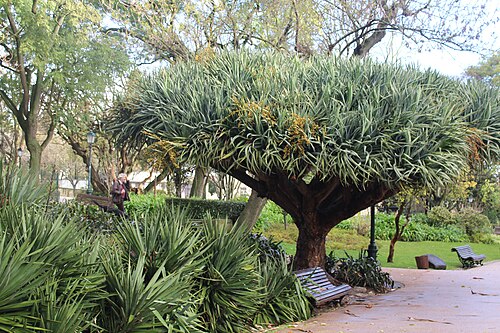
Dragon Tree (Dracaena draco) · 100-175 years · Estrela
Nobody can tell you how old this tree is, and that is a property of the species rather than a gap in the paperwork. A dragon tree is not a tree in the ordinary sense: it lays down no annual rings, so the one method that reliably ages an oak or a beech simply does not apply. Botanists count branch generations instead, because the crown forks only after each flowering, which happens at intervals of a decade or more. What that produces is this shape, a trunk splitting into a tight umbrella of stiff blue-green blades that looks less grown than engineered. Its sap runs red, which is where the name comes from and why the resin was traded across medieval Europe as dragon's blood, used for varnish, medicine and dye. The species belongs to the Canary Islands and Madeira, where it is now scarce in the wild. This one has stood among the palms and benches near the centre of the garden since some point after 1852, quietly outliving every gardener who has worked around it, and Lisbon has a second on our map in the botanical garden at Ajuda.
Photo: Dguendel (CC BY 4.0)
Moreton Bay Fig (Ficus macrophylla) · 155 years · Príncipe Real, Misericórdia
Everyone in this square looks at the cypress. It sits under a metal frame like a green table, it was the first tree in Lisbon given legal protection, in 1940, and it takes all the photographs. Three Australian figs stand around it and almost nobody registers them, which is odd, because they are the reason the square feels roofed. This one carries the thickest trunk of the three, just over six metres around, and holds its crown twenty one metres up. Ficus macrophylla does not start life as a tree in Australia. It germinates in the fork of another one, drops roots down the host's trunk and thickens them until the host is enclosed and dies, which is why the species is called a strangler. Here it had nothing to strangle, so the aerial roots simply hang, reach the gravel and stiffen into props. Underneath all of this is water. The Patriarcal reservoir was finished in 1864, an octagonal chamber on thirty one pillars holding 880 cubic metres for the city, and the garden is its lid. On Saturday mornings a producers' market sets up between the trunks.
European Yew (Taxus baccata) · 130 years · Campo Santana, Arroios
A European yew has no business growing here. The species belongs to damp northern churchyards and mountain shade, and Lisbon offers neither, yet this one has put on close to four metres of girth and fourteen metres of height on a hill above the Avenida. Portugal classified it in May 1968, which makes it one of the earliest protected trees in the city, and the national register now puts it a little past 130 years old. The ground under it has a harder history than the lawns suggest. This field held a slaughterhouse and then a bullring, and in 1817 the men condemned with Gomes Freire de Andrade were hanged on it, which is how Campo de Santana became Campo dos Mártires da Pátria. The garden came afterwards, laid out around a lake with exotic birds wandering the paths, and the medical school and the Hospital de São José still crowd its edges. At the top of the same field stands the statue of Sousa Martins, a physician who died in 1897, its plinth buried under marble plaques left by people who believe he still answers. Every part of a yew is poisonous except the red flesh around the seed.
Weeping Fig (Ficus benjamina) · 130 years · Campo Santana, Arroios
Ficus benjamina is the tree most people know as a pot plant, the glossy thing sulking in an office corner and shedding leaves whenever somebody moves it. Fifty paces from the yew, on the same slope, one of them has a trunk five metres around and a crown twenty metres up. Portugal classified it on exactly the same day as the yew, 21 May 1968, and the national register still files it under a second name that says what the species does when nothing stops it: matapalo, tree killer. Like its Moreton Bay relatives it can begin high in another tree and work downward, and even planted honestly in soil it keeps the habit of letting fine roots down from the limbs. One useful correction before you go. The register maps a single specimen here. Portuguese sources describing the garden count two of them, classified together under the same 1968 diploma. That gap between a national list and what a city actually holds is completely normal, so expect a pair and stand at the bigger one. The garden around them runs to twenty eight tree species, a Himalayan cedar and a paper mulberry among them, so the fig is not the only import that outgrew its label.
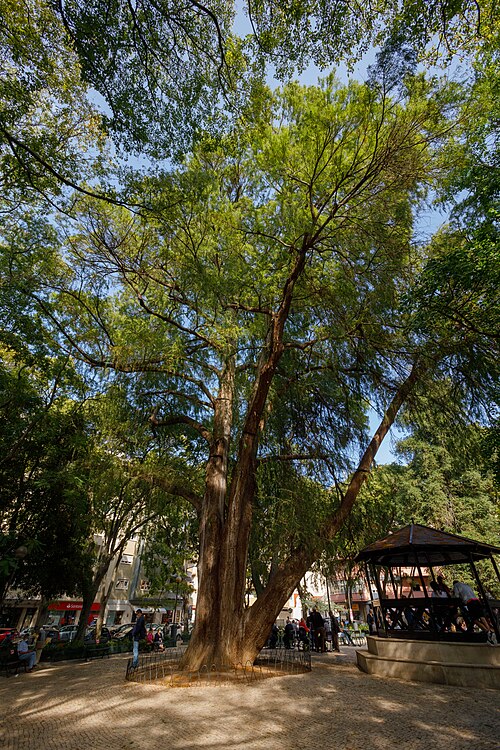
Montezuma Cypress (Taxodium mucronatum) · 80-150 years · Campo de Ourique
Six and a half metres around the trunk and twenty six metres up, this is the largest tree in a garden that fills one whole city block, and for four years it has been at the centre of an argument about a railway. Lisbon is building a metro station under Campo de Ourique. The worksite takes a slice of the garden, residents formed a movement to stop it, and in 2024 they tied coloured ribbons through the branches: black for a tree to be felled, red for high risk of dying, yellow for at risk. The metro company's public answer was a twenty metre radius around the garden's three classified trees with no work inside it and continuing health checks, with six unclassified hackberries taken out instead, four of them replanted in the same holes. The tree carries a small taxonomic dispute of its own. The national register lists it as Taxodium mucronatum, the Montezuma cypress of Mexican riverbanks, the species that produced the widest trunk ever measured on a tree. The parish council and the Portuguese encyclopedia both call it a bald cypress. Nobody has published a resolution. The garden was the parade ground of the Campo de Ourique barracks, which is why nobody calls it by the president's name.
Photo: Camilla Morselli (CC BY-SA 4.0)
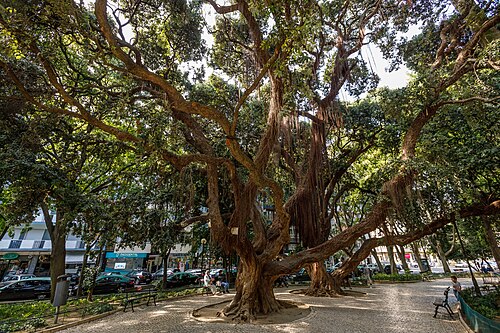
Pohutukawa (Metrosideros excelsa) · 80-140 years · Campo de Ourique
Two of them stand ten metres apart at the edge of this garden and the register protects them as separate trees, which is fair enough: one measures 4.55 metres around the trunk, the other 4.9. From underneath they read as a single thing, a low tangle of grey limbs running almost horizontally out over the pavement with curtains of aerial root hanging off them, more like a tree that fell and carried on than one that stood up straight. Metrosideros excelsa comes from the coast of New Zealand's North Island, where it grips volcanic cliffs with exactly those roots. In Campo de Ourique it grips a kerb. Flowering lands in May and June here, half a year away from the December bloom that made it a Christmas tree at home, and it is not a subtle event: the crown fills with crimson stamens and almost no petal worth the name, and the pavement underneath goes red as they drop. Both trees were classified in September 2018, late for something this size, and both now sit inside the twenty metre no-work radius the metro company promised around the garden's classified trees.
Photo: Camilla Morselli (CC BY-SA 4.0)
Tipu Tree (Tipuana tipu) · 145 years · Santos, Estrela
This garden is named after a defeat. On 9 April 1918 the Portuguese Expeditionary Corps was overrun at La Lys in Flanders in the course of one morning, and Lisbon put the date on a small terrace above the river. The tipuana shades most of it: twenty two metres tall, three and a fifth metres round the trunk, classified in 2001 along with two neighbours, and by the national register's arithmetic somewhere near 145 years old now. Tipuana tipu is Bolivian and Argentine, a legume that behaves like a plane tree in Mediterranean cities and gets planted everywhere for it, along whole Lisbon avenues. What it does that plane trees do not is drip. In warm months the canopy releases a fine sticky rain, honeydew from the sap-feeding insects living in it, and anyone who has parked a car under one does not do it twice. The ground itself was the walled garden of the Albertas, a Carmelite convent, before the city took it over. Two older names for the place survive in daily use because of that, Jardim das Albertas and Jardim da Rocha do Conde de Óbidos. Walk to the parapet and the Tagus opens up, container cranes and all.
Date Palm (Phoenix dactylifera) · 145 years · Santos, Estrela
Lisbon's city hall calls this the tallest tree in the city and puts it at 38 metres, four metres over the triumphal arch at the bottom of the Baixa. The national register measured it in 2015 and wrote down 26.7. Both figures are published, neither has been reconciled, and standing at the foot of it you will not settle the question either, because a date palm gives the eye nothing to measure against: no branches, no taper, just a grey column of old leaf bases and then a burst of fronds a long way up. Phoenix dactylifera is a desert crop from Mesopotamia and North Africa, grown for its fruit for at least five thousand years and almost never allowed to get this tall, because an orchard keeps its palms low enough to climb and harvest. Nobody was harvesting this one. It was classified in 2001 along with the tipuana and the flame tree beside it, and the register's clock puts it near 145 years. The trunk is barely one and a half metres around. It has held all that up for a century and a half, on the lip of a terrace above the Tagus that flatters the height even further.
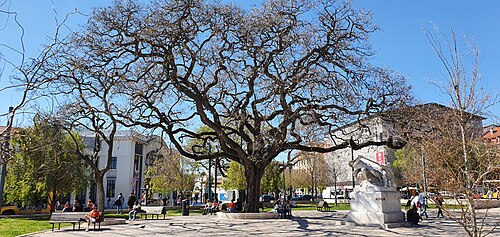
Tipu Tree (Tipuana tipu) · 115 years · Cais do Sodré, Misericórdia
This tree stands in the middle of a bus terminal, and that is the honest story rather than something to smooth over. The garden, popularly called Jardim do Cais do Sodre, sits exactly where the Sintra and Cascais railway lines, the Green Line metro and the Cacilhas ferry all converge, one of the first patches of green a visitor arriving into Lisbon by train or boat actually walks past. For years Carris buses ate most of the available space; a renovation under the city's 'A Square in Each Neighbourhood' programme has been handing some of it back. Through all of it, a single Tipuana tipu has kept growing at the centre, classified a Tree of Public Interest since 2001 and now roughly 115 years old, a South American species that reached Lisbon long before anyone built a transit hub around it. Its trunk runs just under three metres round. Nearby stands a bronze sculpture called Homem do Leme, the Helmsman, and an old kiosk once used as a ticket office, both easier to notice than the tree that predates them. Come between February and May and the argument for stopping gets easier: the canopy turns a burnt orange with clustered flowers, briefly outshining the buses idling underneath it.
Photo: Yair Haklai (CC BY-SA 4.0)
Tipu Tree (Tipuana tipu) · 115 years · Estrela
A tree with a thirty four metre crown grows in the middle of a traffic circle, and by 2018 that crown had become the problem. City arborists and technicians from Portugal's nature institute came out that March to relieve the load: selective limb removal, canopy thinning, cuts meant to let wind pass through rather than push against it, the kind of surgery a tree this size needs to keep standing over a road. The garden that holds it, seven thousand square metres wrapped around a statue of Don Bosco raised in 1988, forms the roundabout that carries traffic between Campo de Ourique and the Prazeres district, directly across from Lisbon's second largest cemetery. The national register measured the tipu's trunk at 100 years old back in 2010, putting it past its first century now, a South American import from the subtropical lowlands of Bolivia and Argentina. It earned legal protection as a tree of public interest in January 2019, one of a few dozen trees in Lisbon to hold that status. Its trunk runs 3.4 metres round, modest next to the spread it throws overhead. Late spring dusts the roundabout's lawns orange when it flowers. Cars circle it a thousand times a day; almost none of the drivers know what they are driving around.
Holm Oak (Quercus ilex) · 110 years · S. Domingos de Benfica
Four trees in Parque Bensaúde carry a national protection order, and the one the neighbourhood is proudest of is not among them. That is the cork oak, reckoned the oldest in Lisbon, standing elsewhere in the same park. The official list runs differently: two holm oaks, a red-flowering gum and a field maple.
This is the heavier of the two oaks. Its companion, about 50 metres away, is a tree you can get your arms around. This one is not: 3.12 metres of trunk, 21 metres of height, and the low dense crown of small hard leaves that holm oaks keep through winter.
The ground was private for most of that time. It began as the Quinta de Santo António das Frechas, a 17th century estate on the road out to Luz, and later carried the name of the Bensaúde family who owned it. Only in recent decades has anyone been free to walk under this tree.
All four were classified together in 2004. The register recorded this oak at 100 years old when it was measured in 2017, which puts it near 110 now. That is a surveyor's estimate rather than a count of rings, and holm oaks grow slowly enough that it could be out by a decade in either direction.
Holm Oak (Quercus ilex) · 110 years · S. Domingos de Benfica
Two holm oaks in Parque Bensaúde were classified on the same day and recorded at the same age. One measures 3.12 metres round the trunk. This one measures 1.72.
They stand about 50 metres apart in the same soil, which is a useful reminder that girth and age are only loosely related. Light, water and whatever the roots hit underground do most of the deciding. This is also the shorter of the pair at 17 metres, and it is the one you can actually put your arms around, which is the quickest way to know you have found the right tree.
Holm oak is the evergreen workhorse of the Iberian countryside, dark and dense, holding its small leathery leaves right through winter. There is no bare season here and no autumn colour, so the tree looks much the same in January as in July.
The park around it was the Quinta de Santo António das Frechas, a 17th century estate later held by the Bensaúde family and opened to the public as a municipal park off the Estrada da Luz. Both oaks were classified in 2004, alongside a red-flowering gum and an unusually thick field maple a short walk west.
The register logged 100 years at its 2017 measurement, so roughly 110 today, on a surveyor's estimate rather than a dated planting.
Red-flowering Gum (Corymbia ficifolia) · S. Domingos de Benfica
This is the smallest of the four protected trees in Parque Bensaúde and the only one on the list for what it does rather than what it is. At 7 metres tall and 1.45 metres round it is beaten on every measurement by its neighbours. Then high summer arrives and the whole crown goes scarlet.
Corymbia ficifolia comes from a narrow strip of coast in southwest Western Australia, a natural range small enough to drive across in an afternoon, and it has been planted around the mild parts of the world for exactly this: dense clusters of red flowers held above the leaves, lasting weeks and dropping a carpet underneath.
No age is recorded for it anywhere. It was classified in 2004 for its flowers and for being uncommon in the city rather than for any claim to antiquity, and nobody has dated it since.
It stands about 40 metres west of the larger holm oak, close to the field maple, so the park's four classified trees make one loop of a few minutes. Parque Bensaúde was the Quinta de Santo António das Frechas before the council opened it, which is how a private planting of an Australian ornamental ended up on a public list. Somebody wanted red flowers in their own garden, and a century later the garden became everybody's.
Field Maple (Acer campestre) · S. Domingos de Benfica
A field maple with a 3.5 metre waist is an oddity. This is the modest one of the European maples, a hedgerow and woodland-edge tree that usually tops out around 15 metres and rarely gets thick, and this one has a trunk wider than either of the classified holm oaks standing a few dozen metres east of it.
It reaches 13.5 metres at the western end of Parque Bensaúde, the fourth of the four trees the state singled out here in 2004. No age is recorded for it. Field maples are hard to date without cutting into them and this one has never been surveyed for age, so the honest answer is that it is old enough to have grown far beyond the usual size, and no more precise than that.
Look at the leaves to be sure you have the right tree. Field maple carries small five-lobed leaves with blunt rounded tips, quite unlike the sharp-pointed maples of parks and streets, and older twigs often develop corky ridges you can feel with a thumb. In autumn it turns clear yellow, briefly, before Lisbon's mild weather takes the leaves off.
The park was the Quinta de Santo António das Frechas, a 17th century estate, which explains how a northern European maple got here at all. Somebody planted it in a private garden and let it get on with it.
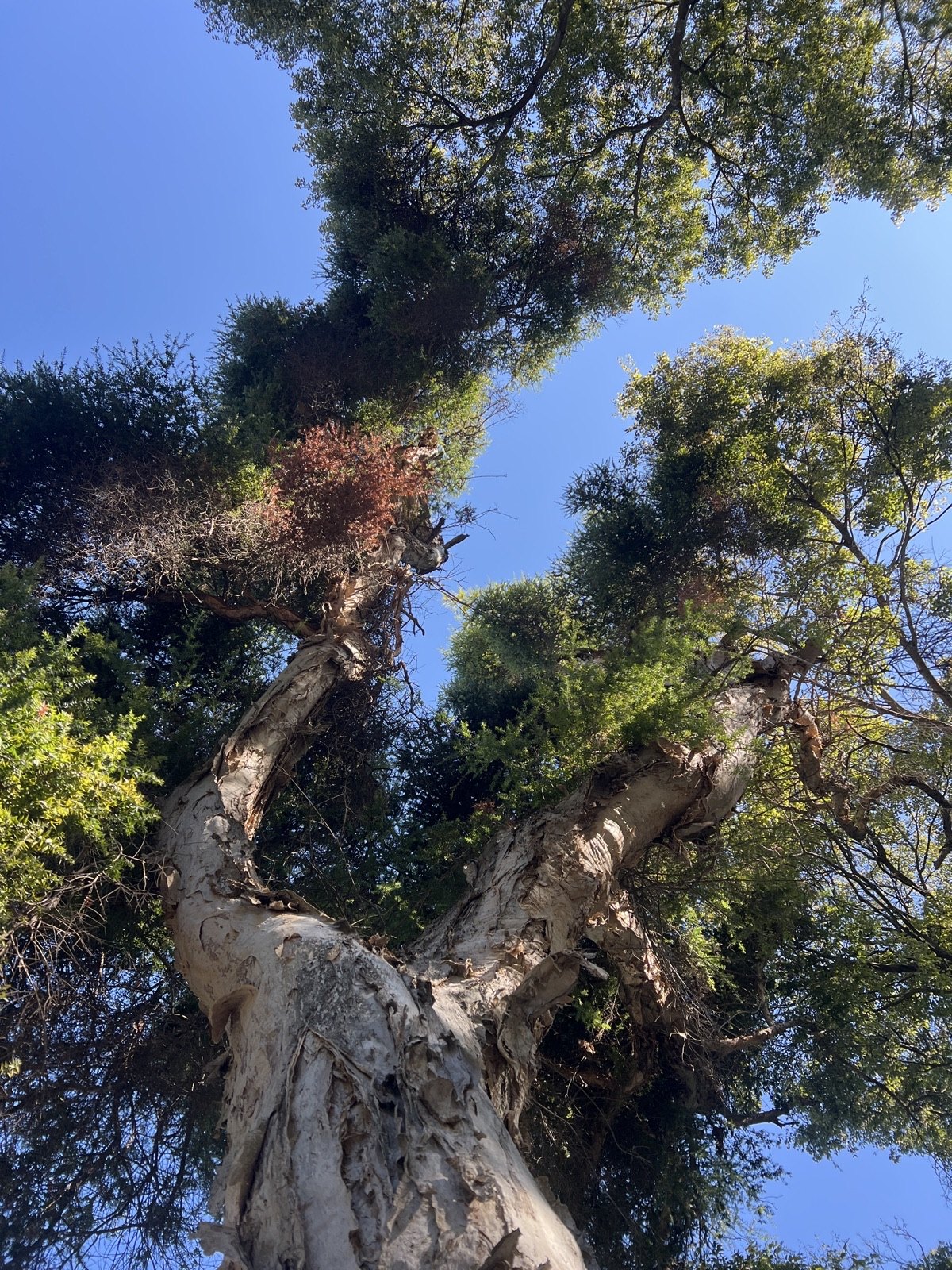
Prickly Paperbark (Melaleuca styphelioides) · 115 years · Arroios
Lisbon has one prickly paperbark, and this is it. The Portuguese record of Jardim Constantino calls the tree unique in the city, which is a strong claim for a garden of a quarter of a hectare to hold.
Melaleuca styphelioides is an Australian tree grown for its bark: white, spongy, laid down in papery layers you can press a thumb into, peeling in sheets around a trunk 1.58 metres round. The leaves are small, stiff and sharp-tipped, which is the prickly half of the name. At 18 metres with an 11 metre crown it is the tall thin one in this garden. The fig a few steps away is the wide one.
The garden opened in 1889 and takes its name from Constantino José Marques de Sampaio e Melo, a florist. It runs to a lake, a playground and a statue of Prometheus, and it sits in Arroios two streets off the metro, so this tree has spent its whole life in a city square rather than a park.
It was classified in 1996, half a century after its neighbour. The register recorded 107 years when it was measured in 2017, so roughly 115 now, which would put it in the ground around 1910, a generation after the garden itself.
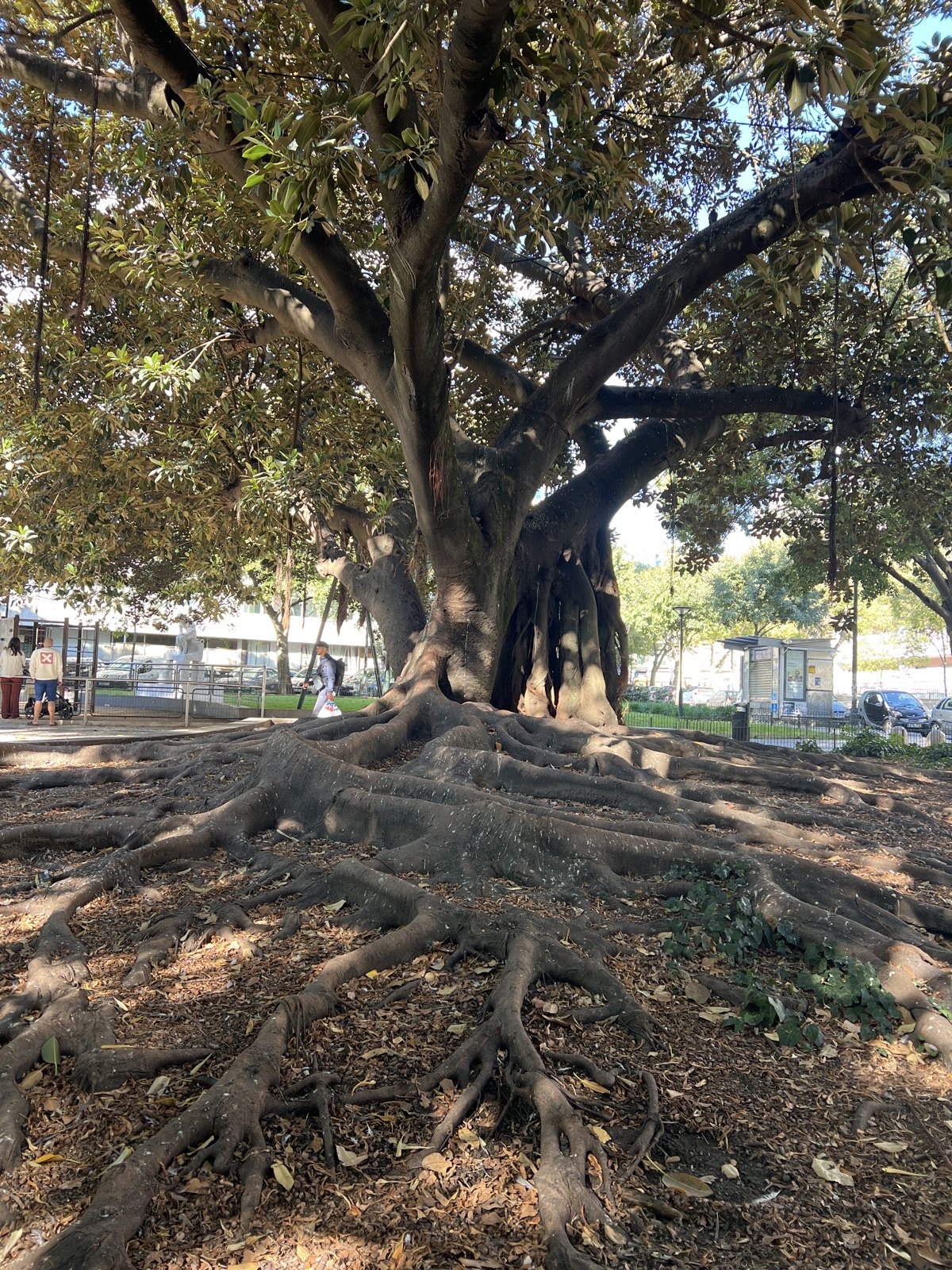
Moreton Bay Fig (Ficus macrophylla) · 115 years · Arroios
A garden of a quarter of a hectare in Arroios holds a fig with a 26 metre crown, which accounts for most of the shade in the place. Jardim Constantino is small: a lake, a playground, a statue of Prometheus and two protected trees. This is the wide one.
Ficus macrophylla comes from the east coast of Australia and was planted across Lisbon in the late 19th and early 20th centuries for exactly this reason. It grows fast, throws a dense crown, and drops the buttressing roots that make a mature specimen look like it is holding the ground down. At 24 metres tall on a trunk 2.33 metres round, this one has done the job.
It has been protected since 1947, which is early. The paperbark standing a few metres away had to wait until 1996 for the same status. The register recorded 107 years when the tree was measured in 2017, so roughly 115 today.
Lisbon has better known Moreton Bay figs, at Príncipe Real and in the Estrela garden, both of them on their own city-centre stages with a crowd in front of them. This one has a neighbourhood square, a bench underneath and no queue.
Ombu (Phytolacca dioica) · 115 years · Arroios
The two fattest trunks in this garden are not really wood. Phytolacca dioica, the bela-sombra, is a giant herb rather than a tree, and the swollen base that makes it look ancient is soft, water-storing tissue you could dent with a thumbnail. It grows fast, it produces no timber worth the name, and it falls apart earlier than its bulk suggests.
There are two of them here, and they came out almost identical: 10.45 and 10.4 metres round, 17.6 and 16.4 metres tall. They stand about 30 metres apart, one at the southeast corner of the garden and one at the top of it, so the visit is both or neither.
The garden wraps around the Igreja de Nossa Senhora dos Anjos, inaugurated in 1911, and the pair went in at roughly the time the church was finished. They were classified in 1947, among the earliest protection orders in Lisbon, and reclassified in 2018.
The register recorded them at 105 years when they were measured in 2015, so roughly 115 now. With a bela-sombra that figure is softer than usual. The trunk does not lay down the tidy annual rings you could count in an oak, so any age for one is worked back from size and from whatever the planting records say.
Ombu (Phytolacca dioica) · 115 years · Penha de Franca
The roots of this one come out of the ground looking like more trunks. The parish council's own account of Praça António Sardinha describes a century-old bela-sombra whose roots resemble trunks converging into one, which is a fair description of what a big Phytolacca dioica does. The base spreads into buttresses and folds until it is hard to say where the tree stops and the ground starts.
At 10.9 metres round it is thicker than either of the pair 600 metres away in Jardim António Feijó. Its crown reaches nearly 21 metres across on a tree only 16.2 metres tall, so it is wider than it is high.
None of that is wood. The bela-sombra is a giant herb from the South American pampas, all soft water-holding tissue, which is why it swells so quickly and why a careless machine can damage it in a way an oak would shrug off.
It stands beside a primary school, and when the square was rebuilt in 2023 the works were laid out around it. It was classified in 2000. The register recorded 105 years at the 2015 measurement, so roughly 115 now, an estimate from size rather than a dated planting.
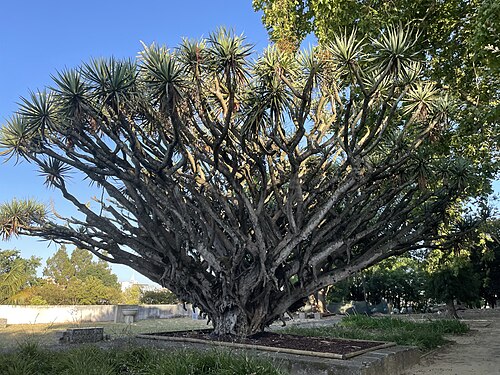
Dragon Tree (Dracaena draco) · 215 years · Olivais
This dragon tree is more than twice as wide as it is tall: 6.2 metres of height under a crown almost 14 metres across, on a trunk 4.75 metres round. Dracaena draco grows that way on purpose. It puts up a stem, flowers, then forks, over and over, until an old one looks like an umbrella made of umbrellas.
Nobody can date it properly. Dragon trees lay down no annual rings, so every age published for one is worked back from the branching or from records. The register recorded 200 years when it was measured in 2010, which makes it roughly 215 now, and that is about as precise as this species allows.
It grows in the Quinta Conde dos Arcos, a private estate the Lisbon council expropriated in 1940 and later opened as a nine-hectare park in Olivais. The old palace holds the municipal gardening school. The parish council names this dragon tree as the one tree of public interest among the 28 species growing there, and runs free guided walks on set dates through the year.
The sap runs red where the bark is cut, which is where the name comes from. Dragon's blood was shipped out of the Canaries and Madeira as a dye and a medicine for centuries before anyone thought to plant one of these in Lisbon.
Photo: DiogoBaptista (CC BY-SA 4.0)
London Plane (Platanus x acerifolia) · 350 years · Lumiar
The national register puts this plane tree at 364 years old. If that is right, it was standing here before the hospital, before the road and before most of Lumiar.
Treat the number carefully. It comes from the classification file opened in 1945 and has been repeated since, including in the book Árvores da Cidade, which gives the same 364 years and near-identical height and crown figures. Two sources, one origin, and nobody has ever dated the wood. Add the years since that survey and the register's own figure would make it about 375 today.
What has actually been measured is impressive enough on its own: 5.85 metres round the trunk, 28 metres tall, and a crown 37 metres across, nine metres wider than the tree is high. It fills the forecourt of the Edifício D. Carlos at Hospital Pulido Valente, and the hospital holds its anniversary events underneath it.
This is not a park. It is a working public hospital, and the tree stands in the open forecourt where you can see it without going near a clinical area, so go as you would go into someone's front garden and stay out of the way.
The London plane is the tree Lisbon planted everywhere in the 19th century for shade. This one, if the file is right, was already old when that fashion started.
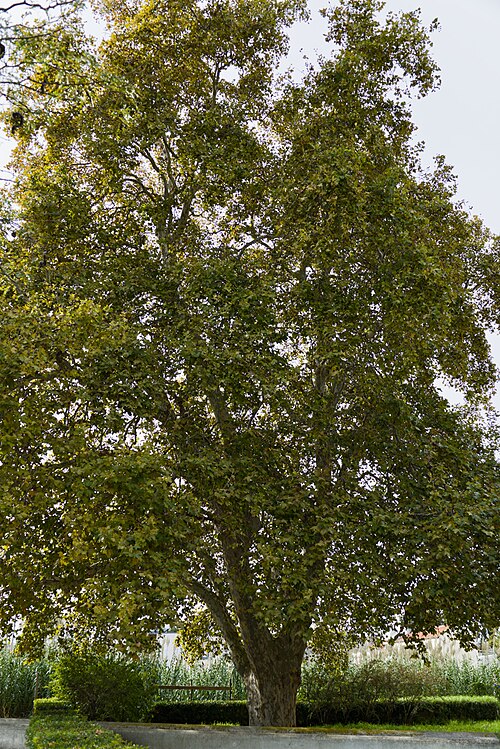
London Plane (Platanus x acerifolia) · 165 years · Belem
Two minutes from the queue at the Torre de Belém, on a back lane most visitors never turn into, stands a plane tree 29 metres tall. Travessa do Arco da Torre runs parallel to Avenida da Torre de Belém, near Largo da Princesa, and this is the tree that overtops the rooflines along it.
The trunk is 3.75 metres round and the crown spreads to nearly 27.5 metres, close to park dimensions for something growing out of a public street with no garden around it. Street planes are usually cut back hard for the wires and the windows. This one has been left to spread.
The register recorded 150 years when it was measured in 2010, so roughly 165 now, and the independent coverage of Lisbon's classified trees gives it about the same. It was classified in 2000.
That age puts its planting in the 1860s, when Belém was still being stitched into the city and long before the waterfront acquired its monuments, its museums and its crowds. Everything that now draws several million people a year arrived within sight of this tree, and it has watched the lot from one street back, over the roofs, with a couple of parked cars underneath it.
Photo: Vampiregrave (CC BY-SA 4.0)
Monterey Cypress (Cupressus macrocarpa) · 95 years · Ajuda/Belem
Monterey cypress has one of the smallest natural ranges of any conifer: two headlands on the California coast near Monterey, a few kilometres of cliff, and nothing else in the wild. It also grows happily almost anywhere mild and coastal, which is how one ended up roughly 9,000 kilometres away with a 3.9 metre trunk in a park above Belém.
At 18.5 metres tall with a 17 metre crown, this is a heavy, wide, dark tree, the shape Monterey cypresses take once the wind has had a few decades at them: horizontal limbs, flattened top, foliage in dense sprays that smell of lemon when crushed.
It stands in the Parque do Caramão da Ajuda, which is a public park and not the Tapada da Ajuda next door. That distinction is worth getting right before setting out, because the two are neighbours and only one of them has this tree.
Beyond the state register, nobody appears to have written it up. The register classified it in 2000 and recorded 85 years when it was measured in 2015, which puts it around 95 now, and those are the only figures anyone has published. It is a solid enough record as far as it goes, and it is the whole of what is known about this cypress.
Blue Jacaranda (Jacaranda mimosifolia) · 200 years · Ajuda
Every jacaranda in Lisbon can be traced back to this garden. The trees that turn the city lilac each May, more than three hundred of them on Avenida 5 de Outubro alone, descend from the first specimens acclimatised here in the early 1800s under Félix de Avelar Brotero, who directed the Ajuda garden from 1811. Brotero did not keep the tree to himself. He handed seed to anyone in Lisbon willing to plant it, which is how a South American species became the signature tree of a Portuguese capital. Two of those first jacarandas are still standing here, among younger ones planted since, and they kept one habit that gives them away: while the rest of the city flowers through May and into June, these two are the last in Lisbon to open. Why is not settled. The suggestion is that being the first to acclimatise left them on a slightly different clock from their own descendants. The garden around them was laid out in 1768 for King José I and is the oldest in Portugal, small enough to cross in half an hour, which makes this an easy visit to time properly. Come at the end of June, when the avenues have dropped their petals and these two are still in flower.
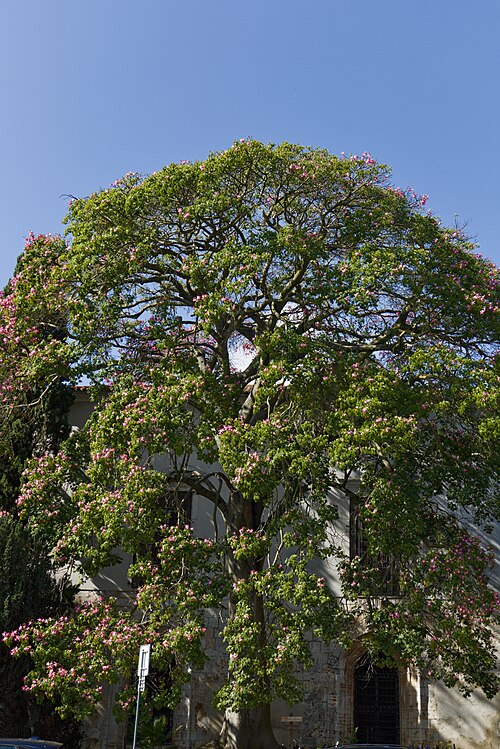
Paineira (Ceiba crispiflora) · 95 years · Belém
One of Lisbon's most walked tourist streets has a South American giant standing on it and almost nobody looks up. The paineira on Rua dos Jerónimos stands two minutes from the monastery that fills every postcard of the city, and it holds its own: 4.2 metres round the trunk, 24 metres tall, with a crown spreading 22 metres when the state last measured it in 2015. Portugal classified it as a tree of public interest in December 2001, the protection reserved for individual specimens worth keeping. Ceiba crispiflora comes from the forests of southern Brazil and does not hide where it is from. The trunk swells into a bottle shape and carries blunt conical thorns, and it flowers pink before splitting open pods packed with a silky white floss, the stuff that once filled pillows and life jackets. By the register's own reckoning it went in around 1930, which makes it younger than most trees on this map and no less worth the detour. It is the sort of tree you walk past twice: once without seeing it, and once when somebody points at the thorns.
Photo: Vampiregrave (CC BY-SA 4.0)
A day trip away
Bairro da Covina, 15 km north-east
Olive (Olea europaea) · 2,850 years · Bairro da Covina, Pirescoxe (Santa Iria de Azoia, Loures)
A road-widening scheme once looked at this olive and saw an obstacle. Rua 18 de Janeiro survived the argument, and so did the tree.
In 2011 researchers from the University of Trás-os-Montes e Alto Douro measured its trunk, a buttressed, hollow mass over ten metres round at the base, and used a dendrometric method built for exactly this kind of ancient, ring-less wood to put its age at roughly 2,850 years. At the time, press called it the oldest tree in Portugal. That title has since moved to two other olives dated by the same method, one in Abrantes at around 3,350 years and one in Vidigueira at over 3,700, so this one is no longer the record holder, only one of the country's oldest confirmed and independently certified trees.
It stands in the Covina neighbourhood of Loures, beside the ruins of Pirescoxe Castle, in what survives of an old olive grove that has otherwise given way to houses. A small square with information panels now marks the spot, the tree that nearly lost an argument with a road, and the reason the road bent instead.
This is a genuine day trip from Lisbon rather than an in-town stop, about half an hour by train and on foot from the centre.