Paris treats its trees as part of the civic record: the city logs every one of its 200,000 street and park trees in an open register and stamps a select few as officially remarkable. Its two oldest trees are father and son, black locusts raised four centuries ago from American seed by the royal herbalist Jean Robin and his son Vespasien, and both still flower every spring. They include the city's oldest tree, its thickest, its tallest, and an address that has held an elm since the Middle Ages. Every one is a metro ride away.
0 of 32 visited in ParisSee your full collection
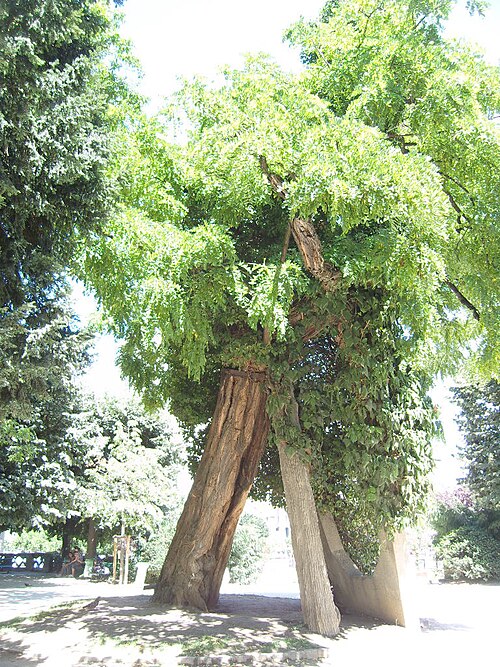
Black Locust (Robinia pseudoacacia) · 425 years · Latin Quarter, 5th arrondissement
The oldest tree in Paris was planted in 1601, before the Mayflower sailed. Jean Robin, herbalist to King Henri IV, raised it from seed sent from the Appalachians by the English naturalist John Tradescant. The entire genus Robinia was later named after him. The tree stands in a small square facing Notre-Dame, which had already stood for centuries when the sapling went into the ground. It has since lived through the Commune, lost its crown to a German shell in the First World War, and watched the cathedral burn in 2019. Concrete props now hold up its heaviest branches and ivy hides much of the trunk, but it still flowers every spring. Parisians walk past it daily without a glance. It is protected by a low fence and a plaque that undersells it considerably. In 2021 National Geographic profiled it as a lesson in urban resilience, four centuries of city life absorbed by one imported American tree.
Photo: Ordifana75 (CC BY-SA 3.0)
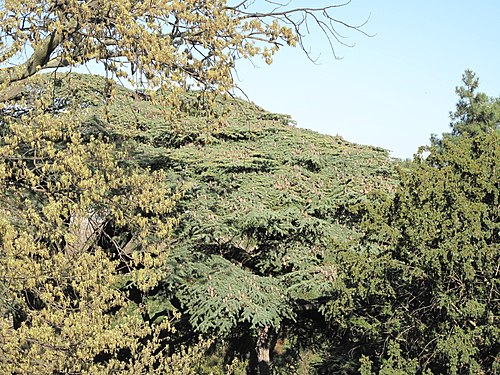
Cedar of Lebanon (Cedrus libani) · 290 years · Jardin des Plantes, 5th arrondissement
Legend says this cedar crossed the Channel in a hat. In 1734 the botanist Bernard de Jussieu carried two seedlings from England to Paris, and when the pot broke on the journey he is said to have finished the trip with a tree cradled in his tricorne. The story is probably embellished, which the Museum's own historians admit, but the tree is real enough: the oldest cedar of Lebanon in France, planted on the slope of the labyrinth in the royal medicinal garden that became the Jardin des Plantes. It was a sapling when Louis XV ruled, stood through the Revolution while the garden's aristocratic patrons lost their heads, and watched the menagerie fill with animals confiscated from Versailles. Nearly three centuries on, its trunk is a metre and a half thick and its flat crown is visible across the garden. A plaque at its base records the planting date for anyone who thinks to look up from the path.
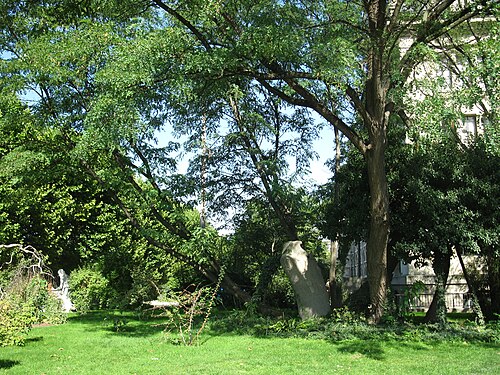
Black Locust (Robinia pseudoacacia) · 390 years · Jardin des Plantes, 5th arrondissement
Paris's second oldest tree is the son of its oldest. In 1636 Vespasien Robin, botanist to the king and son of Jean Robin, took a cutting from his father's black locust and planted it in the brand new royal medicinal garden. The father tree still stands two kilometres away at Square Rene-Viviani. The son has now been growing for close to four centuries in what became the Jardin des Plantes, making the pair almost certainly the oldest parent and child trees in any European city. It was already a mature tree when Buffon ran the garden in the 1700s and when the Museum of Natural History was founded during the Revolution. Like its father it is propped, scarred and still flowering. Botanists still take cuttings from both trees, which means the Robin family line, brought from America as a handful of seeds, keeps spreading four hundred years on. Few of the garden's seven million yearly visitors realize the unassuming acacia is nearly the oldest thing in it.
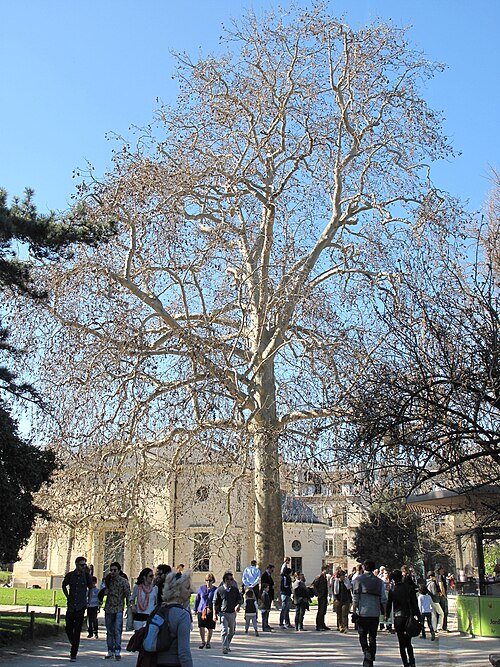
Oriental Plane (Platanus orientalis) · 240 years · Jardin des Plantes, 5th arrondissement
In 1785, four years before the Revolution, the naturalist Buffon planted three oriental planes in the garden he had run for half a century. This is the survivor. Buffon was then the most famous scientist in Europe, author of a 36 volume natural history that scandalized the Church by suggesting the Earth was far older than Genesis allowed. He died in 1788 and missed the Terror by five years; his son went to the guillotine. The tree his gardeners set in the ground kept growing through all of it. Oriental planes were admired in antiquity, and the Romans planted them across their empire for shade. This one received the national Remarkable Tree label in 2001. It stands near the garden's plane alley, wide trunked and mottled, old enough that the institution around it has changed its name three times while the tree kept its place. Its two siblings from the 1785 planting are gone, which makes the survivor the last living tree Buffon is known to have planted.
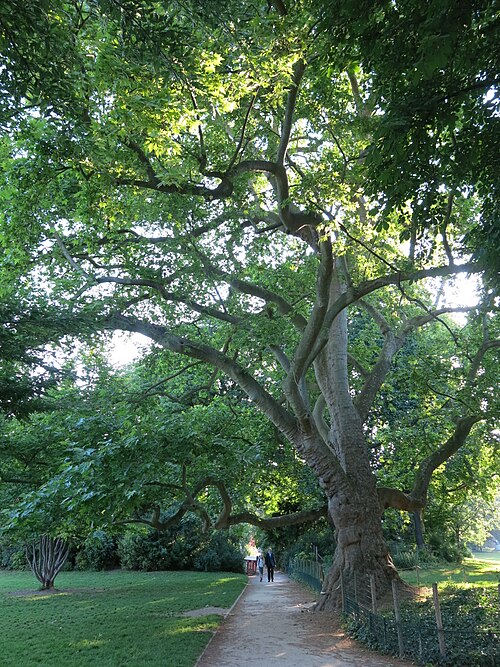
Oriental Plane (Platanus orientalis) · 210 years · 8th arrondissement
The thickest tree in Paris has a waistline of six and a half metres. Planted in 1814, the year Napoleon abdicated and the allied armies camped in the city, this oriental plane grew up in what was then the private pleasure garden of the Orleans family. Parc Monceau had been laid out as an aristocratic fantasy of ruins and follies, and the plane outgrew all of them. It is now 31 metres tall with a crown to match, the largest of its species in the city. The park around it became public under Haussmann in 1861, and the tree has since shaded Proust, who walked here as a boy, and several generations of the best dressed joggers in Paris. Its bark peels in grey and cream patches and its lower branches are thicker than most full grown street trees. The city lists it among its officially remarkable trees. Stand at the trunk and look up: the first branch is higher than the surrounding lampposts.
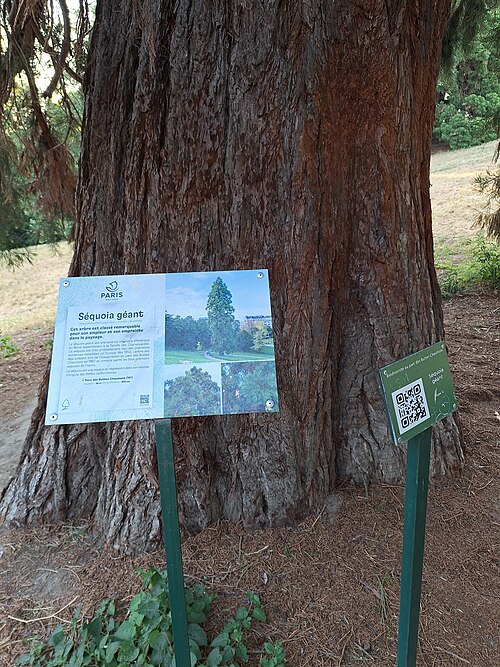
Giant Sequoia (Sequoiadendron giganteum) · ~160 years · 19th arrondissement
A Californian giant grows on a former gypsum quarry in working class Paris. When Napoleon III opened the Parc des Buttes-Chaumont in 1867, his engineers had just finished transforming a scarred industrial pit into a romantic landscape of cliffs, waterfalls and a temple on a crag. Among the plantings was a sequoia from the Sierra Nevada, a species that had only been described by Western botanists fifteen years earlier and was the horticultural sensation of the age. It is now the tallest tree in Paris at over 35 metres, with a trunk approaching five metres around. In its native range such a tree would be a juvenile; sequoias live for three thousand years, which means this one could still be standing when every building visible from the park has been replaced. The species name honours Sequoyah, the inventor of the Cherokee writing system. The park's chief gardeners have called it the crown of their collection.
Photo: Heidi Meudt (Stitchbird2) (CC BY 4.0)
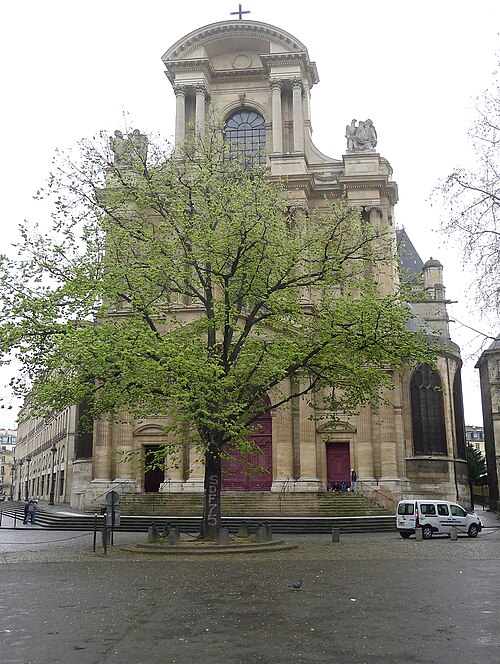
Field Elm (Ulmus minor) · 90 years · Le Marais, 4th arrondissement
This elm is not particularly old. The address is: one has stood on this exact spot in front of the Saint-Gervais church since the Middle Ages, and for centuries it was where the neighbourhood settled its affairs. Debts were repaid under the elm on agreed days, judges heard disputes in its shade, and the phrase attendez-moi sous l'orme, wait for me under the elm, entered French as a way of saying you might be waiting a while. The medieval tree's successors appear in old engravings and even in the wrought iron balconies of the surrounding buildings, where the elm motif was worked into the metal in the 1730s. The Revolution felled the tree then standing, allegedly for cannon carriages. The current elm was planted in 1935, a young stand-in occupying one of the longest continuously treed spots in Europe. The building behind it has hosted a church since the 4th century.
Photo: Mbzt (CC BY-SA 4.0)
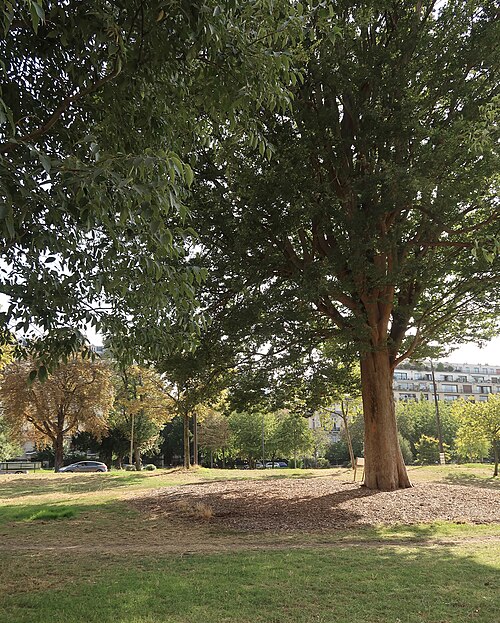
Caucasian Elm (Zelkova carpinifolia) · 175 years · 16th arrondissement
The grandest avenue in Paris keeps its most interesting tree off the main carriageway. Avenue Foch, 120 metres wide and lined with the most expensive apartments in the city, was laid out in the 1850s as the Avenue de l'Imperatrice, the ceremonial route from the Arc de Triomphe to the Bois de Boulogne. Its lower stretch served as a tree nursery, and a Caucasian elm planted there in 1852 simply never left. The species comes from the mountains between the Black and Caspian Seas and is rare in western Europe. This specimen is now 30 metres tall with a fluted, muscular trunk nearly four metres around, one of the finest of its kind in France. It has watched the avenue change from imperial parade ground to Belle Epoque promenade to the discreet fortress of embassies and old money it is today. The city has classified it among its officially remarkable trees.
Photo: Polymagou (CC BY-SA 4.0)
London Plane (Platanus x acerifolia) · 185 years · 14th arrondissement
This plane tree is older than the park around it. Planted in 1840, it was barely twenty when Napoleon III's engineers began carving Parc Montsouris out of old quarries and windmill land in the 1860s, and they built the park around trees like this one. It is now the heavyweight of the 14th arrondissement: six metres around the trunk and 30 metres tall, officially classified as remarkable by the city. Parc Montsouris became the southern anchor of Haussmann's plan to give every quarter of Paris an English style landscape park, and students from the nearby Cite Universitaire have been reading under this tree for a century. The RER line runs in a cutting through the park, which means several million commuters a year pass within metres of one of the oldest planted trees in southern Paris without knowing it is there. The city classified it formally among its remarkable trees, one of only a handful in the south of Paris.
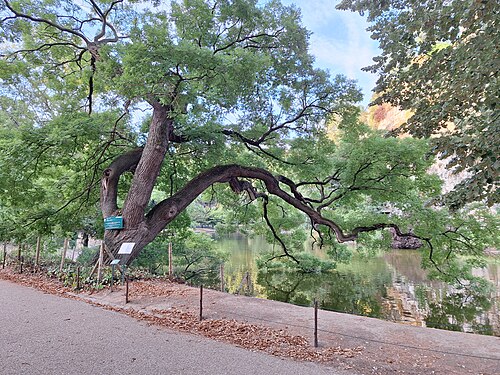
Japanese Pagoda Tree (Styphnolobium japonicum) · 150 years · 19th arrondissement
Some trees earn their place through size, this one through posture. The Japanese pagoda tree at the edge of the Buttes-Chaumont lake was planted in 1873, six years after the park opened, and has spent 150 years leaning slowly toward the water. It is short for a remarkable tree, ten metres, but its trunk is nearly four metres around and its low, twisting silhouette against the lake and the artificial cliff behind it has made it one of the most photographed trees in the park. Pagoda trees reached Europe from China in the 1740s via a Jesuit missionary's seeds, and Paris planted them enthusiastically in its new parks. This one grew up alongside the Third Republic, survived both sieges of Paris in 1870 and 1871 while the park was barely three years old, and now shades rowers and picnickers on the same bank. The city lists it among its officially classified remarkable trees.
Photo: Heidi Meudt (CC BY 4.0)
Caucasian Elm (Zelkova carpinifolia) · Latin Quarter, opposite the Sorbonne, 5th arrondissement
Paris lost most of its elms to a fungus, and this one survived by not quite being an elm. Zelkova carpinifolia is a Caucasian cousin of the true elms, native to the mountains between the Black Sea and the Caspian, and it is far less susceptible to the Dutch elm disease that emptied streets across Europe. That is the reason a tree of this size still stands in the middle of the Latin Quarter. The city register gives it a girth of 267 centimetres and a height of 20 metres, and gives no age at all. Nor does any other source. The species first reached Paris in 1782, but that is a date about the species, not about this trunk, and nothing documents when this one was planted. It stands in the small square facing the Sorbonne across Place Paul Painleve, with the Musee de Cluny and the Roman baths under it a minute away, on ground students have crossed on their way to lectures for as long as the tree has been there. In 2021 the Paris Council renamed the square for Samuel Paty, the history and geography teacher murdered in 2020. The tree kept its address and lost the old name, which is the sort of thing a long-lived tree tends to do more than once.
Oriental Plane (Platanus orientalis) · Latin Quarter, opposite the College de France, 5th arrondissement
Two oriental planes stand a few metres apart here, one measuring 470 centimetres around the trunk and the other 415. That is nearly nine metres of girth between them in a pocket garden of roughly 2,000 square metres, which is why they are listed here as one entry rather than two: you stand in a single spot and look up at both. Neither has a documented age. The city register records their girth and nothing more, no source gives a planting date, and large and old is as far as the evidence honestly goes. For scale, the thickest plane in Paris, in Parc Monceau, measures 645 centimetres around and was planted in 1814, and the Parc Montsouris plane reaches 605 centimetres and dates from 1840. These two sit below those and above almost everything else in the city. The garden faces the College de France across Rue des Ecoles and takes its name from Michel Foucault, who lectured in the building opposite. It was renamed for him in 2005, long after these trunks were full grown. A bronze Dante by Jean-Paul Aube stands beneath them, and the two planes shade a steady traffic of students, visitors walking up to the Musee de Cluny and people eating lunch on the slope.
London Plane (Platanus x acerifolia) · Left Bank of the Seine, near the Jardin des Plantes, 5th arrondissement
The sculptures are the newcomers. The Jardin Tino-Rossi was laid out along the Seine in 1980 as an open-air museum of modern sculpture, and it was built around plane trees that were already standing: the garden's own record notes old planes on the site before the garden existed. One of them is on the city's register of remarkable trees, on Quai Saint-Bernard, with a girth of 380 centimetres. Which of them, precisely, is where this entry has to be careful. The register lists a plane of that size at this point on the quay and gives a position for it. A second source confirms that old planes genuinely stand here, but nothing beyond the register singles out this trunk from the others along the same walk. By that listing it is the registered tree; by any other evidence available it is one large plane among several, and no planting date is documented for any of them. That is still a good reason to walk this stretch. The quay runs below the Jardin des Plantes towards the Institut du Monde Arabe, the river on one side and bronze and stone works standing free in the grass on the other. The planes are the oldest things in the garden and the only part of it nobody designed.
Twisted Beech (Fagus sylvatica 'Tortuosa') · 120 years · Latin Quarter, next to the Roman arena, 5th arrondissement
Every wild tree of this kind on earth grows in one wood near Reims. The hetre tortillard, or fau, is a twisted-branch form of the common European beech, and its only natural population is the Faux de Verzy, roughly a thousand specimens in the Champagne hills. Why they grow that way has never been settled. This one did not arrive by accident: it is a grafted specimen, planted here around 1905, a deliberate piece of botanical strangeness dropped into the Latin Quarter.
The result is a tree that reads as two different trees depending on the month. From May to October it is a low dome of dense leaf, easy to walk straight past, closer to a large shrub than to a beech. In winter the leaves go and the architecture shows: a short trunk turning back on itself, branches spiralling and bending down, some of them trailing to the ground. The city register puts its girth at 110 centimetres, modest for its age, because this form spends its growth going sideways rather than up.
Its address is far better known than it is. The square was laid out around the excavated Roman arena of Lutetia, a first-century amphitheatre built for some 15,000 spectators, found again during nineteenth-century roadworks and saved in part by a campaign Victor Hugo lent his name to. The beech arrived long after that argument had been won.
Horse Chestnut (Aesculus hippocastanum) · 19 years · Le Marais, 3rd arrondissement
The tree this one was cut from no longer exists. On 20 June 2007 a young horse chestnut went into the ground in a small garden off Impasse Berthaud, grown as a graft from the chestnut behind the Secret Annex in Amsterdam, the one Anne Frank could see from the attic window and wrote about in her diary. That original was already failing when the graft was taken, hollowed by fungus and moth damage and propped up with a steel frame. In August 2010 a storm brought it down. The Paris tree had been growing for three years by then.
The Ville de Paris classes it an arbre remarquable, a register otherwise filled with giants and centenarians. This one is on it for what it stands for rather than what it measures, which the classification explicitly allows. The measurements are modest and do not entirely agree: the register records 100 centimetres around the trunk, an earlier account gives 72, and the gap is roughly what a vigorous young chestnut puts on in a decade.
Mayor Bertrand Delanoe planted it alongside Hans Westra, then director of the Anne Frank House. The garden opened the same year, on the grounds of the seventeenth-century Hotel de Saint-Aignan, and at its entrance are inscribed the names of the 11,000 Jewish children deported from France. Nineteen years in, it is still a slim tree with a long job ahead of it.
Common Fig (Ficus carica) · a century · Le Marais, next to the Musee Carnavalet, 3rd arrondissement
A fig has no business standing ten metres tall in the open in Paris. Ficus carica is a Mediterranean species, knocked back by hard winters and usually trained flat against a warm wall this far north, and this one carries a trunk 145 centimetres around with nothing but sky above it. That size at that exposure is most of the reason the city lists it as a remarkable tree at all.
Nobody wrote down when it was planted. Every account of it repeats the same undated phrase, over a hundred years old, and the register designates it without naming a year, so the honest position is that it is old and that no one recorded how old.
The ground is better documented than the tree standing on it. Square Georges Cain was laid out in 1923 as an open-air store for the Musee Carnavalet next door, and pediments, columns, carved fragments and statues pulled from demolished Paris buildings sit among the planting, including a bronze by Aristide Maillol. Before any of that, these blocks were market garden, part of the culture Sainte-Catherine that fed the medieval city.
Figs are shorter-lived than almost everything else on this list and considerably less patient with frost. This one has spent decades winning that argument inside a walled square that runs warmer than the street outside, which is the quiet trick of the place and probably the reason it is still here.
Giant Sequoia (Sequoiadendron giganteum) · 175 years · Jardins des Champs-Élysées
Europe had barely met this species when the tree went into the ground. Giant sequoias reached European gardens from California in the 1850s, and the fullest account of this one dates it to 1850, which would put it among the first ever planted in Paris. That is also why the city register lists it: the designation is for its age, not its size. At 19 metres it is a sapling next to the Californian originals, where General Sherman stands over 80 metres tall. The sources do not agree on the trunk. Paris measures it at 3.6 metres around; the independent account calls it a little over three metres in diameter, which is roughly three times thicker and is almost certainly circumference mislabelled. Take the register's figure. Age is loose in the same way, given as about 165 years around 2015 by one source and about 140 by a passing mention elsewhere, so somewhere between 165 and 180 years is as far as the evidence goes. It grows in the Jardins des Champs-Elysees, the ornamental gardens laid out below the avenue, a short walk from the allee Marcel Proust. It was already a mature tree for the 1900 Exposition Universelle and for every parade that has gone up the avenue since. Its southeast side, the one facing Place de la Concorde, has begun to show signs of weakness.
London Plane (Platanus x acerifolia) · 100 years · Jardins des Champs-Élysées
A trunk five and a half metres around is a great deal of plane tree for a Paris street. Two of them stand about eleven metres apart on Avenue Winston Churchill, on the axis between the Grand Palais and the Petit Palais, and the city registers them separately: one at 5.05 metres around and 28 metres tall, the other at 5.55 metres and 30 metres. From the pavement they read as a single pair, which is how they are treated here. Neither has a planting date. The register carries none and no archive found so far supplies one, so their age is inferred from girth alone and the range stays deliberately wide: certainly more than a century, possibly close to twice that. What is datable is the ground under them. Alphand laid out these gardens for Haussmann in the 1860s, and the avenue and its two palaces were built for the Exposition Universelle of 1900. The trees either predate that construction or went in with the replanting that followed it, and no source says which. London planes take city air better than almost anything else, shedding their bark in plates rather than letting soot build up on it, which is why Paris has hundreds of thousands of them. Reaching this girth still takes a long time and a spot nobody widened a road through. These two got both.
Southern Magnolia (Magnolia grandiflora) · 60-160 years · Square d'Ajaccio
This tree comes from the warm swamp forests of the American southeast, and it has grown to twelve metres in a small square off the Rue de Grenelle. Southern magnolia keeps its leaves all year, thick and glossy with a rust-coloured felt underneath, and in early summer it opens cream-white flowers the width of a dinner plate, lemon-scented and gone within a couple of days. Paris put this one on its remarkable tree register at 163 centimetres around, a figure the one independent account of the square repeats exactly. Nobody has recorded its age. The square supplies the only chronological anchor: Square d'Ajaccio, formerly Square des Invalides, was laid out by Adolphe Alphand, the engineer behind most of Haussmann's parks, in the wave of small green squares cut into Paris between the 1860s and the 1880s. Whether the magnolia went in with the square or a lifetime later, no record says, which is why the estimate here is a broad one. It shares its enclosure with a plane tree forty-five metres away that is also on the register, so this is a two-tree garden and ten minutes is enough for both. Magnolia grandiflora is planted across Paris but rarely gets to stand up like this: the species is tender here, and most specimens spend their lives flattened against a warm wall.
London Plane (Platanus x acerifolia) · 100 years · Square d'Ajaccio
Four metres ninety of trunk, in a square you can cross in twenty paces. The register gives this plane 490 centimetres around and 25 metres tall, and the one independent survey of Square d'Ajaccio quotes exactly the same 490, which is the kind of agreement that makes a measurement worth trusting. The two sources part company on the species. The city types it as Platanus x hispanica, the London plane, the hybrid Europe planted by the million from the eighteenth century onward. The visitor guide calls the square's planes oriental planes, which is one of that hybrid's two parents and a genuinely different tree. The city's own inventory wins here, but the disagreement is real and it is the sort of thing you can stand at the trunk and argue about. Its age is documented nowhere. The same guide calls the square's planes century-old, and the square dates from Alphand's programme of the 1860s to 1880s, so a hundred years is a floor rather than a figure. The tree has therefore watched the Rue de Grenelle become a street of ministries and embassies, with the dome of the Invalides two blocks east, while doing what old planes do: dropping bark in camouflage plates every summer and putting on another centimetre of belt. It stands forty-five metres from a southern magnolia that is also on the register, two designated trees inside one small enclosure.
Turkish Hazel (Corylus colurna) · 80-150 years · Square du Temple - Elie-Wiesel
Most people picture a hazel as a shrub they can see over. This one is sixteen metres tall with a trunk 235 centimetres around. Corylus colurna, the Turkish hazel, is the outsized relative of the nut-bearing hedge hazel, native to the Balkans, Anatolia and the Caucasus, and it grows as a single straight trunk under a tidy cone of a crown. Nineteenth-century park designers liked it for the shape, and cities still plant it because it shrugs off heat, compacted soil and bad air. Nobody wrote down when this one was planted. Paris has other Turkish hazels of similar or greater girth that do carry dates, including one in Square Maurice-Gardette recorded as 1882, so comparison puts this tree somewhere between eighty and a hundred and fifty years old, and that is as precise as the evidence gets. The ground has a heavier history than the garden suggests. This is the old Temple enclosure, the Paris headquarters of the Knights Templar, and later the prison where Louis XVI and Marie-Antoinette were held before their executions. The tower came down in 1808 and the garden that replaced it dates from the 1850s. It now holds 71 trees and 191 varieties of plant, a good share of them foreign: a ginkgo, a Japanese pagoda tree, a Caucasian wingnut, a golden rain tree and a Chinese quince, all within a few minutes of the hazel.
Turkish Hazel (Corylus colurna) · 145 years · Square Maurice-Gardette
French regional television once ran a news piece written in this tree's own voice, headlined "I am 145, stop cracking my hazelnuts and let me age in peace". The grievance is real enough. Turkish hazel nuts are edible, they drop in quantity in early autumn, and people in Square Maurice-Gardette gather them. The two sources differ on when it started. The city register records a planting year of 1882; the broadcast piece says 1879. Three years apart, which makes it roughly 145 years old either way and, more usefully, one of the few Turkish hazels in Paris with any planting date at all. Its trunk measures 265 centimetres around and it stands twenty metres, tall enough to end the argument about hazels being shrubs. Check the bark. This species sheds it once a year in pale corky strips, closer to a birch than to anything you would expect on a nut tree, and on a trunk this size the effect is hard to miss. It shares the square with an olive, a ginkgo and a horse chestnut, none of which crowds it. One caveat on the superlative that follows this tree around. The same broadcaster has called a different Paris hazel, the one in Square Jean-XXIII behind Notre-Dame, the oldest in the city. Both claims cannot be right and nothing settles it, so this one is left as what it demonstrably is: dated, measured and unusually large.
Caucasian Wingnut (Pterocarya fraxinifolia) · 164 years · Square d'Estienne d'Orves
Come up the steps from the Trinite metro and it is right there, twenty-six metres of it, reported to be the oldest living Caucasian wingnut in France. Two independent sources give a planting date of 1862 and a trunk 3.8 metres around, and they match the city register to the centimetre, which is rarer than it should be. The claim about being the oldest in the country belongs to those sources rather than to us: no ring count has been published, and a tree dated 1862 makes it plausible without proving it. Pterocarya fraxinifolia comes from the Caucasus and northern Iran, a wetland species happy in ground too wet for most hardwoods. It gives itself away in high summer, when chains of winged green nutlets up to half a metre long hang from the branch tips, and its ash-like compound leaves can run to sixty centimetres. Left alone the species suckers from the root plate until one tree becomes a thicket of itself, which is what makes a clean single trunk of this size worth the stop. Paris gave it the Remarkable Tree label on 1 April 2017. It stands in the small square in front of the church of La Trinite, in a quarter rebuilt during Haussmann's works, so the tree and the streets around it went up together and it has been growing beside the station entrance since before the Metro existed.
Chinaberry (Melia azedarach) · 60-150 years · Square Boucicaut
Here is a subtropical tree holding its fruit through a Paris winter. Melia azedarach, the chinaberry, belongs to the warm belt running from India to China and is normally a Mediterranean planting; the French call it lilas de Perse, Persian lilac, for the loose sprays of small mauve star-shaped flowers it opens in summer. What happens next is the reason to note the address. Those flowers become hard pale yellow berries that stay on the bare twigs long after the leaves have gone, so the tree is at its most conspicuous in December. The berries are poisonous to people, which is worth knowing if there is a child with you. The register gives it 155 centimetres around and ten metres tall, and the independent survey of the seventh arrondissement's nine remarkable trees repeats that same 155. Neither carries a planting date, and the square's own literature says only that many of its hundred-odd trees pass a century, which is a claim about the square rather than about this tree, so its age stays open. Square Boucicaut opened in 1870 as the square du Bon-Marche, named for Aristide and Marguerite Boucicaut, whose department store still faces it: fixed prices, goods you could handle before buying, and the oldest such shop in Paris. Their garden still collects oddities, Chilean araucarias and a very rare Cunninghamia lanceolata among them. The chinaberry is the one that fruits in the cold.
Amur Cork Tree (Phellodendron amurense) · 100 years · Latin Quarter, opposite the Collège de France, 5th arrondissement
Paris classifies this Amur cork tree as one of its remarkable trees, and it carries proof of a rough century outdoors: a lightning scar runs down the trunk. It shares its small pocket garden, opposite the Collège de France in the Latin Quarter, with the two Oriental planes already listed here, though almost nobody looks past those two to notice it. Phellodendron amurense is a startling find in a French square, native to the river valleys of northeastern China and the Russian Far East, grown there and studied for a thick, corky, deeply furrowed bark long before anyone planted it for how it looks. This one went into the ground in 1925, and the city's own record has it at 14 metres tall with a trunk 1.8 metres round as of 2011, a girth built less by height than by branching low and wide, so the trunk balls up beneath the crown instead of running straight. Compound leaves shaped like an ash tree's turn a hard yellow every autumn. The measurement is now fifteen years old and the tree has kept growing since, and this pass found only the city's own account of it, so the numbers are given as recorded rather than confirmed twice over. Still worth the two extra steps past the planes: not every French square holds a tree from the Amur river valley with a lightning strike already behind it.
Oriental Plane (Platanus orientalis) · 170 years · Square Louise Michel, below the Sacre-Coeur, 18th arrondissement
Millions of people climb past this tree every year on their way to something else. Square Louise Michel is the terraced garden below the Sacre-Coeur, the one with the long staircase up the Butte Montmartre, and three of the city's registered remarkable trees stand within 150 metres of each other inside it. This oriental plane is the oldest and the largest of the three.
It was planted in 1857, which puts it 70 years ahead of the garden around it: the square itself was only laid out in 1927. The city register and the square's own published description agree to the centimetre, 520 centimetres round and 28 metres tall, which is a rarer kind of agreement than it ought to be.
One caveat on the paperwork. A local survey of the 18th arrondissement describes an oriental plane of 470 centimetres planted in 1840, close enough to invite confusion and different enough on both figures that it is probably a different tree somewhere else in the district. The numbers given here are the register's and the square's, not that survey's.
Everyone on the steps is looking up at the basilica. The plane is off to the side, doing nothing in particular, and has been doing it since before there was a basilica to look at.
Caucasian Wingnut (Pterocarya fraxinifolia) · 125 years · Square Louise Michel, below the Sacre-Coeur, 18th arrondissement
There are two Caucasian wingnuts in this square and only one of them has a birthday. The register lists both, sixty metres apart, at 371 and 416 centimetres round. The published account of the garden describes a wingnut of 3.60 metres planted in 1899, which fits the smaller of the two closely and the larger one not at all, so the date sits here, on this tree, and the bigger one keeps no age rather than borrow one.
The heights do not line up as neatly. That same account gives its wingnut 20 metres; the register now measures this one at 26. Years of growth would explain the gap, and so would the account having described the other tree all along, and nothing available settles it.
What is not in dispute is what happens in high summer. Chains of pale green winged seeds hang straight down from the branch tips, long, narrow and unlike anything else growing on this hillside, and on a crown this size there are hundreds of them at once. Come in February and you would walk past it without a second look.
It went into the ground in 1899, the year before the funicular started hauling visitors up the slope beside it, and it has spent every summer since dangling seed chains over people too busy climbing to look sideways.
Horse Chestnut (Aesculus hippocastanum) · 125 years · Square Louise Michel, below the Sacre-Coeur, 18th arrondissement
The best-known figure for this chestnut is forty centimetres out of date. Two published accounts of the garden give it a trunk of 330 centimetres; the city register now measures 370. Nothing has gone wrong. The tree kept growing while the paperwork stood still, which is the most cheerful sort of disagreement between sources.
It was planted in 1902, and the register and both accounts agree on that, which makes it one of the better-dated trees on this page. In 1902 the basilica above it was a building site: work on the Sacre-Coeur ran from 1875 to 1914, so the chestnut spent its first dozen years growing under scaffolding and cranes. The garden itself arrived later still, laid out in 1927.
Horse chestnuts are the most familiar tree on this list and the most taken for granted. This one is 21 metres tall under a broad even crown, and it does the two things the species is loved for on schedule: white flower spikes standing upright all over it in May, conkers split out of their green cases on the path in September.
One correction to the name Paris gives it. The marronnier d'Inde is not from India and not from here either. It came out of the mountains of the Balkans in the sixteenth century, and Europe has been planting it in squares ever since.
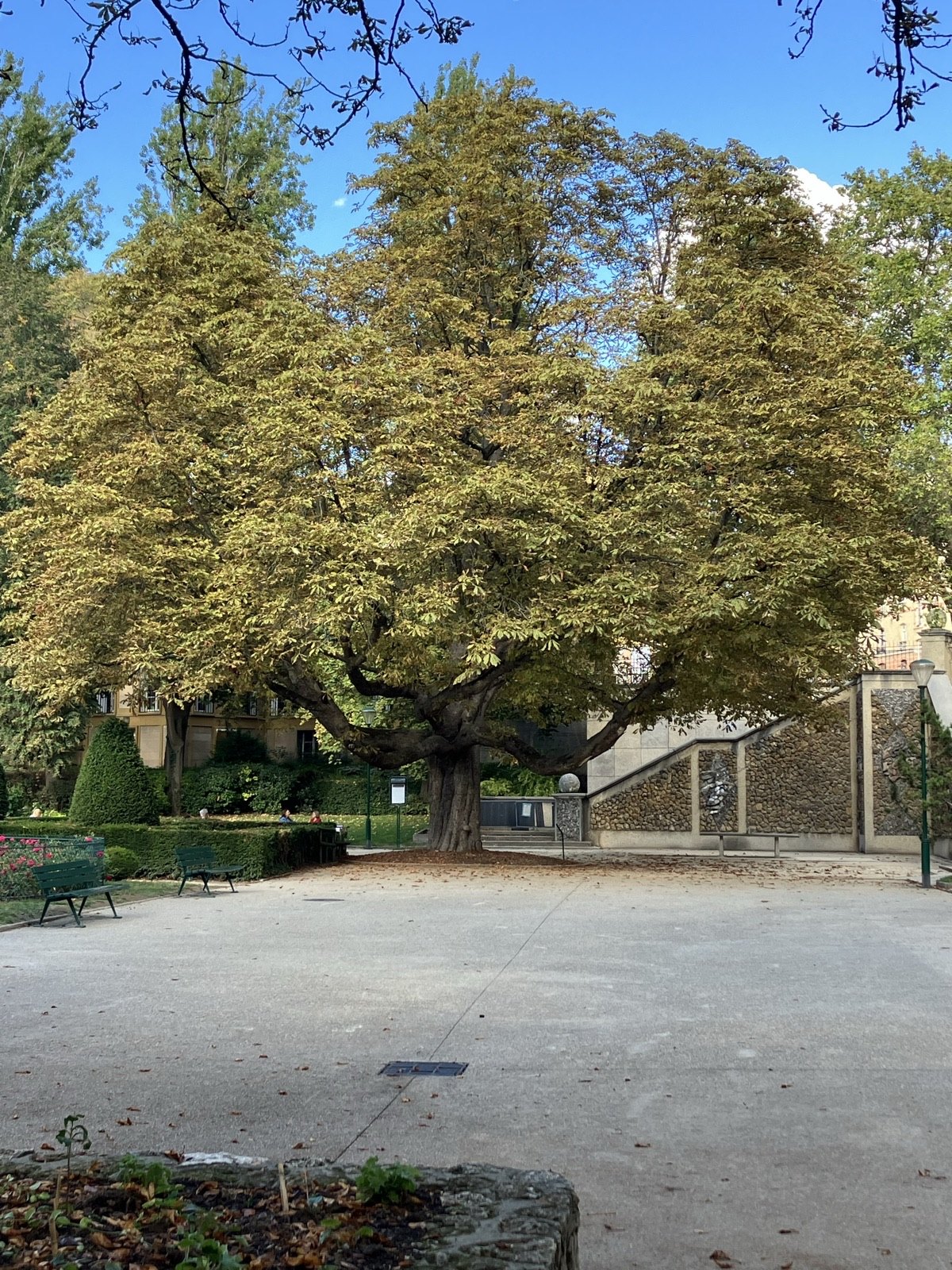
Horse Chestnut (Aesculus hippocastanum) · 130 years · Square Rene-Le Gall (Jardin des Gobelins), Croulebarbe, 13th arrondissement
There is a river under this garden. The Bievre ran through the Gobelins quarter in the open until the city buried the last stretches of it, fouled by the tanners and dyers who had worked its banks for centuries, and Square Rene-Le Gall was laid out in the 1930s across the ground it used to flow over. This horse chestnut was planted in 1893 or 1894, while the water was still above ground.
It stands near the garden's obelisk, at one of the entrances, and its measurements are a small lesson in how slowly a mature tree changes. A 2011 survey recorded 18 metres tall and 360 centimetres round. The city register now gives 17 metres and 369. Nine centimetres of belt in well over a decade, and a metre of height that is measurement noise rather than a tree shrinking.
The square around it is a listed historic monument, protected since 1997, though the protection is for the 1930s design rather than for anything growing in it: rock gardens, a long sunken lawn, brick pavilions and that obelisk, laid out on a scale most Paris squares never get.
The chestnut is one of the few things here older than the design. It was already a grown tree when the diggers arrived, and it is the only part of the garden nobody drew.
London Plane (Platanus x acerifolia) · 120-165 years · Square Montholon, 9th arrondissement
Square Montholon has two enormous plane trees and the city has written down the history of only one of them. This may be that one. The official description of the square records a plane planted in 1872, standing 32 metres tall with a trunk 432 centimetres round. The register of remarkable trees lists a single plane here, at this exact spot, at 470 centimetres and 27 metres. Those are not the same numbers.
Either this trunk has put on 38 centimetres since that record was made, which is entirely ordinary, or the register has pinned the other tree of the pair, which is also entirely ordinary. Nothing available decides it, so the age given here stays broad, well over a century and probably a good deal more, rather than claiming 1872 for a tree that may not have earned it.
What is not ambiguous is the trunk in front of you. Four metres seventy puts it among the larger planes anywhere in Paris, in a garden small enough to cross in a minute.
The square opened in 1863, one of the small public gardens cut into the city while Haussmann was rebuilding it, and was redesigned in 1981. It sits off the Rue La Fayette in the 9th, gates open in the morning and shut at night, with the pair of planes doing most of the work of making it feel older than the rest of it is.
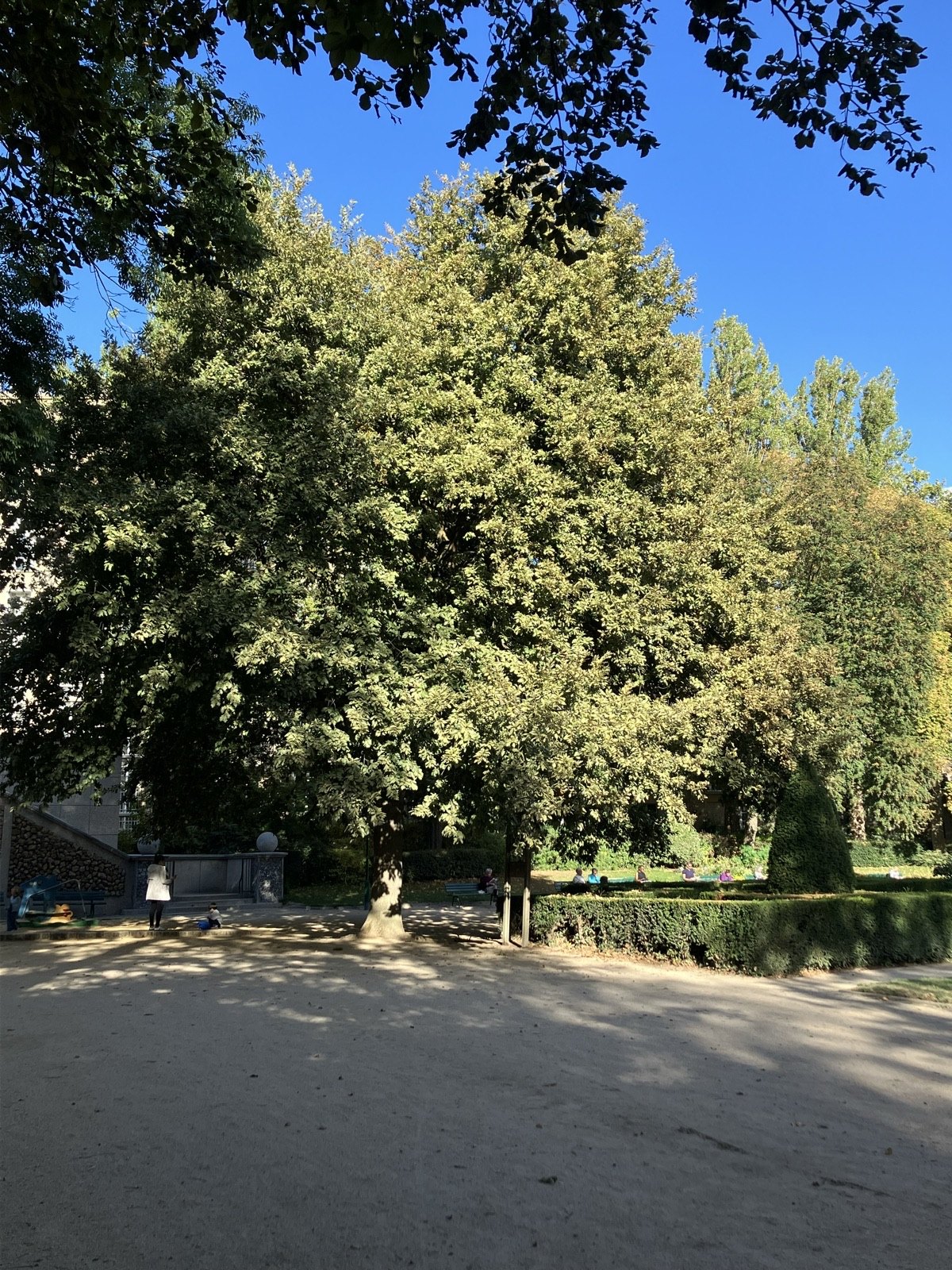
Turkey Oak (Quercus cerris) · 75-150 years · Square Rene-Le Gall (Jardin des Gobelins), Croulebarbe, 13th arrondissement
Three hundred metres from Square Rene-Le Gall's horse chestnut, on the same buried river, stands a Turkey oak the city's own register lists at 190 centimetres round and 18 metres tall. It shares the garden's history without sharing its fame: the horse chestnut has a planting date, an obelisk nearby and a published story, while this oak has only its two register measurements and a spot in the same 1930s park laid out over the vanished Bievre.
Quercus cerris is a fast grower for an oak, native to southern Europe and Asia Minor, distinguishable from more familiar oaks by acorns wrapped in a shaggy, moss-like cup that gives the species its French name, chene chevelu, the hairy oak. Paris plants it as a street and park tree precisely because it tolerates drought and poor soil better than the native pedunculate oak, useful for a garden built on reclaimed, once-marshy ground.
No second source beyond the city's own tree register has been found for this specific tree, so it ships flagged. If you know more, the garden's obelisk is a five minute walk and the two trees make an easy stop on the same visit.
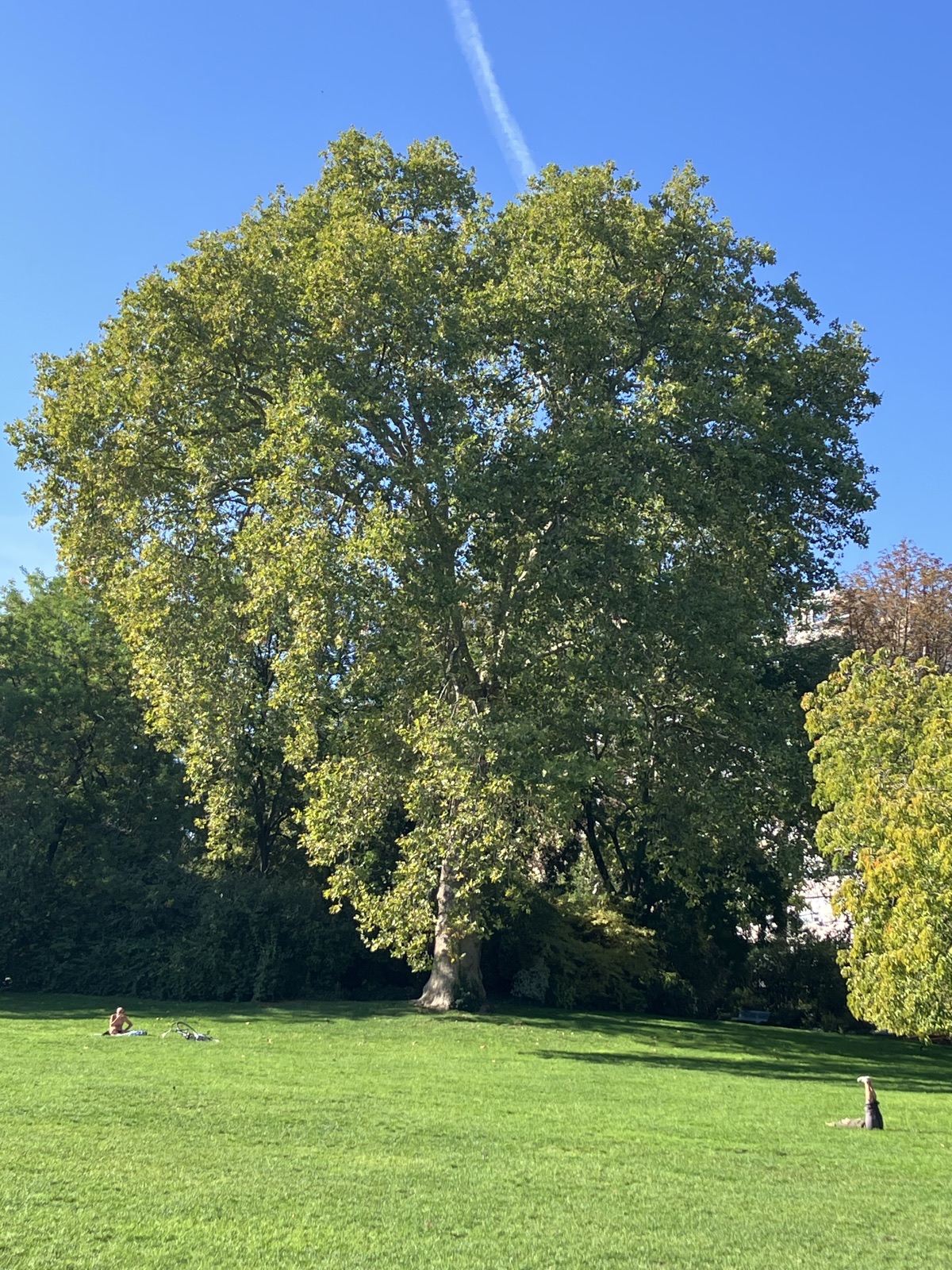
London Plane (Platanus x acerifolia) · 186 years · 14th arrondissement
A reader sent us this plane, and the photograph makes the case for it: a London plane at the edge of the great lawn of Parc Montsouris, its crown so full and even that it reads as a heart against the sky. The city's own tree inventory lists it on the Grande pelouse at 480 centimetres around the trunk and 25 metres tall. Paris has not classed it as remarkable, which is why no list of the park's famous trees mentions it.
The park's classified plane, the one every guide names, stands about 190 metres to the east and is thicker, at 6.7 metres round. The two make an easy pair on one walk: the famous trunk first, then this one, which you see whole from the grass, roots to crown, with the lawn opening in front of it.
How old is it? The reader who found it puts it at about 186 years: a trunk this thick, they reason, has stood here since the park was made. No record we have found gives a planting date, so if you know one, from a park plan, an old photograph or a plaque, tell us.
Montsouris is also the park of Jacques Prévert's poem Le Jardin, from his collection Paroles, about a kiss there one winter morning, “au parc Montsouris à Paris”. The reader who found this tree sent us the poem along with it.