Portland has protected its best trees by city ordinance since 1993, and the law is credited to neighbours who stopped a chainsaw partway through an oak. That oak is here, roughly 300 years old, with thirty-one more. Seven stand within 1.8 kilometres downtown. Seven make a second walk through Irvington, ending at a line of nine Caucasian wingnuts. Lone Fir Cemetery holds the Douglas fir it is named for. The rest are worth the trip alone: a 74 metre Douglas fir, the West's oldest grafted apple and a sequoia on a volcano.
0 of 33 visited in Portland
Copper Beech (Fagus sylvatica f. purpurea) · 135 years · Downtown / Portland State University campus
Portland State University knocked down a Victorian mansion to build its library, then laid out the front lawn around the tree that had stood beside it. The beech is still there. The house is not.
Frank Watson made his money in ironworks and shipbuilding, and around 1890 he and his wife Mary Whalley Watson planted this copper beech beside their new home on the corner of Hall and Park. Sources credit the planting to one or the other of them and do not agree on which. The house came down between 1965 and 1968 to make room for the Millar Library, designed by Skidmore, Owings & Merrill. No record explains why the beech was spared when everything around it was cleared. It simply was, and it ended up the centrepiece of the lawn rather than a casualty of it.
It now stands about 25.6 metres tall with a trunk 5.71 metres around, and went onto Portland's register as Heritage Tree #54 in 1995. A photograph from 1975 shows students packed shoulder to shoulder on the grass underneath it, which is more or less what the lawn is still for on a warm day.
What it has watched is a residential corner turning into a university: Victorian houses giving way to concrete, and then fifty years of students using its shade as somewhere to meet.
London Plane (Platanus x acerifolia) · 145 years · Downtown
The house this tree was planted to shade is now a parking lot. The plane tree has outlived it by more than a century.
An 1880 photograph shows it as a thin sapling beside the home of Sylvester Farrell, a feed-and-grocery merchant who moved into salmon canning and later sat on Portland's City Council. The tree was reportedly a gift from US Senator J.N. Dolph. Farrell's house is long gone, the corner it stood on has been given over to parked cars, and the plane tree carries on in the planting strip beside them.
Portland made it a Historic Landmark in 1973 and entered it on the new Heritage Tree register the same year as number 2, which makes it one of the first trees the city ever formally protected. It is about 19.2 metres tall with a trunk 4.36 metres around. Locally it gets called a sycamore, which it is not.
Portland's old nickname was Stumptown, earned honestly: the city cleared its native forest fast and left the stumps standing in the streets. This tree belongs to the second chapter, planted on purpose by people who had watched the first forest go. It has now outlasted the man who planted it, the house he planted it for, and the neighbourhood they were both part of.
Lavalle Hawthorn (Crataegus x lavallei) · 60 years · Downtown
Four trees, four separate heritage numbers. Portland registered these hawthorns individually as Heritage Trees #109 through #112, which is a lot of paperwork for a row most people walk past as a single hedge.
They stand in the planting strip along SW 12th Ave in front of the First Unitarian Church, all four planted in 1966 and all four added to the register in 1996. Lavalle hawthorns are small trees and these are no exception: 11 to 13.4 metres tall, with trunks between 1.8 and 2.26 metres around. They are also, by a wide margin, the youngest entries in this city.
They earn their place through the congregation rather than through age. Rev. Thomas Lamb Eliot led this church from 1867 to 1893 and became one of Portland's more consequential citizens, founding social and library associations and lending his name to the Eliot Glacier on Mount Hood. The members he drew in did a good deal of the civic building of early Portland, and the row went in as a tribute to that.
Come in autumn and all four hang with dense clusters of dark red haws while the leaves go bronze. That is the point in the year when the row stops reading as a hedge and starts reading as four trees.
Black Walnut (Juglans nigra) · 145 years · Goose Hollow
A fourteen-acre estate has been reduced to a single walnut on a school lawn. This is it.
Jacob Kamm was a Swiss immigrant who engineered steamships and made a fortune moving freight on the Columbia River with the Oregon Steam and Navigation Company. He built a French Second Empire mansion out here when this was the edge of Portland. His wife Caroline Agusta Gray had grown up among the first missionary families living with the Nez Perce in Idaho.
The planting date is genuinely unsettled. The tree's own plaque says the 1880s. The city's field guide, in its narrative, dates it to around 1871 and the building of the Kamm house. Nobody has reconciled the two, so the honest answer is somewhere inside that fifteen-year window.
The Kamms sold up in 1910 and Lincoln High School took the site. When the current school building went up in 1952, architect Hollis Johnston drew his plan around the walnut rather than through it. It stands about 29 metres tall with a trunk 4.24 metres around, close enough to Interstate 405 to hear it. Ask anyone who went to Lincoln and you will usually get a story.
The tree sits at the edge of school grounds. Look at it from the corner of SW Salmon and SW 14th rather than walking onto the property, particularly on a school day.
Austrian Pine (Pinus nigra) · 150 years · Goose Hollow
This 31-metre pine is growing out of a street planter because a florist put it in the ground before there was a street.
Through the 1870s and 1880s this stretch of Goose Hollow lay outside the city limits and belonged to Henry Miller, one of Portland's first florists, who ran a plant nursery, a seed farm and a floral supply business on the slope. The Austrian pine and a large Cedar of Lebanon a short way off both appear to be imports he planted on his own nursery ground. They were stock and demonstration rather than landscaping, which is why they sit where no landscape architect would have put them.
The register dates the planting to the late 19th century and added the tree to the Heritage list in 1993. It is roughly 31.1 metres tall with a trunk 3.23 metres around, rising out of a built-out planter at an intersection that did not exist when it was young.
There is photographic proof of its head start. A 1959 photograph of the Jacob Kamm House, a few blocks east, catches this pine and its cedar neighbour already full grown in the background.
What it has watched is a semi-rural nursery district becoming one of the densest neighbourhoods in Portland, with an interstate cut through beside it.
Dutch Elm (Ulmus x hollandica) · 125 years · Northwest District
A Portland architect once parked his car against this elm so the removal crew could not reach it. It worked.
The city council had condemned the tree in 1963. The owner of the building in front of it wanted it gone, worried that its roots were working into his foundations, and applied for a removal permit. Lewis Crucher's car bought enough time for Mayor Terry Schrunk to place a moratorium on that permit while the city forester and the city engineer went and looked at the tree themselves.
What followed ran in the Oregonian for months: a vigil at the trunk, a poem printed in the paper, and a letter from Dr Eugene W. Rockey recalling that his father had planted the elm in 1900 in front of their newly built house, and had fitted it with a wooden slat guard to stop the family's buggy horse nipping the top off the sapling. The foresters found the tree healthy and safe. The permit was refused.
It is about 24.4 metres tall with a trunk 4.60 metres around, Heritage Tree #46 since 1995. It had already come through the Columbus Day Storm the year before the council came for it, which means it survived the worst windstorm in the region's recorded history and then very nearly lost to a building permit.
Its opposite number, the Storm Elm, stands directly across Flanders Street.
English Elm (Ulmus procera) · 125 years · Northwest District
The Columbus Day Storm of 1962 flattened roughly 15 billion board feet of Pacific Northwest timber and gusted to 116mph over Portland. On the north side of this block, one elm was left standing.
That is this tree, planted in 1902 or 1903 in the planting strip on NW Flanders St. It is around 24.4 metres tall with a trunk 4.30 metres around, and it went onto the Heritage Tree register as number 36 in 1994. The city's own field guide is blunt about the odds: getting through that night at all was no small thing for a mature elm on an exposed street.
The storm was not the end of the threat. Dutch elm disease arrived later, carried by a bark beetle that reached North America from Asia by way of Europe, and a smaller elm on the same block was lost to it. The elms still standing here, this one included, are now inoculated against the fungus by the city and by volunteers.
Look across the street while you are here. The Rockey Elm came through the same night and then had to be defended from a removal permit the following year. Two trees, one block, and one decade that tried twice to take them.
Giant Sequoia (Sequoiadendron giganteum) · Southwest Hills
Forty-five metres of Californian giant sequoia is growing out of a street verge in the Southwest Hills, and nobody has written down when it was planted.
Sequoiadendron giganteum belongs in the western Sierra Nevada, several hundred miles south of here, where it grows in scattered groves at altitude. Victorian and Edwardian planters shipped it all over the world, and this one took to Portland's rain well enough to reach 45.1 metres on a residential road. The register carries no planting date and none has surfaced anywhere else, so the age is simply unknown. The trunk says a great many decades. No source says more than that.
The girth is unsettled too. The city register puts the circumference at 7.07 metres. An independent measurement, taken at a different height on the trunk, gives 6.74 metres. Some of that gap is probably just where the tape went round, but the two figures have never been reconciled, so treat it as somewhere close to seven metres and leave it there.
The tree stands in the public verge at the entrance to a residence driveway. There is room to stand and look from the road, and that is where to do it: the verge is public, the driveway is not.
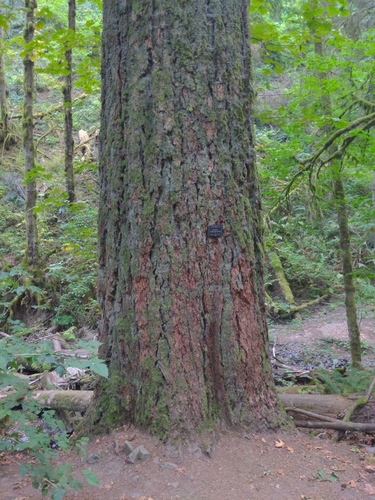
Douglas Fir (Pseudotsuga menziesii) · Forest Park
This Douglas fir is 74 metres tall. Nothing else in Portland comes close.
The city register measures it at 243 feet, or 74.1 metres, with a trunk 5.58 metres around and 1.78 metres through. A student piece in the PSU Vanguard, working independently, arrived at exactly the same height and girth, which is reassuring for a measurement that is genuinely hard to take on a tree this size standing in a steep ravine.
It grows at the bottom of the Balch Creek canyon in Forest Park, one of the largest urban forest reserves in the United States, on the Lower Macleay spur trail about a hundred yards past the stone house ruin that everyone here calls the Witch's Castle. A large stone beside the path marks it. Look up rather than around: at this height the top of the tree is well outside anything you can take in from the trail.
No age is recorded anywhere, and that is not an oversight. This is not a planted landscape tree with a date attached to it but a survivor in a patch of regrown native forest, and nobody has cored it. The ravine explains the height. Steep, shaded, wet, sheltered from the wind, and never quite worth the trouble of logging.
Photo: Jerry Kensler (CC BY)
Dawn Redwood (Metasequoia glyptostroboides) · 78 years · Arlington Heights / Washington Park
Until 1944 the dawn redwood was a fossil. Botanists knew Metasequoia only from imprints in stone and assumed it had been extinct for millions of years, until a living stand turned up in a remote Chinese valley. In 1952 this tree, grown from that discovery, produced cones: the first any dawn redwood had produced in the Western Hemisphere since the species vanished from it.
How long an absence that was depends who you ask. Portland's register says 8 million years. Travel Oregon and Hoyt Arboretum itself both say about 6 million. Neither number is the tree's age. They describe the gap in the fossil record, not the thing in front of you, which went into the ground in 1948 and is about 78 years old.
The route here was fast by the standards of botany. Harvard's Arnold Arboretum organised an international seed-collecting expedition to the Chinese stand in 1947, Hoyt Arboretum was among the institutions sent seed, and the seedlings were planted the following year. Four years after that, cones.
It is now 31.4 metres tall with a trunk 3.29 metres around, and it is an Oregon Heritage Tree. Late in the year it does the thing that makes dawn redwoods worth the walk up: a conifer that turns copper and then goes completely bare.
Giant Sequoia (Sequoiadendron giganteum) · Mount Tabor
Forty two metres, on a trunk 7.8 metres round, standing beside a reservoir on the side of an extinct volcano. Mount Tabor is one of the few cinder cones inside an American city, and the water bureau built open reservoirs into its slope in the 1890s with the kind of civic architecture usually reserved for banks: balustrades, gatehouses, iron railings.
Somebody planted a giant sequoia next to one of them. It is a Sierra Nevada tree, six hundred kilometres south and two thousand metres up, and it has done better here than most things do at home, because Portland gives it what California increasingly cannot, which is water.
The city added it to the heritage register in 1997. What it does not record, because the register has no such field, is when it went in. The reservoir dates the site rather than the tree, and joining those two facts would be a guess dressed as a date.
Go to the west side of the park and look for the rectangular reservoir. The tree is on its east bank and there is no mistaking which one it is.
European Beech (Fagus sylvatica) · Parkrose Heights
Seven metres round and twenty six metres tall, at the end of a residential street in Parkrose Heights, on a strip of unimproved public right of way that never became road.
That detail is the whole story. A beech of this size in a European park would have a fence around it and a plaque. This one survives because the city ran out of street before it ran out of block, so the tree kept the ground it was standing on and the tarmac stopped short.
European beech holds its dead leaves through winter when young and drops them cleanly once mature, and at this size the trunk is the thing worth looking at: smooth grey bark stretched tight, with the surface rippling where the buttress roots begin. Beech bark does not crack with age the way oak does, so an old one looks like something poured rather than grown.
Portland designated it in 1994, the first year of the register. It has no recorded age, because the register does not have that field.
Caucasian Wingnut (Pterocarya fraxinifolia) · Irvington
Nine Caucasian wingnuts line two blocks of NE Knott Street, five in front of the church and four across the road from it, and the city numbered every one of them when it designated the lot in 1996.
Caucasian wingnut is not a street tree anywhere. It comes from the forests between the Black Sea and the Caspian, it suckers freely, it wants wet feet, and no municipal planting manual recommends it. Somebody in Irvington planted nine.
What you get for that is the catkins. Wingnut hangs green chains of winged seeds up to half a metre long through summer, so the whole line drips at once, which is a thing worth timing a walk for. The leaves are pinnate and ash-like, up to twenty leaflets, and the crowns are far wider than the trunks suggest: the biggest here is 2.3 metres round and throws a crown twenty three metres across.
They are the reason to start an Irvington walk at this corner. Everything else on this page in this neighbourhood is within six hundred metres of them.
London Plane (Platanus x acerifolia) · Irvington
Two London planes stand one behind the other outside the same address, and the city registered them as a pair in 2005, recording one as the north tree and one as the south. The north is 4.8 metres round, the south 4.6, and between them they throw crowns twenty six and twenty seven metres across over a street that is twelve metres wide.
That is the London plane's entire case for existing. It was a chance hybrid, probably raised in seventeenth century Europe from an American sycamore and an oriental plane, and it turned out to tolerate compacted soil, road salt, drought and filthy air better than anything native to any of those places. Every industrial city in the northern hemisphere planted it. Portland planted these.
The bark is the giveaway: plane sheds it in plates, so the trunk is a camouflage of cream, olive and grey, and the shed pieces lie around the base like broken crockery.
Stand between them and look up. The two crowns have grown into each other and the street disappears.
Field Elm (Ulmus minor) · 175-350 years · Irvington
Thirty five metres tall on a trunk 4.5 metres round, which makes this the tallest street tree in Irvington and one of the tallest elms anywhere on this site.
That it is standing at all is the point. Dutch elm disease reached North America in 1930 and took an estimated hundred million trees, and it rewrote what American streets look like: the elm arch that shaded half the country's residential blocks is largely a photograph now. Portland was luckier than most, partly through geography and partly through an aggressive city programme of inspection and removal, and elms like this one are what luck plus effort left behind.
Field elm is the European native, no more resistant than any other, so this tree has simply not been found by the beetle that carries the fungus. Every year it goes unfound is another year.
The city registered it in 2003. Two blocks south stand the pair of heritage planes; the wingnut line is four blocks west.
Horse Chestnut (Aesculus hippocastanum) · 150-300 years · Irvington
Twenty nine metres is tall for a horse chestnut. The species usually gives up somewhere around twenty five and spends the difference on width instead, so this one, at 4.4 metres round and twenty across the crown, is a horse chestnut behaving like a forest tree.
It is also a tree with a job. Horse chestnut is the conker tree, and its entire modern distribution outside the Balkans is down to people wanting the fruit: the species is close to endangered in its native Pindus mountains and planted by the million everywhere else. The nuts are inedible, mildly poisonous, and were carried across Europe for centuries anyway because children want them.
So the two weeks to come are the last of September, when the spiny cases split on the pavement. Before that, in early May, the whole crown goes up in white candles with yellow throats that turn red once each flower has been pollinated, which is a signal to bees and a nice thing to know while standing underneath.
Portland registered it in 2004.
Northern Catalpa (Catalpa speciosa) · Irvington
A pair, registered together in 1994, the year Portland's heritage list opened. One is 4.1 metres round and twenty six tall, the other 3.8 and twenty three.
Northern catalpa is a tree that does everything conspicuously. The leaves are heart shaped and up to thirty centimetres long, so the crown reads as coarse from a distance. In June it flowers in upright trusses of white bells freckled with purple and yellow inside, thousands at once, and the fallen petals cover the pavement. Then it hangs seed pods like bean pods, forty centimetres or more, which stay on through winter and rattle, and which give the tree its American nickname of cigar tree.
Its natural range is small, a patch of the Mississippi basin, and it got everywhere else because railway companies planted it in plantations for fence posts: catalpa wood rots slowly. The fashion collapsed, the trees stayed.
Come in the second half of June. There is not much on this site that beats a large catalpa in full flower, and there are two of them here.
London Plane (Platanus x acerifolia) · Overlook
Three planes at one address on Overlook Boulevard, 5.4, 4.8 and 3.9 metres round, and the largest throws a crown thirty one metres across on a tree only twenty one metres tall. That ratio is the whole character of the group: they are wider than they are high, which a plane only manages with room and time.
The biggest of the three carries the largest London plane girth on Portland's heritage register, and the city designated all three together in 2018, which is late. A tree does not get to 5.4 metres round in seven years, so these were large for a long while before anyone wrote them down. That is normal for street trees and worth knowing when reading any heritage list: the designation year records when a city noticed, not when a tree started.
Overlook sits on the bluff above the Willamette with the industrial river on one side and the West Hills opposite, so the walk out here comes with a view whether or not you care about planes.
American Sycamore (Platanus occidentalis) · Irvington
The city's note on this tree reads, in full, "Big 13'". That is the entire official record, written by whoever measured it in 1999, and it is not wrong: thirteen feet is 3.9 metres round, under a crown twenty six metres across.
American sycamore is the parent that gave the London plane its constitution, and side by side the difference is legible. Sycamore sheds bark higher and harder, so the upper limbs go bone white, and from a distance an old one looks as though someone has painted the top half. The leaves are broader and shallower lobed than the hybrid's, and the seed balls hang singly rather than in pairs, which is the field mark worth remembering.
It is the eastern end of the Irvington heritage cluster. From here the catalpas are a block north, the elm and the planes are six blocks west, and the wingnut line closes the walk at NE 15th, which is about a kilometre and a half all told.
Oregon White Oak (Quercus garryana) · 300 years · South Portland
Portland's heritage tree law exists because a group of neighbours once stood between this oak and a chainsaw.
A developer wanted the corner lot for row houses. The neighbours wrapped the trunk in chicken wire and tire chains, and when a crew arrived and began cutting a ring through the bark to kill the tree where it stood, they stopped the work partway round. The horizontal scar from that attempt is still on the trunk.
The fight, led by Phyllis Reynolds and a group calling itself Friends of the Oak, is credited with pushing the city's Urban Forestry Commission to create the Heritage Tree program in 1993, the ordinance that now protects every tree on this page. The oak itself was designated in 1998. Saving a tree is not the same as saving the ground under it, so the neighbours kept raising money, and after a ten-year campaign the lot was bought outright. It is now Heritage Tree Park, a small city-owned corner named for the tree it was bought to protect.
The Oregon Encyclopedia puts the oak at roughly 300 years old, which would make it more than a century old when Portland was founded in the 1840s. The city's register measures it at 28 metres tall, 24 metres across the crown and just under five metres round. Oregon white oak is a slow grower, and a trunk that size is not something a developer's lot produces twice.
Apple (Malus domestica 'Yellow Bellflower') · 175 years · Hillsdale
The oldest living grafted apple tree in the western United States stands at the dead end of a residential court in Hillsdale.
That title was given by the Home Orchard Society in 1976, and the Portland State student paper has since called it the oldest apple tree in Oregon. The claim rests on a documented planting date rather than a count of rings: three independent accounts agree it went into the ground around 1850 or 1851, from stock bought at the Luelling and Meek Nursery in Milwaukie, the first nursery on the West Coast to sell grafted fruit trees. That makes it older than the State of Oregon, which joined the union in 1859.
Who planted it is less settled. One account credits a pioneer minister who homesteaded the orchard here. The tree's own name, and the Dosch Road and Dosch Park a short way off, point to the Dosch family instead. The sources do not resolve it and this page does not pretend to. If you know which household it was, tell us.
The variety is Yellow Bellflower, an old American apple. The city's register measures the tree at nine and a half metres tall, twelve metres across and 2.68 metres round, which for an apple is enormous: most orchard trees are replaced long before a trunk gets anywhere near that. Around it, the pioneer farmland has become streets of houses, and the tree simply stayed where it was put, at the end of one of them.
Douglas Fir (Pseudotsuga menziesii) · 150 years · Buckman
A whole cemetery is named after this one Douglas fir, for a quality it no longer has: being alone.
When Colburn Barrell founded the burial ground it was called Mount Crawford Cemetery. In 1866 it was renamed Lone Fir, the name chosen by his wife, Aurelia Barrell, for the solitary Douglas fir standing in its northwest corner. That is this tree. Wikipedia and Portland Monthly tell the naming story independently, and Portland Monthly in 2010 called it the cemetery's 150-year-old namesake.
The joke is what happened next. The grounds filled with plantings over the following century and a half, and Lone Fir now works as Portland's second-largest arboretum, so the tree the place was named for is today one tree among a great many. The city's register measures it at 33 metres tall and 4.18 metres round, with a crown about 19 metres across, and in 2009 the city designated it a heritage tree.
It is one of three trees in the cemetery with that designation. The others are an incense cedar on the north side, a short walk east, and a bigleaf maple named for Joseph Lane. Sources put the fir at over 150 years. Being the reason for the name, it was already standing in 1866, and has stood over every grave dug here since. The cemetery is open during posted daylight hours and the grounds are owned by Metro, the regional government.
Incense Cedar (Calocedrus decurrens) · Buckman
This incense cedar is 37 metres tall and only four metres across, which makes it look less like a tree than a column.
Those are the city register's figures, and the height, 121 feet, is unusually tall for the species. The spread is the other half of the shape. Thirteen feet across on a tree that tall gives it the narrow, clean-edged outline the Southeast Examiner singled out in 2026 when it named the cemetery's three historic trees. The trunk is 3.38 metres round.
It shares that designation with the Lone Fir itself, the Douglas fir the cemetery is named for, about 170 metres to the west, and with a bigleaf maple named for Joseph Lane. The city designated both conifers heritage trees in 2009. Seeing them together is the easiest way to read the difference between the two species: the fir heavier and broader, the cedar all height.
Incense cedar is native to the mountains of Oregon and California, and its soft, fragrant wood was for generations the standard wood for pencils. Here it grows among the graves of a cemetery that was renamed in 1866 and now works as Portland's second-largest arboretum, on grounds owned by Metro and open during posted daylight hours.
What nobody has published is its age. No source we found gives a planting date or a ring count, and we would rather leave the number blank than guess. If you know when it went in, tell us.
Cucumber Tree Magnolia (Magnolia acuminata) · 125 years · Northwest District
This magnolia is about thirty metres tall, and it stands on a city block that only ever held one house.
That house belonged to Cicero Horatius Lewis, who built it in 1879 and 1880, and the tree was planted on his estate around 1900, which makes it roughly 125 years old. In 1917 the house was razed to make room for a park beside Couch School, the building that is now the Metropolitan Learning Center. The tree has outlasted the family home by more than a century and now stands in the southeast corner of Couch Park.
The cucumber tree is a magnolia native to the eastern United States, named for its young fruit, and it is rare this far west. Portland's heritage register, which designated this one in 1994, calls it perhaps the largest in the city.
How large depends on who you ask. The register gives 100 feet tall, a 55 foot spread and a trunk 17.4 feet round, about 5.3 metres. Portland Parks' own species page gives 93 feet, a 63 foot spread and 15.35 feet round. Nobody has reconciled the two figures, and both describe a tree far bigger than most people expect a magnolia to be.
It is free to visit, in a public park on NW Glisan Street, and somebody photographed it there in May 2026.
Large-leaved Lime (Tilia platyphyllos) · Mt. Tabor
Portland's heritage register is a dry document, all measurements and directions, and for this tree it breaks character: "This tree is gigantic."
The figures back the word up. It is a large-leaved lime, the European linden, and the register gives it 126 feet tall, about 38 metres, with a crown 88 feet across and a trunk 5.06 metres round. The city designated it a heritage tree in 1995.
It grows at the southeast corner of the rectangular reservoir, on the west side of Mount Tabor Park. The park's giant sequoia stands under 300 metres away, which makes the two one walk on the same hill: a Californian conifer and a European broadleaf.
In June it flowers. Limes are better known for the scent than the look of it, pale yellow and loud with bees, and a tree with a crown this wide carries a great deal of it.
Two gaps, stated plainly. Nobody has published its age, and the register says nothing about when it went in. And the register is our only source: a photograph taken at the spot in September 2026 shows a tree standing there, though not necessarily this trunk. If you have stood under it, tell us whether it is still the giant the register describes, and if you know when it was planted, tell us that too.
Oregon White Oak (Quercus garryana) · South Portland
This oak has a name, and nobody seems to know where it came from. Portland's heritage register places it at the south end of Willamette Park, beside the children's play area, and says only that it "is known as the Revolution Oak". We looked and found no page explaining which revolution, or whose.
What the register does record is the tree. It is an Oregon white oak, the oak native to this part of the state, 104 feet tall, about 32 metres, with a crown 75 feet across and a trunk 4.48 metres round. The city designated it a heritage tree in 1998, and somebody photographed it at the spot in April 2026.
The species matters in Portland. The Corbett Oak, about 2.7 kilometres north in Heritage Tree Park, is an Oregon white oak too, and the neighbours who stopped a chainsaw partway through it are credited with the 1993 ordinance under which this one is protected. Of the two, the Corbett Oak has the dated age and the famous rescue. This one has the better name and no explanation for it.
Its age is not recorded either, because the register has no field for it. So there are two open questions on one trunk. If you know either answer, a family story, an old newspaper piece, a sign in the park, tell us. A name like this deserves its reason.
Northern Red Oak (Quercus rubra) · Overlook
This oak's crown is wider than the tree is tall. Portland's heritage register gives it a spread of 115 feet against a height of 111, a canopy about 35 metres across on the east side of Patton Square, a small city park in Overlook.
The trunk keeps up with the crown: 69 inches through and 5.52 metres round. It is a northern red oak, a species from the eastern half of the continent, and the city designated this one a heritage tree in 2005. The register adds a practical note, that it is fully visible from N Maryland Avenue, so you can take in the whole shape from the pavement before you walk underneath it.
The time to come is autumn. Red oaks earn their name in October and into November, when the leaves turn a deep red, sometimes fading to brown, and a crown this broad puts a great deal of that colour over one corner of one park.
Overlook's three London planes, on Overlook Boulevard about a kilometre away, make the other half of a neighbourhood walk.
What the register does not record is age, because it has no field for one, and nobody else has published a planting date. A photograph taken at the spot in May 2026 shows it still standing. If you know when it went in, tell us.
Coast Redwood (Sequoia sempervirens) · Hillside
A coast redwood 114 feet tall stands beside the front door of a gymnasium.
Portland's heritage register gives the directions with unusual precision: to the right of the main entrance to the gym at Hillside Park, a small city park in the hills of NW Portland above Burnside. It records the rest in the same dry way. The trunk is 50 inches through and 5.06 metres round, the height about 35 metres, and the crown only 54 feet across, which is the redwood's usual shape, more column than dome. The city designated it a heritage tree in 2007.
Coast redwoods are native to a narrow strip of the Pacific coast, from California into the far south of Oregon, so this one is several hundred kilometres north of its native range and has reached a size worth a heritage listing anyway, beside a door.
Two things we cannot tell you. Nobody has published its age. And while the register still lists the tree and has never marked it removed, we found no recent photograph from the spot, so we have not confirmed for ourselves that it is still standing. If you pass the gym, look right, and tell us what you see.
The Northwest District's two heritage elms are about 750 metres away, and Couch Park's cucumber tree about 1.4 kilometres east.
Northern Red Oak (Quercus rubra) · Brooklyn
Two northern red oaks stand on opposite sides of Powell Park, and their trunks are identical to the inch: 70 inches through, 18.3 feet round, about 5.58 metres. The city entered them in its heritage register one after the other, in 1998.
This is the southern one, between SE 23rd and 24th Avenues, and it is the one that spreads. The register gives it a crown 116 feet across on a height of 98, so it is about 35 metres wide and only 30 tall, a low dome rather than a tower. Its partner on the north side, about 120 metres away, is a little taller and a little narrower. Seeing both in one visit is the point: two trees of the same species and the same girth that did not grow into the same shape.
Red oaks come from the eastern half of the continent, and they earn the name in October, when the leaves go a deep red.
Two caveats, stated plainly. Nobody has published an age for either tree, because the register has no age field. And we found no recent photograph from this spot, so beyond the register, which has never marked it removed, we have not confirmed it still stands. Powell Park is free, on SE Powell Boulevard in Brooklyn. If you go, tell us whether both are still there.
Northern Red Oak (Quercus rubra) · Brooklyn
Portland's heritage register measured this oak's trunk at exactly the size of the one 120 metres south of it: 70 inches through, 18.3 feet round. The two were entered one after the other in 1998, as heritage trees 175 and 176.
This is number 176, on the north side of Powell Park in Brooklyn, and it is the taller of the pair at 102 feet, about 31 metres. Its crown is 106 feet across, still wider than the tree is tall, though less extravagantly than its partner's. Side by side on paper they look like twins. On the ground they stand on opposite sides of a city park, which is the easiest way to tell them apart.
It is a northern red oak, a species of the eastern half of the continent, and in October the crown turns a deep red. The Lone Fir and its incense cedar, in the cemetery a little over two kilometres north, make the nearest other heritage trees on this page.
Nobody has dated either oak, and we have no recent photograph of this one, so its standing rests on the register, which has never marked it removed. If you walk through, check both sides. And if you know when they were planted, which would tell us whether they went in together, tell us that too.
Coast Redwood (Sequoia sempervirens) · University Park
The thickest coast redwood in Portland's heritage register does not stand in a park. It stands on a strip of public right-of-way beside a trail, at N Carey Boulevard in University Park, between N Princeton and N Syracuse Streets.
The register gives its trunk as 69 inches through and 18.6 feet round, about 5.67 metres, which is more than half a metre fatter than the redwood by the gym door at Hillside Park. It is 106 feet tall, about 32 metres, with a crown 57 feet across. The city designated it in 2016, recently enough that the listing is fresher than most in the register, which counts for something on a tree we have not been able to see for ourselves.
Coast redwoods are native to a narrow strip of the Pacific coast from California into southern Oregon. This one has grown to a girth worth listing in the far north of Portland, on the peninsula between the Willamette and the Columbia.
That is also the honest limit of this page. It stands about eight kilometres from the centre and well away from the city's other heritage trees, so it is a trip of its own, easiest by bike or car along the Peninsula Crossing Trail. Nobody has published its age, and we found no recent photograph from the spot. If you ride past, tell us it is still there.
A day trip away
Pleasant Valley, 14 km east
Lombardy Poplar (Populus nigra 'Italica') · Pleasant Valley
Lombardy poplars are the disposable tree of the temperate world. They are planted as fast screens, they grow like weeds, they are usually rotten by fifty and gone by seventy, and nobody protects one.
Portland protects this one. The city measured the trunk at 122 inches across, which works out at 9.75 metres around, on a tree thirty five metres tall and only twelve across the crown, which is the columnar habit doing exactly what it is famous for. That girth would be remarkable on an oak. On a Lombardy poplar it is close to absurd, and it is the largest circumference on Portland's entire heritage register.
The city added it in 2019, one of the most recent designations on a list that started in 1993, which suggests somebody walked past it and thought the same thing you will.
The measurement comes from the register and we have not found a second one, so treat the number as the city's rather than as gospel. It is on the Mountain View Trail in Pleasant Valley, out on the eastern edge of the city.
Douglas Fir (Pseudotsuga menziesii)
Portland's register of Heritage Trees measures this Douglas-fir at 166 feet, about 50 metres, and 18.8 feet round, about 5.7 metres, with a trunk 71 inches across. That puts it among the largest Douglas-firs on the city's whole list, and it stands not in a garden but on a trail through a nature park at the city's edge.
The park is Powell Butte, on Portland's far east side, about 11 kilometres from the centre. The butte is Water Bureau land, run with Portland Parks as Powell Butte Nature Park, and its trails are free to walk. The register's own note is short and useful: the tree is located along the Cedar Grove Trail. The city designated it a Heritage Tree in 2004, and its crown spreads 56 feet.
What the register does not give is an age, and nobody else has published one. A trunk that size is plainly not young, but girth alone does not date a Douglas-fir honestly, so we leave the number open. If you know it, tell us.
It was standing in July 2025, when an iNaturalist observer photographed it and labelled the record with its Heritage Tree number, 260. The register's point is given to only four decimal places, so our pin is approximate, and the honest instruction is the register's own: walk the Cedar Grove Trail.
Powell Butte holds a second Heritage Tree on this page, a Lombardy poplar, so one visit takes in both.