Modena's monumental trees are all in town, which makes them an afternoon rather than a drive. The comune counted thirty of them in a 2015 census, and the two best are the ones the national register never listed: an oak in the ducal garden that lightning half destroyed and cables hold together, and the city's oldest plane tree, marooned in a flowerbed in the middle of the coach station square. Add a holm oak that named its courtyard and five bald cypresses 30 metres tall. All five are free, all within two and a half kilometres of Piazza Grande.
0 of 5 visited in Modena
Pedunculate Oak (Quercus robur) · 175 years · Centro storico, Modena
Lightning took a large part of this oak's crown and it is still standing, held together with steel and visited by climbing arborists. It was planted at the centre of the Giardino Ducale while Francesco V was duke, though the sources disagree on when: one puts it at 1854, the comune's own account says between 1840 and 1850. Either way it is around 175 years old, 25 metres tall, and 5.4 metres round the trunk, which makes it the thickest tree we have mapped in Modena.
It is a veteran rather than a specimen in its prime, and the page is better for saying so. Since the strike it has carried a dynamic bracing system, cables that flex with the tree instead of holding it rigid. A 2019 piece described bracket fungi, decay in the wood and beetle activity and argued for urgent treatment. In March 2022 the comune sent certified climbers into the canopy to take out deadwood.
Decay is not the same as dying. An oak can hollow for decades and keep going, and rotten wood in a living tree is the rarest habitat in a city park.
The garden is free and open daily, ten minutes' walk from Piazza Grande. The oak stands near the Corso Canalgrande side.
London Plane (Platanus x acerifolia) · Cittanova, Modena, near the railway station
The oldest plane tree in Modena stands in a flowerbed in the middle of a coach station, and the last person to put a tape around it did so in 1986. The city's own 2015 census of thirty monumental trees gives it the title. The measurement, 4.25 metres of girth, comes from Valido Capodarca, who spent the 1980s surveying the region's notable trees and published eighty of them under a title that reads as a warning: Emilia-Romagna, ottanta alberi da salvare, eighty trees to save. The citizen registry that re-recorded the tree in October 2021 noted that the trunk has grown appreciably since and that nobody had taken a new figure.
Nobody has dated it either, and we are not going to invent a number from the girth of a fast-growing species. If you know when it was planted, or you have five minutes and a tape measure, tell us and the page changes.
Everything around it has been rebuilt into tarmac, kerbs and bus bays, and the tree kept its bed in the centre of the square. It is five minutes' walk from Modena's railway station, on open ground, free, and it is the easiest tree in this city to combine with a train.
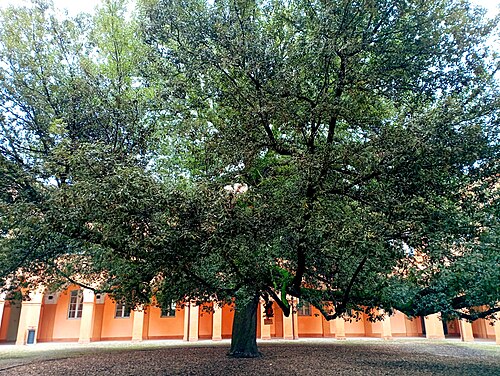
Holm Oak (Quercus ilex) · 100-250 years · Historic centre, Modena
The courtyard is named after the tree. Not a saint, not a duke, not the monastery it belongs to: the Cortile del Leccio takes its name from the holm oak standing in it, and one look explains why. The tree is about 15 metres tall and its crown spreads roughly 30 metres, twice as wide as it is high, so it does not stand in the courtyard so much as fill it. The national register puts its girth at 2.7 metres.
How old it is depends on who you ask. One Modena magazine gives it 120 years. The FAI listing calls it secolare, which in Italian means age-old and can be stretched from one century to several. Nobody has published a dated planting, so this page gives you the disagreement rather than picking a winner. If you know the answer, we would like to hear it.
The complex around it was the San Paolo monastery. It is now the university's law library, a European documentation centre and a cafe, restored between 2010 and 2015, and through all of that the oak kept the middle of the yard. Walk in from Via Selmi through the corridor. It is free, and nobody asks what you want.
Photo: EliFrelly (CC BY-SA 4.0)
Bald Cypress (Taxodium distichum) · Villaggio Giardino / Vaciglio, Modena
Five swamp trees from the American southeast are standing 30 metres over a Modena suburb. Bald cypress belongs in the flooded bottomlands of Louisiana and the Carolinas, and it does two things most conifers do not: it drops all its needles every autumn, turning a foxy red first, and where the ground is wet it pushes woody knees up out of the soil around itself. The comune's 2015 monumental-tree census counts the group at five and notes the 30 metres. A citizen registry measured the largest of them in 2021 at 4.3 metres round.
Nobody has dated them. The park was the country estate of Ludovico Antonio Muratori, the historian who died in 1750, and it would be neat to connect the two, but nothing does beyond the ground itself. The villa later became a medical facility, then a municipal park, and since 2019 it has also housed Modena's Casa delle Donne.
They stand together in one small public park with entrances on four streets, no gate and no ticket, about two kilometres from Piazza Grande. Our pin marks the park rather than a single trunk, which is honest for a group of five: walk in and look up, they are not hard to find.
Bald Cypress (Taxodium distichum) · Buon Pastore-Sant'Agnese-San Damaso, Modena
Woody spikes up to two metres tall are coming out of the ground around this tree. They are called pneumatophores, or cypress knees, and a bald cypress grows them when its roots are sitting in water: the working theory is that they help the root system breathe, though botanists have argued about their function for a century and still do. In a Louisiana swamp they are ordinary. On a street beside a Modena hospital they are strange enough that a local feature writer called this tree a vegliardo solitario, a solitary old man, and the knees are the reason to make the trip.
It is one of the thirty trees in the comune's own 2015 census of monumental specimens, listed simply as the taxodium of Via del Pozzo.
Beyond that, the record is thin and we will not pad it. No girth, no height, no age, no street number: neither source gives any of them, so our pin marks Via del Pozzo near the Policlinico rather than the trunk, and you may have to walk a little of the street. If you find it, a photo and a house number would fix this page.