Germany's tallest tree grows in Freiburg's city forest: Waldtraut vom Mühlwald, a Douglas fir planted in 1913 and measured at 67.85 metres in 2024, a proper forest walk from the tram network. The oldest recorded age belongs elsewhere, to a pair of limes on the Lorettoberg that local tradition dates to 1645. In town, a weeping beech that survived a fight with the state government, a car-park ginkgo, a forester's oak, a Gründerzeit giant sequoia and a monastery plane make up the rest. All seven are designated natural monuments, and every one can be seen without a ticket.
0 of 7 visited in Freiburg
Douglas Fir (Pseudotsuga menziesii) · 116 years · Günterstal / Mühlwald
The tallest tree in Germany is not a German species and it is only 116 years old. Waldtraut vom Mühlwald is a coastal Douglas fir, planted in 1913 as a three-year-old sapling in a forestry trial that had been putting North American conifers into the Freiburg city forest since 1896. The age comes from a written planting date rather than a guess. The height, measured in April 2024, is 67.85 metres.
It is still going up. Five years earlier it was measured at 67.10 metres, and the two sources that track it differ slightly on the current rate, somewhere between 15 and 30 centimetres a year. Both call it vigorous. The trunk is 3.38 metres round at chest height, which for that height is slender. Freiburg's own foresters gave it the name.
The experiment it belongs to is still standing around it: several more Douglas firs of the same 1913 planting, none of which won the title. A century-old test of whether an American conifer would take in the hills above Freiburg, with the answer visible from a long way off.
Be realistic about getting there. It is a signed forest walk of about 2.5 kilometres from the Kyburg stop in Günterstal, roughly 150 metres of climb, an hour or more each way. There is no viewing platform. There are wooden information boards at the foot of the tree, and a lot of looking straight up.
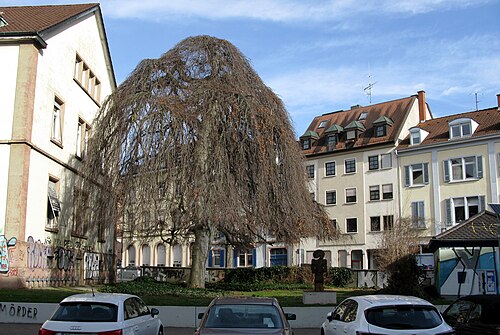
Weeping Beech (Fagus sylvatica 'Pendula') · Sedanquartier
The State of Baden-Württemberg owned the plot, wanted to build on it, and lost to the tree. This weeping beech stands on the corner of Wilhelmstraße and Moltkestraße on state-owned land in the Sedanquartier, and in 2020 a member of the state parliament, Gabi Rolland, filed a formal question pressing for its protection. The government's answer acknowledged the tree's ecological value and noted, in the same breath, that the plot's development value was considerable too.
The tree won. Freiburg designated it a natural monument on 29 October 2021, one of thirty announced together, which took the city's total to 130. A week later the neighbourhood's residents' group held a small ceremony at the trunk with the environment mayor present. Very few trees anywhere get a party.
The press covering the row never called it anything more precise than a splendid deciduous tree and a giant, which is the useful part of the record and also its limit. Nobody has measured its girth or dated it, and no source names the cultivar; it is almost certainly the standard weeping form of the European beech, but that is a reasonable assumption rather than a documented one. If you can tell us how thick it is, we will put the number on this page.
It shares its corner with a public sculpture, the Kaichina Doll by Peter Zimmermann, so the walk gives you two things to stand in front of.
Photo: Andreas Schwarzkopf (CC BY-SA 4.0)
Ginkgo (Ginkgo biloba) · Bernhardstraße / Habsburgerstraße
The car park is gone and the ginkgo is protected. This gnarled, fan-crowned tree stands on a former parking lot on Bernhardstraße towards Habsburgerstraße, in a perfectly ordinary stretch of shops and flats, and Freiburg's council made it a natural monument on 28 January 2011, in a batch of ten. The local report on that decision called it markant and knorrig, striking and gnarled, and singled out the golden autumn foliage as something the street watches for.
Ginkgo biloba is the last survivor of an order of trees that was widespread when dinosaurs were, and the fossil leaves are close enough to the living ones that you can match them by eye. It is also one of the toughest trees a European city can plant, largely indifferent to exhaust fumes, road salt and compacted ground, which is why so many end up on pavements and, evidently, car parks.
Nobody has recorded when this one was planted or how thick it is. That is a genuine gap rather than a hedge, and it is the sort of thing a person with a tape measure could close in a minute. If that is you, tell us.
One warning for cross-checkers: Freiburg has at least three registered ginkgos, so go by the street rather than the species. This is the Bernhardstraße one.
Oak (Quercus sp.) · Zähringen / Landwasser area, northern Freiburg
The Alexandereiche is not named after Alexander von Humboldt, which is the first thing almost everyone assumes. Freiburg's own environment office says the oak carries the name of Alexander Wasmer, the city's chief forester, who drew up the first management plan for the Freiburg city forest in 1842. A forester's paperwork is a thin sort of immortality, and a street-corner oak is more than most of them get.
Note what that does not tell us. The city names the tree for what Wasmer did in 1842; no source anywhere says the tree was planted then, or gives it an age at all, and we are not going to turn a commemoration into a birth date. Nobody has published a girth for it either. Even the species is only recorded as oak: the register does not say whether it is a pedunculate or a sessile oak, and the two are easy to tell apart on the ground, since one hangs its acorns on stalks and the other sits them tight against the twig. If you go and look, tell us which it is, and we will correct the page.
It has been a protected natural monument since 2 May 1974, which puts it among the older designations on Freiburg's list. It stands on the corner of Einsteinstraße and Hermann-Mitsch-Straße in northern Freiburg, a separate outing from the old town rather than a stop on one.
Giant Sequoia (Sequoiadendron giganteum) · 130-150 years · Neuburg
A boy named Klaus Doelle used to press small treasures into the soft bark of this sequoia and seal them back up, sure nobody would ever find them. Decades later, grown up, he still lives across the street, and it was his father who got the tree protected in 1979.
The Starkenstrasse Giant Sequoia went in during Freiburg's Gruenderzeit, the building boom of the late 1800s, when a handful of exotic sequoias reached the city as a fashion tree for new villa gardens. Only a few of that generation still stand on public ground; this one and its sisters on Karlstrasse and Waldhofstrasse are what is left. At roughly 30 metres tall and just under seven metres round, it now fills a quiet side street off Starkenstrasse with a red-brown, fire-resistant bark soft enough to sink a small metal box into without hurting the tree, which is exactly what Doelle did as a boy.
The city has since removed the parking that once pressed against its base and installed bollards to keep vehicles off the roots. It stands on open pavement, free to walk past any time.
Nobody has measured its exact age. The estimate, roughly 130 to 150 years, comes from the Gruenderzeit planting window the newspaper account places it in, not from a ring count.
Large-leaved Lime (Tilia platyphyllos) · 380 years · Wiehre (Unterwiehre-Sued)
These two limes are the oldest protected trees in Freiburg, first on the city's Naturdenkmal register when it opened in 1954, and local tradition puts their planting in 1645, during the last years of the Thirty Years' War.
They stand on the Lorettoberg beside the path to the Lorettokapelle, a chapel built in 1657 specifically to give thanks that the war was over. A pair of Sommerlinden, large-leaved limes, growing together beside a chapel raised for peace: the dates line up closely enough that the connection is hard to resist, even though no single source ties this exact pair to that exact chapel foundation. Take the 1645 figure as the tradition it is rather than a measurement.
At roughly 380 years old they would have been young trees when Freiburg itself was still recovering from decades of war passing through the region. The path up to the chapel is open at all times, a twenty to twenty-five minute walk uphill from the Altstadt through Wiehre, and the pair still shades the last stretch of it.
London Plane (Platanus x acerifolia) · Waldsee
At 38 metres this London plane is the tallest protected tree in Freiburg, by a margin nobody has bothered to measure the runner up against.
It grows at the edge of the Kartause, a former Carthusian monastery in the Waldsee district whose garden still keeps the shape of the order that built it: a walled, cultivated plot, tended rather than left to itself, which is likely part of why a plane tree here had the room and the care to run this tall. Planes tolerate poor soil and pollution better than almost any other species, which is why cities plant them along roads and squares; this one had a monastery garden instead, and used the advantage.
The garden keeps limited public hours, open for casual visiting on Friday afternoons from three to six without booking, and by arranged tour at other times, so this is not a tree to detour past on a whim. The tree itself is visible from Kartauserstrasse regardless.
Nobody has recorded its age or the size of its trunk. A tree this tall on grounds this settled could plausibly be read either way, decades or a century plus, and without a plaque or a girth measurement we would rather leave the number blank than guess at it.