Out in Kaditz a lime that half burned down in 1818 still stands, held up from inside by roots that turned into stems; it is probably Dresden's oldest tree. Its rival is an oak in the Dresdner Heide, listed as a boundary marker in 1679. Upriver at Pillnitz, a camellia planted in 1801 survived a 1905 fire inside a shell of frozen hose water. In Blasewitz a copper beech made a clinic move 25 metres, and an oak of about 1650 lost its twin in 2025. Out west, five sweet chestnuts at Oberwartha have a lane named after them.
0 of 32 visited in Dresden
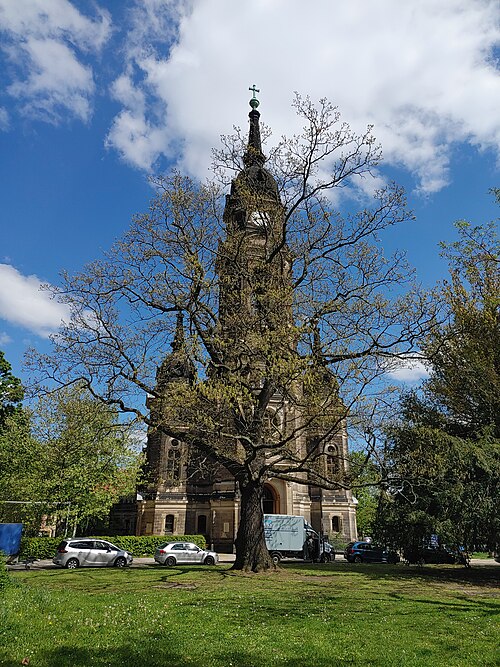
Turkey Oak (Quercus cerris) · 130 years · Johannstadt
Dresden got round to protecting this oak in February 2024, some 130 years after the city planted it. It was raised at the municipal nursery on the Tatzberg and set out on Trinitatisplatz in 1895, facing the main portal of the Trinitatiskirche. Fifty years later the air raids of February 1945 came over Johannstadt, and the oak came through them without serious damage. It then came through the winters that followed, when firewood was scarce enough in Dresden that standing trees disappeared into stoves, and this one was left alone.
It is a Turkey oak, a southern European species with deeply cut leaves and acorns sitting in shaggy, mossy cups rather than the smooth ones a German oak wears. The case for designating it called it the strongest of its kind in Dresden and the third strongest in Saxony, on grounds of age, rarity, form and genetic value.
The trunk measures about 3.84 metres round, worked from a recorded stem diameter of 122 centimetres, although the city's own register line says more than four metres. Nobody has reconciled the two figures and neither is worth much fuss.
Twenty metres tall, standing in the open on a public square with a tram stop at its foot, it is about as easy to reach as a protected tree gets.
Photo: Lvem95 (CC BY-SA 4.0)
London Plane (Platanus x acerifolia) · 140 years · Innere Neustadt
This plane tree lives on a traffic island. Albertplatz is one of the busiest interchanges in Dresden, a circle of tram and bus routes in the Neustadt, and the tree stands out in the middle of it toward Bautzner Strasse, twenty-five metres tall with a crown roughly as wide as it is high.
It was planted around 1885, when that ground was open and quiet. Everything else arrived later: the trams, the traffic, the night of 13 February 1945 and the long rebuilding after it, forty years of the GDR, and the Neustadt's more recent turn into the loudest quarter in the city. The tree has stayed put through all of it on its own island, which is the closest thing to a fixed point Albertplatz has. Dresden made it a natural monument on 3 January 1985, by the same council resolution that protected the oak on Fetscherplatz.
A London plane is a hybrid of the American and the Oriental plane, and it was planted across European cities for exactly the qualities on show here. It takes heat, compacted soil and dirty air better than almost anything else with a trunk, and it sheds its bark in pale plates through the summer instead of letting the grime build up.
Its trunk measures 3.30 metres round. Both the register and the city's own record agree on the figure, which is rarer than it sounds.
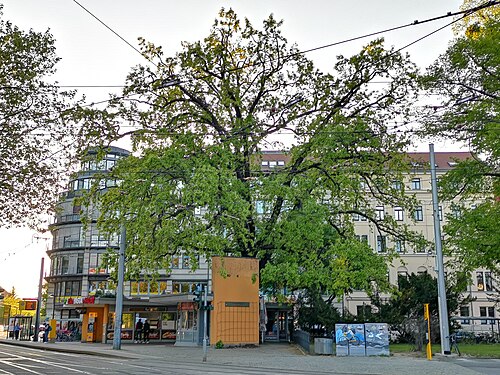
Overcup Oak (Quercus lyrata) · 125 years · Johannstadt
In 1949 an architect built a tram shelter around this tree rather than move either of them. Herbert Schneider put his waiting kiosk on Fetscherplatz so close to the trunk that the roof had to curve to make room for the oak, four years after the air raids, in a city with more urgent things to be careful about. The two have shared the corner ever since.
The tree is an overcup oak, a North American species and an unlikely thing to find holding down a square in Johannstadt. It went in around 1900, when the place was still called Fuerstenplatz, and it has since put out a crown about thirty-two metres across, wider than the tree is tall. That crown is effectively the roof of the square. Twenty-five metres up, 3.35 metres round at the trunk, and the only real shade anyone waiting for a tram is going to get.
Dresden protected it as a natural monument on 3 January 1985, in the same council resolution that covered the plane tree on Albertplatz.
If you are there in autumn, look at the acorns on the ground. The cup on this species swallows almost the entire nut, which is where the name comes from and the quickest way to tell it apart from every other oak in the city.
Photo: Z thomas (CC BY-SA 4.0)
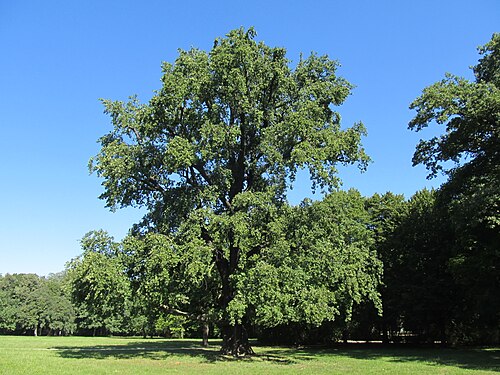
Pedunculate Oak (Quercus robur) · 250-300 years · Grosser Garten
This oak is named after its wounds. On the nights of 13 and 14 February 1945 the bombing of Dresden reached the Grosser Garten, and splinters tore open one side of the trunk along roughly eight metres of its height. The tree survived. The damage is still there and still obvious, which is how it came to be called the Splittereiche, the splinter oak.
It was already old when that happened. An assessment made in the 2010s put it at between 250 and 300 years, a range nobody has narrowed since and which is itself a decade out of date by now. It stands twenty-seven metres tall with a trunk over six metres round, out on open lawn a short walk south of the Mosaikbrunnen, so you see the whole shape of it from a distance before you get to the scar.
On 8 May 2017, the seventy-second anniversary of the end of the war in Europe, a memorial plaque went up beside it carrying a line from Mark Twain: time may heal all wounds, but it is a lousy cosmetician. The year after, the city fitted metal sheeting over the damaged flank, because visitors picking at the old injury were making it worse.
We have not found it listed individually in Dresden's register of natural monuments. It stands inside a protected historic park instead, and it is the tree people in that park come to find.
Photo: DynaMoToR (CC BY-SA 4.0)
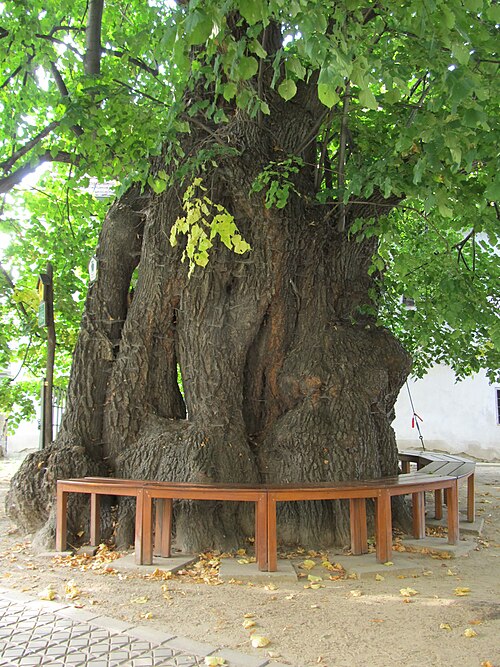
Large-leaved Lime (Tilia platyphyllos) · 500-1000 years · Kaditz
Half of this tree burned in 1818 and what holds the other half up is its own roots.
A fire that year took eighteen farms, thirty barns and the parsonage of Kaditz, and the lime beside the church went with them. The side facing the parsonage died outright. What survived is a half shell of trunk, and the city's sign on it explains the trick that kept the thing alive: the stems standing inside the hollow are former roots that turned into supports.
Dresden calls it the oldest tree in the city and will not put a number on it. The sign says many centuries old, then adds a thousand years with a question mark after it. Nothing can be counted, because the trunk has been damaged too often for rings to survive. A parish account of 1909 put the circumference at twelve and a half metres. A measurement at chest height in 2007 gave 9.6. Both figures are in the record and nobody has reconciled them.
Since 1829 its heaviest limbs have been held up, first on timber, now on steel anchors and cables. The smaller of its two stems stopped leafing out in 2021 and died. The larger one did not.
A bench runs in a ring around the base.
Photo: DynaMoToR, CC BY-SA 3.0 (CC BY-SA 3.0)
Pedunculate Oak (Quercus robur) · 400-700 years · Dresdner Heide / Langebruck
In 1679 a forest protocol listed two oaks in the Sauerbusch as boundary markers. One of them is still alive. Its main stem broke off at about fifteen metres long ago, so what stands now is a trunk about 6.60 metres round carrying a crown made of single limbs. The local account puts it at up to 700 years, which is an estimate rather than a count; somewhere between four and seven centuries is the honest reading.
The two oaks were probably mast trees, kept for their acorns, and both were placed under protection in 1938, although some sources give 1958. In 1993 a fire started by children killed the second one. This one carried on.
It has not carried on easily. The forest district describes it as being in the last stage of its life, although it is still vital. Heavy growth covers the stem, one side is almost stripped of bark, and parts of it are held together with concrete. Even its height is disputed: the Wikipedia article says about 22 metres, the city's natural monument list says 14.
A signposted trail, the Rieseneichen path kept by the heritage society in Weixdorf, leads through the far north-east of the Dresdner Heide to the trunk. It is a forest walk from Langebruck or Weixdorf rather than a city stroll, and this oak is the reason to make it.
Pedunculate Oak (Quercus robur) · 140 years · Leipziger Vorstadt (Neustadt)
This oak probably started out in a beer garden. It was planted around 1880 on the tip of land where Weinbohlaer Strasse and Barnsdorfer Strasse fork, and the pub on that tip, Zur Gruenen Aue, stood until 1960. The written record says the tree was probably part of the pub's garden, and nobody has managed to get further than probably. The pub is gone. The oak, about 140 years old, has outlasted it by more than sixty years.
It has grown to about 25 metres with a crown some 30 metres wide, and its trunk measures 4.45 metres round. Dresden made it a natural monument on 3 January 1985, the same day the city protected the Kaditzer Linde, an oak on Doebelner Strasse and a pine in the Heide.
About 150 metres to the north-east, in the St.-Pauli-Friedhof, stand two more oaks of the same generation, the Marschall oak and the Meschwitz oak, planted around 1870 or 1880 and treated by the city as memorial trees. We have not checked how freely the cemetery can be walked, so this page sends you only to the junction.
The newest photographs of this oak date from 2015, and we have no recent confirmation that it is still in good health. If you pass the fork and it is standing, tell us.
Small-leaved Lime (Tilia cordata) · 340 years · Laubegast
In March 1940 the biggest Elbe flood of the twentieth century drove ice floes 40 centimetres thick against this lime for ten to fifteen hours. The floes hit both the tree and the masonry surround its owner had built in 1913. The ice tore a wound about half a metre tall around half the trunk, and the ridge it left still shows at roughly 1.5 metres up.
The lime was already old by then. The local account has it planted or sown in the second half of the seventeenth century, most likely in the 1670s or around 1680, and in 1997 the owner wrote of a 320-year-old linden. That puts it somewhere near 340 today. The house behind it at number 17 is a youngster by comparison, built in 1879 for a Saxon court marshal and now a listed monument in its own right.
It is a small-leaved lime, about 20 metres tall with a trunk 3.90 metres round, standing outside the ice-protection wall beside the road. The paving over its roots was replaced with cobbles to protect them, and the city made it a natural monument in June 1999.
Just north of the driveway the road closes to cars and becomes part of the Elbe cycle route, and two more protected trees stand about 500 metres away in each direction along it: black poplars at number 1 and a black pine at number 39.
European White Elm (Ulmus laevis) · Aussere Neustadt
Dresden protected this elm in 2015 for surviving something most of its kind have not. Dutch elm disease, spread by fungi that arrived from Asia, has killed elms across Europe, and when the city went looking in the early 2010s for its most valuable trees, 39 of them at 29 sites, it picked this European white elm as an exceptional specimen that was still healthy.
It is not a park tree. It stands on Konigsbrucker Strasse in the Aussere Neustadt, on the pavement side in front of numbers 49 and 51, and it sets the look of the street: about 30 metres tall, with a crown some 20 metres across and a trunk 3.57 metres round. Trams run past it along the Konigsbrucker Strasse corridor.
It was not the city's first protected elm. A white elm in Altubigau and the elms on Sachsenplatz had been natural monuments since 1999, so this one joined a short list rather than starting it.
Two things we do not know. Nobody has documented when it was planted, so this page gives no age; if you know, tell us. And the newest photographs on record are from 2019, so if you walk past and it is still standing over the pavement, that is worth a message too.
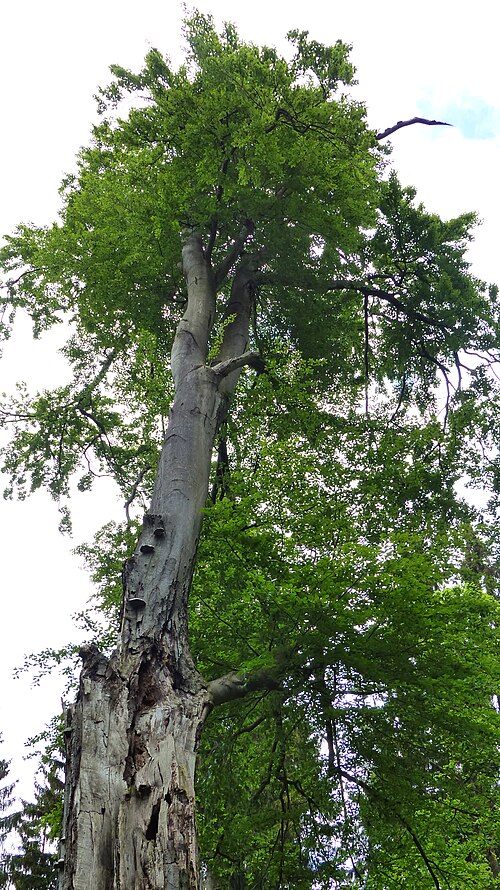
European Beech (Fagus sylvatica) · 250 years · Dresdner Heide
In October 2002 a hurricane found a fork in this beech that nobody knew was failing, and more than a third of the crown came down. Two years earlier Dresden had made it a natural monument, measured at about 35 metres tall, 5.70 metres round and with a crown some 28 metres across. At that point only one beech in the city was bigger, the one behind the Weisses Schloss in Cossebaude.
What stands in forest section 109 of the Dresdner Heide today is the tree that came out of that storm: lower than the 35 metres in the record and lopsided where the crown went. Every photograph on file was taken after the damage, so they show the beech as a visitor will meet it rather than as it looked on the day it was designated.
The age given in 2000 was about 250 years, and that was an estimate then. Add the years since and it lands somewhere around 275, give or take a few decades. The ordinance protects a ring of 18 metres around the trunk along with the tree itself.
It stands a short way into the forest, about 150 metres north-west of the point where Radeberger Strasse crosses the forest ride called Schneise 8. Our pin is approximate, so expect to look around for the broken crown once you reach the crossing.
Photo: Dr. Bernd Gross (CC BY-SA 3.0)
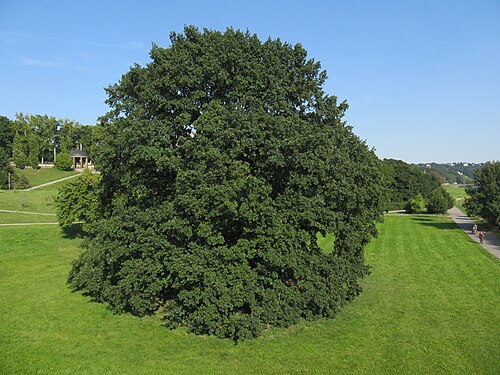
Pedunculate Oak (Quercus robur) · 160 years · Radeberger Vorstadt
This oak was planted for a song festival, and the sources still argue over whether it is the oak they planted. In July 1865 Dresden hosted the first German Sängerbundesfest, and a festival hall went up on this stretch of the Elbe meadows. On 13 November that year, according to the Ostdeutsches Baumarchiv, Heinrich Hartwig and two gardeners planted a memorial oak where the hall had stood.
That is where the agreement ends. A festival booklet from 1925 says the November tree was the singers' own gift, a young oak that choirs from around Leipzig had carried through the procession in a tub, and that it later had to be replaced after vandals got to it. Rainer Pfannkuchen, once head of Dresden's nature-protection authority, reads it the other way: the festival oak died of drought, and the November 1865 planting was already the replacement. So the trunk in front of you is either the 1865 tree, which would make it about 160 years old, or a later stand-in, and nobody has settled which.
Whichever it is, the open ground has suited it. In 1994 it stood 26 metres tall under a crown 20 metres wide, and its girth grew from 3.80 to 4.26 metres between 1994 and 2018. Since 2013 it has had a neighbour it never asked for: the Waldschlösschenbrücke now crosses the river about 25 metres away, and the Elbe cycle path runs past its feet.
Photo: DynaMoToR (CC BY-SA 4.0)
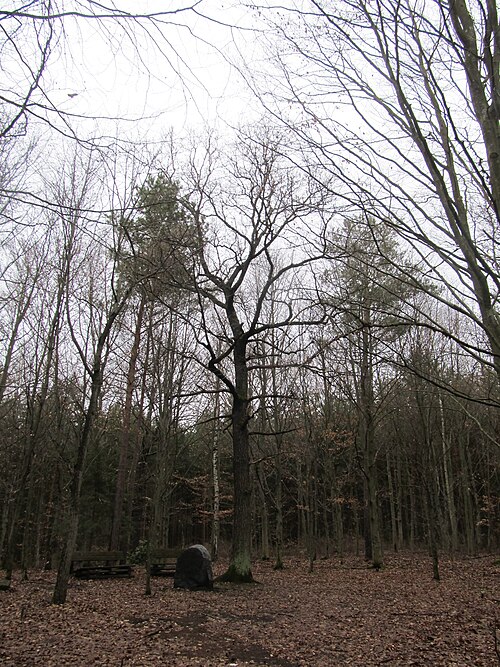
Oak (Quercus sp.) · 109 years · Dresdner Heide
This oak was planted to honour four hundred years of the Reformation, and it has spent a century failing to look the part. On Sunday 28 October 1917, with Germany deep in the First World War, it went into the ground in the Dresdner Heide to mark the anniversary of Luther's 95 Theses. A memorial stone carrying a Luther inscription was set beside it, and the two together are now a protected Saxon cultural monument, number 09217019.
The ground was against it from the start. This corner of the forest is dry sand over Lusatian granite, and the oak never thrived: local coverage in 2017 called it a puny specimen, which is fair. Nobody comes here for the size of the trunk. What makes it worth the detour is the setting, beside a forest ride in the Prinzeß-Margarethen-Park section of the forest, and the small act of remembrance that keeps being renewed around it. For the Luther year of 2017 the benches were replaced and a table added, and one of the benches now carries a quotation from Luther himself.
It makes a good stop on a walk through the Heide rather than a destination of its own. Two things nobody has recorded: which species of oak it is, and how big it has managed to grow. If you know either, tell us.
Photo: DynaMoToR (CC BY-SA 4.0)
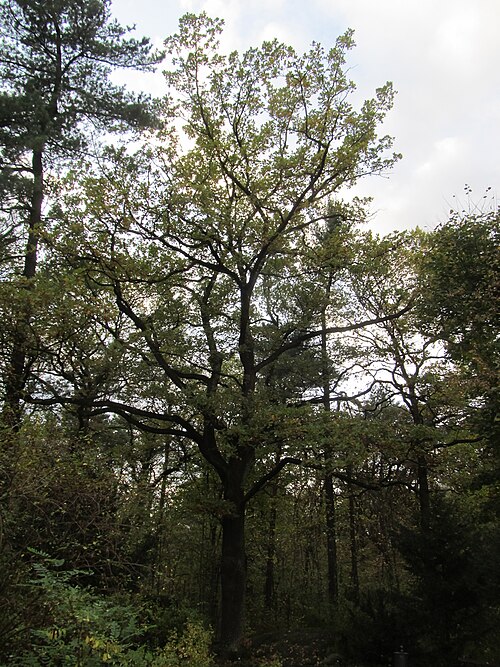
Pedunculate Oak (Quercus robur) · 130 years · Blasewitz
The stone beside this oak has changed its mind about who it honours. The tree was planted in 1895 for Otto von Bismarck's 80th birthday, and the sandstone block next to it was dedicated to him too, with his portrait in a bronze medallion. The medallion went missing shortly after the Second World War. In 1998 the block was given a new bronze plaque, this time remembering Hofgärtner H. S. Neumann, 1829 to 1880, the court gardener who designed the Waldpark itself.
So the oak has outlasted the man it was planted for and the monument that explained it. At about 130 years old it is no giant, and nobody has published its girth or height. What it offers is the park its stone now commemorates, and a small lesson in how a memorial gets rewritten when the century moves on.
Be warned before you go: there is no information sign, and the Bismarck Oak stands as part of a group of trees. Our pin is approximate, close to the spot but not on the trunk, so you will have to pick the right oak yourself. The stone is the giveaway. Find the sandstone block with the Neumann plaque on the Lothringer Weg, west of the tennis courts, and the oak is the one beside it.
Photo: DynaMoToR (CC BY-SA 4.0)
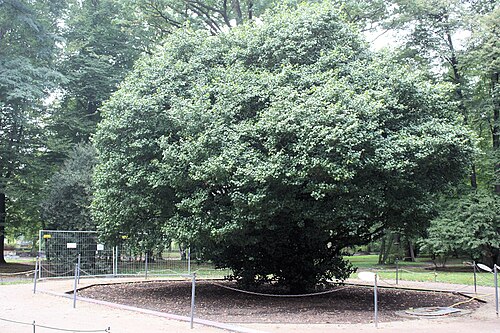
Common Camellia (Camellia japonica) · 250 years · Pillnitz
In January 1905 this camellia's winter house burned down at about minus 20 degrees, and the water from the fire hoses froze around the plant in a shell of ice. It survived, and sprouted again that spring.
It has stood on this spot since 1801, when the court gardener Carl Adolph Terscheck planted it. The camellia reached the Dresden court somewhere between 1770 and 1790, so 225 years at Pillnitz are documented; the palace's owners, the Saxon state palaces administration, put it at over 250. A favourite story says it is one of four plants the botanist Carl Peter Thunberg brought back from Japan in the 1770s. Kew has no record of that, and the claim is increasingly doubted. A 2015 study at TU Dresden found it almost genetically identical to the old camellias of Caserta, Campobello in Portugal and Greifswald, which points to cuttings from one shared stock.
Strictly it is a shrub grown into a tree: almost nine metres high, with a crown nearly eleven metres across. In 2025 it became the first camellia in Germany to be named a Historic Camellia by the International Camellia Society.
From October to May it lives inside a heated 13-metre glass house that weighs 54 tonnes and runs on rails. In summer the house rolls aside and the tree stands in the open park. The owners call it the largest and oldest of its kind north of the Alps. Come in March, when up to 35,000 crimson flowers are open.
Photo: Dguendel (CC BY 3.0)
Black Poplar (Populus nigra) · 217 years · Babisnau (Kreischa), about 9 km south of Dresden Altstadt
Legend says that when this poplar blooms, a war is about to end. People reported it in 1870, in 1918 and in 1943, when Victor Klemperer noted it in his diary on 23 May. What appears is not really a bloom but the fluffy white seed of the ripe fruit, and it does not come every year.
The landowner Johann Gottlieb Becke planted the black poplar in 1808 to mark the edge of his property. By 1884 it drew so many visitors that a farmer wanted it felled to keep them off his land, and the local mountain club bought the tree for 300 marks to save it. A viewing frame went up beside it the following year and has been rebuilt in 1922, 1963 and 1999. In the war of 1866 it served as a lookout, and surveyors used it as a sighting mark.
The weather has been harder on it than people were. A thunderstorm on 20 July 1967 took a third of the crown, storms in 1996 took most of the rest, and the main stems were later topped. The 2025 survey gives 15 metres of height where 2004 recorded 26, a trunk 5.50 metres round, and only a few side branches still in leaf. A clone grown from its cuttings was planted a few metres away in 2006, in case.
It stands alone on an open plateau outside the city, and the platform looks over the Elbe valley to Saxon Switzerland and the Ore Mountains.
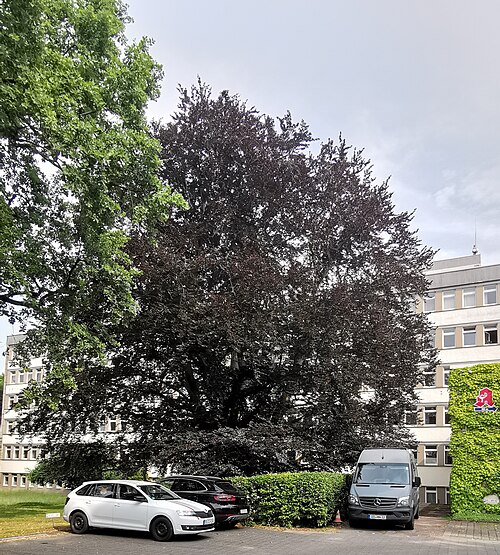
Copper Beech (Fagus sylvatica f. purpurea) · 175 years · Blasewitz
In the early 1970s a new clinic in Blasewitz was moved 25 metres to spare this tree. The polyclinic had been drawn on the axis of Villa Marienlust, which meant the copper beech in its garden would have had to come down. Volunteer conservationists negotiated, the building went up further south-east with an angled wing to join it to the villa, and the change cost 30,000 marks, judged at the time a great but necessary sacrifice.
The beech was planted in 1849, already four years old, in the villa's 17,000 square metre grounds. The villa now houses a medical centre, the Ärztehaus Blasewitz, whose own history page counts more than 177 years. It has grown about 25 metres tall, with a crown about 24 metres across, so broad and low that it is said to grow like a giant shrub. The register gives its girth as 5.35 metres, but that was measured 30 centimetres above the ground, where any trunk is wider than at the usual chest height.
The city made it natural monument number 34 in January 1985, and a plaque on the tree says so. It stands in the medical centre's garden. The crown can be seen from Naumannstrasse, and we have not confirmed whether the garden is open to walk into; if you have been in, tell us. The surviving oak of Hüblerstrasse stands about 450 metres to the south-west.
Photo: Z thomas (CC BY-SA 4.0)
Pedunculate Oak (Quercus robur) · 375 years · Blasewitz
Until June 2025 there were two of them. These pedunculate oaks stood a few metres apart on the verge of Hüblerstrasse for something like 375 years, until fungi, viruses and bacteria left one unstable and it was felled on 22 June. This is the survivor, which the local press called its healthy brother. The stump of the twin stands beside it, and the city planned to plant a young oak of a more climate-tolerant kind in its place.
The age comes from a resistograph test in 1995 that suggested the pair already stood by 1650, so read it as somewhere between 350 and 400 years rather than a birth certificate. Either way they are older than the villa quarter around them. Around 1866 this was still open ground and the road was the old route from Striesen through Blasewitz to Loschwitz; the shape of the crowns suggests the oaks once stood free, perhaps kept for their acorns to fatten pigs. The house at number 23 was destroyed in the Second World War. The oaks came through.
Until 1998 they stood with half their trunks in the roadway. That year protective barriers went in, root bridges were laid at the neighbouring driveways, and the soil was replaced to 60 centimetres with a suction vehicle, which uncovered an old granite road half a metre down. Before the felling they were about 23 metres tall, with trunks of 4.65 and 4.80 metres; nobody recorded which girth belongs to the survivor.
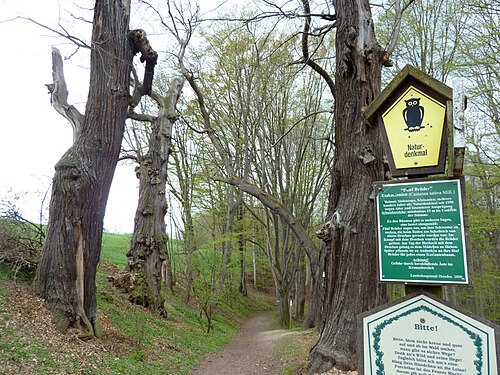
Sweet Chestnut (Castanea sativa) · 400 years · Oberwartha (Cossebaude), west Dresden
Nobody agrees why there are five. One legend has a girl carried off by a dragon and her five brothers dying in the search for her, with the trees planted in their memory. Another has six monks from Altzella monastery planting six chestnuts before a crusade: five grew, and five monks came home. A third has five brothers who went out into the world, came back rich and planted a tree each. Dresden's city wiki adds that they replaced five limes at a spring once sacred to the Slavic Nisani, which is folklore too.
What the sources do agree on is the date, the first half of the 17th century, which makes these sweet chestnuts roughly 400 years old. They stand along a lane at the edge of Oberwartha, on the far western rim of Dresden, where it runs down into the Tännichtgrund valley. The lane is the Fünf-Brüder-Weg and the stream below is the Fünf-Brüder-Bach, both named after the trees, which tells you how long they have been the landmark here.
They run from 12 to 25 metres tall, with crowns 10 to 20 metres across, and their trunks measure between 4.15 and 6.20 metres round at chest height. The group is a protected natural monument, signposted beside the lane. Come in October, when the chestnuts drop.
Photo: Derbrauni (CC BY-SA 4.0)
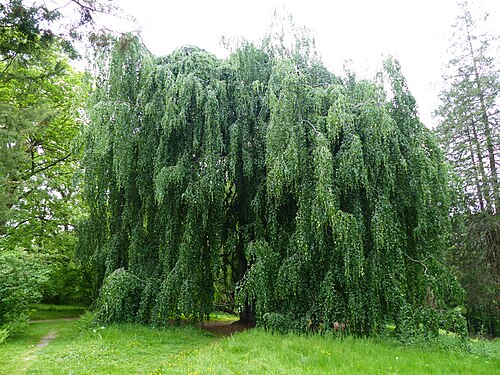
Weeping Beech (Fagus sylvatica 'Pendula') · 180-220 years · Helfenberg (Schönfeld-Weißig), east Dresden
Of the two weeping beeches this park was protected for, one now lies on the grass. Storm Niklas pulled the larger and more imposing of the pair out of the ground on 31 March 2015. Dresden left the fallen tree where it fell, as habitat for wildlife, and planted a young one into its root zone.
The survivor is the one to walk to, and it has had the harder life. In 1985 a hole in its trunk, a metre and a half up, was filled with concrete, and it has since lost a large limb. The pair were described as about 20 metres tall with crowns some 25 metres across, the biggest and gnarliest weeping beeches in the area. Measurements disagree: the city's green-space office lists 3.90 and 4.35 metres round, while baumkunde.de taped this one at 4.70 metres in 2018.
Look low on the trunk for the bulge where it was grafted onto an ordinary beech, which proves a gardener made it rather than nature. Some say 300 years. More likely it went in when James Ogilvy, 7th Earl of Findlater, had the park remodelled in the English style between 1806 and 1811; a city publication of 2008 put the beeches at about 180 years. Either way it has outlived the earl, the secretary who inherited his estate, and its own twin. The district council protected both trees on 23 January 1958.
Photo: Dr. Bernd Gross (CC BY-SA 3.0)
Large-leaved Lime (Tilia platyphyllos) · 400 years · Kaditz
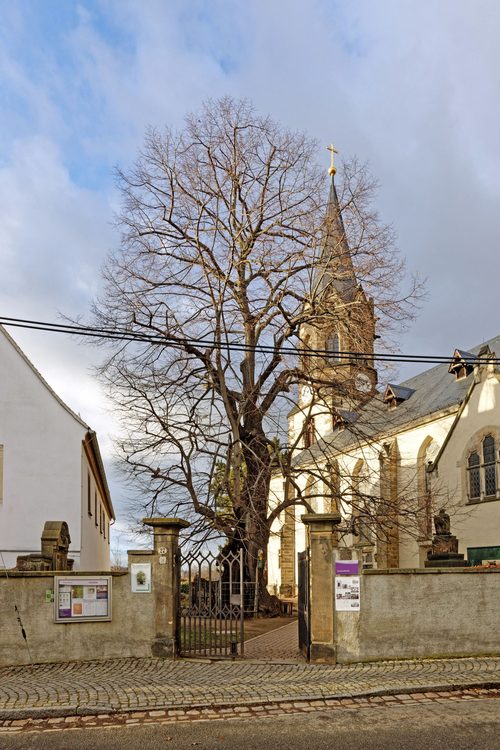
Few trees come with their planter's own words. On 8 April 1622 Paul Schulze, schoolmaster of Kaditz, wrote in the church chronicle that he had planted a lime beside the churchyard wall, facing the school, and added a line of hope: God help that it may grow well. It did. Four centuries later the Schulmeisterlinde is the oldest tree in Dresden whose planting date and reason are both on record. Schulze put it in at Easter, when the new school year began, four years into the Thirty Years' War, opposite the village school that stood across the street.
It has not had an easy four hundred years. In the 1920s the road was widened and the churchyard wall was rebuilt hard against its trunk. On 8 August 1970 the fire brigade cut the crown back drastically because the hollow trunk threatened to break, and it was pruned again in 1999. The hot, dry summers of the late 2010s hit it too. What stands now is a barrel of a trunk 4.4 metres round, hollow all the way through, under a crown reduced to about 8 metres.
It has a famous neighbour. Fifteen metres to the south-west stands the Kaditzer Linde, older, wider and far better known, and most visitors come for that one. The schoolmaster's tree is the one with a birth certificate.
Photo: Rainer Lippert
Shingle Oak (Quercus imbricaria) · 145 years · Leipziger Vorstadt
Germany's largest known shingle oak began as a father's grief, and for fifty years nobody remembered whose. In autumn 1880 Friedrich Wilhelm Meschwitz, Dresden's forest master and the man who opened the Dresdner Heide to walkers, buried his son Wilhelm here. Wilhelm was 19, the only one of three sons who could have followed his father into the forest. Meschwitz brought a young North American oak from the forest botanical garden at Tharandt and planted it beside the family grave. In 1888 he was laid there himself.
In 1960 the grave was cleared. The oak stayed, and its story left with the headstone. It was simply a big tree in section B of St. Pauli Cemetery until 2010, when Rudolf Schroeder of the Saxon Heimatschutz association rediscovered it and the city entered it in its tree register as probably the finest shingle oak in Saxony. The German Dendrological Society has listed it as a record tree since 2012. A plaque went up on 18 October 2013, on Juergen Lambrecht's initiative, and with it came the name: the Meschwitz Oak.
In 2020 it measured 3.8 metres round and 28.5 metres tall, and the 2012 plaque figures gave its crown 33 metres across. Cables and safety pruning now keep that crown safe above the people walking beneath it. Our pin is approximate, because two published coordinates disagree by about 100 metres; the plaque is the surer guide.
Pedunculate Oak (Quercus robur) · 210 years · Raecknitz
Beneath these three oaks lie a general's legs. On 27 August 1813, in the Battle of Dresden, the French general Jean-Victor Moreau was fighting on the allied side, next to Tsar Alexander, when a cannonball shattered both his legs. He died six days later. A monument went up on the spot in 1814, commissioned by the Russian governor-general Repnin-Wolkonski, and on 4 November that year the amputated legs were buried beneath it in an urn. That same November three pedunculate oaks were planted around the stone, one for each ally: Russia, Prussia and Austria.
They did not start well. In 1836 the writer Ferdinand Stolle reported that the oaks looked sickly and had given no shade even in 1830, on ground judged poor for them. They stand today regardless, carrying the scars: broken branches, pruned crowns, and a cavity in one trunk that has been surgically closed. Their crowns have grown together into one, and their stems now press against the monument's stone border.
Nor did they grow evenly. One trunk is 4.75 metres round, the other two 3.00 and 2.55. The meadow, called the Franzosenhöhe, is protected together with the monument as a heritage site, which is why the oaks carry no natural-monument status of their own. The inscription still reads: Moreau, the hero, fell here at Alexander's side.
Pedunculate Oak (Quercus robur) · 140 years · Kleinluga (Prohlis district)
Schoolchildren planted this oak on 10 November 1883, Martin Luther's 400th birthday, and it has run the village square ever since. The pupils came from the school at Grossluga, whose district took in the little village of Kleinluga, and they set it in the middle of the Teichplatz, near the pond. A memorial stone went in front of it.
The young oak was planted in the German Empire and has stood through every state that followed. It is now about 20 metres tall, with a crown about 22 metres across and a trunk 4.10 metres round, by the city's own nature-protection records. Nothing else on the square comes close: the farmsteads keep to its edges and the oak takes the middle.
In 1998 and 1999 the square was redesigned around it and the memorial stone was renewed. On 10 June 1999 the city council made the tree natural monument ND 88, with a protected zone reaching three metres beyond the edge of its crown and never less than 15 metres from the trunk. Together with its stone it is also a listed heritage monument, so the Luther Oak is protected twice: once as nature, once as history.
It stands about 10 km south-east of Dresden's old town. Another village-square oak, at Oberpoyritz about 5 km to the north-east, was protected by the same council on the same day.
Pedunculate Oak (Quercus robur) · 150 years · Oberpoyritz (Loschwitz district)
This oak was slowly dying of the village around it, and Dresden dug up its square to save it. Through the 1980s and 1990s its crown thinned and paled. The blame fell on the paving laid around the trunk, and possibly on a leaking gas main in the root zone. In 1998 the city rebuilt the site: the gas pipe was re-routed, and the roots were bridged under the driveways and the pavement. The diggers found thick roots five metres beyond the edge of the crown, which says something about how far an oak reaches for what it needs. Within a few years the crown had recovered.
It stands free on the Dorfplatz of Oberpoyritz, the village's landmark. The city's records give it about 25 metres of height, a crown about 25 metres across and a trunk 4.30 metres round. The Viehbotsche brook runs between the tree and the house plots to the east and joins the Graupaer Bach about 40 metres to the south.
On 10 June 1999 the city council made it natural monument ND 85, on the same day as the Luther Oak of Kleinluga, with a protected zone of at least 16 metres around the trunk. Its age is an estimate: in 2008 the city's environment office put it at about 150 years, which would place it in the middle of the 19th century. Nobody recorded the planting. If you know when it went in, tell us.
Pedunculate Oak (Quercus robur) · 125 years · Kauscha
In 1945 a laundry owner named Menzel plastered over the gold lettering on the stone in front of this oak, to hide a king's name from the approaching Soviet army. The king was Albert of Saxony. The oak had gone in as a young tree in spring 1898, on the village square of Kauscha, for his 70th birthday and his 25th year on the throne. Several Albert oaks were planted around Dresden for that double jubilee, at Waldschlösschen, Loschwitz, Stetzsch, Strehlen and Weissig. This is the largest known of them.
It is also the one that outgrew its age. Its trunk measured 5.10 metres round in 2008, under a crown about 35 metres across and 25 metres high. In 2004 the Sächsische Zeitung called it Dresden's mightiest tree. Yet it has no old-age bark, the city's official gazette noted the same year, unlike the 17th-century oaks of the Hüblerstrasse and the Sauerbusch: a big tree, not an old one.
In the 1950s children scraped the plaster off the stone. By 1999 little of the lettering was legible, and the stone has since been reconstructed. The oak had its own trouble: after the 1990s switch to natural gas, a leaking pipe through its root zone drove the oxygen out of the soil and thinned the crown. The pipe was replaced in 1998, and once Kauscha joined Dresden in 1999 the city rebuilt the site and the tree recovered markedly. The street through the village core is now called Zur Eiche.
Pedunculate Oak (Quercus robur) · 130 years · Strehlen
This oak was planted as a birthday present for a king, and has spent most of its life negotiating with traffic. It went into the ground on Wasaplatz in Strehlen in April 1898, on the 23rd or the 24th depending on which record you trust, for King Albert of Saxony's 70th birthday and his 25th year on the throne. Several Albert oaks went in around Dresden for that double jubilee. This one got a fenced decorative plot ringed with birches.
The square did not stay quiet. A tram line has run through Wasaplatz since 1928, a main road now presses hard against one side of the tree, and its crown is pruned back regularly so that traffic clears it. In 1991 a cable was laid through its root zone and the roots were cut. It kept growing anyway. The most recent measurements put it at about 21 metres tall, with a crown some 24 metres across and a trunk 3.85 metres round; the city's older designation figures give 20 metres and 3.65.
Dresden made it a natural monument in 1999. At under 130 years it is not an ancient tree and does not pretend to be. It is a royal anniversary that kept its leaves, holding the middle of a busy junction while the city works around it.
Pedunculate Oak (Quercus robur) · 140 years · Bühlau
This oak is wider than it is tall: when it was measured in 1999 its crown spread about 28 metres across, on a tree about 25 metres high. It stands on what was once the village green of Bühlau, beside Quohrener Strasse, and a few metres to its south-east a small stream, the Quohrener Abzugsgraben, rises out of the ground.
It is not a veteran. The city's 2008 brochure on its natural monuments put it at about 140 years, which places its planting somewhere around the 1860s or 1870s. That is an estimate, not a record, and nobody has written down who planted it or why.
Dresden protected it in 1999, and the ordinance gives three reasons: its particular form and character, what it does for the look of the place, and dendrological grounds. At designation the trunk was 1.26 metres thick at a metre off the ground, about 3.95 metres round; the city's own list gives 4.00.
Two things we would like help with. The pin is approximate: two published coordinates for this tree sit about 60 metres apart, and ours is the one beside the spring. And the most recent dated photographs of it we know of were taken in May 2015. If you have stood under it since, tell us it is still there, and where exactly.
Horse Chestnut (Aesculus hippocastanum 'Digitata') · 90 years · Räcknitz
This horse chestnut belongs to a variety that normally grows as a shrub, and it is about 20 metres tall. 'Digitata', the fingered-leaf form, has been spreading out of France since 1864. This specimen was grafted onto an ordinary horse chestnut, and above the graft it has gone on to raise a trunk of its own, under a crown about 18 metres wide.
It came out of the Reichsgartenschau of 1936, the national garden show Dresden hosted that year, as one of the rare trees the exhibitors left to the city when the show was over. No planting year was written down, so its age of about 90 is counted from the show rather than from a record of the day it went in.
In January 1985 Dresden's council made it a natural monument, and it was the only tree from the then district of Dresden-Süd in that resolution. The city's documentation gives its trunk as 3.05 metres round at 0.7 metres up; the German Dendrological Society's list of record trees has it at 3.53 metres at breast height in 2010.
It stands in the north-west corner of Volkspark Räcknitz, at the edge of the raised lawn just inside the entrance from Stadtgutstrasse. A garden show lasts a summer. Its shrub that turned into a tree is still here, ninety years on.
Pedunculate Oak (Quercus robur) · Langebrück
This oak is protected less for its size than for the way it looks beside a pond. It stands on open land west of Langebrück, beside the Brauteich, a pond fed by a stream called the Braugraben, and it is the picture the two make together that the city's documentation singles out: the tree's form, and its interplay with the water.
It has been on the books since 1958, when the district council of Dresden registered two natural monuments at Langebrück, this oak and a spring pond, the Quellteich. The figures are respectable rather than record-breaking. The city gives a height of about 22 metres, a crown about 20 metres across and a trunk 4.70 metres round, less massive than the Albert oak at Kauscha. And the form that earned it protection has had a hard time since: rot and a lightning strike have broken out part of the crown.
Nobody has recorded its age, and the history of the tree is described as largely unknown. If you know when it was planted, or own an old photograph that shows it, tell us.
In 2008 the city put it on a walking and cycling route past five natural monuments in Dresden's north, together with the giant oak in the Sauerbusch; they are kilometres apart, so it is a ride rather than a stroll. The pin is approximate, and the last dated photographs we know of are from 2017 and 2018. If you go, tell us how it is doing.
Pedunculate Oak (Quercus robur) · 345 years · Pesterwitz (Freital), just west of Dresden
This oak was planted in 1681 as a timber investment, and nobody ever collected. The parish of Pesterwitz put it in together with several other trees, meaning to sell the wood one day. The others are gone. This one still stands on the bend at the entrance to the village, on the road called An der Winzerei near the church of St. Jakobus.
Its name comes from the calendar rather than from any record of why it went in: 1680 and 1681 were plague years, and the tree became the Pesteiche, the plague oak.
It has come close to the axe since. In the Second World War it was marked to be felled for a tank barrier, and it survived that too. Today it is over 20 metres tall, the regional tourism office says almost 22, with a trunk more than five metres round. The crown needs help to hold together: it is secured with ropes, and another brace went in with the pruning of 2023.
The custom of naming a tree for an epidemic did not end with it. In 2021 a young oak was planted near the old Winzerei and called the Corona oak.
Pesterwitz belongs to the town of Freital, just west of Dresden, which protects the oak as one of its natural monuments. It stands right on the road with no verge or bench, so this is a tree to look up at from the roadside rather than to sit under.
Pedunculate Oak (Quercus robur) · 250-450 years · Oberpesterwitz / Potschappel (Freital), just west of Dresden
The sources disagree about when this oak was planted by two full centuries: somewhere between 1570 and 1770. What they agree on is where. It stands in the Grünes Tälchen, the little green valley of the Hammerbach, on the old boundary between Pesterwitz and Potschappel, and it may have been planted to mark that line. That is how it got its name, the Grenzeiche, the boundary oak.
Whatever its age, it has the build of an old tree. When it was measured in February 2022 its trunk was 6.20 metres round, it stood about 29 metres tall and its crown spread more than 22 metres. The trunk is hollow. Somebody once tried to set fire to it, and it survived; on that same 2022 visit it was recorded as vital, with no fungi.
So the age here is a band rather than a number, roughly 250 to 450 years depending on which local history you follow, and one tree register settles on the low end. If a dated document for the planting exists, we would like to see it.
The oak is one of the natural monuments of the town of Freital, just west of Dresden, and the Plague Oak of Pesterwitz, planted in 1681, stands about a kilometre away. Here the setting is quieter: the bank of a stream, where the public path from Kohlsdorfer Strasse to Kohlsdorf crosses the water.
Scots Pine (Pinus sylvestris) · 250 years · Dresdner Heide (Ullersdorf side)
This pine has watched the forest around it be felled and grown back twice. Foresters count in rotations, the 80 to 140 years between planting a stand and cutting it, and this tree, which the city's documentation estimates at about 250 years old, has outlasted two of them. It was left standing each time, and now rises to about 25 metres over the open high forest of the Dresdner Heide.
It is not a giant. Its trunk is 2.75 metres round and its crown about 12 metres across. What makes it rare is age in a working forest, where pines are grown to be harvested; the estimate puts its start somewhere in the middle or later part of the 18th century.
In the 1970s volunteer naturalists proposed naming it the Karl-Jahn-Kiefer, after the forester who ran the Dresdner Heide forestry office from 1958 to 1975 and pushed for the landscape protection area of 1969. The name never caught on, though a sign bearing it has been photographed on the tree. Dresden made it a natural monument in January 1985, and its protection zone covers the whole crown and at least 18 metres around the trunk.
It stands about 60 metres east of the Weissiger Weg, between the Ochsensteig and the Bischofsweg, with a plaque on its trunk. The most recent dated photographs we know of are from June 2017. If you walk out to it, tell us it is still there.