Nine of Nuremberg's seventeen protected trees stand within a kilometre of the old town, six of them in the Kontumazgarten, a park of under two hectares named after a quarantine station. In Woehrd stand a Stadtpark lime eight metres round, at around four hundred years the best documented of the lot, and a pair of undated beeches in Cramer-Klett-Park. Further out are three oaks along the Nummernweiher in the Volkspark Dutzendteich, a bricked-up oak nearly seven metres round on the Platnersberg, and in Gebersdorf a wild pear named after Gustav Adolf of Sweden.
0 of 18 visited in Nuremberg
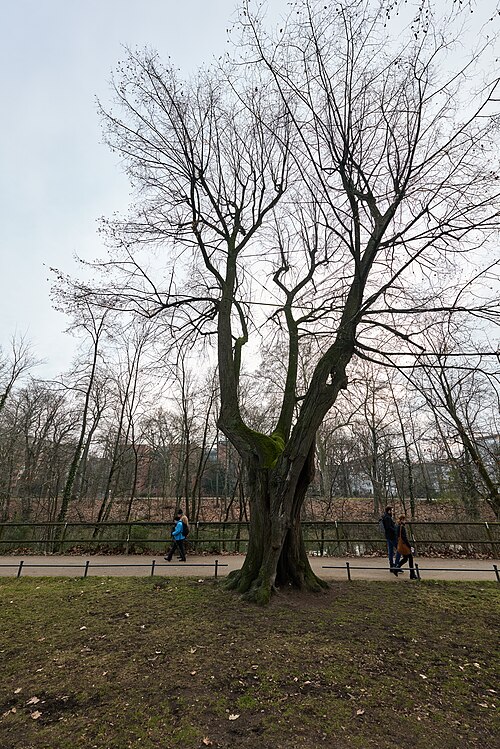
Lime (Tilia sp.) · 350 years · St. Johannis
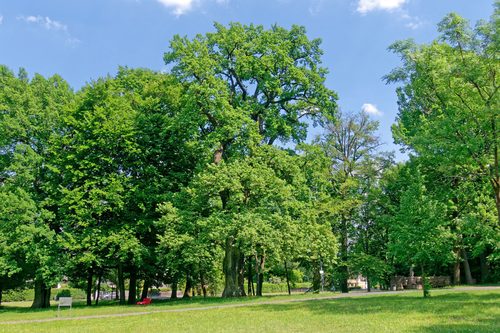
Lightning has struck this lime and a storm has taken pieces off it, and it is still putting on growth. Nuremberg's own survey of the city's oldest trees describes it as a gnarled linden of roughly three hundred and fifty years at the southern end of the Hallerwiese, damaged and healthy at the same time, which is a fair summary of what that many centuries do to something that cannot move. It is protected as ND-5 on the city's 2020 natural monument ordinance. What nobody has settled is which lime it is. German parks of this period were planted with three of them almost interchangeably, summer lime, winter lime and the hybrid between the two, and no source identifies this one, so it stays a lime and goes no further. Three hundred and fifty years covers most of what happened to Nuremberg. The tree was already mature while the city was still a free imperial city answering to nobody but the emperor, and it was well over a century old when that ended in 1806 and Nuremberg was handed to Bavaria, bankrupt and stripped of its independence. Two large planes stand on the green immediately behind it, planted at close to the same time. The meadow is free and open, roughly fifteen minutes on foot from the Hauptmarkt.
London Plane (Platanus x acerifolia) · 300 years · St. Johannis
The London plane is not much older than this tree. The hybrid turned up in European gardens some time in the seventeenth century, a cross between an American and an Oriental plane that nobody set out to make, and Nuremberg's survey of its oldest trees puts this one and its neighbour at over three hundred years, which places the pair within a couple of generations of the hybrid's own beginning. Both stand on the green behind the old gnarled lime, planted at close to the same moment, and both carry their own entry on the city's 2020 natural monument ordinance, this one as ND-4. The register lists them separately. The newspaper survey describes them as a pair and does not tell them apart, which is why this page does not pretend to either. What is not in question is the size. Planes put on girth faster than limes and then hold it, and three centuries on the Hallerwiese have given these two the heavy trunks that make the species recognisable from the far end of a park, bark flaking off in jigsaw plates to leave a camouflage of cream, olive and grey underneath. It is the one large tree that looks different every year in the same way. Free and open, about fifteen minutes on foot from the Hauptmarkt.
London Plane (Platanus x acerifolia) · 300 years · St. Johannis
City foresters plant planes because they are difficult to kill, and this one has had the chance to prove it. It is the second of the two large planes on the Hallerwiese, protected as ND-3, standing about forty metres from its twin and, by the city's own reckoning, over three hundred years old. Planes tolerate compacted soil, road salt, drought and smoke better than almost any other large broadleaf, which is why they line boulevards across Europe, and why this pair was still standing after the night of 2 January 1945, when an RAF raid destroyed roughly nine tenths of Nuremberg's old town on the far side of the Pegnitz. The medieval centre was rebuilt over the following decades from photographs and salvaged stone. The trees needed nothing. Nuremberg's own survey of its oldest trees treats the two planes as a pair and never separates them, while the ordinance gives each its own number, so this page keeps them as two entries while admitting they are one sight. Walk to the gnarled lime first, which is the oldest thing on the meadow, and the planes stand on the green immediately behind it. All three are within a minute of each other, free and open, about fifteen minutes on foot from the Hauptmarkt.
Horse Chestnut (Aesculus hippocastanum) · Kleinweidenmühle
This park was a quarantine station. Kontumaz is the old German word for it, and the ground here is where Nuremberg held arriving travellers and goods until the city was satisfied they carried nothing worse than themselves. It is a lawn and a playground now, and this chestnut is protected on it as ND-6 under the city's 2020 natural monument ordinance. The ordinance calls it Kastanie and leaves it there, chestnut, without saying which kind. In a planted German municipal park an unqualified Kastanie is almost always the horse chestnut rather than the sweet chestnut, so that is what this page records, on inference rather than on anyone's botanical word. No source gives it an age either. What the register does confirm is that in 2020 the city still counted it worth protecting by name, which is the most recent thing anyone has published about this tree. Come in May. Horse chestnuts flower by putting up hundreds of white candles at once, upright over the entire crown, and a mature one doing that above a children's playground is the best ten days this park has all year. By late September it is dropping conkers in spiny green cases that split open on the ground, which is the other reason children have always known this species better than adults do.
London Plane (Platanus x acerifolia) · Kleinweidenmühle
Six individually protected trees stand on 1.7 hectares here, which is a great deal of legal attention for one small park. Kontumazgarten is a lawn, a playground and some old trees, and the city's 2020 natural monument ordinance lists ND-6 through ND-11 inside it: a chestnut, two beeches and three planes, each with its own number and its own protection. This is the first of the planes, ND-7. A Naturdenkmal is not a plaque. It is a legal designation under German conservation law that attaches to a single named object rather than to an area, and it makes cutting, damaging or altering the tree an offence, which is why a municipal park gets redesigned around a tree rather than through it. The ordinance is also the only source. It gives the species and the position and stops: no age, no girth, no description, and no article or survey names this plane on its own. So what is documented is the city's own judgement, repeated six times over in one small green, that this particular set of trees was worth writing into law. The six sit within about a hundred and fifty metres of each other, which makes the park a single stop rather than six errands. Free, open, with a playground, about fifteen minutes from the old town.
European Beech (Fagus sylvatica) · Kleinweidenmühle
Almost nothing grows under a beech, and the tree is doing that on purpose. European beech holds its leaves in dense overlapping layers that let very little light reach the ground, so the soil beneath a mature one is usually bare and brown, which is why beech woods feel like rooms rather than thickets. This is the first of two beeches protected inside the Kontumazgarten, listed as ND-8 on Nuremberg's 2020 natural monument ordinance. The city recorded it and stopped there. No age, no measurements, no description, and no independent source names it, so the honest position is that it is old enough for a city to protect by name and nobody has published a number. The bark is the way to read a beech: it keeps a smooth grey skin for its whole life, so unlike an oak it hides nothing, and every scar, carving and old wound stays legible for decades. Come in late October or November. Beech is the best autumn tree in central Europe by some margin, turning through yellow into copper and russet and holding the colour for weeks, and young beeches keep their dead leaves right through winter instead of dropping them. The park is free, open and has a playground, about fifteen minutes on foot from Nuremberg's old town.
London Plane (Platanus x acerifolia) · Kleinweidenmühle
These two planes stand five metres apart and the law counts them as separate monuments. ND-9 and ND-10 on Nuremberg's 2020 natural monument ordinance each have their own register number, their own coordinate and their own protection, and anyone walking into the Kontumazgarten will see one pair of trees. That gap between how a register sees a park and how a person sees it is worth knowing before you go hunting for ten separate trees in this city. This is ND-9, the closer of the two to the lawn. Neither has an age on record, neither has been measured in any published source, and no article names either of them individually, so what exists is the city's designation and the trees themselves. Planes grown this close do something worth looking up at: instead of two round crowns they build one shared canopy, each leaning away from the other's shade until the pair spreads wider than either would have alone, while the trunks stay straight because neither has room to lean into the gap. The join is directly overhead if you stand between them. Treat the two as one stop rather than two. Free, open, with a playground beside them, about fifteen minutes on foot from the old town.
London Plane (Platanus x acerifolia) · Kleinweidenmühle
Germany protects individual trees the way other countries protect buildings. A Naturdenkmal is a legal designation that attaches to one named object rather than to a landscape, and Nuremberg's 2020 ordinance runs to dozens of them, each with a number, a location and a species. This plane is ND-10. It stands about five metres from ND-9, its near neighbour, the two of them effectively one sight carrying two entries in law. The ordinance is also the only thing ever written about it. No age, no girth, no height, nothing beyond the species and a point on the map, and no survey or article names it on its own. That is thin, and it is better said than dressed up: the reason to walk over here is the park as a whole, six protected trees in one small green, not this individual plane's biography. What a plane does give you is scale without the wait. The species grows faster than almost any other large broadleaf that also lives a long time, which is exactly why nineteenth century park designers reached for it so often, and why three of the six protected trees in this park are planes rather than anything slower. Free and open, with a playground, about fifteen minutes on foot from the old town.
European Beech (Fagus sylvatica) · Kleinweidenmühle
Two trees in this park would be here without anyone's help, and both of them are beeches. European beech is the natural dominant of central Germany: left alone, most of Franconia would return to beech forest within a couple of centuries, shading out nearly everything else. The horse chestnut in this park came from the Balkans and the three planes are a garden hybrid that did not exist before the seventeenth century, which leaves this beech and its neighbour as the locals. It is ND-11 on Nuremberg's 2020 natural monument ordinance, the last of the six protected trees in the Kontumazgarten. As with the rest of them the register is the entire file: species, position, protection, and no age, measurement or description anywhere. Beech also suffers in cities, which is the other half of why an old one in a small urban park earns a listing. It has shallow roots, thin bark that scalds in full sun, and little tolerance for compacted ground or drought, all of which a public lawn supplies in quantity. Late October and November is the time to come, when it turns copper and holds it, and the ground underneath fills with beech mast, small triangular nuts in prickly husks that were fed to pigs for centuries before anyone thought of a park.
Large-leaved Lime (Tilia platyphyllos) · 400 years · Gärten bei Wöhrd
The sign at the foot of this tree and the botanists who have looked at its leaves do not agree on what it is. The sign says Winterlinde, small-leaved lime. An independent German tree register assessed the leaf hairiness and concluded large-leaved lime, which is what this page records, with the disagreement left standing rather than quietly resolved. Everything else about it is settled and considerable. Nuremberg's own survey of its oldest trees calls this one of the strongest and oldest in the city, roughly four hundred years old with a trunk about eight metres around, growing in the Stadtpark just south of the Schiller monument and northeast of the pond. It is the best documented old tree in Nuremberg: two independent sources plus the 2020 natural monument ordinance, where it sits as ND-38. Four hundred years puts its first decades inside the Thirty Years War, which emptied and impoverished Franconia and cost Nuremberg a large part of its population to famine and plague while the armies moved around it. It was a sapling then, on ground that was not yet a park. The park was laid out around it much later. The N1 bus stops at Stadtpark, and the walk from the Hauptbahnhof takes about fifteen minutes.
European Beech (Fagus sylvatica) · Gärten bei Wöhrd / Wöhrd
Eighty metres from this beech stands another one just like it, and Nuremberg's own register keeps them as two separate legal entities: Naturdenkmal Nr. 28 and Nr. 29, each with its own designation rather than a shared one for the pair. This is Nr. 29, a European beech in what used to be the Cramer-Klett family's private garden before the city bought the land in 1929 and opened it to the public two years later. The garden was badly damaged in the Second World War and was renovated as recently as 2019, one of the older green spaces in Woehrd to have outlasted both the family that laid it out and the war that came close to erasing it. The city's own list of protected trees names exactly two Naturdenkmaeler lost to fungal disease: a beech near the Laufer Schlagturm and a copper beech elsewhere in this same park. Nr. 29 is not one of them, and neither is its neighbour eighty metres away. Nobody has published a girth or an age for this tree, unusual for a specimen important enough to carry its own municipal registration number. If you have stood under it with a tape measure, or just an eye for how old these things get, tell us what you found.
European Beech (Fagus sylvatica) · Gärten bei Wöhrd / Wöhrd
This beech and its neighbour eighty metres away are the two survivors of a trio. A copper beech elsewhere in the same Cramer-Klett-Park was designated in 1996 with a four-metre trunk and a 23-metre crown, and died of fungal disease around 2009. This tree, registered separately as Naturdenkmal Nr. 28, carries no comparable measurements in either the state or the city record, and none of the dead tree's numbers belong to it, whatever a quick read of the park's history might suggest.
What the record does confirm is that it is alive and current in Bavaria's state register, standing in a park laid out for the Cramer-Klett family before the city bought the grounds in 1929 and opened them to the public two years later. The war damage and the 2019 renovation both belong to the park's history rather than to this tree specifically, since the sources never narrate it on its own. A beech surviving quietly enough that nobody has measured its girth or dated it is, in a park that has already lost one of its beeches to disease, the more ordinary story, and ordinary is not the same as unremarkable here.
Nobody has published this tree's size or age. If you have stood under it and can say how it compares to its sibling eighty metres away, tell us.
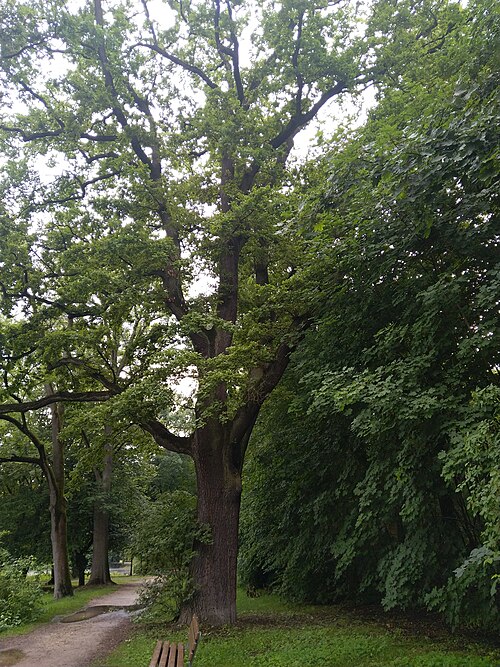
Pedunculate Oak (Quercus robur) · Gleisshammer
Three oaks along one lakeshore in Nuremberg carry registration numbers of their own, and this is number 34. It stands on the north shore of the eastern Nummernweiher, one of the ponds of the Volkspark Dutzendteich, and of the three it is the one whose position nobody disputes. Bavaria's state register, the German Wikipedia list of the city's natural monuments and a photographer's geotag all put it within about three metres of the same point.
That agreement is rarer than it sounds. Its two protected neighbours, numbers 33 and 31, stand within roughly 450 metres along the same water, and for each of them the official coordinates drift apart by twenty or thirty metres. This is the one you can walk straight to.
The paperwork is otherwise thin. The register calls it simply Eiche, oak; the Wikipedia list gives it as a pedunculate oak. The photograph dates from June 2019, and the register keeps no record of the tree's health, so whether it still looks the way it did that summer is something a visitor can tell us better than any document.
Nobody has published its girth, its height or its age. If you have stood beside it with a tape measure, or simply know how old it is, tell us.
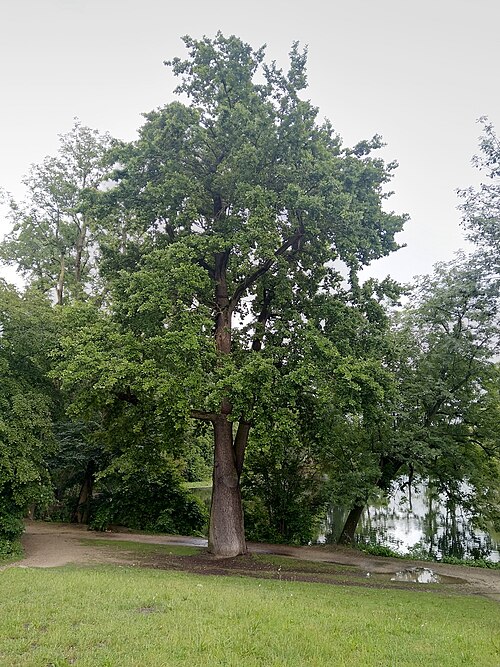
Pedunculate Oak (Quercus robur) · Gleisshammer
This oak grows in the footpath itself. It stands on the north shore of the eastern Nummernweiher, one of the ponds of Nuremberg's Volkspark Dutzendteich, and the German Wikipedia list of the city's natural monuments describes it exactly that way: on the east side, in the path.
It carries Bavarian registration number 33, one of three protected oaks along this stretch of water. Its neighbour, number 34, stands a short way west on the shore and already has a page here. Number 31 is further round, between the pond and Jakob-Wolff-Strasse.
The official records do not quite agree on where 33 stands. Bavaria's state register and the Wikipedia list put it about 30 metres apart, which is why our pin is marked approximate. In practice that matters less than it sounds, because a tree growing out of the path surface is hard to walk past without noticing.
The register calls it simply Eiche, oak, and photographs of it are filed as pedunculate oak. The most recent we found was taken in June 2019, so whether it looks the same today is something a visitor can tell us better than any document.
Nobody has published its girth, its height or its age. If you have stood beside it with a tape measure, tell us.
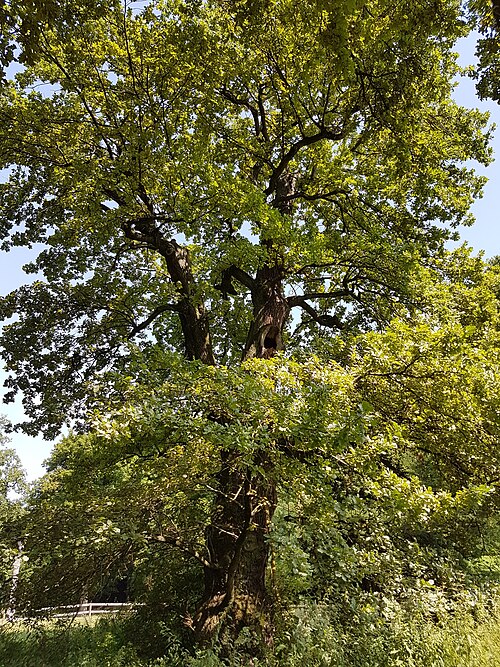
Pedunculate Oak (Quercus robur) · Gleisshammer
Of the three protected oaks along the Nummernweiher in Nuremberg's Volkspark Dutzendteich, number 31 is the one that stands back from the water. Its official name places it by two edges at once: north of the pond, south of Jakob-Wolff-Strasse. Somewhere in that strip of park between the shore path and the street is an oak the state of Bavaria has decided must not be cut down.
The register says little else. It calls the tree Eiche, oak, with no species, no girth, no height and no age. A photographer who stood beside it in August 2017 filed it as a pedunculate oak, Quercus robur, and that photograph is the most recent record we have of it. Bavaria's register still lists it as current, but nobody has put a fresh date on it since that summer, so if you have seen it lately, tell us it is still there.
Where exactly it stands is a matter of about twenty metres. The register and the German Wikipedia list of the city's natural monuments give coordinates that far apart, so our pin is approximate.
The other two oaks make it an easy detour. Number 34 stands on the north shore of the eastern pond, and number 33 grows in the footpath a little further east. If you measure this one round the trunk at chest height, tell us the number.
Photo: Buendia22 (CC BY-SA 4.0)
Wild Pear (Pyrus pyraster) · Gebersdorf
This wild pear carries the name of a Swedish king, and nobody has written down why. Nuremberg's list of natural monuments records it as the Gustav Adolf-Birne, the Gustav Adolf pear, protected under its own number, 23.
The obvious guess is the summer of 1632, when Gustav Adolf fought around Nuremberg and Gebersdorf lay on the battlefield. But no source we have found says this tree was standing then, or explains when the name was given or by whom. A pear named after a king is a fact. A pear that watched him fight is a story nobody has backed, and we are not going to be the first to tell it.
What it does have is its species. Pyrus pyraster is the wild pear, small-fruited and thorny, not an orchard tree gone feral. In mid-April 2022 a photographer caught it in blossom, and that is the week to come.
It stands by Hügelstrasse, south-west of the Gebersdorf sports ground. We have not confirmed whether you can walk right up to the trunk or only see it from the street, and nobody has published its age or girth. If you know either, tell us.
Pedunculate Oak (Quercus robur) · 300 years · Erlenstegen
Around 1960 somebody filled the base of this oak's trunk with brickwork, and the tree has been slowly growing over the masonry ever since. The Bear Oak, the Bäreneiche, is the thickest of six old oaks lining a path on the Platnersberg in Erlenstegen: 6.77 metres round at chest height when it was measured for a survey of Germany's monumental oaks in 2014, and about 28 metres tall. In 1934 the same trunk measured 5.35 metres.
The row once led to the summer house of Georg Thummen, who bought this land in 1533. The path was later moved to spare the oaks. The tree itself came later than Thummen: an estimate made in 2016 put it at about 300 years, and a city tree official told the Nordbayern paper it is almost as old as the old lime on the Hallerwiese. Read that as 300 to 350 years, a reckoning rather than a count.
It takes its name from the Bärenbrunnen, a fountain going back to 1500 that stands a few paces south and still has a festival every year. The oak keeps company of its own: a 2004 survey found two summer roosts of Daubenton's bats inside it.
It is not untroubled. A sulphur polypore, a wood-rotting fungus, has lived in it for some years, though the man who measured it still called its vitality fine. Nuremberg has protected it as a natural monument since 1986.
Photo: Rainer Lippert
Pedunculate Oak (Quercus robur) · Dutzendteich / Gleißhammer
Bavaria protects this oak by an address rather than a park: the green in front of the house at Jakob-Wolff-Strasse 19, 21 and 23. It is natural monument number 35 in Nuremberg, and it stands about 75 metres from number 31, one of the three protected oaks along the Nummernweiher in the Volkspark Dutzendteich.
That makes four registered oaks within a few hundred metres, and this is the one that stands among the flats rather than in the park. The register gives it as Eiche, oak, and nothing more. A photographer who visited in August 2017 filed it as a pedunculate oak, Quercus robur, and named the photograph after exactly this monument. That 2017 picture is the most recent record of the tree we have found, so if you have walked past it lately, tell us it is still there.
Where precisely it stands on the green is a matter of about twenty metres: the German Wikipedia list of the city's natural monuments and the Bavarian register put it that far apart, so our pin is approximate.
The green lies in front of apartment blocks, and we have not been able to confirm it is public ground, so look at it from the street rather than walking across. Nobody has published its girth, its height or its age. If you know any of the three, tell us.