Seven of Como's nine monumental trees line one lakefront road, which makes this among the easiest walks on the site. Via Borgovico runs from Villa Olmo past Villa del Grumello toward Villa Geno, a stretch the city itself signposts as the Kilometer of Knowledge. One won Lombardy's Tree of the Year vote in 2024, and three more stand inside Villa del Grumello's grounds, which open free on Sundays and a weekday schedule. The other two stand apart: a plane tree at Piazzale Camerlata, and a horse chestnut by the church at Quarcino in the hills above the lake.
0 of 9 visited in Como
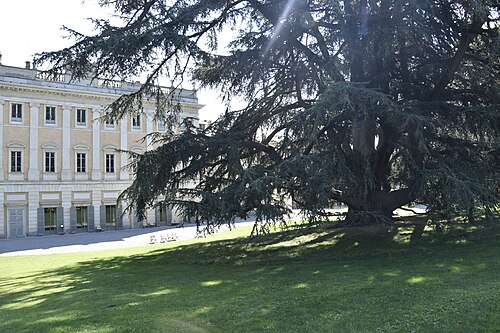
Cedar of Lebanon (Cedrus libani) · 200 years · Villa Olmo, lakefront (Via Borgovico)
Lombardy held a public vote for its tree of the year in 2024, and this cedar won it. The Comune di Como announced the result that November, crediting not the measurements but the setting, the history and the number of people with a memory attached to it. The measurements are worth having anyway. The trunk runs to roughly eight metres around, the thickest in Como's monumental list, and the tree stands twenty five metres high, with several heavy limbs forking low from the base rather than rising as one clean stem. Three registers put its age near two hundred years and agree closely: the national monumental register, the Italian tree register RAMI at about 197 years, and a provincial survey at roughly 200. It has not had an easy decade. Storms broke major branches in 2016 and again the following year. As of the summer of 2026 it stands inside a ring of protective stakes with a wrap around the bark, which is what a city does for a tree it has decided to keep. The park behind Villa Olmo is Como's main public green space, five hectares and some 780 trees, free and open daily. Generations of Como children have played in this cedar's shade, and the lakefront walk north to Villa del Grumello and Villa Geno starts here.
Photo: Daniela Manili Pessina (CC BY-SA 4.0)
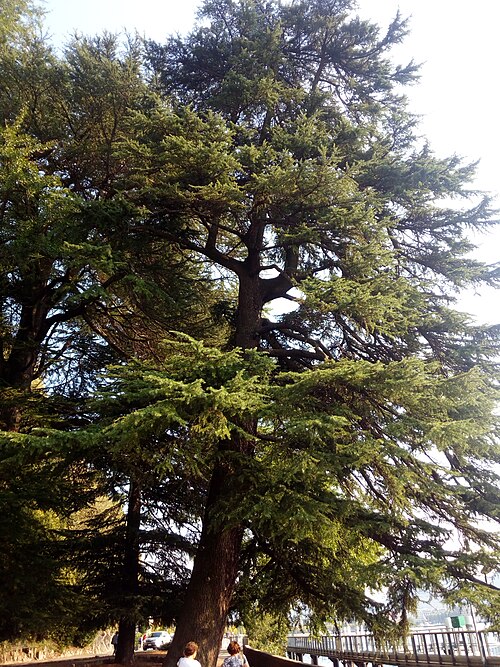
Himalayan Cedar (Cedrus deodara) · Villa Geno, lakefront promenade
The Italian tree register lists this one as Il Maggiore, the greater one, because there are two of them and somebody had to rank them. A pair of Himalayan cedars closes the end of Viale Geno, the lakeside promenade Como walks in the evening, and Lombardy's tourism office gives their girths as 5.80 and 4.30 metres. The national register records this tree at 5.60, near enough to make it the larger of the two. They stand over a clearing beside a lakeside fountain that throws its jet more than forty metres into the air, which means most people meeting these cedars are looking the other way when they arrive. Villa Geno began as an eighteenth century estate. The Cornaggia family bought it in 1850 and had the architect James Tazzini rebuild the house, and in 1911 the whole property, villa, park and the promenade leading to it, passed to the city of Como. The cedars have therefore spent most of their lives in public ownership, shading a walk that is free at any hour and about fifteen minutes on foot from the station. Deodars droop at the tips of every branch, which at this size reads as a very large tree hanging its head, and they hold that shape all year. No age has been published for either of the pair.
Photo: Mipiacecamminare (CC BY-SA 4.0)
American Sycamore (Platanus occidentalis) · Villa Geno, lakefront promenade
At thirty three metres this is the tallest tree on Como's lakefront walk, and the only American on it. Platanus occidentalis is the sycamore of the eastern United States, a species Europe mostly grows as one parent of the hybrid London plane rather than in its own right, and a full grown one in an Italian park is unusual. Its trunk measures five and a half metres around. That figure comes from the national monumental register and is matched to within a few centimetres by a survey of the province's trees run by A Scuola dagli Alberi. Those two records are the only ones we have found for this tree, so read the numbers as well corroborated and the biography as absent: nobody has published an age, a planting date, or the name of whoever put it here. It stands a few dozen metres from the two Himalayan cedars and the ginkgo in the same clearing at the end of Viale Geno, where the promenade runs out at the water. Bark is the giveaway if you are unsure which tree you are looking at. Sycamores shed theirs in plates and leave the trunk mottled cream and olive, brighter and flakier than the plane trees in the squares behind you. Free, open, and a fifteen minute walk from the station.
Ginkgo (Ginkgo biloba) · 90-120 years · Villa Geno, lakefront promenade
This ginkgo is male, which in this species is a decision rather than an accident. Female trees drop a fleshy seed that smells like something died in the flowerbed, so parks that want the autumn colour without the complaints plant males, and the nursery trade has propagated them from cuttings for over a century. The colour is the reason to come. Ginkgo leaves hold their green late, then go to a flat butter gold across the whole crown at once, usually in November here, and drop within a day or two of each other. Twenty metres of that standing over a lakeside clearing justifies the walk out along Viale Geno. The tree is roughly a hundred years old according to the provincial survey that recorded it, which puts its planting in the villa's first decades as public property. Como took over Villa Geno, its park and its promenade in 1911. On girth the sources do not quite agree: the national monumental register has 312 centimetres, the provincial survey about three metres flat, close but not the same measurement, and we have flagged that rather than pick one. The species has been around long enough not to care. Ginkgo biloba is the last surviving member of an order of plants that predates flowering trees entirely.
Cedar of Lebanon (Cedrus libani) · 155 years · Villa del Grumello, lakefront (between Villa Olmo and Villa Geno)
Six metres of trunk, standing directly in front of the house, in a park that grows a botanical collection dedicated to Pliny the Elder, the Roman naturalist Como claims as its own. The cedar came a great deal later than Pliny. The Italian tree register dates it to about 156 years, putting it in the ground around 1870, and the national register's girth of 595 centimetres matches the provincial survey's rough six metres almost exactly. Both rate it of national importance. Cedars of Lebanon do their growing outward. A tree of this age is young by the species' standards, and what it has already built is the flat tiered crown that makes a cedar readable from across a park, layer above layer, each one nearly horizontal. The four hectare grounds hold more than this one tree: pines, redwoods, and a camphor leaning at an angle that looks temporary and is not. The villa sits on the lakefront between Villa Olmo and Villa Geno and forms the middle stretch of Como's Kilometro della Conoscenza, the pedestrian path linking the three estates. One thing to plan around. The Grumello park does not keep ordinary park hours. Entry is free, it opens on Sundays and on weekdays, it shuts in the late afternoon rather than at dusk, and on Saturdays it does not open at all.
Ginkgo (Ginkgo biloba) · 145 years · Villa del Grumello
This ginkgo and the cedar a short walk away were almost certainly planted by the same person in the same decade. The Italian tree register dates the ginkgo at roughly 146 years and the cedar at roughly 156, which for ages estimated rather than counted is the same answer twice. Somebody was landscaping the Grumello grounds in the 1870s and buying the fashionable things. Ginkgo was exactly that. Europe had only had the tree since the 1730s, when seed reached Dutch collectors from Japanese temple gardens, and by the mid nineteenth century no serious villa garden was without one. This one went in beside the greenhouses, where the estate kept the plants that needed help surviving the winter. The ginkgo needed none. It is among the toughest trees in cultivation, which is how a species that had spent millions of years in the fossil record ended up in every second European park. Its trunk is now around four metres in circumference: 390 centimetres in the national register, roughly four metres in the provincial survey. In November the whole crown goes gold and then drops, often inside a couple of days. Access is the catch. The park is free but opens on Sundays and weekdays only, on a set schedule that ends in the late afternoon, and never on Saturdays.
Southern Magnolia (Magnolia grandiflora) · Villa del Grumello
The villa's own website lists magnolias among the centuries-old trees of its park, and that is as precise as anyone has been about this one. The national monumental register records a trunk of 330 centimetres, and the Italian tree register knows it as the Magnolia di Villa Grumello. Neither publishes an age, and no independent measurement exists to check the girth against, so this entry rests on thinner ground than the cedar and the ginkgo in the same grounds. It is on the register, it is where the register says it is, and beyond that the honest answer is that nobody has written the tree up. What you get is the plant itself, which needs no biography. Magnolia grandiflora came out of the American southeast in the eighteenth century and became the status tree of European villa gardens: evergreen, glossy, dark, and through May and June covered in heavily scented white flowers up to thirty centimetres across, visible from the far end of a lawn. It keeps its leaves through winter, so it looks much the same in January as in August, which is odd company for the deciduous giants around it. Entry is free, in a park that opens on Sundays and weekdays to a set schedule and stays shut on Saturdays.
London Plane (Platanus x acerifolia) · Camerlata
Piazzale Camerlata is where Como's traffic converges, and a plane tree with a trunk four and a third metres around stands in the middle of it. Two registers agree on that figure almost to the centimetre: the national monumental list records 430 centimetres and the Italian tree register 4.30 metres. They part company only on the Latin name, one calling it Platanus x acerifolia and the other Platanus hispanica, which are two names for the same hybrid rather than two different trees. Neither publishes an age. A search of the local press turned up a good deal about the square and nothing at all about the tree, so how much of the junction's history it has actually stood through is anybody's guess. The square has plenty of it. Camerlata was a commercial crossroads on the old Via Regina by the fifteenth century, took its present shape in 1879 and now centres on a monumental fountain by Cesare Cattaneo and Mario Radice. The Italian register surveyed the plane in September 2025 and rated its condition good, which is the most recent evidence that it is thriving rather than merely standing. It is a separate errand from the lakefront villas, about 2.9 kilometres south of them, twenty minutes on foot from Como San Giovanni or a short ride by bus. Free, at any hour, in the way a public square is free.
Horse Chestnut (Aesculus hippocastanum) · 125-250 years · Quarcino
The church beside it is a thousand years old, and the tree cannot be, because the species had not arrived yet. Horse chestnut comes from the mountains of the Balkans and only spread through western European gardens from the sixteenth century, so every one in Italy was planted by somebody on a date somebody chose. Nobody wrote this one down. The national monumental register gives a trunk of 335 centimetres and no age, and the Italian tree register adds a health rating of good and no age either. What the tree does have is an unusually well pinned position. A photographer entered it in Wiki Loves Monuments in September 2018, filed under veteran trees of Como, and the coordinates on that image land within a metre or so of the register's own point, which is better location evidence than most undated trees get. The church is Santi Filippo e Giacomo, Romanesque, tenth century in its earliest phase and rebuilt twice since, standing in the hill neighbourhood of Quarcino, also called Sagnino, four kilometres above the lake. Locals have put it forward for FAI's Luoghi del Cuore, the heritage fund's public list of places people care about, which is a fair description of what is here: a small parish church, a big tree next to it, no crowd. No source records opening hours for the churchyard. In May the whole crown goes up in white candles.