Frankfurt bent a subway line rather than lose a lime tree, and its Naturdenkmal register, refreshed in October 2025, protects old trees one by one. Four of the eleven here stand within a few hundred metres of each other in the Westend, between the Palmengarten, the Botanical Garden and Gruneburgpark, which makes that the walk. The rest are out in the districts: the lime in Eschersheim, a ginkgo from about 1750 in Rödelheim, a peace oak of 1871 in Sossenheim, and some thirty wood-pasture oaks in the Schwanheimer Wald that may be the oldest of all.
0 of 11 visited in Frankfurt
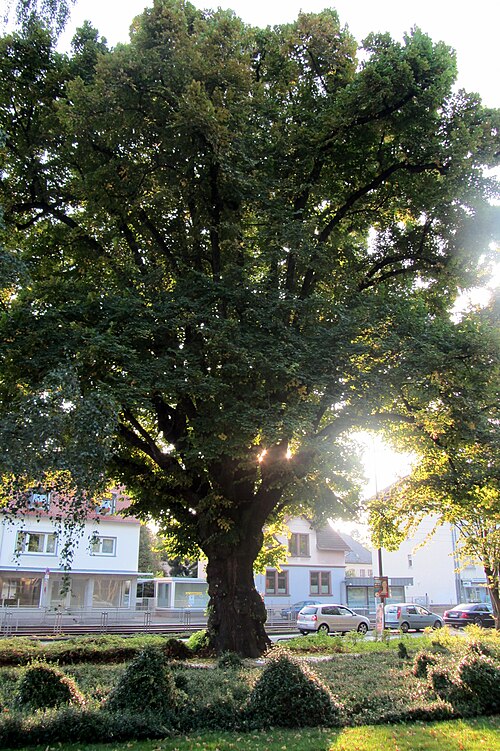
Large-leaved Lime (Tilia platyphyllos) · 300 years · Eschersheim
Frankfurt bent a subway line rather than lose this lime. The U-Bahn under Eschersheimer Landstrasse curves slightly where the tree stands, the station beside it is called Lindenbaum, and so is the street. That is a lot of infrastructure named after one large-leaved lime.
It went in at the end of the 17th century as a landmark on what was then an open road out of the city, and it was the smaller of a pair. Locals called it the Kleine Linde, because a bigger Grosse Linde stood nearby until a storm brought that one down in 1923. Around five metres round and some 25 metres tall, it has been a protected natural monument since 1937.
Being a landmark on a road that turned into a city has cost it. The street was paved, the ground around it sealed, and the roots began to suffocate. It got tree surgery in 1955 and again in 1974, drainage in 1968, and by 1984 the city was pumping water and air into the soil around it to keep it alive. Frankfurt has now spent seventy years on life support for a tree it could have removed in an afternoon.
It stands directly on the public street, so there is nothing to pay and nothing to enter. Get off at Lindenbaum station and it is right there, which is the whole point of the name.
Photo: Daviidos (CC BY-SA 3.0)
Dawn Redwood (Metasequoia glyptostroboides) · 75 years · Westend-Nord
Until 1943 this species was known only from fossils. Metasequoia had been described from stone and written off as long extinct, and then living trees turned up in central China and seed went round the world's botanical gardens within a few years. Which means every large dawn redwood in Europe can be dated to within a human lifetime, and this one is among the first of them: it was planted in the Frankfurt Botanical Garden around 1950, as a cutting.
Seventy-five years later its trunk measures 5.72 metres round at chest height, which the German Dendrological Society ranks as the second thickest recorded specimen of its species in the country. It is a conifer that behaves like a broadleaf, putting out soft feathery needles in spring and dropping every one of them in autumn once they have turned rust orange.
It stands in the East Asia section, opposite the flat-roofed building and to the right of the bee house, which is precise enough to walk to. Entry to the Botanical Garden is free. The Palmengarten and its two protected beeches are next door, so the two gardens make a single afternoon, and the city added this tree to its register of natural monuments in 2025.
The odd thing to hold in your head under it: this tree is younger than the news of its own species, and it is already one of the biggest in Germany.
Weeping Beech (Fagus sylvatica 'Pendula') · 180 years · Westend-Süd
This beech has been quietly making more of itself. Where its drooping branches reached the ground they took root, and what began as one tree is now a hall of leaves you can walk into. From outside it reads as a single heavy green dome. From underneath it is a room, held up by the parent trunk and by branch tips that grew themselves legs.
Frankfurt's own tree cadastre dates the planting to 1845. It stands just over four metres round and about 16 metres tall, and a tree surveyor who measured it in June 2023 recorded it as vital with some branch breakage, which is what happens to a weeping beech carrying that much weight sideways. The city put it on its register of natural monuments in 2025.
Weeping beeches are not a wild form. Every one is propagated from a mutant that hangs instead of reaches, so a garden that planted one in 1845 was buying a curiosity, and this is what a curiosity looks like after 180 years of being left alone.
It is in the western part of the Palmengarten by the Gesellschaftshaus, a short walk from the Palmenhaus and from the copper beech that is three decades older again. The Palmengarten charges admission, so this and the copper beech are the two trees on this list you pay to stand under. This one you can also stand inside, which is the better way to do it.
Copper Beech (Fagus sylvatica f. purpurea) · 210 years · Westend-Süd
The Palmengarten opened in 1871. This beech was already 56 years old. Frankfurt's tree cadastre dates its planting to 1815, the year of Waterloo, which makes it older than the garden that now charges people to come and look at it.
It is a grafted copper beech, which is how nearly all of them are made. The purple-leaved form does not come reliably true from seed, so a shoot of it is joined onto ordinary green beech rootstock, and on an old specimen you can often still find the join low on the trunk. A surveyor measured it at four and a half metres round in August 2022 and recorded its condition as vital. The city listed it as a natural monument in 2025, under the heading of beauty and rarity, which is an unusually frank thing for a register to write down.
It stands out on the meadow in the middle section of the park with room around it, so the whole low, wide crown is readable at once rather than in pieces through other trees.
Come in late April or May rather than in August. The new leaves open translucent red and only darken through the summer, and by high season the tree has gone almost black-purple and lost half of what makes the walk worth it.
Lime (Tilia sp.) · Westend
Eight trunks come out of the ground here in one tight ring, and they are a single tree. This is a Bündelpflanzung, a bundle planting: several young limes set into one hole so that they grow up together and merge into a single crown. It is deliberate, not an accident of self-seeding, and it is rare enough that Frankfurt made this one a protected natural monument in 2025.
It stands at a path crossing in the middle of the Grüneburgpark, beside the small children's playground, which puts it on everyone's route and almost nobody's list. Walk in among the stems and you are standing inside the tree rather than in front of it, with eight columns around you and one canopy overhead.
Nobody has established how old it is. No published record we can find carries a planting date, and the designation does not give one either, so this page does not guess. The same goes for which lime it is: small-leaved, large-leaved and the hybrid between them are close enough that neither source commits, and we are not going to commit for them.
If you know either answer, from a park archive, an old photograph or a plaque we have missed, tell us and it goes on the page. Meanwhile the park is free, open at all hours, and the tree is unmistakable once you are looking for eight of anything.
London Plane (Platanus x acerifolia) · 210 years · Innenstadt
Seven metres and thirteen centimetres around the trunk, measured in October 2025. That is a plane tree you could not reach a tenth of the way around, standing in a strip of park a few minutes from Frankfurt's opera house. An independent big-tree survey recorded 713 centimetres last autumn; another surveyor measured 704 in 2022. Two measurements three years apart agreeing that closely is the kind of number worth trusting.
It was planted in 1820, ten years after the neoclassical pavilion it stands behind, the Nebbiensches Gartenhaus. Both sit in the Bockenheimer Anlage, part of the ring of parkland Frankfurt laid out on the ground where its city walls had stood, which is why the green in this part of town runs in a curve instead of a grid. The tree is around 35 metres tall with a crown some 26 metres across, and it carries entry 028 on the city's register of natural monuments.
Two centuries is not particularly old for a plane. It is old for this address, where a garden pavilion from 1810 now sits in sight of the banking towers.
Access is free and unrestricted at any hour, which is worth saying because two of the protected trees on this list stand behind an admission desk. This one is simply in a public park, and you can put your hand on it.
Ginkgo (Ginkgo biloba) · 270 years · Roedelheim
In September 1815 Goethe wrote a poem about a single ginkgo leaf, split down the middle and still one leaf, and sent it to Marianne von Willemer with two real ginkgo leaves fixed to the page. Rödelheim would like those leaves to have come from this tree. It has a case, and it does not have proof.
The ginkgo went in around 1750 beside the Petrihaus, in what was then the little County of Solms-Rödelheim. The house later belonged to the banker Georg Brentano, and in September 1814 Goethe was a guest of the Brentano family in Rödelheim. A year later came 'Gingo biloba'. The board at the tree suggests the connection. Wikipedia calls it possible and says the leaves cannot be traced to this tree with certainty, which is where the evidence stops, and so does this page.
The tree needs no poem. The city register gives it about 260 years and 18 metres; the Wikipedia article says over 270 and calls it the oldest ginkgo in Germany, which is that article's claim rather than ours. It stands a few metres south of the Petrihaus, with the Nidda weir just beyond and Brentanopark on the far bank.
The catch is the gate. The grounds open only for events of the Förderverein Petrihaus and on the last Sunday afternoon of each month from spring to autumn, so check before you go. The newest dated photograph we found is from 2017; if you have stood under it since, tell us.
Pedunculate Oak (Quercus robur) · 140-160 years · Sachsenhausen-Sued
Frankfurt protects this oak for two reasons, and one of them is a beetle. The city's register entry 035 lists the tree's rare, striking form, and then adds that it is habitat for the stag beetle, a protected species that depends on old oaks.
It was not always the main event. The city's own description says it was once just one oak among many in the Stadtwald, the city forest on Frankfurt's south side, and is now a solitary tree that shapes the landscape around it. Somewhere along the way people started calling it the Paradieseiche, the Paradise Oak. The city records the nickname and does not explain it. If you know where it comes from, tell us.
The numbers are the city's own. It is 140 to 160 years old, which puts it in the second half of the 19th century, with a trunk about 4.2 metres round, a crown about 20 metres across and a height of 25 metres. For an oak of that age, that is a lot of tree.
It stands at the corner of Oberer Schafhofweg and Sachsenhäuser Landwehrweg, on the forest edge in Sachsenhausen-Süd, and you see it from the road. There is nothing to pay and no gate, and a protected zone of 20 metres runs around the trunk.
Pedunculate Oak (Quercus robur) · 300-500 years · Schwanheim
Until the 1920s, pigs were driven into this wood to feed under these oaks, and in the Middle Ages sheep, goats, horses and cattle grazed here too. That is the whole explanation for the place: about thirty pedunculate oaks that grew up on open, grazed ground rather than packed into a forest, which is what wood-pasture means.
Germany was once full of it. From the 18th century most of it was replaced with spruce plantations, and what survived became a favourite subject for the painters of the Kronberg colony. One of them, Fritz Wucherer, painted 'Bei den Schwanheimer Eichen' in 1899, showing a conspicuous oak whose trunk forks in two. A large reproduction stands on the path, so you can compare the painting with the trees.
How old they are depends on which official text you read. The city's own page says up to 500 years; the register as mirrored on German Wikipedia says 600 to 1,000. Several centuries is as far as the sources agree. They are only 12 to 16 metres tall, and the trunks average about 2.75 metres round.
The thickest carries thumb-thick galleries bored by the great capricorn beetle, and woodpeckers come for the larvae. Not all the news is good. For some years the oaks have been suffering from climate change, their crowns thinning and branches dying, and some of the group is already dead wood.
The Alteichen-Pfad, part of Frankfurt's GrünGürtel, runs through the group. It is open forest, and free.
Pedunculate Oak (Quercus robur) · 140 years · Sossenheim
Lightning once split this oak from its crown to its roots, and it is still standing. The crack is part of the city's own description of the tree, entry 022 on Frankfurt's register of natural monuments.
It was planted in 1871 to mark the peace that ended the Franco-Prussian War, which makes it a Friedenseiche, a peace oak, put in the ground in the same year the German Empire was proclaimed. That gives it something most old trees lack: a known birthday, and an age of about 150 years that nobody had to estimate.
It also stands on an old line. Sossenheim was a village before it was part of Frankfurt, and until about 1800 it was closed in by a Haingraben, a fence and hedge with a ditch along it. The oak stands where the village edge used to be. Today that edge is the Wiesenfeldweg, between housing and allotment gardens, and the tree has outlasted both the Empire it was planted under and the peace it was planted for.
It is 4.60 metres round and about 18 metres tall, a broad trunk for a century and a half. The city does not say whether the lightning crack is weakening it, and we will not guess. The newest dated photograph we have found is from 2020; if you have walked past since, tell us how it looks.
It is free, and seen from the public way at the southern edge of Sossenheim.
Pedunculate Oak (Quercus robur) · 150 years · Hoechst
Frankfurt's register entry for this oak says it is still fairly young and has not reached its full size, which is a candid thing to write into the document that protects it. It is over 150 years old, about 13 metres tall and 2.6 metres round. None of that is a record. What it has is the square.
The Höchster Schlossplatz sits in the tight old town of Höchst, beside the castle on the Main, and the city's own text calls the oak the formative centre of the place. Its crown spreads about 21 metres, wider than the tree is tall, over a square closed in by old buildings. A wooden bench runs in a ring around the trunk, which tells you what the square thinks the tree is for.
It stands in front of the entrance to the Zollhaus, and it was already here when Höchst was still a town of its own. Frankfurt only absorbed it in 1928, so this oak has been the middle of the square under two different town halls. Today the city protects it as natural monument 024, with a zone of ten metres around the trunk.
So come for the place rather than the measurements. There is nothing to pay and nothing to find: walk into the square, look for the bench, and sit on it.