Four of the five trees on this page stand on Wielka Wyspa, the Great Island between the Oder and its canal, within about a kilometre and a half of each other. Three were protected on the same day in February 1953. The oldest, Dziadek, Grandpa, is held up by steel clamps; another survives because a mayor bought its riverbank in 1865; a third was hit by lightning; the fourth is in good shape. The fifth stands over a kilometre away in the city centre, a plane tree called Swiadek, the Witness, beside the Civil Registry Office.
0 of 5 visited in Wroclaw
Pedunculate Oak (Quercus robur) · 400 years · Szczytniki, on the riverside path between the Zwierzyniecki and Szczytnicki bridges
In 1865 the mayor of Breslau bought a piece of riverbank so that this oak would not be cut down. Artur Hobrecht made the purchase on the city's behalf and the tree carried his name for the next eighty years, the Hobrecht-Eiche, until Breslau became Wroclaw in 1945 and the new Polish city renamed it for Jan Dzierzon, the Silesian priest and beekeeper who worked out that drones hatch from unfertilised eggs. It has been a protected natural monument since 16 February 1953, decision 5/53, one of three on this page designated on the same day. A dedicated survey of the monument trees of Wielka Wyspa puts it at 652 centimetres round and 22 metres tall, which is within half a centimetre of the girth recorded for Dziadek, a kilometre away. Poland's national register has no column for either figure, so the measurements come from that survey rather than from the state. The same survey is blunt about its condition: the interior is substantially decayed, the trunk is hollow and the structure is poor. The tree is alive and comes into leaf, standing on the open boulevard along the Oder canal between the Zwierzyniecki and Szczytnicki bridges, where anyone can walk up to it at any hour.
Pedunculate Oak (Quercus robur) · 440-460 years · Dabie, on the edge of Park Szczytnicki
Wroclaw's oldest tree is called Grandpa and it is held together with steel. Dziadek is reported at somewhere between 440 and 460 years old, which puts its start in the era when this was Habsburg Breslau, and its trunk now carries damage serious enough that the branches are reinforced with elastic bindings and clamps. The measurements tell the same story from another angle: 652.5 centimetres round in 2019, up from 629 in 2015, against a height of only 17 metres, the shortest and thickest of the four oaks on this page. A trunk that wide under a crown that low is what a very old tree looks like once it has begun losing its upper limbs. It has been a protected monument since 16 February 1953, decision 2/53. What it has stood through includes the Prussian takeover of Silesia, two centuries of German Breslau and the eighty-day siege of 1945 that left most of the city in ruins and changed both its country and its language. It stands on the public pavement of ul. Kopernika, in front of a training centre but not inside its grounds, on the edge of Park Szczytnicki. Poland's register records the protection and nothing about the tree's size; those numbers come from a survey of the island's monument trees.
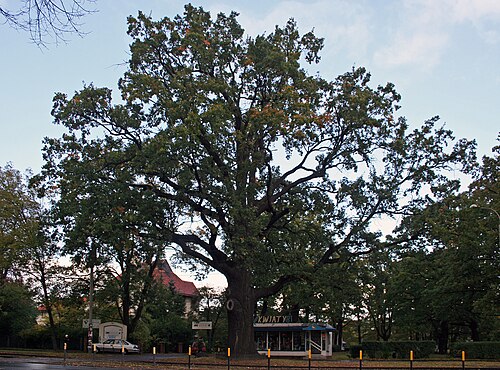
Pedunculate Oak (Quercus robur) · Dabie, near Park Szczytnicki and the Wroclaw Zoo
This is the one in the group that is not falling apart. Its three companions on Wielka Wyspa are variously hollow, lightning-struck and clamped together; this oak was recorded in good health at the last survey, with a large, well-formed crown and no bracing, standing 25 metres tall on 510 centimetres of girth. It has been a protected natural monument since 16 February 1953, decision 3/53, the same morning's work as two of the others. The name is a dedication rather than a date. Piotr Wlostowic, Piotr Wlast, was a twelfth-century Silesian magnate and founder of monasteries whose reputation is tied to this region, and nobody is claiming the tree goes back to him: no independent age estimate for this oak has been found at all, and Poland's national register carries no age field to consult. So it ships here with its girth, its height and its designation date, and without a number for its years. It stands on public ground on ul. Wroblewskiego, a few minutes from the entrance to Wroclaw's zoo, which opened in 1865 and is the oldest in Poland. Free, open, and the healthiest tree of this walk.
Photo: Siliesiac (CC BY-SA 3.0)
Pedunculate Oak (Quercus robur) · Szczytniki
Lightning found this oak and it is still in leaf. The strike left it in poor structural condition, which is the surveyors' phrase and not a euphemism, and it went on growing: 554 centimetres round and 26 metres tall, the tallest of the four oaks on this page. It stands inside Park Szczytnicki near the narrowing of the park pond, a few minutes from the Hala Stulecia, Max Berg's concrete dome of 1913 that went on the UNESCO list in 2006 and drew the world's architects to this corner of the city. Unlike the other three, this tree was not protected in the 1953 batch. Its designation came on 2 April 1976, decision 26/76, twenty-three years later. It carries the name of Jan Stanko, the fifteenth-century physician and naturalist who compiled one of the earliest catalogues of Central European plants and animals, which is a fair patron for a tree in a park built as a botanical showpiece. No age estimate for it exists in any source found: the register that protects it records a species, a position and a date, and has no column for age or girth anywhere in it, so the girth and height here come from a dedicated survey of the island's monument trees.
London Plane (Platanus x acerifolia) · 200 years · Stare Miasto (Dzielnica Czterech Wyznan)
Wroclaw's Civil Registry Office sits fifteen metres from a plane tree the city calls Swiadek, the Witness, and the name is not an accident: everyone who has married or registered a birth at that building for decades has walked past this trunk on the way in. The city made the connection official in January 2020, granting the tree protected status by council resolution and giving it the name outright rather than leaving it as a bare register entry.
The tree stands on Plac Jana Pawla II, on the embankment named for Tadeusz Jasinski, beside a fountain flanked by two bronze allegories, a young man wrestling a lion and another seated calmly on one, cast by Bernard Shering and Ernest Seger as a study in struggle and victory. Growing since the early 19th century, the plane now measures 538 centimetres round, thick enough that the whole ensemble, tree, fountain and statues, reads as one composition rather than three separate things sharing a corner.
It stands more than a kilometre from Wielka Wyspa's four oaks, a different species and a different kind of witness, a city-centre square rather than a river island, but the same instinct that protected the oaks in 1953 protected this tree in 2020.