No European capital does ancient trees quite like London. Its oldest oaks survive largely thanks to royal appetite: kings walled off huge hunting parks for their deer, and the trees inside were left to grow old while the countryside around them was cleared. The city even gave its name to the London plane, the soot-proof hybrid that lines its streets. The trees here range from a churchyard yew older than Londinium itself to a plane once valued at three quarters of a million pounds. All but Kew are free, though two Temple trees keep lawyers' hours.
0 of 32 visited in London
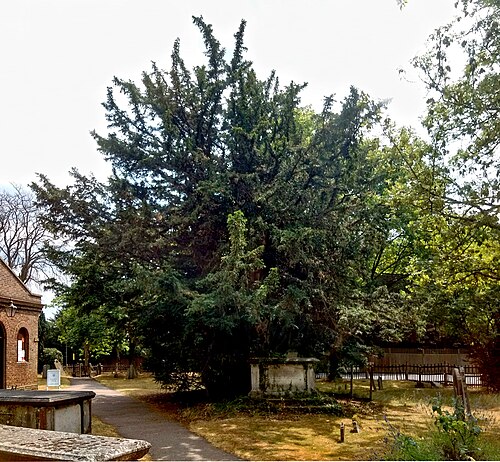
European Yew (Taxus baccata) · 2000 years · Totteridge, North London
The oldest living thing in London stands in a churchyard most people drive straight past. This yew was already ancient when the Romans built Londinium two thousand years ago, and the church beside it is the newcomer: St Andrew's dates only to the 13th century, a good thousand years younger than the tree growing at its edge. A 2008 survey by the Conservation Foundation, the Ancient Yew Group and Barnet Council named it possibly the oldest tree in the city, though ring counting is useless here. Yew heartwood rots away long before it can be counted, which is why the estimate spans a thousand years, 1,000 to 2,000, rather than a single number. What survives is a hollow, propped trunk with a girth of nearly eight metres, kept alive the way most ancient yews are kept alive: repeated pollarding, cutting the tree back hard and often enough to reset its own clock rather than let it grow toward collapse. Totteridge was a village long before London reached it, and its Hundred Court, the local medieval assembly that settled disputes and collected dues, once met in the yew's shade, using the tree as a landmark centuries before anyone thought to measure its age.
Photo: Philafrenzy (CC BY-SA 4.0)
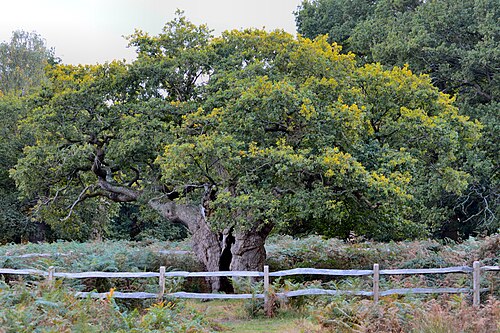
Pedunculate Oak (Quercus robur) · 750 years · Richmond Park
The wall came second: this oak was already centuries old when Charles I enclosed Richmond Park around it in 1637, walling off common land for his own deer rather than planting anything new. It has lived behind royal fences ever since. The tree is a massive hollow pollard now, its trunk split and gnarled into a shape wide enough to shelter a small football team, kept alive by the same repeated cutting-back that saves most ancient oaks from their own weight. Richmond Park holds one of the largest collections of ancient oaks in Europe, and the Royal Oak is treated as its figurehead: Sir David Attenborough chose it as the symbol of a conservation campaign for the park's veteran trees, and it carries its own entry in the Woodland Trust's national Ancient Tree Inventory, a formally surveyed and registered specimen rather than a folk legend. Fallow deer, descendants of the herd Charles I first enclosed the park to hunt, still graze in its shadow, close enough on a quiet afternoon that the oak and the animals read as one scene rather than two separate facts.
Photo: AndyScott (CC BY-SA 4.0)
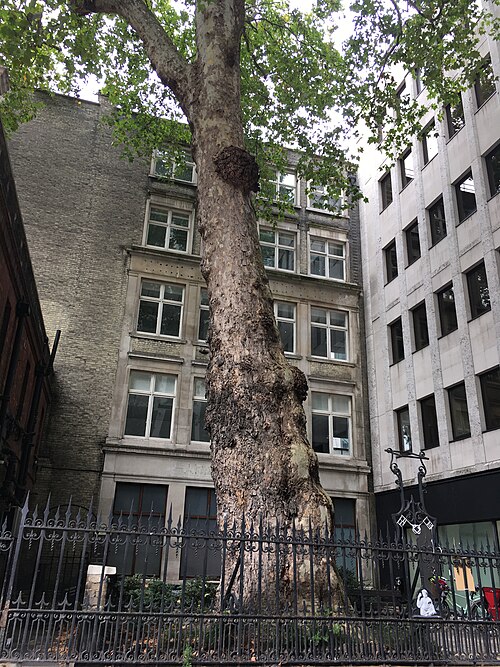
London Plane (Platanus x acerifolia) · 200-300 years · City of London
The only Great Tree of London still standing inside the Square Mile grows out of a churchyard that no longer has a church. St Peter Cheap burned down in the Great Fire of 1666 and was never rebuilt, and the plane tree that replaced its congregation is old enough that nobody can say exactly when it was planted. By 1853 a cab company was advertising its rank simply as 'Under the tree, Cheapside,' proof the tree was already a fixed point on the map before street numbering caught up with London's growth. In 1901 the press went further and called it the most valuable tree in the world, a claim about the land beneath it as much as the tree itself. It has survived since through the Blitz, through the City's total postwar rebuilding, and through a peculiarity of property law: the leases on the buildings flanking it forbid construction above two storeys on that side, an accident of contract law that has kept its canopy open to the sky for longer than most buildings nearby have existed. William Wordsworth is thought to have had this exact tree in mind writing his 1800 poem Poor Susan, in which a countrywoman hears a thrush singing from a tree on Cheapside and briefly mistakes the City for home.
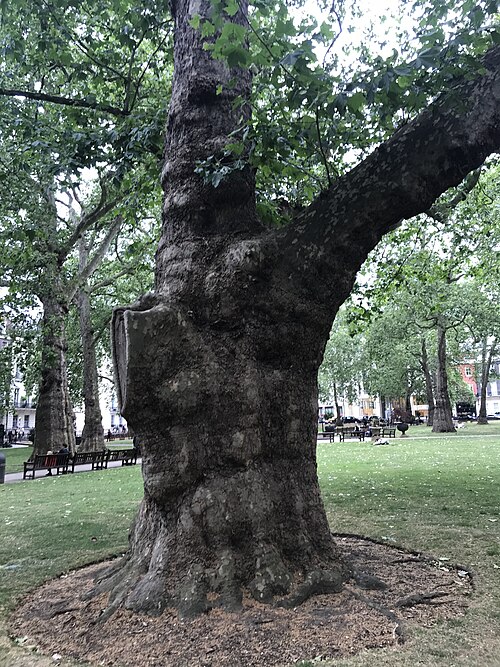
London Plane (Platanus x acerifolia) · 235 years · Mayfair
In 2008 a valuer put a price on one of the plane trees in Berkeley Square: 750,000 pounds, briefly the most valuable tree in Britain, a number that says more about Mayfair real estate than about the tree itself. The square's planes went into the ground in 1789, planted by the MP Edward Bouverie, who lived at number 13, and they now rank among the oldest London planes anywhere in the city. There are more than thirty of them, planted as a single scheme rather than one famous specimen, which is why this entry marks the square itself rather than a single trunk. The nightingale of the song 'A Nightingale Sang in Berkeley Square' almost certainly never existed as a literal bird here, nightingales do not really sing over central London traffic, but if one had, these are the branches it would have used. The planes were named among the original 41 Great Trees of London, and the Grade II listed garden they shade has kept the same rectangular shape since the square was laid out, a fixed green rectangle while Mayfair rebuilt itself around it for over two centuries.
Photo: Hopefully Acceptable Username (CC BY-SA 4.0)
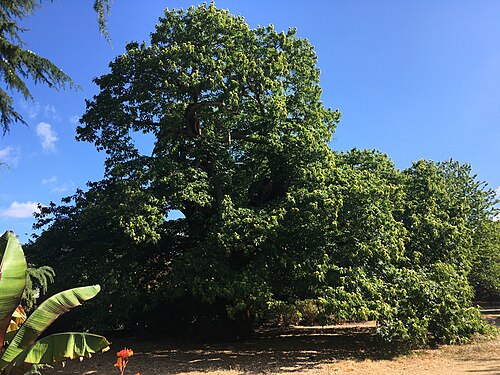
Sweet Chestnut (Castanea sativa) · 365 years · Greenwich
Charles II wanted Versailles and settled for Greenwich instead. After taking the throne in 1660, he ordered grand formal avenues cut through the old royal hunting park, hundreds of sweet chestnuts marched up the hill toward the future Royal Observatory in straight French rows. Most of that planting is gone, lost to storms, disease and three and a half centuries of ordinary attrition. This chestnut is one of roughly fifty survivors, and the one the Great Trees of London list points to in the Flower Garden. Its trunk has thickened into something closer to architecture than plant, and it has been pollarded more than once, a pruning technique that resets a tree's internal clock and is a large part of why it is still standing while so many of its neighbours from the same planting are not. Its slowly rotting heartwood, hollow in places, now shelters beetles and fungi that need old deadwood and nowhere else. Every October it drops a carpet of spiny green cases across the grass, food for the park's squirrels and for anyone willing to peel one open. It has stood through the Restoration, two world wars and the digging of anti-aircraft gun pits nearby. Unlike the oak that once stood a short walk from here, it has never stopped growing.
Photo: Hopefully Acceptable Username (CC BY-SA 4.0)
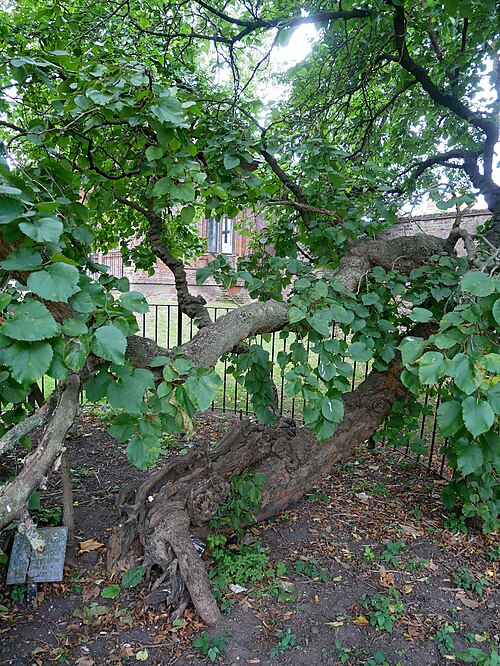
Black Mulberry (Morus nigra) · 400 years · Charlton, South East London
James I wanted Britain to grow its own silk, and in 1608 he ordered mulberry trees planted across the country to feed the silkworms that would spin it. The plan collapsed almost immediately over a basic mistake: silkworms eat white mulberry leaves and mostly refuse black ones, and the trees planted nationwide, including this one, were black mulberries. Charlton House got one of them, and unlike England's silk industry, the tree itself survived the error by four hundred years and counting. It now leans so far from vertical that its lower branches nearly touch the ground, propped up by a scaffold of wooden supports rather than left to collapse under its own spread, and it still fruits every August, small dark berries falling onto grass that has replaced whatever formal garden once surrounded it. The tree predates the surrounding community centre by roughly three centuries. Charlton House itself, a Jacobean mansion finished the same decade this mulberry went into the ground, has changed use many times since, while the tree in its garden has simply kept growing, propped a little more with each passing century.
Photo: Ethan Doyle White (CC BY-SA 4.0)
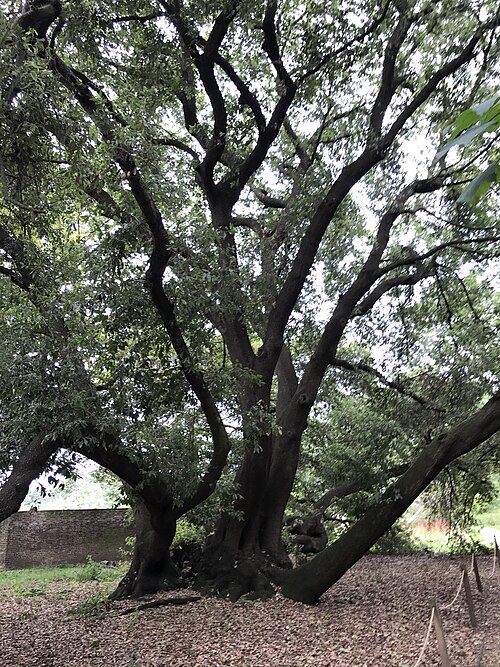
Holm Oak (Quercus ilex) · 450-550 years · Fulham
This oak survived five centuries partly because people kept attacking it. It was coppiced long ago, cut back hard to its base, a brutal-looking practice that paradoxically resets a tree's age clock and can add centuries to its life rather than shorten it. What grew back is a Holm Oak, an evergreen Mediterranean species that has no business thriving this far north, and quite possibly the oldest specimen of its kind anywhere in Britain. It grows in the grounds of Fulham Palace, for centuries the working home of the Bishop of London rather than a royal estate, and the two bishops most often credited with planting it, Edmund Grindal and John Aylmer, both lived here in the second half of the 16th century, among the first people in England to try growing the species at all. The oak was named among the original 41 trees given Great Tree status in 1988, and a later record corrected an old misidentification of the tree as a common Pedunculate Oak rather than the rarer Mediterranean evergreen it actually is. Fulham Palace Gardens are free to enter daily, which means reaching London's likely oldest holm oak costs nothing but the walk from Putney Bridge station.
Photo: Hopefully Acceptable Username (CC BY-SA 4.0)
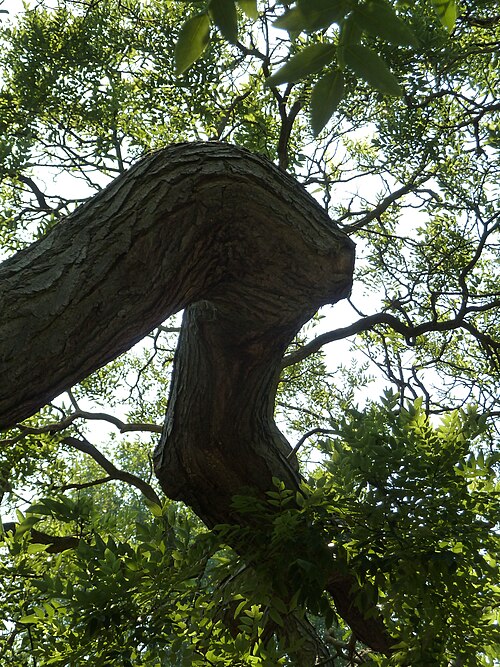
Japanese Pagoda Tree (Styphnolobium japonicum) · ~260 years · Kew, South West London
John Smith, Kew Gardens' first curator, gave five of its oldest trees a nickname that stuck: the Old Lions, veterans that have outlasted every curator, director and fashion in planting since the garden began. The group spans the site rather than clustering in one corner: an oriental plane near the Orangery, an elm, a locust, and the most storied of the five, a Japanese pagoda tree planted in 1762 that ranks among the oldest of its species growing anywhere in Europe outside its native range. All five predate Kew's formal existence as a public institution. They were already growing when Princess Augusta laid out the first pleasure garden here in the 1750s, decades before Kew merged with the neighbouring Richmond estate and grew into the botanic garden it is today. Seeing all five in one visit means crossing a meaningful stretch of the grounds, since Smith grouped them by age and survival rather than by location, but each carries its own small marker naming it as one of the Lions. Entry to Kew requires a paid ticket, unlike most of London's ancient trees, but the garden built its reputation partly on outliving its own founders, and these five are the proof of it.
Photo: Deror avi (CC BY-SA 3.0)
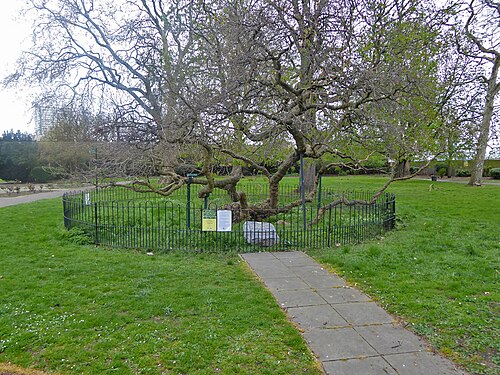
Black Mulberry (Morus nigra) · 300-350 years · Deptford, East London
John Evelyn's garden at Sayes Court was one of the most celebrated in 17th century England, laid out by a writer and diarist who helped define English ideas about forestry and planting, and it lasted less than four decades before a tenant wrecked it for sport. Tsar Peter the Great of Russia rented the house in 1698 while studying shipbuilding nearby, and legend holds that he spent his evenings being wheeled through Evelyn's prized holly hedges in a wheelbarrow, flattening years of careful topiary for entertainment. Historians doubt Peter planted anything here himself, and this mulberry's own age is uncertain enough that the honest claim is only that it may have survived the same visit that ruined everything around it, not that it predates the destruction with certainty. What remains today is a fenced, propped tree standing in an unremarkable public park where almost nothing else of Evelyn's garden survives, plus a stone marker at its base that tells visitors the wheelbarrow story rather than leaving them to wonder why one old mulberry gets special treatment. It still fruits every August, one of the few parts of Sayes Court's story that still repeats on schedule rather than existing only in an old diary.
Photo: Robin Webster, via Geograph Britain and Ireland / Wikimedia Commons (CC BY-SA 2.0)
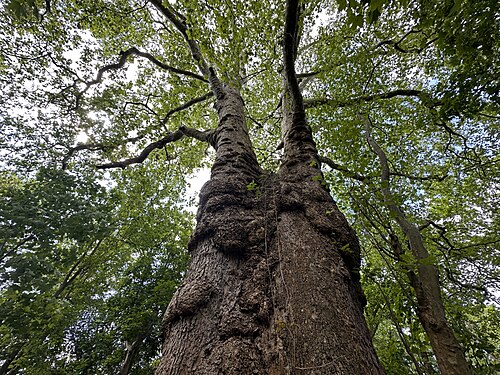
London Plane (Platanus x acerifolia) · 300-350 years · Barnes, South West London
The biggest London plane in the city is a tree most Londoners have never heard of. Nicknamed Barney, it stands at Barn Elms in the riverside suburb of Barnes, tucked at the edge of the land next to the London Wetland Centre, and it is old enough, over 300 years, that it is treated locally as potentially the single oldest London plane anywhere in the capital. The species is the city's signature tree for a reason: it tolerates soot, survives brutal pruning, and outlives almost everything planted around it, and Barney is the patriarch of them all in Barnes. Its own Great Trees of London plaque states the claim plainly, calling it simply the oldest in London, though the tree's coordinates only firmed up in 2026, when a photographer's geotagged shot of Barney was checked against the plaque's own recorded position and the two turned out to sit within nine metres of each other, close enough to count as the same tree rather than two separate estimates. Most visitors to Barn Elms come for the birdwatching at the Wetland Centre next door and walk straight past the small plaque without noticing it, which is itself part of Barney's story: London's biggest plane tree stands anonymously beside one of the city's most visited nature reserves.
Photo: Matt Brown (CC BY 4.0)
London Plane (Platanus x acerifolia) · 260 years · City of London
Four planes stood on the north side of St Paul's churchyard until the Great Storm of 1987 took one of them down. The three that remain are, according to one detailed local history of the cathedral, over 250 years old, which would put their planting in the middle of the 18th century, when Wren's dome was still the newest thing on the skyline and the ground beneath them was a working burial place. That age comes from a single account. The London Parks and Gardens Trust inventory for the churchyard agrees only that these are among the oldest plane trees in the City, without giving a number or a date, so read 250 years as the best figure anyone has published rather than a measured one.
What they lived through is less disputed. On the night of 29 December 1940 incendiary bombs set the streets around the cathedral alight and burned out much of the City. The dome held, and so did the planes. Londoners later planted this species everywhere precisely because it shrugs off soot and smoke; these three were in the ground a century before that fashion started.
This is an ensemble rather than one specimen: three unnamed trees, none of them individually catalogued or given coordinates by any source. Stand on the paved path along the north side and all three are in one view. The pin marks that garden, not a particular trunk.
Common Fig (Ficus carica) · 195 years · Clerkenwell, Islington
This fig may have been planted as a teaching aid. It sprawls across the front of the former Clerkenwell Parochial Schools on Amwell Street, several stems rising from one rootstock and propped where the limbs have outgrown their own strength. Paul Wood, who has spent years cataloguing London's street trees, reckons it has stood here since the schools opened, put in deliberately at the front of the building and perhaps partly so that Bible lessons had something living to point at. Figs run all through scripture, and a fig outside the classroom window is an illustration nobody can lose.
The dates want care. The Amwell Society dates the school building to 1830, while other accounts say 1827. And the planting claim rests on that one specialist reading rather than on two independent records, so roughly 195 years is a careful estimate, not a birth certificate.
Clerkenwell changed around it more than most of London did: watchmakers, radical printers, the New River head a few streets north still delivering water into the city, charity schoolchildren giving way to board schools and then to flats. The building stopped being a school. The fig stayed, and Islington still counts it among the borough's notable street trees.
It is a working fruit tree on a public pavement in central London, which is the part that stops people. Come in late summer and the figs are there, at eye level, on the street.
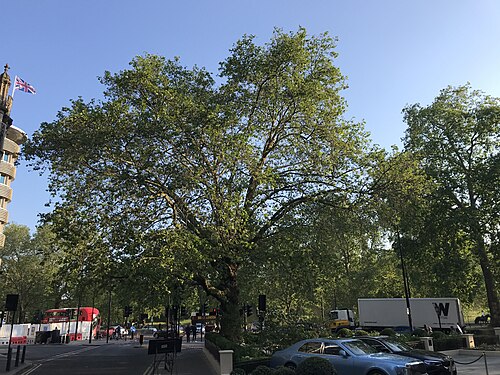
London Plane (Platanus x acerifolia) · 95 years · Mayfair
One of the Great Trees of London stands at the front door of a hotel where a night costs more than most people's monthly rent, and you can walk up to it for nothing. The London Tree Forum and the Countryside Commission put this plane on their 1997 list of the capital's great trees, which was generous of them: the Great Trees map dates its planting to the early 1930s, making it younger than almost every other tree on this page by a century or more.
The arithmetic is suggestive rather than proven. The Dorchester opened in 1931, and a plane put into a brand new Park Lane forecourt in the early 1930s fits that opening neatly, but no source actually joins the two facts, and the planting date itself comes from that one specialist record.
What the tree unquestionably has is roots. Its root plate has risen clear of the ground and spread across the forecourt in ridges, the sort of thing a city normally paves over and here has been designed around instead: the hotel's recent refit tucked its garden underneath the tree rather than the other way round.
It has stood through the Blitz, when the hotel's reinforced concrete frame earned a reputation for being bomb-proof and politicians and generals moved in for the duration, and through ninety years of Park Lane traffic since. You see it from the pavement. No need to go inside.
Photo: Hopefully Acceptable Username (CC BY-SA 4.0)
Huntingdon Elm (Ulmus x hollandica 'Vegeta') · 160 years · Marylebone
Dutch elm disease killed around 25 million British elms from the 1960s on, roughly three quarters of the country's population. This one was missed. It stands on the pavement of Marylebone High Street, more than 100 feet of it by the Great Trees of London map, the last elm of its kind in Westminster to have escaped the beetle that carried the fungus through every hedgerow around it.
Specialist tree writers identify it as a Huntingdon Elm, a hybrid of wych and field elm. A recent account of the street calls it simply a wych elm, so the exact cultivar is not universally agreed. Nor is the age: writers through the 2010s consistently put it at about 150 years, which makes it roughly 160 now, a figure carried forward rather than measured.
It has outlived a church. The small garden beside it, the Memorial Garden of Rest, was laid out in 1951 on the site of the old St Marylebone parish church, which was bombed in the war and then demolished. The building is gone. The tree that grew outside it is still there, leaning out over the pavement as though it means to cross the road.
A naturalist photographed it in bud and healthy in 2017, and someone walking the High Street described it still standing there in April 2026.
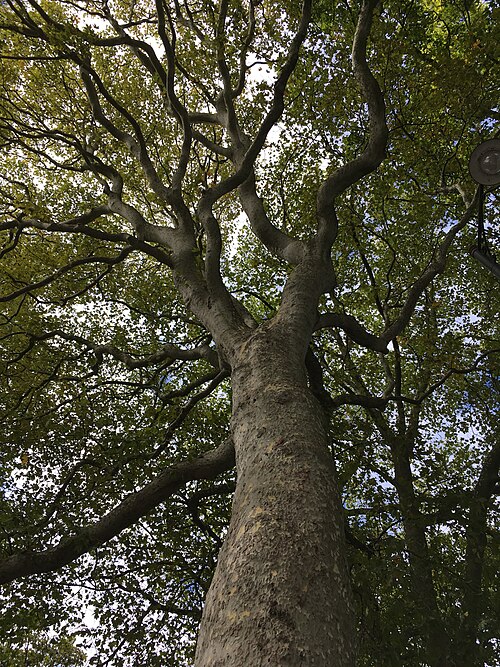
Oriental Plane (Platanus orientalis) · 156 years · Westminster
The tree that helped make London a city of planes is not a London Plane. It is an Oriental Plane, one of the two species crossed to produce the hybrid now growing down half the streets in the capital, and it stands where Horse Guards Avenue meets the Victoria Embankment, on ground that was river water until Bazalgette's engineers pushed the Thames back in the 1860s.
The Great Trees of London map dates it to 1870 and gives the species. Both of those rest on that one specialist record. General histories of the Embankment agree that planes went in along the new road from about 1870, the first scheme in the city to plant a thoroughfare with trees systematically, but none of them names this individual tree. So it is a survivor of that first planting on the evidence available, rather than a documented one.
It has had a good view. Cleopatra's Needle was raised a few hundred metres along the same Embankment in 1878, trams came and went, the Ministry of Defence rose behind it in the 1950s, and Whitehall traffic has run past its trunk for a century and a half.
It gets called one of the tallest planes in Britain, a claim nobody appears to have checked. Easier to say what it plainly is: a very large tree on one of the busiest corners in Westminster that almost nobody stops for.
Photo: Hopefully Acceptable Username (CC BY-SA 4.0)
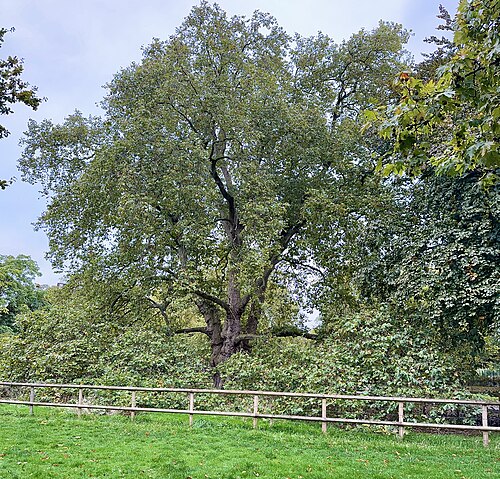
London Plane (Platanus x acerifolia) · 230 years · Bloomsbury
This plane was planted for orphans. Brunswick Square Gardens was laid out in 1796 as green space for the children of the Foundling Hospital, and this tree is reckoned to date from that laying out, which makes it around 230 years old. Only the planes of Berkeley Square, put in seven years earlier, are commonly held to be older among the planes of central London. It has stood through everything Bloomsbury became: the Hospital selling up and moving out of London in the 1920s, its buildings coming down, the square rebuilt around the gap, the Blitz, and the concrete decks of the Brunswick Centre arriving to the west in the 1970s. The institution it was planted to shade is gone. The tree is not. In 2008 it was named one of the ten Great Trees of London, and it has since been given its own information board in the square, which is a quiet way of saying the neighbourhood knows what it has. Photographs taken in spring 2026 show it in full health. Neither source that agrees on the 1796 planting records a girth or a height, so there are no measurements to quote here, only the thing itself: a very large plane in a small square five minutes from Russell Square station, free and open, with the Foundling Museum on the far side telling the rest of the story.
Photo: Matt Brown (CC BY 2.0)
Holm Oak (Quercus ilex) · 150-350 years · Becontree, Barking and Dagenham
The October 1987 storm brought down some 15 million trees across southern England and left this one untouched. Its low, heavily buttressed frame is credited for that: a holm oak that grows outward rather than upward gives the wind nothing to lean on. Roughly ten years later it was added to the Great Trees of London list. How old it is depends on which source you take, and the two do not agree. The Barking and Dagenham Post, quoting the borough's own heritage education officer, credits the Mertinn family, German immigrants who had made their money in jewellery and bought the estate in the early 1700s, with planting it to make their grounds look grander. That would put it close to 350 years. The London Gardens Trust's survey record for the site is more clinical and dates the grounds' holm oak and yew only to the nineteenth century, which would make it under 225. Both agree on what stands there: one of the most impressive holm oaks in London, beside the moat of Valence House, a medieval manor that is now the borough's museum. One practical note. The moat enclosure immediately beside the tree was closed for restoration work due to finish in spring 2026, so whether you can currently get right up to the trunk is unconfirmed. The park around it stays open, and the pin here is park level rather than surveyed.
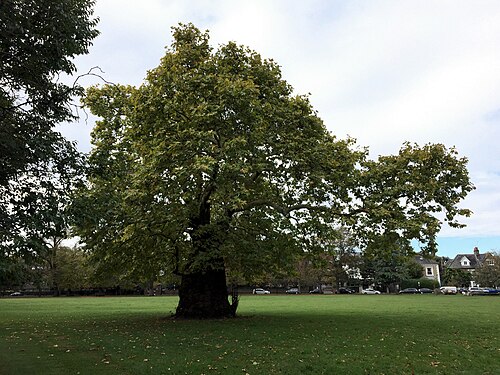
London Plane (Platanus x acerifolia) · 100-200 years · Hammersmith
A virus is the best explanation anyone has for the shape of this tree. It carries a swollen, knobbled trunk under a crown far too small for it, the signature of the rare Baobab group of London plane, a form believed to come from viral infection rather than ordinary growth. Few are known; the closest comparable specimens grow in Canterbury. Nobody can say how old it is, and the sources sit far apart. A specialist plane blog puts its planting somewhere in the nineteenth century, so 150 to 225 years. A local tree firm reckons closer to 100, while allowing it might date to 1812, when the park was the private estate of George Scott. The same firm repeats a story that a wartime bomb damaged the tree and that the regrowth explains its shape; no other source carries it, so treat that as local legend until one does. What is documented is stranger. The arborist Richard Moore took cuttings from this exact tree. Two of six rooted and now grow at a sculpture park in Dorset, still far too young to show whether the swelling travels with the cutting or belongs only to the parent. It is one of two Great Trees of London inside Ravenscourt Park, standing south of the lower grassy area near the elm avenue, five minutes from the District Line station, and it is unmistakable once you are in front of it.
Photo: Paulitzer (CC BY-SA 4.0)
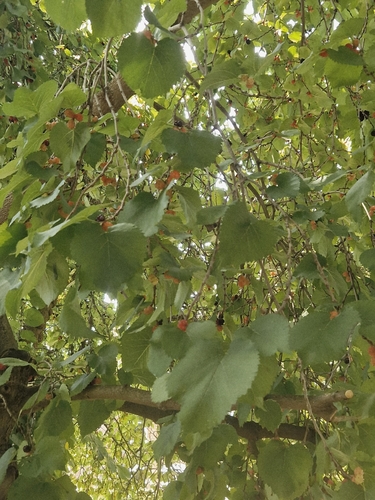
Black Mulberry (Morus nigra) · 130-140 years · Temple, City of London / Westminster border
Two black mulberries lean on wooden crutches either side of a fountain that has been running since 1681. They were planted for a queen's jubilee and the sources cannot agree which one. Middle Temple's own archive dates them to 1897 and Victoria's Diamond Jubilee. An independent mulberry history gives 20 June 1887, her Golden Jubilee, and adds that the planting was marked with a dinner in Middle Temple Hall. Ten years apart, both plausible, neither picked here: call the trees roughly 130 to 140 years old. Four went in together and only these two are left, the other pair removed in the 1970s. Black mulberry ages like this, going crooked and heavy limbed early, propping itself on whatever it is given, and fruiting hard regardless. Fountain Court is a small enclosed square between Middle Temple Hall and the gardens that run down toward the river, a working courtyard of the legal quarter rather than a park, and one of the quietest corners in the City. Access is real but narrow. The court and garden open to the public on weekdays, roughly 12:30 to 3pm, not on bank holidays, entered through the Garden Room off Middle Temple Lane, and they close in high winds or for private functions. Turn up inside that window and both trees are there, one on each side of the water.
Photo: Clive Freedman (CC BY)
Black Mulberry (Morus nigra) · Temple, City of London
The Inner Temple's garden opens to the public for two and a half hours on weekday afternoons, and this tree is a fair reason to time the visit. A black mulberry stands by the railings of Benchers' Walk, outside Paper Buildings, its trunk about a metre and a half around and ten metres of crown above it. The Inner Temple's own history of the garden names it as one of the survivors of an old orchard, alongside a large-fruiting walnut and a quince, which is the institution itself calling this inherited planting rather than decoration. What no source will say is how old it is. There is no planting date anywhere, and black mulberries are among the hardest trees to age: they rot hollow early, lean until they need propping, and root wherever a low branch touches soil, so the trunk stops being a record of anything. This entry carries no age for that reason rather than a guess. The ground is famous for a scene that never happened here. Shakespeare set the plucking of the red and white roses, and with it the start of the Wars of the Roses, in the Temple garden; the tree is centuries younger than the fiction. Two hundred and fifty metres across the lane, Middle Temple's mulberries at Fountain Court at least have a disputed planting date to argue over. This one does not even have that.
Japanese Pagoda Tree (Styphnolobium japonicum) · 200 years · City of London
This is the only Japanese pagoda tree in the City of London, on the City of London's own account of its gardens, and a City business paper's tour of Finsbury Circus says the same. The species comes from China and flowers cream in August, when almost nothing else does, which is a useful habit in a garden ringed by offices where lunch happens outdoors. Both sources tie the tree to the garden's original 1815 layout by George Dance the Younger, and neither produces a planting record, so the age here is circumstantial: roughly two centuries, inferred from the design rather than read off a document. Treat it as a range rather than a birthday. It has come through the most disruptive stretch of its life. Finsbury Circus lost most of its surface to Crossrail works for over a decade, then closed in 2023 for the first full renovation of the gardens in more than a hundred years and reopened in May 2025. The gardens are small, 2.2 hectares, so finding it takes a minute. Half a kilometre south, the Cheapside Plane is the only Great Tree of London still standing inside the Square Mile, and Kew's Old Lions include pagoda trees of roughly the same generation in a botanical collection. This one has spent its two hundred years in the middle of the banking district instead.
London Plane (Platanus x acerifolia) · 145 years · Bunhill, Islington
George Fox, who founded the Quakers, was buried on this ground in 1691, and the plane trees standing over it are nowhere near old enough to have seen it. The burial ground took Quaker dead from 1661 until 1855, and the space became a public recreation ground in 1965, laid out inside the Banner Street estate with the trees left in place. Their age is genuinely disputed. Bunhill Fields Quaker Meeting's own account of the garden says the mature London planes here were planted about 1880, which makes them roughly 145 years old. A local record drawing on the London Gardens Trust inventory describes three notable planes, two of which may date from the 18th century, which would make them a century older and among the oldest planes in London. The two claims have not been reconciled, and this page follows the Meeting's own figure because it is the institution's own history, while saying plainly that the bigger claim is out there. It is worth not confusing this with the celebrated burial ground next door. Bunhill Fields holds Blake, Defoe and Bunyan and gets the visitors; the Quaker ground is a separate, quieter square of grass and trees between Banner Street and Chequer Street, six minutes from Old Street. The Amwell Street Fig is about 1.4 kilometres west if you want to make an afternoon of it.
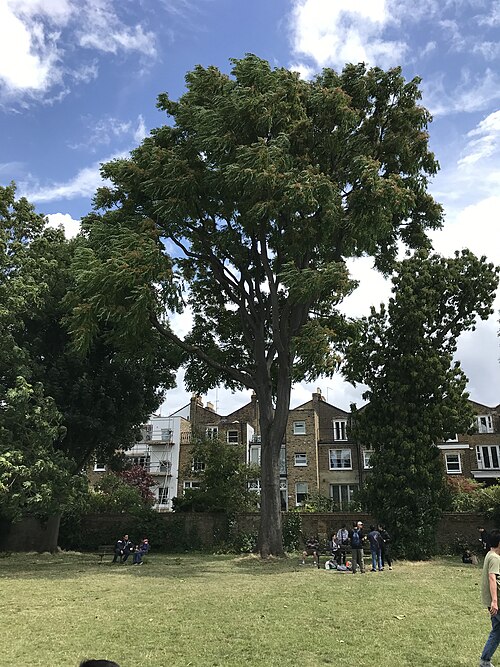
Tree of Heaven (Ailanthus altissima) · Hammersmith
Tree of heaven is the species councils spend money removing. This one has a plaque. The circular green plaque at its foot calls it one of the largest examples of the species in the country and one of the Great Trees of London, and the Tree Register's champion database carries it too, with at least one account calling it the tallest of its kind in Britain. Nobody gives it an age, and that absence is the interesting part. Ailanthus altissima arrived in Britain from China in the 18th century, spreads by seed and suckers, and is usually treated as short-lived, rarely making it much past fifty years. Something this size therefore breaks the pattern for its own species, and since no source anywhere offers a planting date, this entry gives no age rather than inventing one. It qualifies on size and status, not on years. It is also the cheapest addition to a walk on this whole list. The Ravenscourt Park Baobab Plane, with its swollen virus-knobbled trunk, stands about 150 metres away in the same park, which means Hammersmith now offers two Great Trees of London within a two minute walk of each other, near the sports area and the playground, five minutes from Ravenscourt Park station. The coordinates here come from the Great Trees map and are tree-level, so the pin lands on the trunk.
Photo: Hopefully Acceptable Username (CC BY-SA 4.0)
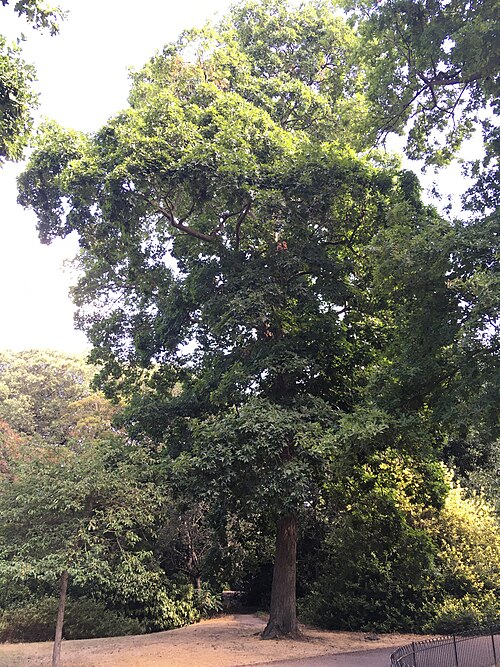
Shagbark Hickory (Carya ovata) · Greenwich
Britain's largest shagbark hickory, by the reckoning of the Great Trees of London list, is an American nut tree just short of 100 feet tall, growing in the Flower Garden of Greenwich Park. The list named it one of the capital's Great Trees, and a tree-care firm's round-up of London's finest gives the same height. Nobody else has published a measurement, so treat the national title as the list's claim rather than a settled record.
The name describes the bark. On an old trunk it comes away in long shaggy strips that lift from the wood, which makes the tree look permanently half-undressed and is the quickest way to pick it out from its neighbours. The species belongs to the forests of eastern North America and reached Britain around 1629. This one is a long way from home and standing up well to it.
What this tree does not have is a birthday. No source dates it, and nobody has published its girth either. If you know when it went in, or have stood at it with a tape measure, tell us.
The pin comes from the Great Trees map rather than a survey of the trunk, so expect to look around the Flower Garden in the south-east of the park. Greenwich Park's old sweet chestnut is a short walk away, which makes this an easy second tree for the same afternoon.
Photo: Hopefully Acceptable Username (CC BY-SA 4.0)
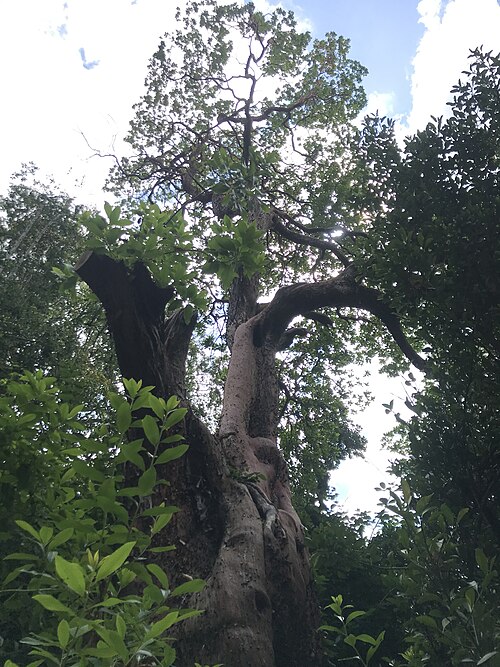
Hybrid Strawberry Tree (Arbutus x andrachnoides) · 150-175 years · Battersea
A round green plaque on the railings calls this the biggest hybrid strawberry tree in Britain, and dates the claim to 1997. Since then the titles have multiplied and drifted apart. A tree-care firm's survey calls it the largest in Britain by girth, just under 60 feet tall, and a Champion Tree of London. The Friends of Battersea Park, who know it best, settle for "second highest in the country" and "one of the treasures of the Park". They also call it the most splendid of the park's strawberry trees, which is the one title nobody contests.
It is a cross between the Mediterranean strawberry tree and its Greek cousin, and it shows off in two ways. The bark peels back to red, so the trunk looks freshly skinned all year, and it flowers in autumn, when most of the park is shutting down. The Great Trees of London list dates it to the 1850s. Where it came from, the Friends admit, nobody knows.
The last few years have been hard on it. A storm in February 2022 tore off a major limb, and in September 2023 the next bough up came down too. It is still standing, and still a Great Tree of London.
You will find it near the south-west corner of the Ladies Pond, ten minutes on foot from Battersea Park station, and the pin is on the tree.
Photo: Hopefully Acceptable Username (CC BY-SA 4.0)
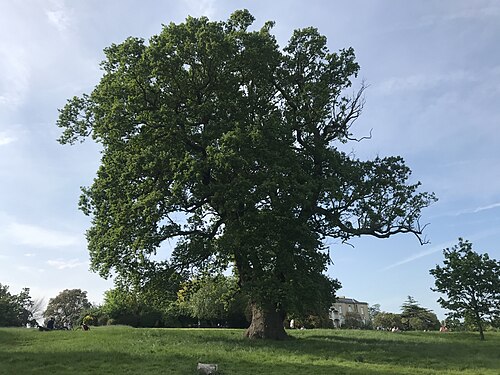
Pedunculate Oak (Quercus robur) · 500-700 years · Herne Hill / Brixton
The Brockwell Oak was old before Brockwell Park existed, and old before the country estate the park was made from. Lambeth Council, which owns the ground, said so in 2008 when the tree was counted among London's Great Trees, and put its age at probably well over 700 years. The Great Trees of London list is more cautious: 500 to 700 years as of 2010. Read together, they put the acorn in the ground no later than the early 1500s, and around 1300 or before if the council is right. That band is the honest answer.
Even at the cautious end it was more than a century and a half old when the Great Fire burned the City in 1666, a few miles to the north. The public, by contrast, are newcomers: the park only opened in 1892, when this oak was already several centuries into its life.
Lambeth gives its girth as over six metres. That is the council's figure rather than a published measurement, and it is a floor, not a ceiling. Photographs from May 2023 show it in full leaf, broad and heavy in open grass, with people picnicking in its shade.
The pin comes from the Great Trees map, not a survey of the trunk, so expect to look. You want an oak with a trunk over six metres round, standing in the open. It is not a subtle tree.
Photo: Hopefully Acceptable Username (CC BY-SA 4.0)
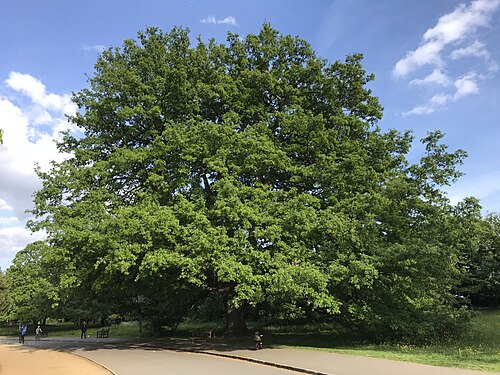
Turkey Oak (Quercus cerris) · Dulwich
Dulwich has exactly one Great Tree of London, and it is not a native oak. It is a Turkey oak, a southern European species, and it was among the original 41 trees chosen for the Great Trees list. The Dulwich Society, writing about the area's notable trees in 2020, called it perhaps the finest Turkey oak in Dulwich. The species has been planted in Britain since the early 18th century.
That date belongs to the species, not to this tree. Nobody has published when this one went in, how tall it is or how far round, and this page will not guess. If you know, or have measured it, tell us.
What it has instead is a plaque, set beside it to mark it as a Great Tree, and that is the most useful thing a visitor can know. Look for the broad, low crown near the south carriageway, the park's road on the south side, and then for the plaque at its foot.
The pin comes from the Great Trees map and lands close to where a photographer stood to take its picture in 2017, so it puts you within a few metres rather than on the trunk. Dulwich Park is free and open daily, about fifteen minutes on foot from North Dulwich or West Dulwich station.
Photo: Hopefully Acceptable Username (CC BY-SA 4.0)
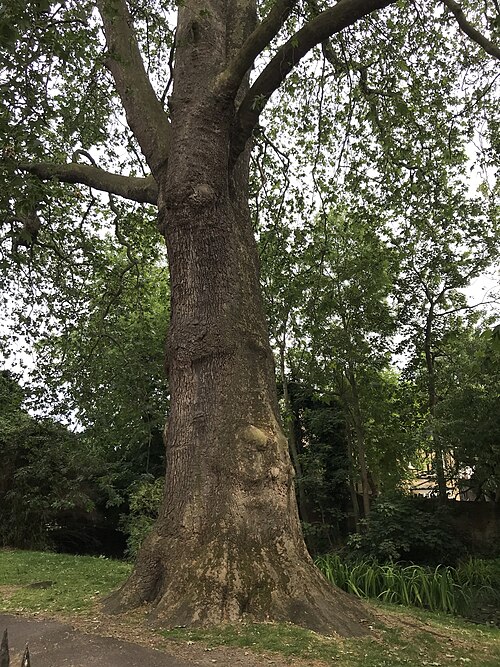
London Plane (Platanus x acerifolia) · 250 years · Carshalton
In 1964 the Forestry Commission set a plaque at the foot of this plane recording 123 feet, then the tallest London plane known in Britain. It has not stopped growing. On 5 August 2026 the Forestry Commission and Sutton Council's parks service measured it again: 39.6 metres tall, about 130 feet, and 7.6 metres round the trunk, almost 25 feet. Since the plaque, its girth has grown by 19 percent and its height by 6 percent.
The height record has moved on, though. On the Tree Register's list, as read by Secret Carshalton, the local site that published the new figures, two planes in Richmond stand at 40.40 and 40.25 metres. That makes Carshalton's the third tallest London plane on that list, still a giant and no longer the champion.
Nobody recorded when it was planted, and the guesses do not quite agree. The 1964 plaque already called it likely over 200 years old, which puts it past 250 now. The Great Trees of London list, which counted it among its original 41 trees, gave about 200 years as of 2010. Both are estimates rather than records.
It stands beside Festival Walk, on the stream that feeds Carshalton Ponds, with the plaque at its base and the Honeywood Museum a few dozen metres away. The path is open and free, and Carshalton station is roughly ten minutes on foot.
Photo: Hopefully Acceptable Username (CC BY-SA 4.0)
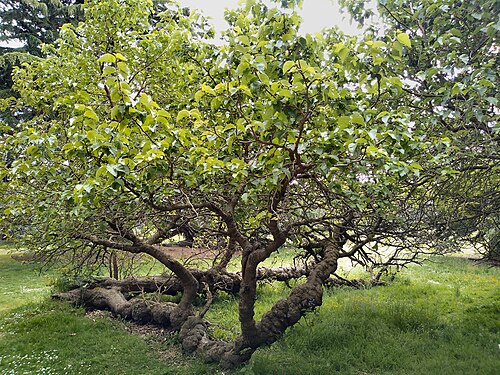
Black Mulberry (Morus nigra) · 150-220 years · Gunnersbury
This mulberry fell over and kept growing. At some date nobody recorded, the twin-stemmed tree below the terrace of Gunnersbury's Large Mansion keeled over. It now lies in a V shape, sending branches straight up to build a new, squat crown. Before it went down it stood about 11 metres tall, according to Morus Londinium, the London mulberry survey, which records a largest girth of 184 centimetres and classes the tree as Notable and recumbent.
Peter Coles of Morus Londinium found it on a visit in April 2024, tucked away near the foot of the steps that climb through an arch to the terrace, and reported it thriving. Its neighbour dwarfs it: a cedar of Lebanon over 200 years old. A young upright mulberry a few metres away seems to have died, so do not mistake that one for it.
The age is a single source's judgement: probably 19th century. The same writer suggests the Rothschilds planted it, which is an inference rather than a record; the family bought Gunnersbury in 1835. Somewhere between 150 and 220 years is as close as anyone can say.
The pin is the survey's grid reference, which lands near the steps rather than on the trunk, so let the cedar and the fallen V guide you. Black mulberries fruit in high summer, dark berries that stain whatever lies beneath. The park is free and open daily from 7am until dusk, about ten minutes on foot from Acton Town station.
Photo: AndyScott (CC BY-SA 4.0)
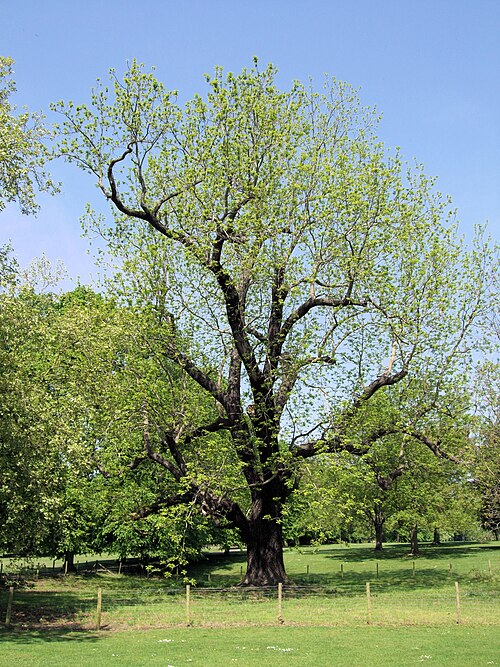
Black Walnut (Juglans nigra) · 300 years · Twickenham
In 1907 the standard survey of British trees ranked this walnut first of its kind in the country. Elwes and Henry, in The Trees of Great Britain and Ireland, recorded it in 1905 at 98 feet tall with a trunk 14 feet 3 inches round. Owen Johnson of the Tree Register measured it again in 2001: 27 metres tall and 184 centimetres across the trunk, which works out at roughly 5.8 metres round. A century had taken a few metres off the top and added well over a metre to the waist.
The Tree Register's verdict, as quoted in John Grimshaw's garden diary, is that no other black walnut in England matches it for both height and girth with a full canopy. It was among the original 41 Great Trees of London.
Its age rests on a story. Tradition, repeated by Grimshaw, says Henrietta Howard planted it in the 1720s, and a London parks survey thinks it probably belongs to the park's original landscaping. Neither is a planting record, so roughly 300 years, somewhere between 250 and 320, is as close as anyone can honestly put it.
The pin comes from the Great Trees coordinate and is approximate. The park's own description puts the tree near the entrance from the Thames towpath, so start there. Marble Hill Park is free and open daily from dawn to dusk; the house is ticketed separately. St Margarets and Twickenham stations are each about 15 to 20 minutes on foot.
Photo: Jim Linwood (CC BY 2.0)

Cork Oak (Quercus suber) · 170 years · Osterley
A Mediterranean oak has stood beside a lake in west London since, by the account everyone repeats, 1855. Cork oaks belong to Portugal and Spain, where their thick, spongy bark is stripped for bottle stoppers. This one has kept its bark, and its leaves too: the species is evergreen, and the London Trees blog photographed it in full leaf in winter.
The Grafting Gardeners guide to London's greatest trees calls it one of the oldest and largest cork oaks in the country, and it was chosen as one of the Great Trees of London.
The date needs a caveat. The blog, the guide and the Great Trees list all give 1855, but they may be repeating one another rather than three separate records, so it is a date the tree is said to carry. If it holds, the oak is about 170 years old. Nobody has published its height or girth; if you have measured it, tell us.
It stands on the north side of the lake, directly south of Osterley House. The pin is approximate, so walk down to the lakeshore below the mansion and look for the ridged, corky bark that gives the species its name. The parkland belongs to the National Trust and is free on foot daily. Art Fund gives about 9am to 5pm, but listings disagree, so check the National Trust first. Osterley station on the Piccadilly line is roughly 10 to 15 minutes' walk from the park gate.
Photo: I M Chengappa (CC BY-SA 2.0)

Lucombe Oak (Quercus x hispanica 'Lucombeana') · 250 years · Roehampton
This oak belongs to a variety that is barely older than it is. William Lucombe, a nurseryman in Exeter, raised the cross of a cork oak and a Turkey oak around 1763, and the hybrid still carries his name. The Grafting Gardeners guide to London's greatest trees puts this one at about 250 years old, which would make it one of the early generation.
The guide also says it was probably planted by Capability Brown, who landscaped the area around 1773. That is the guide's guess, and no record we have found backs it, so read it as a possibility rather than a pedigree.
Whoever put it in, it now stands on the green between the housing blocks of the Alton Estate, at the junction of Danebury Avenue and Tangley Grove in Roehampton, and it was chosen as one of the Great Trees of London.
Two caveats. Our sources are one chain, the Great Trees list and a guide drawing on it, so the age is a single estimate, somewhere between 200 and 260 years, and nobody has published a girth or height. And the pin comes from the Great Trees list rather than from the trunk, so it is approximate; one unconfirmed account puts the tree just south of Finchdean House. No source describes a gate, but none confirms open access either. If you have stood under it, tell us.
Photo: Hopefully Acceptable Username (CC BY-SA 4.0)