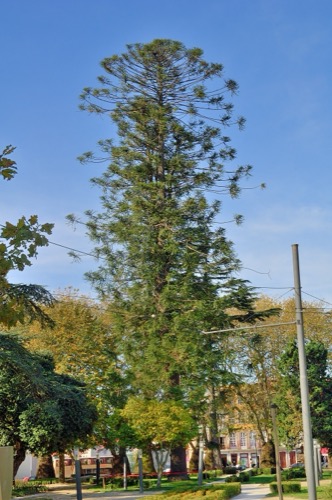
Thirty-seven plane trees line one avenue in the Jardim da Cordoaria, and every one of them stands on what looks unmistakably like an elephant's foot. A disease swelled the trunk bases into wide, splayed pads. The trees themselves are perfectly healthy. Portugal's register protected them as a tunnel rather than as thirty-seven trees. The classification of 2005 treats the whole Alameda dos Plátanos as one thing of public interest, which is how a visitor experiences it anyway. Walked separately these are ordinary London planes, 19 metres tall, carrying the flaking camouflage bark the species is known for. Walked together they make a green corridor with the light coming through in patches, every trunk repeating the same swollen base, which is why the avenue turns up in photographs of Porto far more often than any single tree in the garden. Rope-makers worked this ground for two centuries, which is where Cordoaria comes from, until the council cleared them out in the 1860s and hired Emile David, who also laid out the gardens of the nearby Palácio de Cristal. The planes went in around 1866, and the register's own measurement in 2004 recorded 140 years, which agrees. A cyclone tore through in 1941 and reshaped the garden's canopy; the avenue survived it. Stand in the tunnel and look up at the far end. The dark dome breaking the roofline is the bunya pine, classified in the same decree on the same day.
The line is our estimate of how much there is to see, not a measurement. Typical for this species where this tree stands; exact weeks shift with the year.
Jardim da Cordoaria (Jardim de João Chagas), PortoYou can recognise them by the swollen, splayed trunk bases, like an elephant's foot, on every one of the 37 planes lining this avenue. Look up at the far end: the dark dome is the bunya pine.
Free, public municipal garden, open daily
Central Porto, adjacent to the Faculty of Law; roughly 10 minutes on foot from São Bento station
Sources
Where the facts on this page come from.
- In the official register: ICNF, Arvoredo de Interesse Publico
- ICNF, Arvoredo de Interesse Publico (Portugal's national register of trees of public interest) (processo KNJ3/050, classified D.R. n.º 6, II Série…
- commons.wikimedia.org
- dias-com-arvores.blogspot.com
- 100 Mil Arvores project, 'Arvores de Cedofeita: segredos bem guardados' (100milarvores.pt, June 2017): confirms 37 London planes forming one classi…