Two of the oaks here are growing at megalithic tombs, and one of them is growing inside one. The Hondsrug ridge that Emmen sits on carries the greatest concentration of hunebedden in the Netherlands, stone chambers built about five thousand years ago and covered with earth, and where the mounds were never ploughed out the trees came instead. Hunebed D43 is the only long grave in the country, 52 stones round a forty metre mound with two chambers in it. D42 has an enormous oak standing in the middle of the stones.
0 of 7 visited in Emmen
Common Lime (Tilia x europaea) · 225-275 years · Noordeind
The oldest part of Emmen is a street, and this is the tree on it.
Emmen began as an esdorp on the southeastern shoulder of the Hondsrug, the long sand ridge that runs across Drenthe. An esdorp is a village organised around a shared arable field, the es, built up over centuries with sods and manure until the soil was deep enough to farm on ground that was otherwise heath. The Noordeind was where it started, lined with the characteristic Drenthe farmhouses, most of which have gone.
The lime stayed, planted, the register suggests, around 1790.
A village lime in this part of the country was never ornamental. It was the meeting point: shade in summer, a place to stand and settle things, sometimes the spot where local justice was spoken, and always the thing you gave directions by. That is why so many of them are older than the houses. Nobody removes the tree everyone arranges to meet at.
Go in July, when it flowers. Lime blossom on a still evening is heavy and sweet and carries the length of a village street, and it is one of the few sensory experiences here that has not changed since 1790.
Pedunculate Oak (Quercus robur) · 135-145 years · Emmerdennen
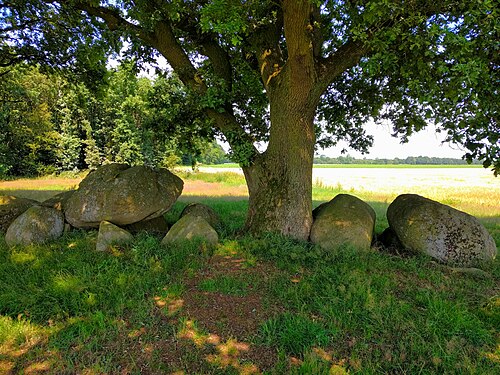
The oak is standing in the middle of the tomb.
Hunebed D42 is one of the larger megalithic chambers in Drenthe and one of the less visited, which is part of why this happened. Five thousand years ago people here dragged glacial boulders into a chamber and covered it with earth. Somewhere around 1880 an acorn got into the middle of it and nobody took the seedling out.
The register describes the result plainly: an enormous oak in the middle of the hunebed, which it calls a striking sight, and says the whole picture makes it worth a visit. That is unusually enthusiastic for an official survey and it is right.
What you get is two kinds of permanence in one frame. The stones have been there since before writing, before the wheel reached this part of Europe, before bronze. The oak has been there for a century and a half and is, in tree terms, not old. Standing between them rearranges your sense of both.
An oak's roots in a chamber tomb are not neutral, and that tension is part of what you are looking at.
It is off the Schietbaanweg, northwest of Emmen.
Photo: Rudolphous (CC BY-SA 4.0)
Pedunculate Oak (Quercus robur) · 155-165 years · Emmerhout
There is only one long grave in the Netherlands and this oak is standing next to it.
Hunebed D43 is a langgraf: instead of a single chamber under a round mound, it has a covering mound forty metres long with two separate burial chambers set into it, the whole thing ringed by a kerb of stones. Fifty two of them survive, and the ring has been restored so that it reads almost completely. Nothing else of this form exists in the country.
The oak went in some four and a half thousand years later, between 1860 and 1870.
What makes this pair better than the tomb alone is scale. A forty metre mound is hard to see as a shape; from a distance it is a rise in the ground. A big oak beside it gives you something to measure against, and the length of the thing suddenly registers.
Oaks and burial sites go together across northern Europe, and not by chance: burial mounds were left unploughed for centuries, so they became the one place in a farmed landscape where a tree could reach two hundred years.
Walk the full length of the kerb. It takes longer than you expect.
Copper Beech (Fagus sylvatica f. purpurea) · 225-275 years · Nieuw-Schoonebeek
The church is gone and only the tower is left. The presbytery has been rebuilt out of recognition. The park is still there, and so is this beech.
A fine park was laid out at the old presbytery of the Catholic church of St Bonifatius in Nieuw-Schoonebeek at the beginning of the twentieth century. The beech, banded 1750 to 1800, is far older than that and was standing long before anyone laid out anything, which is the same pattern as almost every other church tree in this country: the ground was already planted and the institution arrived to join it.
If the band is right, this is as old as the lime at the Noordeind and one of the oldest trees in the municipality.
A copper beech at two and a half centuries in a Drenthe village is also slightly improbable. The purple form was a scarce nursery product in the eighteenth century, largely confined to estates and botanic collections, so somebody with money and connections put it here.
October, when it burns through to copper against a medieval tower stump.
London Plane (Platanus x acerifolia) · 155-165 years · Nieuw-Schoonebeek
A London plane in a Drenthe village is a stranger, and that is the interesting part.
The species is the definitive city tree of northern Europe, planted by the hundred thousand along boulevards from London to Vienna because it survives paving, pollution, root damage and hard pruning better than anything of its size. What it is not is a village tree. Out here, in a small park behind a parish centre on the German border, there is nothing for it to tolerate.
So it has simply grown, in good soil, unpruned, with room. That produces a shape most people never see on a plane: broad rather than columnar, low branching, and far wider than a street specimen of the same age.
It is banded 1860 to 1870, and it stands with the copper beech in the park laid out at the old presbytery, of whose church only the tower survives.
The bark is the giveaway from any distance, flaking away in irregular plates to leave a mottle of cream, olive and grey. On an unpolluted country tree the pale patches stay paler, so it is a brighter thing here than in any city.
Pedunculate Oak (Quercus robur) · 145-155 years · Erica
This village was made by digging peat, and the oak is about as old as the village.
Erica began around 1863 as a buckwheat colony on the higher sandy ground, the kind of marginal settlement people started where nothing better was available. It became a proper peat colony when the Hoogeveense Vaart, the canal, was completed in the same period, and the centre of the place shifted to sit on the water. The address of this tree still says it: Verlengde Vaart Zuidzijde, the south side of the extended canal.
Peat colonies were built to strip the ground. Men cut the bog, dried it, and sent it out by barge, and when the peat was gone what was left was thin sand and a grid of canals. Almost nothing planted in that first generation survived, because there was no reason to keep it.
This oak was planted between 1870 and 1880 in a front garden, which is exactly why it did. A tree in somebody's own garden had a defender.
It is a private front garden on a canal bank. Look from the road.
Sycamore 'Leopoldii' (Acer pseudoplatanus 'Leopoldii') · 135-145 years · Coevorden town centre, Kasteel Coevorden grounds
From across the grounds this maple looks as though somebody is shining a light on it.
That is the cultivar. 'Leopoldii' is a sycamore whose leaves come out flecked and streaked with cream, yellow and pink instead of plain green, so a whole tree of it reads as permanently dappled. Nurseries pushed variegated forms hard in the nineteenth century, when one of them on a good lawn was a statement rather than a plant.
This one went into the ground between 1880 and 1890, on the most conspicuous spot at Kasteel Coevorden, and it still frames the view of the building.
Everything around it has changed hands more often than the tree has. The municipality bought the castle in 1938, restoration began in 1968, and since 2014 it has been privately run as a hotel. The register notes that the maple's growing conditions actually improved after that last handover, which is not the usual direction of travel. Its crown carries cables as a precaution and the last inspection found no defects in it.
The castle is a hotel now. The maple stands out in front of it in full view, and the register still lists the municipality as its owner, which is a fair description of how a lot of Dutch castle grounds work.