Two fires shaped this list. The fire of 1842 and the firestorm of July 1943 took whole districts, and the old trees that survive stand away from both, in the estate parks strung along the Elbe. The pick of them is an oak 8.30 metres round with a hollow you can look up through, and a second oak 500 metres away carrying a full-grown birch inside its open trunk. Closer in, a pagoda tree on the Alster promenade holds a world record for its species, and a plane in Planten un Blomen was planted on a recorded day in 1821.
0 of 6 visited in Hamburg
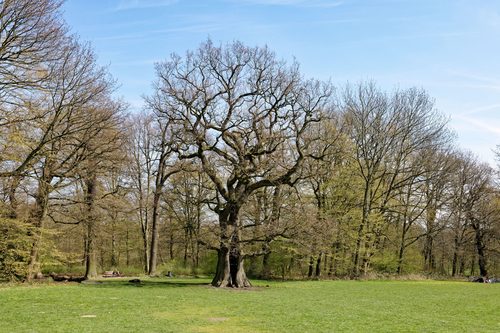
Pedunculate Oak (Quercus robur) · 400-450 years · Othmarschen
Hamburg's thickest oak has a hole in it big enough to stand in. The opening runs up one side of the trunk from just above the ground to more than four metres, and the tree simply carries on around it: 8.30 metres of girth when it was last taped in April 2020, agreed to the centimetre by two separate German tree registers, and wider than any other pedunculate oak in the city.
Nobody recorded the planting. German arboriculture dates a tree like this from its trunk instead, which puts it at about 1600 with fifty years of tolerance either way, so somewhere between 375 and 475 years old. Either end of that band leaves it standing here long before the ground around it became a park. Jenischpark was laid out as an English landscape garden above the Elbe in the early 1800s, and the oak was already a large tree when that work began.
It has had help staying upright. In 1972 the tree surgeon Michael Maurer restored the trunk and braced the opening with iron rods, which are still in place and visible from several metres away. The park is free, open and ungated, and the oak stands about 100 metres east of the Jenischhaus, the villa that gives the place its name.
Photo: Rainer Lippert
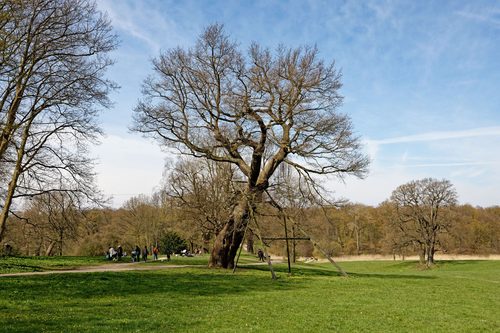
Pedunculate Oak (Quercus robur) · 300-350 years · Othmarschen
A birch is growing inside this oak, and has been for decades. The oak's trunk is open along one side, a birch of roughly a hundred years took root in the gap, and neither has given way since; the two crowns have grown together overhead, so from underneath it reads as one canopy with two kinds of leaf in it.
The oak is the older half by two centuries, put at roughly 300 to 350 years by both sources that record it, and 6.74 metres round when it was measured in 2017. It leans badly enough to need a metal frame holding it up. That the two independent registers agree on the age and on the arrangement is worth noting, because a tree whose main feature is a curiosity rather than a measurement usually collects contradictions instead.
It stands in the southeast corner of Jenischpark, close to the Elbchaussee and about 500 metres from the hollow oak that is the thickest in the city. The park was laid out above the Elbe in the early 1800s as an English landscape garden, all sweeping lawns and arranged views. This is the arrangement nobody planned. Free, open, no gate, and the walk between the two oaks takes about ten minutes.
Photo: Rainer Lippert
Copper Beech (Fagus sylvatica f. purpurea) · 135-175 years · Rotherbaum
Ask how thick this beech is and you get three answers, all of them correct. Taped at waist height in November 2018 it came to 7.21 metres, a figure the citywide tree list and the independent register at baumkunde.de match to the centimetre. Measured again on 31 July 2025 it gave 7.32 metres across the buttresses at the base and 6.92 metres a metre higher up. The trunk is swollen, buttressed and covered in the raised tissue an old tree grows over its own wounds, so where you put the tape decides the number.
Nobody recorded when it was planted. The estimate from its girth is 1870 with twenty years either way, so roughly 135 to 175 years, which is a band rather than a date and is stated here as one.
It stands on the open lawn between the Alsterufer and Klein Fontenay, on the promenade along the Aussenalster, with grass and a footpath between it and the water. What the 2025 re-measurement really records is that somebody is still checking on it: this beech is monitored, healthy, and free to walk up to at any hour.
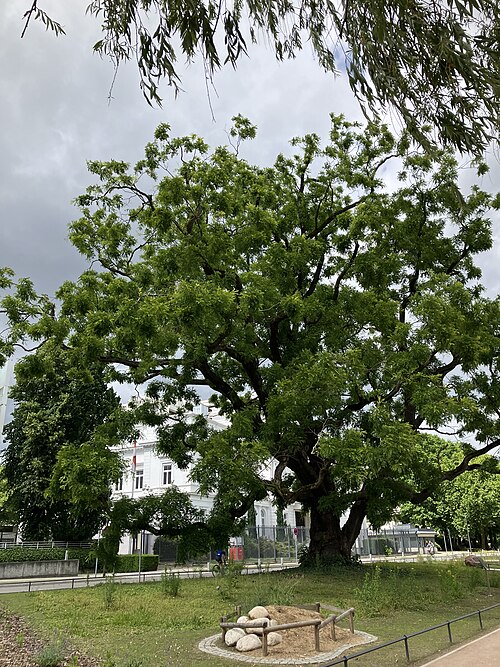
Japanese Pagoda Tree (Styphnolobium japonicum) · 150 years · Rotherbaum
There is no stronger Japanese pagoda tree known anywhere in the world than this one, according to the city that owns the ground it stands on. Hamburg's environment authority said so on 16 April 2026, naming it a Nationalerbe-Baum, a German national heritage tree, of which there are only about a hundred in the country. It is Hamburg's second, after the sycamore maple in Hirschpark.
The measurements track that claim. The registers recorded 5.50 metres of girth in 2016; the 2026 announcement puts the trunk at over six metres, which is a generous decade. Age is given as around 150 years, matching the citywide list's estimate of a planting around 1880. The authority's own wording describes exceptional vitality, and the work that came with the honour was practical rather than ceremonial: ivy stripped off the trunk, the crown cabled. It had been protected as a Naturdenkmal long before any of that.
Styphnolobium japonicum is Chinese despite both of its names, and it does its one loud thing in late summer, hanging cream flowers over the Alster in August and September when almost nothing else is in flower. The tree stands free of anything else on the promenade, on open public ground.
Photo: Tobibauer (CC BY-SA 4.0)
Sycamore (Acer pseudoplatanus) · 200-270 years · Nienstedten
This maple was the sixth tree in Germany to be made a national heritage tree, and the first in Hamburg. The Deutsche Dendrologische Gesellschaft gave it that status on 23 October 2020, six years before the pagoda tree on the Alsterufer became the city's second.
What earns it is the shape. The crown domes down almost to the ground on every side, roughly 35 metres across, so the tree finishes as a wall of leaf rather than tapering into open trunk the way a park specimen usually does. It is 22 metres tall with 5.50 metres of girth measured at the waist in 2020, which is large for a sycamore maple and still the slimmest trunk on this page. The shape is what people come for.
It stands in Hirschpark, a free public landscape park on the Elbe at Nienstedten, south of the Lindenallee. Jenischpark and its two old oaks are about 3 km east along the Elbchaussee, which makes a long riverside walk rather than a single afternoon's stroll. No planting record survives; the estimate from the trunk gives roughly 200 to 270 years.
London Plane (Platanus x acerifolia) · 205 years · St. Pauli / Wallanlagen
Most old trees are dated by argument. This one has a date: 6 November 1821, when Professor Johann Georg Christian Lehmann put it in the ground as the first tree of Hamburg's new botanical garden, which he had founded and would direct. That makes it about 205 years old, and it is one of the few trees in this city whose age needs no tolerance attached to it.
The garden it was planted to open has since moved on and the ground around it has become Planten un Blomen, a public park in the old ramparts on the edge of the centre. The plane stayed put and kept growing: 29 metres tall and 6.15 metres round when it was measured on 1 November 2020, with a trunk that leans slightly out of true and throws its first branch off low and steeply, at about three metres.
Hamburgers call it the Lehmann-Platane. The botanical garden's own history describes it as its living founding document, which is unusually good phrasing for an institution writing about itself, and accurate: the garden was founded around this planting, and the planting is still standing, free to walk up to.