Four of Trento's registered trees stand within 900 metres of the station, which means you can be under the oldest of them two minutes after stepping off a train. That one is a plane planted in 1835, recognised as the city's oldest only in 2024. Others spread further out, among them an elm that survived the disease which killed most of Europe's mature elms, a cedar planted the year Italy was founded, a sweet chestnut up at Sardagna reached by cable car, and a beech standing alone in a mountain pasture on Monte Bondone.
0 of 10 visited in Trento
London Plane (Platanus x acerifolia) · 190 years · Santa Croce, city centre
Trento's oldest tree went into the ground in 1835, and the city only made it official in 2024. That year the comune finalised a list of eighteen monumental trees and entered thirteen of them on the national register, and the local press led on this one. ANSA, il Dolomiti and the Trentino all reported the same planting date and the same framing: a plane that has watched nearly two centuries of Trentine history from a small garden off Via Santa Croce. The history it watched was not gentle. In 1835 Trento was an Austrian city and had been since the prince-bishops lost their power in the Napoleonic settlement. The tree was mature when the railway came up the valley in the 1850s, standing when Cesare Battisti was hanged in the castle in 1916, and about eighty years old when Italy took the city in 1918. It has spent more of its life under Vienna than under Rome. It stands in the Giardino Martino Martini, a small public garden named for the Trento-born Jesuit who mapped China for European readers in the 1650s. Free, open, and about ten minutes on foot from the station. As monumental trees go this is an easy one. No cable car, no opening hours, no gate, and the rest of the centre cluster is within a few hundred metres.
Black Poplar (Populus nigra) · city centre, near the station
A black poplar with a trunk of 570 centimetres is a rarer thing than it sounds. Populus nigra is one of Europe's most threatened native trees, not because anyone cuts them down but because nearly every poplar planted along a European road or river for two centuries has been a hybrid with an American species, and the native form has been bred out of its own landscape. It is also fast, soft and short-lived by the standards of this map. Most do not last long enough to be measured at nearly six metres round. This one made Trento's list of eighteen monumental trees in 2024, named in the national coverage as the black poplar of Largo Pigarelli. What that coverage does not give is an age, and neither does anything else we found. The register's girth is the only measurement on record, with no second reading to check it against, so the number stands uncorroborated and the tree is flagged for it. The garden is small and municipal, listed in the comune's own directory of parks, a few minutes on foot from the station in a stretch of the centre where several monumental trees stand within a short walk of one another. Free, no gate, no hours. Poplars move in wind more than any tree of their size, which is the thing to stand under it for.
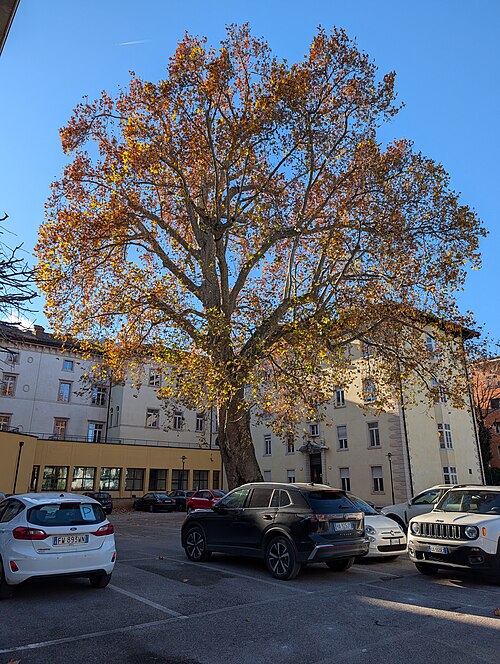
London Plane (Platanus x acerifolia) · Piazza Dante / city centre, next to the station
This plane belongs to a garden it no longer stands in. The comune's page for the Giardino di Piazza Dante describes monumental planes and walnuts surviving from the garden's original nineteenth century planting, and this tree stands at the edge of that garden with a street address on Via Vannetti, a few steps outside the railings. The comune does not name it individually, so the link is inference rather than record, and we have flagged it on that basis. What is on record is the national monumental register entry that put it on this list. No age has been published for it. The garden it came from was laid out in 1879 on ground that only existed because of the railway. The Adige used to run where Piazza Dante is now. The river was diverted in the late 1850s to clear space for the line, and the city planted its first public garden on the reclaimed strip. The trees left from that first planting are products of the railway as much as of any gardener. Practically, this is the easiest tree in Trento to reach. Five minutes from the platforms, on an open public street, at any hour, with no gate and nothing to pay, and the Piazza Dante elm is thirty seconds further on.
Photo: Ivanbranco (CC BY-SA 4.0)
Wych Elm (Ulmus glabra) · 100 years · Piazza Dante / city centre, next to the station
Step off a train at Trento and the walk to a centuries-old elm takes under two minutes. The Giardino di Piazza Dante faces the station, and the comune's own description of it puts an elm and a group of yews along the north side, all of them called secolari, of the centuries. The elm is on the national monumental register. Nobody has published a precise age, so a hundred years is the floor rather than the estimate. The garden was designed in 1879 by the engineer Annibale Apollonio and was the first public garden Trento had. It has been restored in stages since 2007, and the Art Nouveau pavilion inside it now holds a children's library, which means that on a weekday afternoon the oldest tree in the square has small children reading underneath it. That is a better use of a monument than most of them get. Stand between the elm and the yews for a minute, because the pairing is instructive. The elm is a fast hardwood that can put on a metre of shoot in a good year and hollows from the inside once it stops. The yews beside it grow so slowly that they outlive almost everything planted with them. Ten metres apart, two entirely different bets on how to last. Free, open, no gate and no hours.
Field Elm (Ulmus minor) · 150-300 years · San Giuseppe-Santa Chiara
Europe lost most of its mature elms inside a single lifetime, and this one is still standing. Dutch elm disease is a fungus carried by bark beetles that blocks a tree's water vessels from the inside. It swept the continent from the 1930s and killed elms by the tens of millions, which is why an elm of any size is now worth going to see. The Italian tree register notes exactly that about this one, that it came through while others nearby did not. Its trunk measures 393 centimetres around, past the threshold that gets a tree onto the national monumental register on girth alone. No age has been recorded for it, and no height either. The register's description is honest about the setting: the tree sits in a corner of the garden and takes some finding, then stops being easy to overlook once you are in front of it. The Giardino di Maso Ginocchio is an ordinary municipal park, about 3.6 hectares in the San Giuseppe and Santa Chiara district south of the centre, with a playground, a small animal enclosure and entrances on Via Veneto, Via Giusti and Via Monte Baldo. Local reporting in 2016 grumbled about its upkeep. It is free and it is open, and the elm is the reason to walk the fifteen minutes out.
Himalayan Cedar (Cedrus deodara) · 165 years · Gocciadoro
This cedar was planted around the year Italy was founded, in a city that would not join it for another fifty seven years. Local reporting in 2024 dates it to roughly 1861, the year of Unification, and ranks it the second oldest of Trento's eighteen monumental trees after the 1835 plane in Via Santa Croce. Trento was Austrian in 1861 and stayed Austrian until 1918. A Himalayan cedar going into the ground here was a Habsburg garden fashion, not an Italian one. That reporting stops short of a girth, so there is nothing to check the register's 525 centimetres against, and it names the cedar only by park rather than by position. The flag on this entry is for the missing measurement. The park is also not a one-tree park: the same article credits Gocciadoro with a tulip tree of thirty five metres, the tallest of the city's monumental trees. Cedrus deodara is the easiest cedar to name once you know it. The needles are longer than any other cedar's, the tips of the branches droop instead of reaching, and a mature tree carries a slightly mournful posture that the Lebanese and Atlas cedars do not. The park is public and free, roughly twenty five minutes on foot east of the centre or a short bus ride.
Sweet Chestnut (Castanea sativa) · 200-400 years · Sardagna (across the Adige, reached by cable car)
Somewhere in this chestnut grove above Trento stands a tree that stopped a runaway bus in January 1949. Local accounts name it, along with the Castegnar della Lasta and one or two others, and none of them says whether either is the tree the national register mapped here. This entry is the register's, and its pin is approximate: we know the locality, called Castagnara, and not the trunk. Come expecting a grove rather than an appointment. The grove earns the trip on its own terms. Sardagna sits on the mountainside across the Adige from the city, and the way up is a cable car that climbs from 200 to 600 metres in about four minutes. In 2025 the chestnuts here won a De.Co. mark, the municipal designation Italian towns give a food that belongs to one specific place, and the district and the forestry service waymarked the Sentiero dei Castagni through the trees the same year. The village held a festival when the mark came through. Go in October. Sweet chestnut is one of the few trees on this map whose best moment is edible: the spiny burs split open on the ground and the nuts are there to gather. Free, public, and on this one the walk is at least half the point.
Mediterranean Hackberry (Celtis australis) · Cortesano
Most hackberries with a trunk this thick are twice as tall. This one measures 410 centimetres around and stops at ten metres, an odd shape for Celtis australis, a species that normally runs to twenty-odd metres of straight grey trunk under a high rounded dome. Cortesano sits 570 metres up, nearly four hundred metres above the centre of Trento, and what grows well on that hillside is not what grows well down in the Adige valley.
It stands on the Salita ai Spiazzi, the lane climbing through the hamlet, near the church of Sant'Antonio. It is one of the eighteen trees Trento formally recognised as monumental in 2024, when the comune finished its list and entered thirteen of them on the national register, and it is the only one of the eighteen this far out of town.
Nobody has published an age for it. Italy's register carries girth, height and altitude and no age column at all, and the press coverage that named this tree named a place rather than a date, so the field is left blank instead of guessed at. Only one report puts it precisely, at the church, which is why the entry is flagged.
Getting there is a bus rather than a walk: line 3 out of the centre, about twenty-five minutes up the hillside, then a short climb. What you get for it is a hamlet, a church, and a tree built like a barrel.
European Beech (Fagus sylvatica) · 175-350 years · Monte Bondone (above Sopramonte and Candriai)
Four and a half metres of trunk, and nothing else growing within reach of its branches. Fagus sylvatica is Europe's great crowding tree: in a wood it goes up straight and clean and throws a shade so heavy that almost nothing lives beneath it. This one was left standing on its own in an alpine pasture at around 940 metres on Monte Bondone, and it grew the other way, low and broad, until Italy's national register recorded its girth at 465 centimetres on sheet 08/L378/TN/22.
The meadow belongs to Malga Brigolina, a working mountain dairy at 990 metres that feeds walkers from early June to late September. The beech stands out in the grass below it with nothing around it, which is why it reads as architecture rather than as forestry.
Nobody has published an age. Italy's register carries girth, height and altitude and has no age column at all, and local accounts get no further than secolare, centuries old, so the field here is left empty rather than guessed at. If you know the number, or know who measured it, tell us.
The bus up the Monte Bondone road stops at Candriai, and a waymarked path called the Giro della Selva leaves the village near the football pitch and reaches the malga in about fifteen minutes, level and shaded most of the way. The pin is the register's, so expect the meadow rather than an exact spot.
Wild Cherry (Prunus avium) · 125-250 years · Passo del Cimirlo, above Povo
One of Trento's 18 monumental trees stands well outside the city, at a mountain pass most residents know for hiking and old war ruins rather than for a tree. The Comune di Trento's own open register puts this wild cherry at 3.59 metres round and 26.5 metres tall, at 790 metres above sea level on public forest land managed by the province's forestry agency.
Passo del Cimirlo sits between Monte Celva and the Marzola massif, linking Povo to the villages of Oltrecastello and Roncogno on an unpaved road that has carried foot and cart traffic for longer than anyone living remembers. During the First World War the Austro-Hungarian army dug trenches and built gun batteries across this ground as part of the ring of forts defending Trento; the nearby Forte Roncogno and the Batteria Cimirlo are still standing.
A wild cherry this size is unusual on its own terms. Prunus avium is a fast grower and rarely a long liver by forest-tree standards, which makes a trunk over three and a half metres round a genuine rarity rather than simply an old specimen of a long-lived species. Trento added it to its monumental tree list in 2021 alongside 17 others, from a Himalayan cedar in a city park to a beech on a Monte Bondone pasture; this is the one that asks for the longest walk to see.