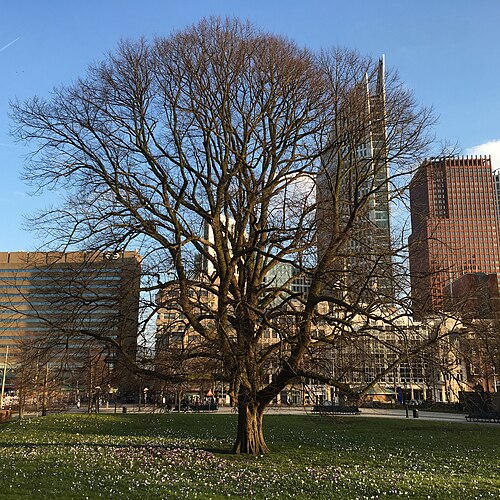
Huijgenspark carried an uglier name for most of its early life, Bogt van Guinea, until a murder in the neighbourhood in 1873 gave the city reason to rename it after Constantijn Huygens, the Hague-born diplomat, poet and composer whose son would go on to discover Saturn's rings. Before the park existed at all, this stretch was the busy road out toward Delft, lined with inns and wagon-hire businesses for travellers leaving the walled city, one of the few built-up areas outside The Hague's old canal ring. These London planes went into the newly laid-out park around the 1870s, not long after it was first established in 1860 on the ground between Huijgensstraat and the old Bogt. The park was renovated in 2002, its planting refreshed and its paths repaved, but the planes from the original layout survived that work intact. They stand in the open today, free, in a park whose own name change still quietly marks a crime nobody living remembers the details of.
The line is our estimate of how much there is to see, not a measurement. Typical for this species where this tree stands; exact weeks shift with the year.
Huijgenspark, opposite the TGM hof, Huijgenstraat, Den HaagYou can recognise it as the planes from the park's original 1870s layout, kept through a later renovation. It stands in Huijgenspark, opposite the Huijgenstraat.
Free, public park, open at any time
Stationsbuurt, Den Haag; about a 10 minute walk from Den Haag Centraal station
Sources
Where the facts on this page come from.
- In the official register: Landelijk Register Monumentale Bomen v2024
- Landelijk Register Monumentale Bomen v2024 (LRMB), Bomenstichting (nr 1684631)
- nl.wikipedia.org