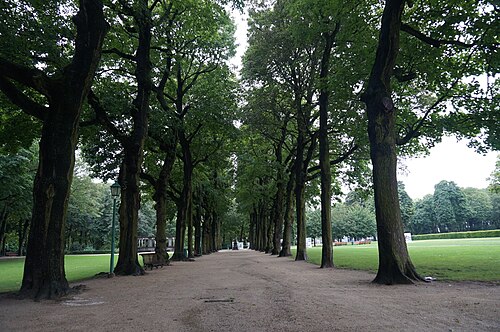
When Brussels built Parc du Cinquantenaire in 1880 to mark Belgium's fiftieth year as a country, it cheated on the trees.
Photo: Sam.Donvil (CC BY-SA 4.0)
Aesculus hippocastanum
Every conker in Europe descends from a handful of mountain ravines in northern Greece, Albania and North Macedonia, the only places the horse chestnut still grows wild and where it is now classed as vulnerable. We map 70 of them, in 44 cities.
Everywhere else it is a planted tree, and cities planted it hard. Vienna lined its grandest avenue with chestnuts from 1840. Munich's brewers put them over their beer cellars, because the species throws heavy shade from shallow roots that will not force their way into a vault, and the beer garden followed from there. Geneva went further than anyone: since 1818 an official has walked to a designated chestnut each spring, recorded the date its first leaf opens and reported it to the press, which makes one of the longest continuous records of its kind anywhere. None of the old ones here is anywhere near the wild population.
When Brussels built Parc du Cinquantenaire in 1880 to mark Belgium's fiftieth year as a country, it cheated on the trees.
Photo: Sam.Donvil (CC BY-SA 4.0)
The horse chestnut is one of the most planted trees in Europe and one of the rarest in the wild.
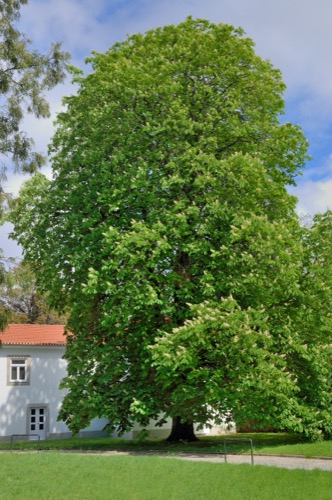
Every conker in Europe descends from a handful of mountain ravines in Greece and Albania, the only places the horse chestnut still grows wild, and where the species is now classed as vulnerable.
Photo: Paulo V. Araujo, Dias com Arvores
Munich's beer gardens are chestnut groves for an engineering reason.
Gasteig comes from gacher Steig, steep path, and that is the whole explanation of this corner of Munich.
The word Munich's ordinance uses for this tree is Solitär, which in the trade means a tree with open ground on every side and therefore the shape the species actually has.
Munich's beer gardens are shaded by this species for an engineering reason.
If you find this chestnut brown and blotched in August, autumn has nothing to do with it.
The horse chestnut in Placa de Carles Buigas went into the ground around 1937, in the middle of the Spanish Civil War, in a city then still held by the Republic.
Barcelona's register of trees of local interest runs past two hundred entries and contains exactly one horse chestnut.
The best-known figure for this chestnut is forty centimetres out of date.
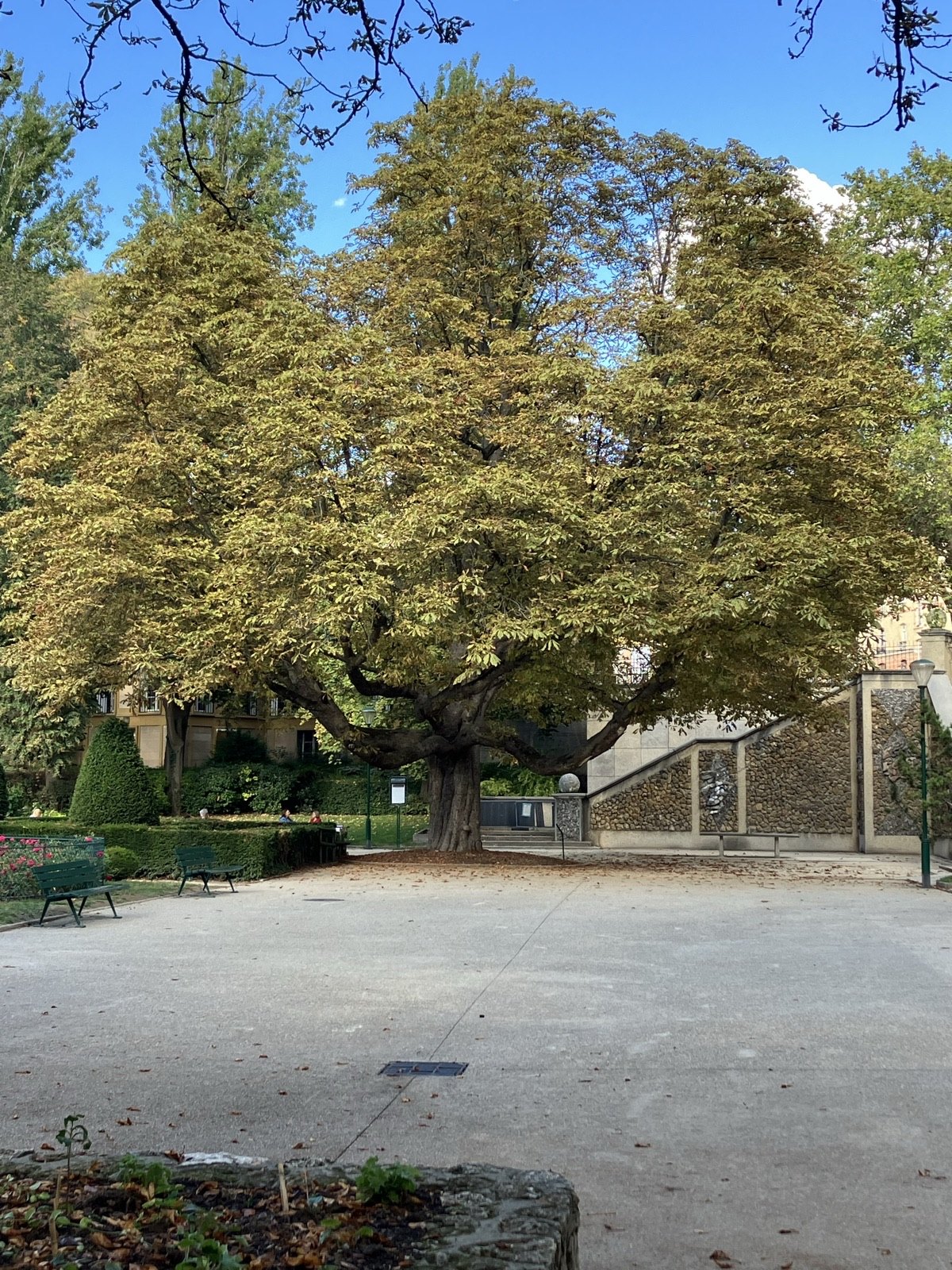
There is a river under this garden.
The tree this one was cut from no longer exists.
The trunk you are looking at carries on about two metres below your feet.
Most visitors to this park come for the wildness rather than any single tree, but the chestnut at its centre is the reason locals bother naming the place at all.
This chestnut is not old.
This tree is almost exactly as old as the idea of a public park in this country.
Left to itself, this horse chestnut would surround itself with children.
The register does not soften it: the thicker of these two chestnuts has a cavity with a fungal infection and a strong case of bleeding canker, and the condition of both is rated moderate.
This chestnut spent most of its life outside a prison and now stands outside a library.
This chestnut made the city's top ten on the strength of one branch.
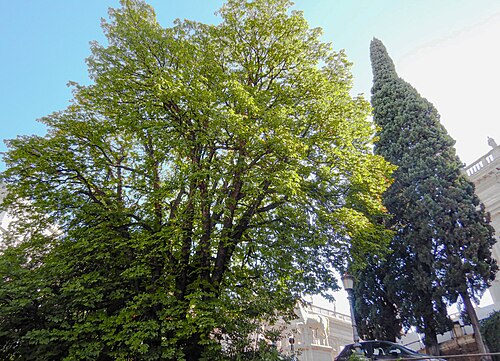
A Balkan mountain tree has no business being this large on a Roman hill.
Photo: Albarubescens (CC BY-SA 4.0)
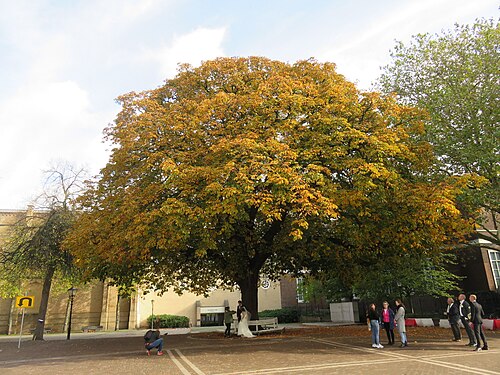
Up to a hundred stamp collectors at a time used to crowd around this horse chestnut on Wednesday and Saturday afternoons, trading and selling postage stamps under its branches for decades before th...
Photo: WeeJeeVee (CC BY-SA 4.0)
In March 1997 this horse chestnut was dragged eighty metres across the Koekamp on steel plates, with a hundred tonnes of soil still around its roots, and the operation went into the Guinness Book o...
A ruined medieval chapel stands a few steps from this chestnut and is six centuries older than anything else growing on the site.
The Vijverberg exists because of a hole in the ground.
When a Dutch horse chestnut looks scorched in August, the summer is not to blame.
The wooded hillside visitors climb to reach the Alhambra did not exist when the fortress was still in Muslim hands.
Vienna's grandest avenue is older than the trees that define it by two centuries.
This horse chestnut has grown twelve centimetres round the trunk since Vienna made it a monument, which is the best news we have about it.
It has 470 square metres of ground reserved for its roots, in a city centre, next to a football stadium.
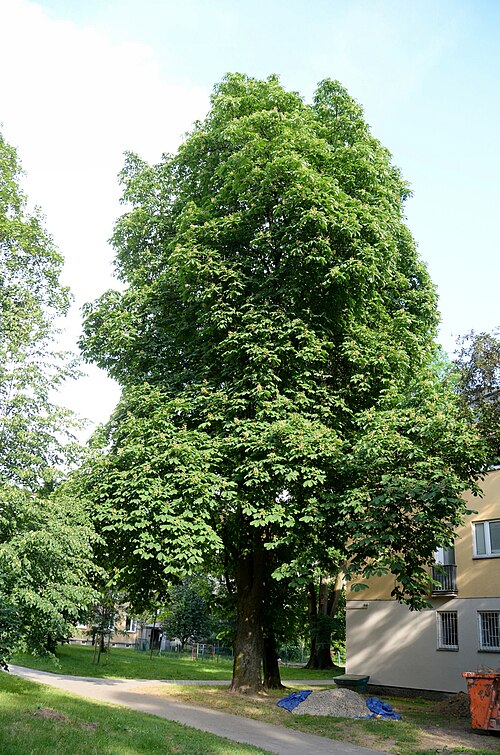
Warsaw wrote two trees in this one courtyard into its register of natural monuments on the same day in June 2020, 19 metres apart: this horse chestnut and a European ash.
This chestnut has outlasted the government that protected it.
In a park stocked with trees from five continents, the specimen the guides keep naming is a horse chestnut.
Two horse chestnuts stand thirty metres apart in this garden and the register measured both at exactly 335 centimetres of girth and exactly twenty-three metres of height.
Two registers measured this horse chestnut and they cannot both be right.
Trieste's protected trees stand in designed grounds: a Habsburg's experimental headland, the public garden a botanist mayor laid out, the wooded hill above it.
This horse chestnut belongs to a variety that normally grows as a shrub, and it is about 20 metres tall.
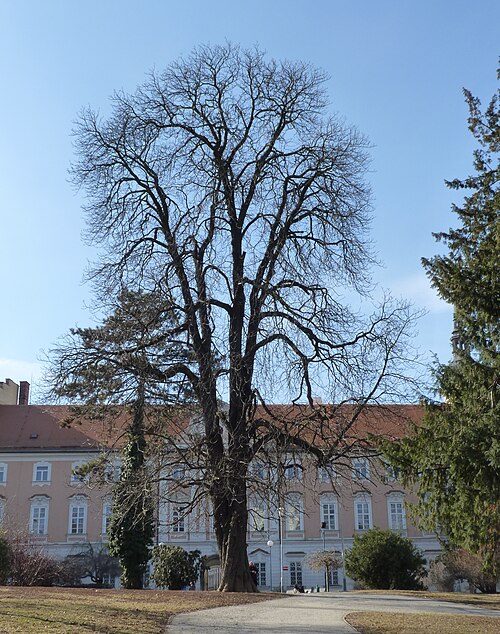
A car park nearly wrote the end of this chestnut's story.
Photo: Michal Klajban (CC BY-SA 3.0)
A parish square in Lent doubles as a chestnut's front garden.
This chestnut has a birthday on record: 4 September 1948, the day Juliana became Queen of the Netherlands after her mother Wilhelmina's abdication.
Nijmegen's own city register and the national monumental tree register agree on almost nothing about this horse chestnut except where it stands.
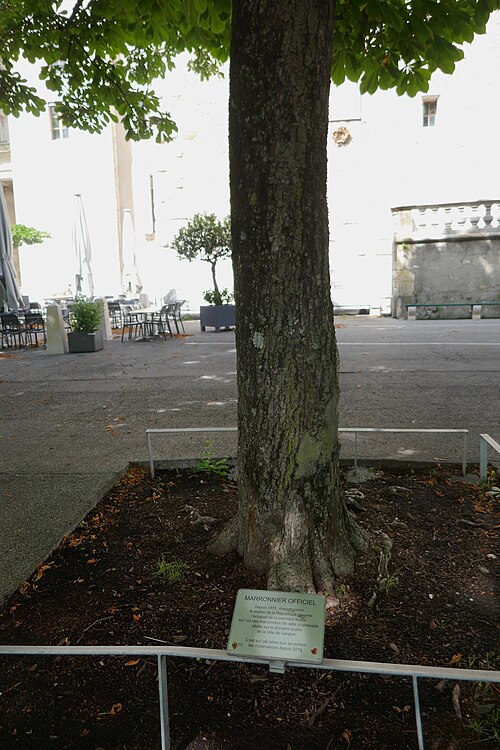
Geneva has kept an unbroken written record of a chestnut tree's first spring leaf since 1818, one of the oldest continuous phenology datasets anywhere, third-oldest in the world by the canton's own...
Photo: MHM55 (CC BY-SA 4.0)
Five horse chestnuts on Sint Agathaplein, three white-flowered and two red, have stood outside the building where William of Orange was shot dead since 1920, planted as part of a coordinated square...
Horse chestnuts are, by the park's own count, one of its three most common old species alongside plane and lime, and this one earned an individual place on Italy's monumental register on its own me...
In May this tree puts up its white flower candles directly in front of a theatre entrance, which is about as well staged as a chestnut gets.
Amersfoort's registered horse chestnut stands on the station square itself, which means more people probably walk past this tree on an ordinary Tuesday than pass any other tree on this page in a mo...
At 5.8 metres round, this is the thickest horse chestnut in the Netherlands by the national monumental tree register's own measurement.
Five horse chestnuts stand within sixty metres of each other along this stretch of the Casinotuin, and this is the thickest by a clear margin: four metres round against roughly three and a half for...
A horse chestnut in a castle park is a tree planted for children, whether or not anyone admitted it at the time.
There are two horse chestnuts in these grounds, and on paper the only thing separating them is ten years.
Nobody is certain whether this is one tree or a bouquet of them.
Torre Boldone had two comune-protected giants until 2017, when the Cedar of Lebanon in Parco dei Sordomuti was illegally felled.
Anne Frank could see one tree from the annex, and this is its child.
The church beside it is a thousand years old, and the tree cannot be, because the species had not arrived yet.
Heidelberg protects a whole small stand of horse chestnuts here as one object, not a single trunk.
At the fork of the Hilvertsweg and the Bosdrift stand two trees and two boulders, and the inscriptions on the boulders have worn down to almost nothing.
The register gives this chestnut an actual planting year, 1901, which is rarer than it sounds: most trees on this list carry a ten year band and nothing better.
This horse chestnut was planted to celebrate a king's death.
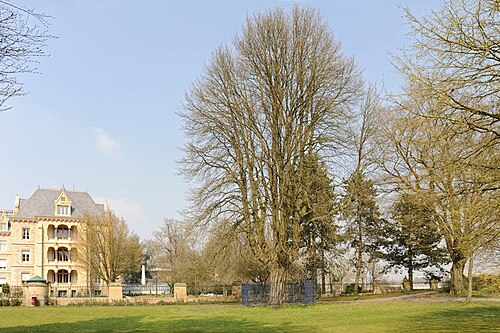
This is the one tree on this list whose age nobody has to estimate.
Photo: Cayambe (CC BY-SA 3.0)
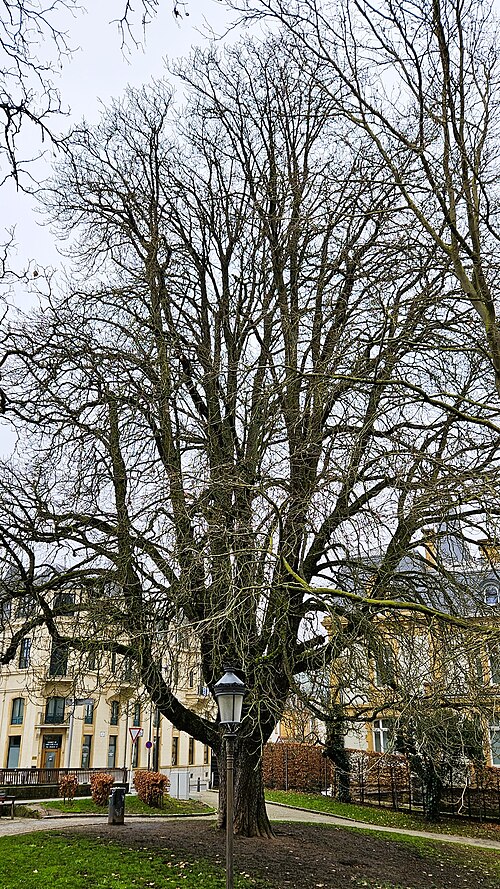
This chestnut forks at about three metres into ten strong branches and goes up from there like a candelabra, throwing a crown some fifteen metres across over a small square opposite the Grand Theatre.
Photo: GilPe (CC BY-SA 4.0)
This park was a quarantine station.
The body that planted this tree was called the Ottawa Improvement Commission, and it was handed sixty thousand dollars a year to make a lumber town look like a capital.
Twenty nine metres is tall for a horse chestnut.
One of these chestnuts is dying, and the most recent public look at them was taken four years ago.
The protection here covers one horse chestnut and a torso.
This horse chestnut stands behind the pond in Emile van Loonpark, banded by the national register to a planting around 1870, roughly 160 years old.
At least eighty nails are hammered into the dead side of this horse chestnut, and that is the whole point of it.
Spokane opened a heritage tree register in 1998, and by 2012 it held exactly three trees.
A fungus at the foot of a tree is the last thing to appear, not the first.
Explore by city: Brussels · Porto · Munich · Barcelona · Paris · Amsterdam · Lyon · Leeuwarden · Rome · The Hague · Granada · Vienna · Eindhoven · Warsaw · Bilbao · Trieste · Dresden · Brno · Nijmegen · Geneva · Delft · Parma · Dordrecht · Amersfoort · Leiden · Den Bosch · Helmond · Assen · Bergamo · Boise · Como · Heidelberg · Hilversum · Hoorn · Luxembourg City · Nuremberg · Ottawa · Portland · Regensburg · Spokane · every city · or browse all species.