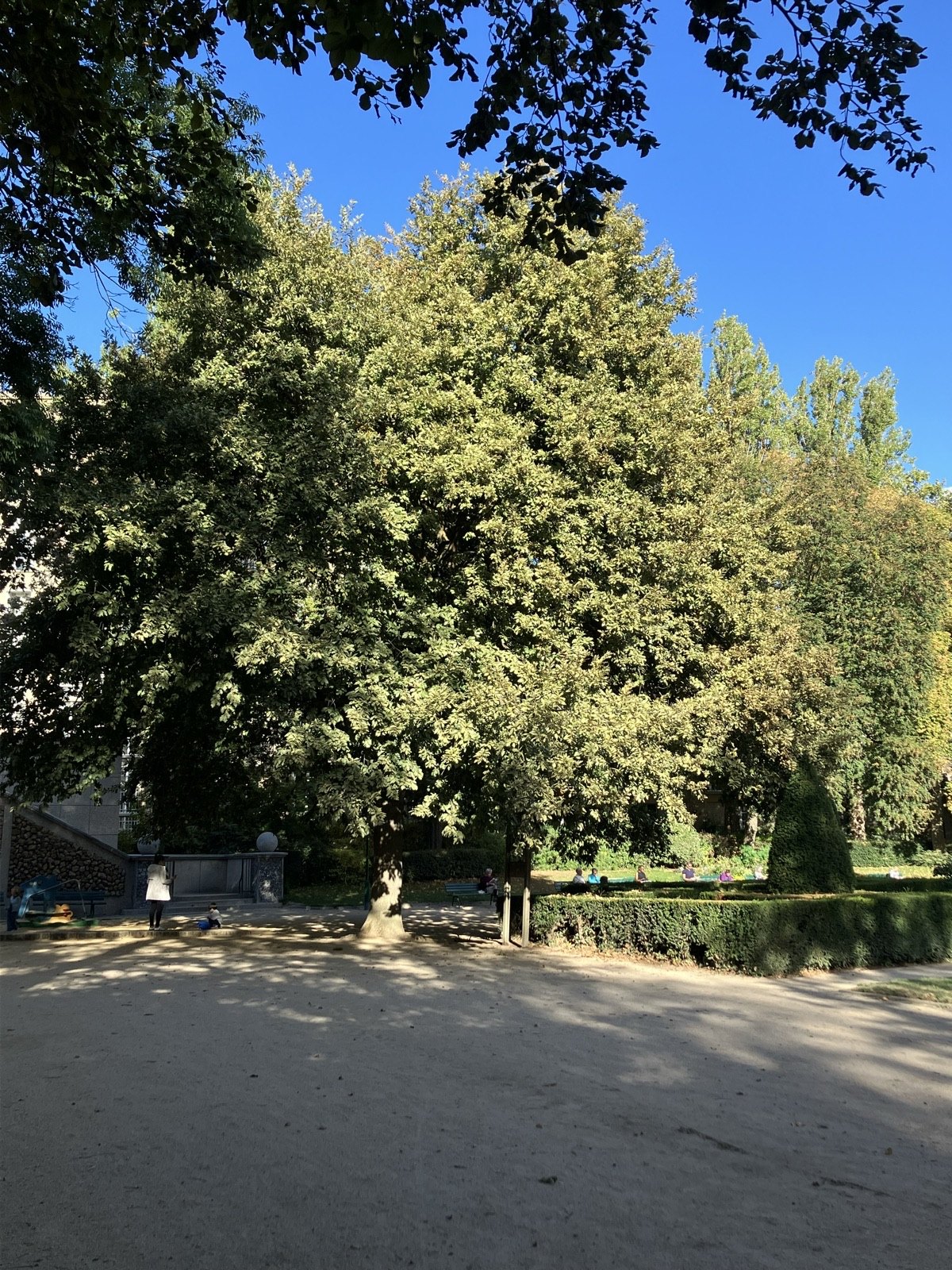
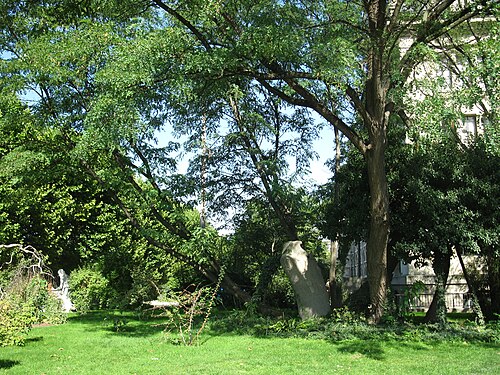
There is a river under this garden. The Bievre ran through the Gobelins quarter in the open until the city buried the last stretches of it, fouled by the tanners and dyers who had worked its banks for centuries, and Square Rene-Le Gall was laid out in the 1930s across the ground it used to flow over. This horse chestnut was planted in 1893 or 1894, while the water was still above ground. It stands near the garden's obelisk, at one of the entrances, and its measurements are a small lesson in how slowly a mature tree changes. A 2011 survey recorded 18 metres tall and 360 centimetres round. The city register now gives 17 metres and 369. Nine centimetres of belt in well over a decade, and a metre of height that is measurement noise rather than a tree shrinking. The square around it is a listed historic monument, protected since 1997, though the protection is for the 1930s design rather than for anything growing in it: rock gardens, a long sunken lawn, brick pavilions and that obelisk, laid out on a scale most Paris squares never get. The chestnut is one of the few things here older than the design. It was already a grown tree when the diggers arrived, and it is the only part of the garden nobody drew.
In bloomIn fruit
May, when it flowers
The line is our estimate of how much there is to see, not a measurement. Typical for this species where this tree stands; exact weeks shift with the year.
1 Rue Emile DeslandresNear the garden's obelisk, at one of the entrances.
Free, public municipal square (Square Rene-Le Gall, also known as Jardin des Gobelins), open standard Paris park hours and closed at night
Corvisart or Les Gobelins (Metro 6/7), 8-10 min walk
Sources
Where the facts on this page come from.
- In the official register: Arbres remarquables de Paris (Ville de Paris), no. 104841
- opendata.paris.fr
- fr.wikipedia.org