The Horse Chestnut of the Witte Singel
NetherlandsLeidenAcademiewijk
You need a ticket to see this treePaid entry to the Hortus Botanicus (Rapenburg 73): adults 14 euros at the desk, 13.50 online; open daily 9:00 to 18:00 from 21 March to 20 September and 10:00 to 17:00 from 21 September to 20 March; closed 3 October and 25 December to 1 January.
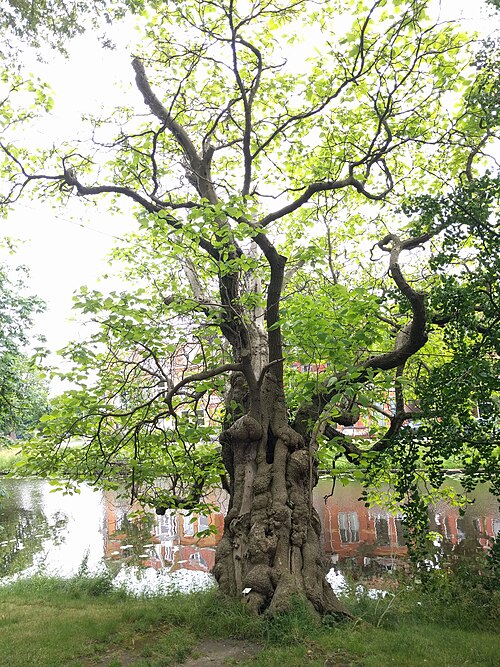
At 5.8 metres round, this is the thickest horse chestnut in the Netherlands by the national monumental tree register's own measurement. It stands at the edge of the Hortus Botanicus with its roots almost in the water of the Witte Singel, and the register's note dates it to 1841, inside a recorded planting band of 1800 to 1850. There is a hollow in the trunk on the water side, fitted with iron pins to stop the remaining wood pulling itself apart, which is the standard treatment for a veteran that has outgrown its own structural margin. It has a problem every horse chestnut in northern Europe now shares. The horse chestnut leaf miner, a moth whose larvae eat the tissue between the two surfaces of a leaf, reached the Netherlands in the late 1990s and browns the foliage from midsummer onward. It disfigures without usually killing, so a chestnut in August looks considerably worse than it is. Come in May instead, when the flower candles are up and none of that has started. Horse chestnuts went into Dutch cities by the thousand in exactly this period, mostly along avenues and canal banks, and almost none of them reached this girth. Conkers drop here in September, onto a bank where the water does half the collecting for you.
In bloomIn fruit
May, when the white flower candles stand up over the water
The line is our estimate of how much there is to see, not a measurement. Typical for this species where this tree stands; exact weeks shift with the year.
Hortus Botanicus Leiden, on the Witte Singel watersideYou can recognise it by its trunk, 5.8 metres round, the thickest horse chestnut in the Netherlands, with a hollow on the water side pinned together with iron. It stands at the edge of the Hortus, roots almost in the Witte Singel.
15 minute walk from Leiden Centraal station
Sources
Where the facts on this page come from.
- In the official register: Landelijk Register Monumentale Bomen (Bomenstichting), no. 1679546
- bomenstichting.nl
- services-eu1.arcgis.com
- hortusleiden.nl