Hilversum's oldest trees are scattered across the estates and woodland edges the town grew up around. An oriental plane has had a whole meadow at Landgoed Bantam since the 1870s. A horse chestnut and a lime stand paired at a road fork, planted in 1937 for a royal wedding. A western red cedar has stood in a banker's walled pinetum since near its founding, and an Atlas cedar has outlasted a street repaving that nearly killed it. All six come from the national monumental tree register, so far the only source recording any of them.
0 of 6 visited in Hilversum
Oriental Plane (Platanus orientalis) · 150 years · Landgoed Bantam
Left to itself in open ground an oriental plane spreads sideways rather than upward, and this one has had a meadow to do it in for about a century and a half. It stands free on the east side of the pond at Landgoed Bantam, an estate laid out as a landscape garden in the late 1870s and nicknamed Klein Zwitserland for its artificial hills. The hills and the ponds are still there, and so are the straight beech and oak avenues from the same period. The national register dates this plane to the estate's first years, giving a band that puts it at roughly 150 years old. That is a band rather than a measurement, and the register is the only source we have found for the tree, so treat the age as its estimate. Platanus orientalis is the eastern parent of the London plane that lines half the streets in Europe, and the difference shows in the leaf: cut far deeper, into five narrow fingers, closer to a maple than to its own offspring. The bark flakes in the same olive and cream plates. Individual trees of this species in Greece and Turkey are credibly reckoned at many centuries, so at 150 years this one is barely into middle age. The estate is managed as a nature reserve and open to walkers.
Common Lime (Tilia x europaea) · 130 years · Spanderswoud
Wilhelmina was eighteen when she was crowned in 1898, and the country marked it by planting limes. The register records this as one of them, standing at the crossing of the Spanderslaan and the Oude Meentweg with a wrought iron fence still around it, which is the giveaway: an ordinary woodland lime does not get railings. The register dates the tree to the 1890s, so roughly 130 years, and it is the only source we have located for it. Wilhelmina went on to reign for fifty eight years, through two world wars and an exile in London, and the tree has outlasted her by decades without any sign of stopping. Tilia x europaea is a hybrid Dutch towns planted by the thousand: heart shaped leaves that go butter yellow in autumn, a permanent thicket of shoots around the base of the trunk that comes back however often it is cut, and small yellow-green flowers in late June that smell of honey and pull in every bee for streets around. Look for the mushroom shaped path marker at the junction, number 24591. The tree is beside it, in public woodland that is open all day. If you know whether the fence around it is the original one from 1898, we would like to hear.
Horse Chestnut (Aesculus hippocastanum) · 90 years · Hilvertsweg / Bosdrift
At the fork of the Hilvertsweg and the Bosdrift stand two trees and two boulders, and the inscriptions on the boulders have worn down to almost nothing. The register explains them: a horse chestnut and a lime, planted in 1937 for the marriage of Princess Juliana and Prince Bernhard. This is the chestnut, the Bernhard tree, roughly 90 years old on the register's dating, and the register is the only record we have found of it. Horse chestnut was an odd choice for a royal wedding if anyone was thinking long term. It is a Balkan mountain tree, spectacular for two weeks and structurally unserious for the rest of the year: soft wood, shallow roots, limbs that fail without much warning, and since the 1990s a leaf miner moth that turns the foliage brown by August across northern Europe. What it does have is May. The flowers stand up in white candles all over the crown, thousands of them, each with a yellow blotch that turns red once the flower has been pollinated so that bees stop wasting visits on it. Then in September the conkers come down and the children take them. Bernhard died in 2004. The tree has outlived him by two decades and is still holding the corner.
Common Lime (Tilia x europaea) · 90 years · Hilvertsweg / Bosdrift
A lime was the safe choice, and that is the point of it. Dutch villages have planted limes at crossroads and in front of churches for centuries, the tree you hold a market under or hang a lantern in, and this one stands at the fork of the Hilvertsweg and the Bosdrift next to a horse chestnut, with worn inscribed stones at the foot of both. The register records the pair as planted in 1937 for the wedding of Princess Juliana and Prince Bernhard, and dates this one to the 1930s, so roughly 90 years. It is the only source we have located for the tree. Juliana was twenty eight at the wedding, became queen in 1948 and abdicated in 1980 in favour of her daughter, which for a Dutch monarch is the ordinary way to leave the job. Tilia x europaea forgives almost anything done to it. Cut one to a stump and it comes back from the base, which is why so many survive road widening that finished off everything else at a junction. In late June the flowers open, pale and not much to look at, and the scent reaches you across the road. Stand under it then and the noise overhead is bees rather than traffic.
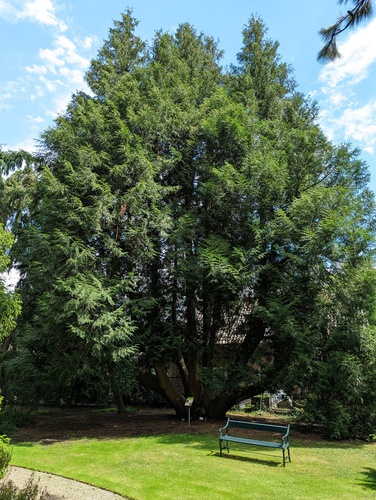
Western Red Cedar (Thuja plicata) · 130 years · Pinetum Blijdenstein
When the house came down in 1928 the land was parcelled up and sold, all of it except the walled garden, which the owner's will required to be kept. That garden is the Pinetum Blijdenstein, and this western red cedar has stood in its southeast corner since close to the beginning. Benjamin Willem Blijdenstein was an Amsterdam banker who bought six hectares here in 1880, had a villa built, and in 1898 turned the estate's walled fruit and vegetable garden into a collection of conifers. He worked on it until he died in 1914. The register dates this tree to that first period, a band that puts it at roughly 130 years old, and it names a giant sequoia from the same years standing nearby. The register is the only source we have found for it. Thuja plicata comes from the Pacific Northwest, where the coastal peoples built canoes, longhouses and totem poles out of it and where the species can pass a thousand years. Crush a spray of the flat green foliage and it smells of pineapple. The bark peels away in long fibrous strips, and the branch tips droop before turning up at the end, which is how you tell it from the cypresses around it. The paths Hendrik Copijn drew in 1909 are still broadly the ones you walk on.
Photo: Michel Langeveld (CC BY)
Atlas Cedar (Cedrus atlantica) · 140 years · Soestdijkerstraatweg
In 1990 the street was repaved and the cedar nearly died of it. Pipes went in between the trunk and the front gardens, straight across the root plate. By 1994 the municipality was digging test pits and rebuilding the soil underneath; by the summer of 1996 the tree had recovered reasonably; in May 2005 the register's own inspector recorded it as doing only moderately, with dead and broken branches. It has been pruned hard since and stands a little out of balance because of it. All of which is what a 140 year old Atlas cedar looks like when you set it in paving on a through road. The register dates the tree to the 1880s and notes that the houses along here went up around 1900, so the cedar was standing before the street was. Cedrus atlantica comes from the Atlas mountains of Morocco and Algeria, where it grows on dry limestone at altitude and is now threatened in its own range. On the Soestdijkerstraatweg it gets the opposite of everything it evolved for: wet feet, compacted ground, road salt and services under the roots. It has managed 140 years anyway. The needles sit in tight blue-grey rosettes on short spurs and the branches leave the trunk in flat horizontal tiers you can read from across the road. The register is the only source we have found for it.