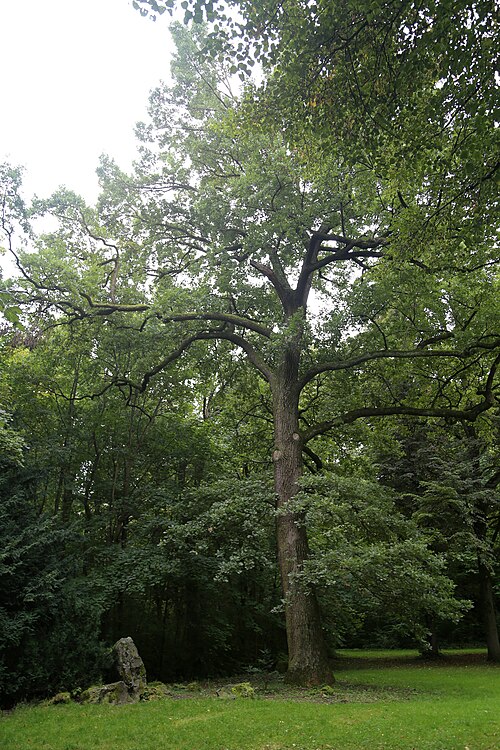
The word Munich's ordinance uses for this tree is Solitär, which in the trade means a tree with open ground on every side and therefore the shape the species actually has. Almost no street tree gets that. They go in as rows, get pruned away from windows and cables, and end up as half a crown facing the road. This chestnut got the room, and the 2021 natural monument ordinance says as much: a solitary, beautiful and evenly grown tree, very dominant in the streetscape. It stands where Sommerstraße meets Edlingerstraße in the Au, the low quarter on the flood plain of the Isar that spent centuries being washed out by the river and just as long being the poorest district in Munich. A few streets away, Mariahilfplatz has hosted the Auer Dult three times a year since 1905, a crockery and junk fair whose market privileges run back to the eighteenth century. An evenly grown horse chestnut is a specific thing to stand under: a dome that starts low and closes to a point, carried on limbs that sweep down before turning back up at the tips. In May the whole of it goes up in white candles, each flower marked with a yellow blotch that turns red once it has been pollinated, so the tree is telling the bees which ones are already finished. No age is on record.
In bloomIn fruit
May, when the whole dome goes up in white candles
The line is our estimate of how much there is to see, not a measurement. Typical for this species where this tree stands; exact weeks shift with the year.
Sommerstraße / Edlingerstraße, 81543 MünchenYou can recognise it as a horse chestnut given open ground on every side, growing into a full dome rather than the half-crown most street trees end up with. It stands where Sommerstraße meets Edlingerstraße, in the Au.
Free, public land, no restrictions
4 min walk from Kolumbusplatz station
Sources
Where the facts on this page come from.
- In the official register: Naturdenkmal (Bayern LfU), no. ND-01970
- Munich Naturdenkmalverordnung 2021, Au-Haidhausen 11
- lfu.bayern.de