Liernu is a small village in Namur built around a single oak reputed to be Belgium's widest and oldest tree, hollow enough that a chapel was once built inside it. A local confraternity still keeps festival around it, it represented the country at a European final, and it has been a protected national monument since 1939, its status raised again in 1992 to exceptional heritage. A second champion tree, a horse chestnut planted as a liberty tree in 1796, stands by road in Waret-la-Chaussée, a village of the same Eghezée municipality.
0 of 2 visited in Liernu
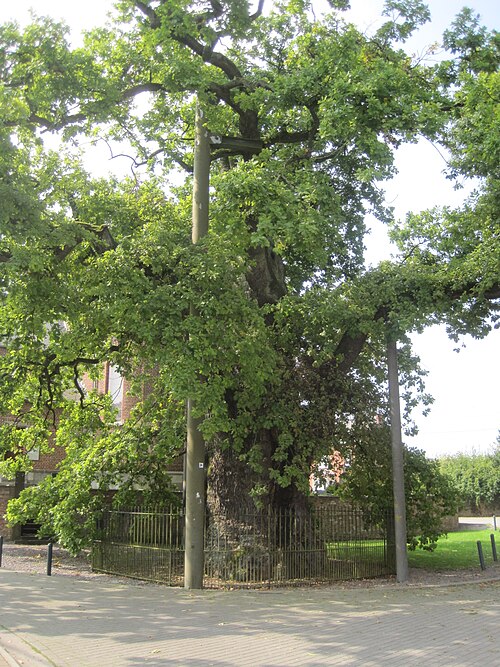
Pedunculate Oak (Quercus robur) · 1,000 years · Liernu (Eghezee)
At just over 14 metres round, the Gros Chene of Liernu is reputed to be the widest tree trunk in Belgium, and oral tradition in the village puts its age near a thousand years, back to Charlemagne. Nobody has cored it to check, and the tree does not make that easy: the trunk is hollow and fissured, and in 1838 someone furnished the inside as a small chapel to Saint-Antoine Ermite, so the girth reported is a fused, hollow mass rather than a single clean stem. It stands beside the church, the former rectory and a school in the small village of Liernu, and the local children who now walk past it daily continue a habit their grandparents had. The Confrerie du Gros-Chene has tended and celebrated the tree for decades, with its own annual festival. Belgium made it a protected monument by royal decree in 1939 and raised it to exceptional heritage status in 1992; it also represented the country at the European Tree of the Year final in 2016. The oldest-tree-in-Belgium claim is a village story more than a measurement, and this project repeats it as exactly that. Come in January, when the leaves are down and the whole fissured, chapel-holding shape of the trunk is easiest to read.
Photo: Mortier.Daniel (CC BY-SA 3.0)
Horse Chestnut (Aesculus hippocastanum) · 225 years · Waret-la-Chaussée (Eghezée)
This horse chestnut was planted to celebrate a king's death. In 1796, with the Southern Netherlands under French rule, it went into the ground at Waret-la-Chaussée as an arbre de la liberté, a liberty tree, marking the fall of "the tyrant" Louis XVI. Both the European contest page and the Belgian broadcaster RTBF give that year. The tree's own entry on OpenStreetMap says 1769, which cannot be right, since Louis XVI was not even on the throne until 1774; it is probably 1796 with two digits swapped.
Eleven years later it gained a second meaning. In 1807 a stone niche went up at the tree, a shrine to Saint Joseph, patron of workers and craftsmen, and a revolutionary tree became a devotional one without anybody cutting it down.
It is now 20 to 22 metres tall, depending on who measured, and it was 334 centimetres round in 1997, the last published figure, so it will have put on wood since. It is recorded as a natural monument.
A local association, Pour la ruralité de Waret, nominated it for Belgium's Tree of the Year as a stand for the village's rural character. It won, and represented Belgium at the European final in 2020, placing fifteenth of sixteen with 10,942 votes.
Waret-la-Chaussée is a separate village of Eghezée, 8.5 km from the Gros Chêne of Liernu and reached by road.