Bergamo's monumental trees do not sit in one place, which is why this page holds several outings rather than one. A walk of a kilometre or so, from the lower town up to the Rocca, links a pair of American swamp cypresses, an Atlas cedar in a park the city itself calls its least known, a strawberry tree grown to a height its species rarely reaches, and three white mulberries left over from the silk trade. The rest stand out in Seriate, Pedrengo and Torre Boldone, each a short trip and worth it.
0 of 8 visited in Bergamo
Bald Cypress (Taxodium distichum) · 200 years · Citta Bassa
These two are American swamp trees, and they have been standing in a walled Bergamo garden for more than two centuries. Bald cypress evolved for the flooded bottomlands of the American South, where it pushes woody knees up out of the waterlogged ground to breathe. Both do it here, at the edge of Parco Marenzi's small artificial lake, which is about as close to Louisiana as Lombardy gets. The national register measures the pair separately, at 455 and 380 centimetres round the trunk, and lists them a third time as a single group; what a visitor gets is one destination, two enormous trunks and roughly 32 metres of tree above them. The park is a 9,000 square metre nineteenth century garden behind walls, and for years that was literal. It stayed shut while the pond and its water system were rebuilt, and reopened to the public in April 2026 after a 180,000 euro restoration. In May 2025, for Italy's national day of monumental trees, the city ran a guided forest bathing walk among them, on the reasoning that a bald cypress can live a thousand years. These two are barely a fifth of the way there. They turn rust orange and drop their needles in November, which is the only time of year a conifer this size looks dead and is not.
Atlas Cedar (Cedrus atlantica) · Citta Bassa
Bergamo's own green space writers call Parco Caprotti perhaps the least known park in the lower town, which is a strange thing to say about a garden holding a 25 metre Atlas cedar, a sequoia and a ginkgo. The three arrived together. The grounds go back to the fifteenth century, but the planting is the work of Carlo Caprotti, an industrialist who gave the park its current layout around the turn of the twentieth century and stocked it the way wealthy Italians of that era stocked gardens, with conifers from other continents chosen for size. The Atlas cedar comes from dry mountain forest in Morocco and Algeria. Here it has 405 centimetres of trunk circumference and the flat, layered branching that the species only develops with age, close cousin to the cedar of Lebanon and often mistaken for it. Beyond the register entry the documentation is thin: one local green space site names it, and no newspaper or municipal page found so far does, so treat the garden's history as local knowledge rather than settled record. The tree itself is not in question, and neither is the way in. Parco Caprotti is free, open, and a short walk from Parco Marenzi, which makes the two of them half an afternoon in the lower town.
Strawberry Tree (Arbutus unedo) · Citta Alta
Most strawberry trees are shrubs you can see over the top of. This one is 16 metres tall with a trunk 355 centimetres round, which for Arbutus unedo is close to the ceiling of what the species does. It grows in the public park below the Rocca, the medieval fortress crowning Bergamo's upper town, and locally it is read as a symbol of strength and resistance. That reading is not sentiment. The species carries dark green leaves, white flowers and red fruit on the same branches at the same time, and nineteenth century Italian patriots noticed the tricolour and adopted it, which makes its position under a fortress about as pointed as a planting gets. The strawberry tree is slow, hard and stubborn, native to Mediterranean scrub, and it flowers in late autumn while the previous year's fruit is still ripening, so October and November give you both colours on one branch. The fruit is edible and dull, which is what the Latin name says: unedo, eat only one. Beyond the national register, which lists it on girth and height alone, a single local source names it, so who planted it and when has not survived. The Rocca grounds are free, reached on foot or by the funicular from the lower town and then a short climb.
White Mulberry (Morus alba) · Santa Lucia
These three trees were planted as machinery. White mulberry leaf is the only thing a silkworm will eat, and for centuries the gardens and field edges around Bergamo were planted with mulberries to supply the province's silk trade, which stripped the leaves each spring and fed them to trays of larvae in farmhouse lofts. The industry is gone. Its trees are still here, in a small public garden in the Santa Lucia district, where three old white mulberries survive as a group. The national register lists them exactly that way, as a homogeneous set rather than three separate specimens, with no individual measurements, so what you are visiting is a garden with three trunks in it rather than one named tree. That is also why the pin is approximate: the register gives the garden's centre point and nothing finer, though the garden is small enough that the trees find you. Mulberries grown for leaf were cut back hard year after year, and it shows in the species: squat trunks, heavy stubbed limbs, none of the reach of a tree left alone. Beyond the register a single local source names them and their silk connection, and their ages are unrecorded. In June and July they drop pale fruit that stains the path underfoot.
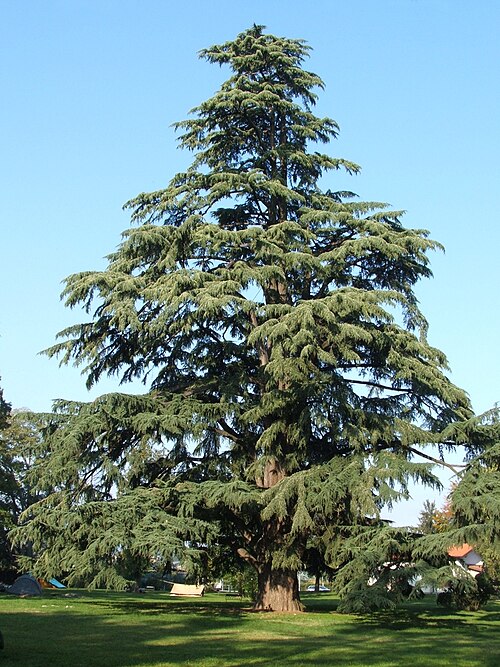
Himalayan Cedar (Cedrus deodara) · ~130 years · Pedrengo (day trip from Bergamo centre)
This cedar has its own lightning conductor. It stands alone in the middle of the lawn in a small public park in Pedrengo, a village about five kilometres east of Bergamo, roughly fifteen minutes by bus or car and not a walk from the city centre. Out on open grass at 32 metres by the national register, or 35 by the regional tourism board, it is the tallest thing for some distance, and somebody decided it was worth wiring rather than losing. Its root plate is fenced for the same reason. The trunk measures 683 centimetres round in the register and 720 in the tourism survey, which is measurement variance rather than a dispute, and either way it takes four adults with linked arms to close the circle. The crown spreads about 25 metres, and the leading tip droops over in the way old deodars do, a shape known as a stork's nest. It was planted at the end of the nineteenth century, which is as precise as the record gets, so somewhere around 130 years old is the honest figure. Three more large cedars of the same species stand nearby in the same park, unregistered and worth the extra two minutes. Parco Frizzoni is free, small, and recognised by FAI, Italy's heritage trust.
Photo: Luigi Chiesa (CC BY-SA 3.0)
Himalayan Cedar (Cedrus deodara) · Seriate (day trip from Bergamo centre)
The merchants who owned this garden brought plants back from Asia, Africa and the Americas, and built a Moroccan style greenhouse in 1860 to keep the fragile ones alive. The Himalayan cedar never needed it. It came from mountain forest that gets snow, so it took to the high bank above the Serio river without help, and is now 30 metres tall with a trunk 465 centimetres round, the largest tree in the park. Deodar is the timber cedar of the western Himalaya, cut for temples in India because the wood does not rot, and it reached European gardens only in the 1830s, which puts a hard upper limit on how old any specimen on this continent can be. The eighteenth century villa was built by the Piccinelli family on trading money; the council owns the grounds now and runs them as a free public park, with the old greenhouse still standing as a garden pavilion and used for occasional exhibitions. No age is recorded for the tree anywhere we could find, only the measurements. Parco Piccinelli is in Seriate, about four kilometres from central Bergamo and ten to fifteen minutes by bus, so this is a short trip out rather than a stop on a city walk. The grove of pagoda trees a few minutes away in the same park is the other reason to make it.
Japanese Pagoda Tree (Styphnolobium japonicum) · Seriate (day trip from Bergamo centre)
Local press calls this the most renowned of Seriate's seven registered monumental trees, and it is not a tree. The national register lists it as a homogeneous group of pagoda trees, with trunks ranging from 265 to 455 centimetres round and heights up to 35 metres, which means the grove holds both its founders and its successors and no single specimen carries the entry. The pin is approximate for that reason: the register gives a centre point for the group rather than a position for each trunk. It sits in the same municipal park as the Villa Piccinelli cedar, a few minutes' walk away, in Seriate, about four kilometres out from central Bergamo. Despite the name the pagoda tree is Chinese rather than Japanese, planted around temples there long before European gardeners got hold of it in the eighteenth century. Its useful trick is timing. It flowers in August and September, when almost everything else in a northern Italian park has finished, hanging cream panicles over the grass and then dropping them, so the ground under these trees goes pale for a couple of weeks in late summer. Strings of seed pods follow in autumn, shaped like beads on a wire. Seriate has a second registered pagoda tree at Villa Ambiveri, on private ground, which is a different tree and not this one.
Horse Chestnut (Aesculus hippocastanum) · Torre Boldone, a comune bordering Bergamo
Torre Boldone had two comune-protected giants until 2017, when the Cedar of Lebanon in Parco dei Sordomuti was illegally felled. This horse chestnut, standing on Viale delle Rimembranze since long before either tree was designated, became the village's last one and has had a hard decade of it since.
An agronomist checked it in 2017 and found nothing worse than ordinary decline. The comune's own crew then pollarded it without authorisation the following January, cutting its height by roughly a third, a job forestry officials confirmed had no permit and that a local environmental group formally protested. A large limb came down on its own in June 2021.
Nobody has published a sighting since. What keeps it on this list is a colder kind of evidence: Lombardy's regional register of monumental trees, most recently updated in October 2025, still lists it standing, at a girth of 391 centimetres unchanged from before the damage. A comune has to report a felling for a tree to drop off that register, and nobody has.
So this entry ships on an official record rather than a fresh photograph. If you walk Viale delle Rimembranze and the chestnut is there, or isn't, tell us. Torre Boldone has already lost one monumental tree to a saw it was not supposed to hold; this is how you find out whether it kept the other.