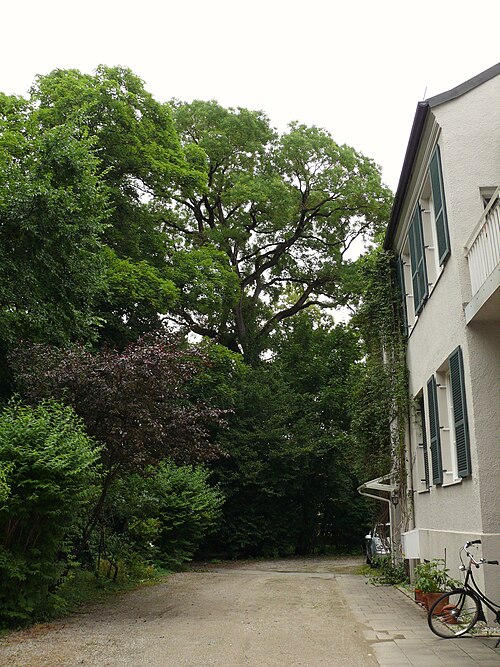
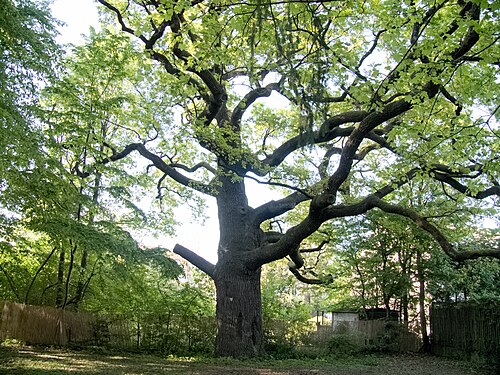
Munich's beer gardens are shaded by this species for an engineering reason. Brewers dug ice cellars along the Isar terraces and planted horse chestnuts over the vaults, because the roots run shallow and do no damage below while the leaves throw a dense, low shade that kept the beer cold through August. The tree came from the mountains of the Balkans and reached central Europe in the sixteenth century as a curiosity; Bavaria put it to work. This one is off duty. It stands on Gollierplatz, the green square at the heart of the Westend, and Munich's 2021 natural monument ordinance protects it as a wide-spreading tree that stands out clearly above the others around it. That is worth knowing before you go, because the square has plenty of trees and only one of them is the one you came for: look for the crown that overtops the rest. The Westend is a dense grid of tenement blocks thrown up for workers at the end of the nineteenth century, on the rise just above the Theresienwiese, where the Oktoberfest has been held since 1810. Gollierplatz is where the quarter goes to sit down. The city recorded no age for it and nobody else has published one. If you know the square's history, or the tree's, we would like to hear it.
In bloomIn fruit
May, when it flowers
The line is our estimate of how much there is to see, not a measurement. Typical for this species where this tree stands; exact weeks shift with the year.
Gollierplatz, 80339 MünchenYou can recognise it by a crown that overtops every other tree on the square, the one to look for among several. It stands on Gollierplatz, in the Westend.
Free, public land, no restrictions
In Schwanthalerhöhe, close to the Gollierplatz tram stop
Sources
Where the facts on this page come from.
- In the official register: Naturdenkmal (Bayern LfU), no. ND-01976
- Munich Naturdenkmalverordnung 2021, Schwanthalerhöhe 2
- lfu.bayern.de