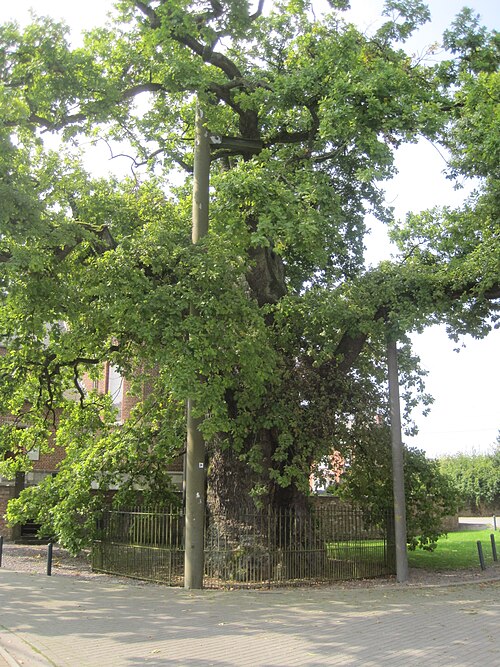
The Tree of Freedom of Waret-la-Chaussée
This horse chestnut was planted to celebrate a king's death. In 1796, with the Southern Netherlands under French rule, it went into the ground at Waret-la-Chaussée as an arbre de la liberté, a liberty tree, marking the fall of "the tyrant" Louis XVI. Both the European contest page and the Belgian broadcaster RTBF give that year. The tree's own entry on OpenStreetMap says 1769, which cannot be right, since Louis XVI was not even on the throne until 1774; it is probably 1796 with two digits swapped. Eleven years later it gained a second meaning. In 1807 a stone niche went up at the tree, a shrine to Saint Joseph, patron of workers and craftsmen, and a revolutionary tree became a devotional one without anybody cutting it down. It is now 20 to 22 metres tall, depending on who measured, and it was 334 centimetres round in 1997, the last published figure, so it will have put on wood since. It is recorded as a natural monument. A local association, Pour la ruralité de Waret, nominated it for Belgium's Tree of the Year as a stand for the village's rural character. It won, and represented Belgium at the European final in 2020, placing fifteenth of sixteen with 10,942 votes. Waret-la-Chaussée is a separate village of Eghezée, 8.5 km from the Gros Chêne of Liernu and reached by road.
Rue de la Croisette, Waret-la-Chaussée, Eghezée, Namur You can recognise it by the stone niche to Saint Joseph set at the tree, a horse chestnut 20 to 22 metres tall and over 3.3 metres round. It stands beside Rue de la Croisette in Waret-la-Chaussée.
Free. Stands beside Rue de la Croisette, a public road in the village of Waret-la-Chaussee (confirmed by OSM/Nominatim reverse geocode), tagged on OpenStreetMap as an officially denoted natural monument (denotation=natural_monument). No gate, ticket or restriction in any source.
SAME-COMMUNE ADDITION to Liernu (data/cities/liernu.json), not the same village: Waret-la-Chaussee is a separate village of the Eghezee municipality, about 8.5km from Liernu by straight-line distance. No train station in either village, same as Liernu's own entry ('reached by road from Eghezee'). Eghezee's TEC bus line 71 and an on-demand local transport service cover the commune's villages, but no source confirms a fast direct scheduled link between the two specific villages, so this is honestly a road/car connection (roughly 10-15 minutes' drive) rather than a confirmed ~30-minute public-transport day trip; state it as reached by road, the same honest phrasing already used for Liernu itself.