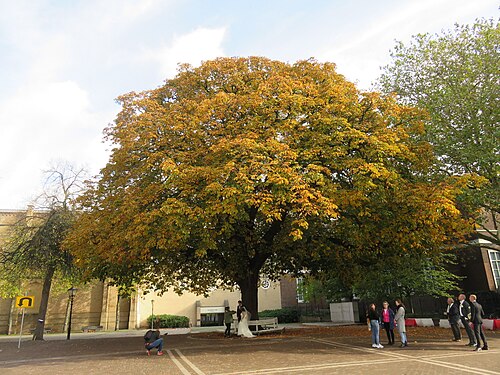
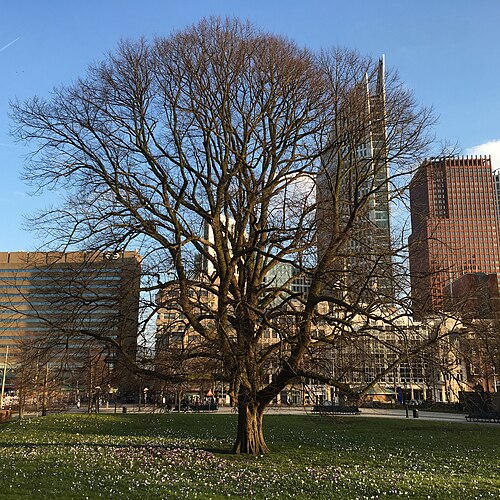
The Vijverberg exists because of a hole in the ground. When the Hofvijver, the rectangular pond that still sits beside the Binnenhof and reflects the seat of Dutch government in postcards by the thousand, was enlarged centuries ago, the excavated sand was piled up along one side, raising the ground into the low ridge that gives this street its name, hill by the pond. Rich families built townhouses along it from the 17th century on, most with gardens facing the water. This row of seven horse chestnuts, planted around the 1830s, lines that same historic ground today, tall enough now to shade the water they were planted to look out over. Horse chestnut is not native to the Netherlands, imported as an ornamental from the Balkans, but it became the default tree for exactly this kind of grand civic promenade across Dutch cities for two centuries running. The trees stand in the open, free, on one of the most photographed short stretches of pavement in the country, a few minutes' walk from the Binnenhof itself.
In bloomIn fruit
May, when it flowers
The line is our estimate of how much there is to see, not a measurement. Typical for this species where this tree stands; exact weeks shift with the year.
Lange Vijverberg and Korte Vijverberg, beside the Hofvijver, Den HaagYou can recognise it among a row of seven horse chestnuts shading the water. It stands along the Lange and Korte Vijverberg, beside the Hofvijver.
Free, public street, open at any time
Centrum, central Den Haag; about a 10 minute walk from Den Haag Centraal station
Sources
Where the facts on this page come from.
- In the official register: Landelijk Register Monumentale Bomen v2024
- Landelijk Register Monumentale Bomen v2024 (LRMB), Bomenstichting (nr 1686927)
- nl.wikipedia.org