Alfred Solvay, brother of the industrial chemist Ernest Solvay, built a country manor at the edge of the Sonian Forest in 1878, and the park around it still carries his family's name today.
Copper Beech
Fagus sylvatica f. purpurea
Every copper beech in Europe descends from an accident. We map 74 of them, in 49 cities.
The purple leaf is a mutation that turns up at random in wild green beech forests, and it is a handicap rather than an advantage: the pigment masks the chlorophyll underneath and cuts the light the leaf can put to work, so purple seedlings are outgrown by green ones and vanish. The tree exists in numbers only because gardeners in German and Swiss forests kept the freak and propagated it, usually by grafting, since it does not come true from seed. Leiden's was grafted low onto a green rootstock, and two centuries of mismatched growth rates have left it with a broad gnarled base that looks nothing like a beech. Boston's is the only living Historic Landmark in Cambridge, designated in 1985 to stop a building. In 2024 a grafted Silesian beech was voted Europe's tree of the year.
Brussels
Porto
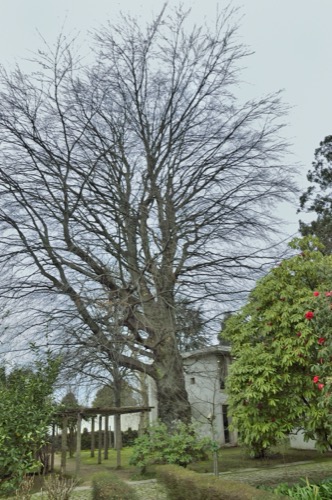
Architects travel to this campus for the buildings.
Photo: Paulo V. Araujo, Dias com Arvores
Munich
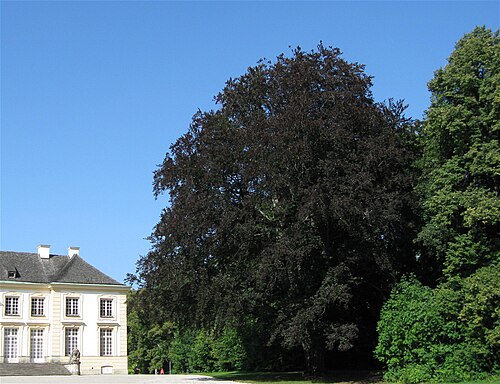
Every copper beech in Europe descends from an accident.
Photo: Rufus46 (CC BY-SA 3.0)
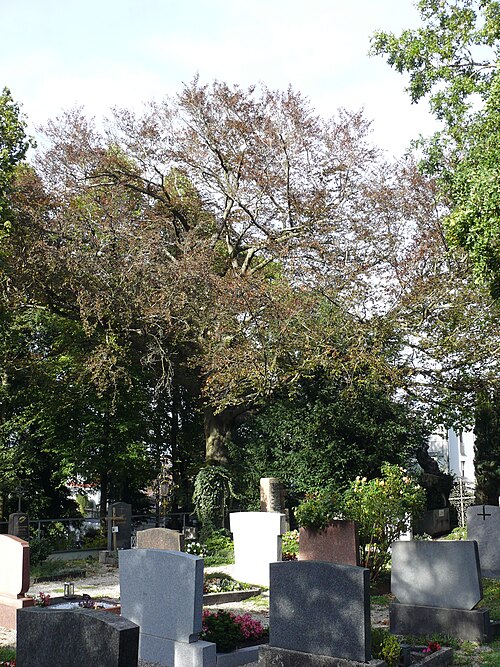
Autumn colour
When it was photographed in mid-September 2023, this copper beech already had the thin crown of a tree in November.
Photo: Martinus KE (CC BY-SA 4.0)
Purple leaves are a handicap.
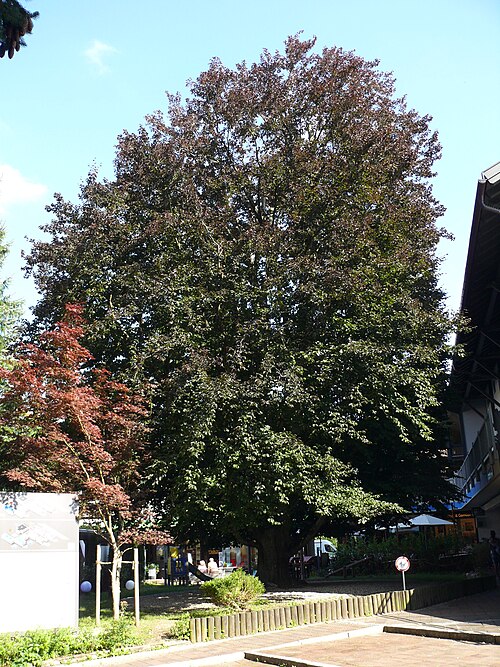
Most protected trees stand in parks or churchyards.
Photo: Martinus KE (CC BY-SA 4.0)
Alkmaar
Storm Poly came through Alkmaar on 5 July 2023 and felled more than five hundred trees in an afternoon, with roughly two hundred more damaged badly enough to matter.
Seattle
Two measurements taken nineteen years apart put this copper beech at almost exactly the same height: 92 feet when the tree expert Arthur Lee Jacobson recorded it in 2000, and 94 feet when the city...
Amsterdam
Autumn colour
The best evidence for this tree's age is a photograph.
Berlin
Autumn colour
Berlin declared this copper beech a natural monument in 1993, growing inside Landhausgarten Dr.
Autumn colour
The square in front of Berlin's natural history museum holds five protected trees, and the two that give the group its name are copper beeches, one off each wing of the building.
Leipzig
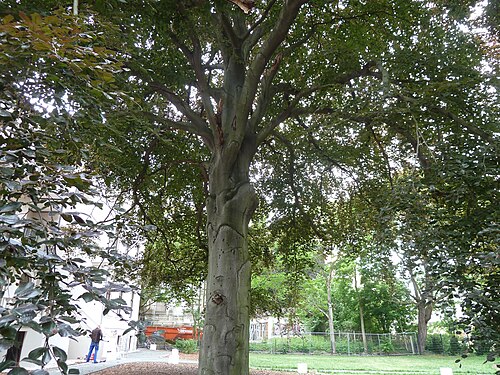
Copper beeches were a fashionable planting across nineteenth century Europe, their near-black foliage a deliberate contrast to the ordinary green beech beside them, and this one has grown large eno...
Photo: Edlerin (CC BY-SA 4.0)
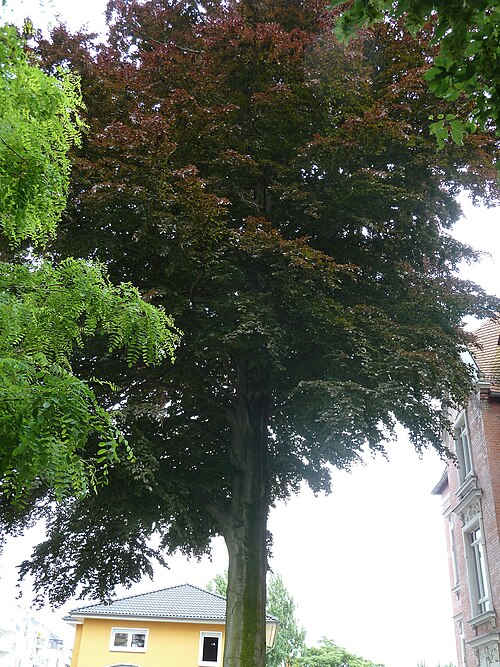
This copper beech is 23 metres tall on Leipzig's register, and the most recent proof we can find that it still stands is a photograph taken in June 2015.
Photo: Edlerin (CC BY-SA 4.0)
Leeuwarden
The national register does not usually tell you a tree is going to die.
For most of its life this beech was half of something else.
Autumn colour
This copper beech used to have a twin.
Rotterdam
Schoonoord holds roughly a thousand species of plants and trees inside a garden barely bigger than a football pitch, and this copper beech is one of only two survivors from the day its original lay...
Fifteen grand townhouses built between 1888 and 1891 once earned this small square a joking nickname, Rijkeluishofje, the rich people's almshouse, a dig at how sheltered and comfortable its wealthy...
The Hague
A copper beech is an ordinary beech with a fault in it.
The register gives this tree no street address.
Landscape gardeners put copper beeches beside water deliberately.
Autumn colour
Trees last longest on ground nobody will ever build on.
Montreal
At roughly 75 years old this is one of the youngest trees on this map, and the city still counts it among the largest purple beeches on Mont-Royal.
Vienna
Autumn colour
This copper beech was the last of four.
Boston
This is Cambridge's only living Historic Landmark, and it was made one in 1985 to stop a building.
Eindhoven
Autumn colour
Strijp was its own village until 1919, and this copper beech is older than the annexation that folded it into Eindhoven.
Warsaw
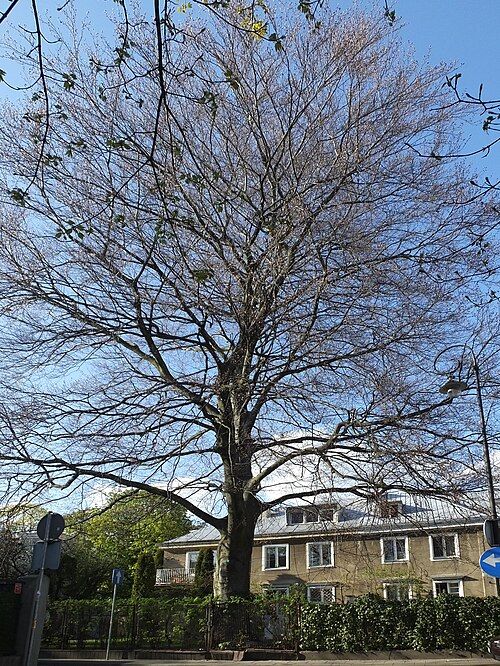
A copper beech is an accident somebody kept.
Photo: Panek (CC BY-SA 3.0)
Utrecht
Autumn colour
Utrecht's own tree register cannot agree with itself about this copper beech.
This copper beech carries a health warning rather than just an age.
Autumn colour
Two beeches stand roughly 45 metres apart on the same small stretch of Servaasbolwerk, and it is easy to walk past one thinking you have already seen the other.
This stretch of canal has a beech problem, and it is worth saying out loud before you go looking.
Autumn colour
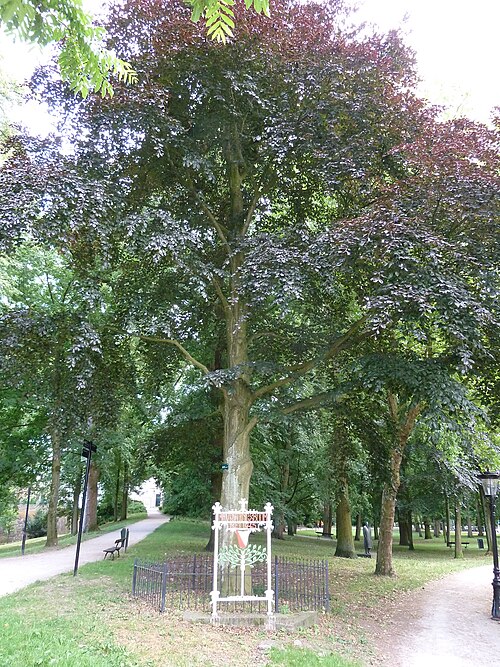
This copper beech was planted to be looked at and remembered, not simply grown.
Photo: Kattenkruid (CC BY 3.0)
Dresden
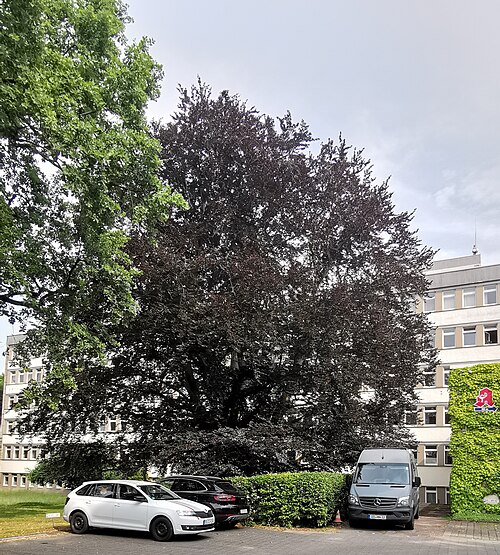
In the early 1970s a new clinic in Blasewitz was moved 25 metres to spare this tree.
Photo: Z thomas (CC BY-SA 4.0)
Nijmegen
Autumn colour
This copper beech is older than the church beside it.
Dordrecht
The name of the square says what happened here: a pig market, and a lively livestock trade for a long time.
Autumn colour
Nobody, including the register that lists them, is sure which of these three beeches is the old one.
Amersfoort
Autumn colour
The church went up between 1881 and 1883.
Autumn colour
This copper beech stands where Amersfoort's old public library used to be, on the east side of the Zonnehof, and it has outlasted the building it once stood beside.
It is at the back entrance of a function venue, which is a demotion, and it is the reason to look.
Autumn colour
The Zonnehof is a piece of open ground on the edge of the old centre that the twentieth century got hold of, and this beech was standing before any of it.
Antwerp
Nobody can say for certain which revolution this tree commemorates, only that it commemorates one.
Leiden
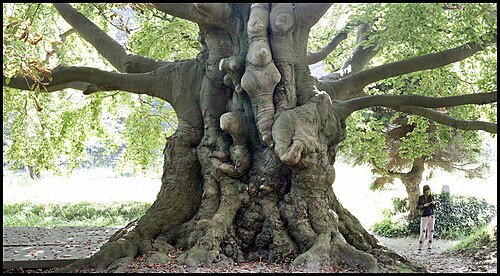
Autumn colour
Two beech varieties grafted together, growing at different rates for two centuries, is why this one looks nothing like a normal beech.
Photo: Marianne Cornelissen-Kuyt (CC BY-SA 4.0)
This tree is named after a student who wrote one of the Netherlands' best-loved books while it was still young.
Haarlem
This copper beech stands in front of a 19th-century villa with the kind of theatrical, deep purple-red canopy that looks almost too deliberately composed to be real, the sort of tree that would not...
Arnhem
The house is from the 1930s.
Zwolle
Autumn colour
A dark tree next to moving water was somebody's decision.
The purple is a mask.
A fence went up beside this beech, and the tree has been taking it in ever since.
A copper beech planted at the water's edge around the time the 20th century began, and still standing there: that is what the national monumental tree register records in the southern part of Park...
Deventer
Autumn colour
A copper beech planted in 1822 was an early one, and in a public park it was very early indeed.
Helmond
Autumn colour
The wood this beech stands in is a leftover piece of the hunting ground of the lords of Helmont, and the register knows what the farmhands used to eat in it.
Autumn colour
The present church is younger than the trees standing behind it.
Nobody has ever put a tape around this tree, which is the first thing a big copper beech makes you want to do.
Baarn
At 5.28 metres around, this is the thickest beech on the Groeneveld estate, and the number comes with an asterisk.
Emmen
Autumn colour
The church is gone and only the tower is left.
Assen
Autumn colour
The same footpath that leads to the weeping beech behind Nieuw Echten passes a second registered tree a few steps further on: a copper beech, its leaves running dark purple-red instead of green, pl...
Ceska Lipa
The state protects a circle twelve metres wide around this copper beech, and the circle sits on a street corner beside a hospital.
Frankfurt
The Palmengarten opened in 1871.
Frydlant
Frýdlant protected this beech by drawing a circle around it.
Ghent
This beech has a trunk 4.26 metres round and no birthday.
Graz
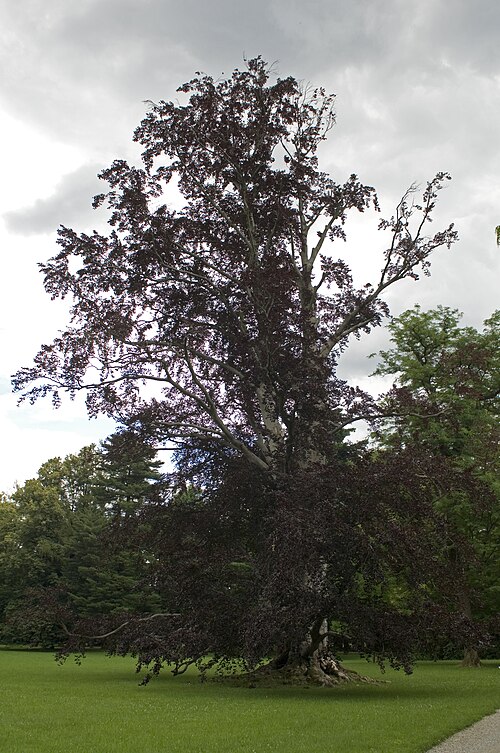
Autumn colour
Wikipedia's list places this copper beech at Eggenberger Allee 90 with a set of coordinates that match, to six decimal places, the GPS tag on a photograph taken here in June 2014 and filed on Wikim...
Photo: Kulac (CC BY-SA 3.0 at)
Hallstatt
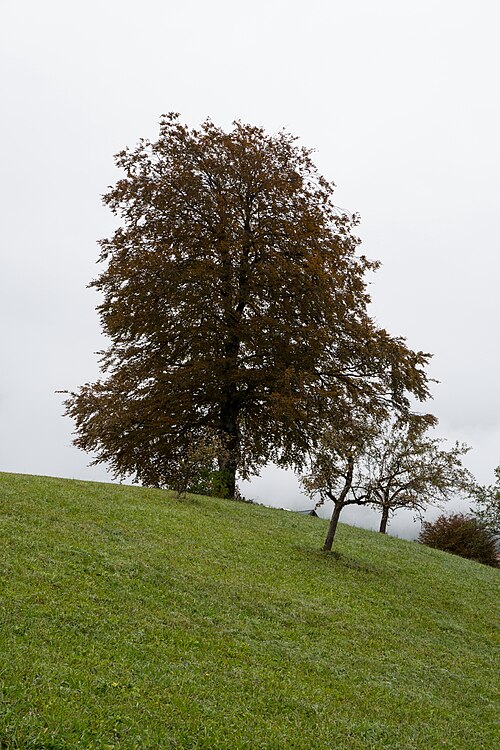
Most of Hallstatt's protected trees earned that status through age or size, numbers the state could put in a file.
Photo: Christian Pirkl (CC BY-SA 3.0 AT)
Hamburg
Autumn colour
Ask how thick this beech is and you get three answers, all of them correct.
Hoorn
Every copper beech in Europe descends from a handful of freak trees found growing purple in ordinary green forests, most famously in Germany in the seventeenth century.
Jihlava
A group of Jihlava students campaigned this beech to the national Tree of the Year title in the autumn of 2003.
Luxembourg City
The state put this tree under protection and then wrote nothing else about it.
Madeira
The last Emperor of Austria died in this garden.
Portland
Portland State University knocked down a Victorian mansion to build its library, then laid out the front lawn around the tree that had stood beside it.
Priekulė
The writer Ieva Simonaitytė spent her summers in the house this beech stands beside, and that house is now her memorial museum.
Roosendaal
Autumn colour
The thickest beech in Roosendaal's part of the national tree register is really three trunks grown into one.
Sittard-Geleen
This copper beech grows in the Jardin d'Isabelle, a historic town garden in Sittard, banded by the national register to a planting around 1870, roughly 160 years old.
Strasbourg
Purple-leaved beeches are a mutation that gardeners decided to keep.
Wojslawice
Autumn colour
In 2024 a beech from a small Silesian arboretum became Europe's tree of the year, beating every other national champion on the continent.
Zaanstad
This tree's own file cannot agree with itself about its age.
Explore by city: Brussels · Porto · Munich · Alkmaar · Seattle · Amsterdam · Berlin · Leipzig · Leeuwarden · The Hague · Montreal · Vienna · Boston · Eindhoven · Warsaw · Utrecht · Dresden · Nijmegen · Dordrecht · Amersfoort · Antwerp · Leiden · Haarlem · Arnhem · Zwolle · Deventer · Helmond · Baarn · Emmen · Assen · Frankfurt · Ghent · Graz · Hallstatt · Hamburg · Hoorn · Luxembourg City · Madeira · Portland · Priekulė · Strasbourg · every city · or browse all species.