Priekulė, a small town in Klaipėda district, protects five trees across two neighbouring parks: two oaks and a copper beech in and around Vingis Park, and a beech and fir sharing a wilder former manor park a kilometre away. All five were designated in a single 2018 ministerial order. One stands in the garden of a writer's house-museum; the rest are reachable on public paths.
0 of 5 visited in Priekulė
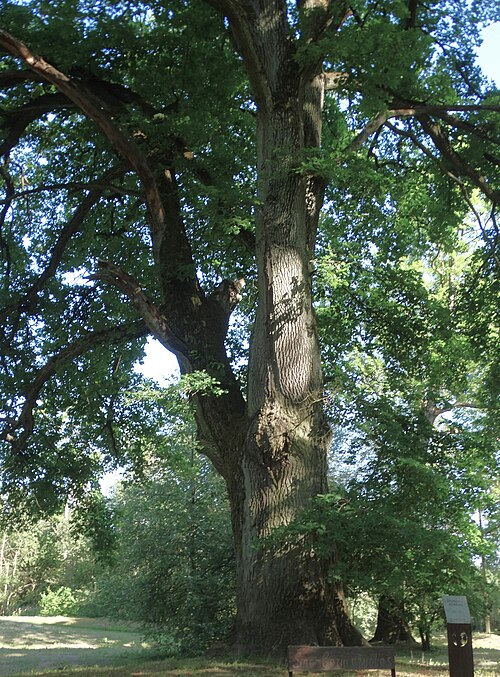
Oak (Quercus sp.) · Priekulė, Klaipėda district
Oaks in this part of Europe usually spread rather than climb. This one is 32.5 metres tall, a height you would expect from a spruce, over a trunk 5.03 metres round. It takes its name from the Šperberiai family, who owned the Priekulė manor and the ground it grows on.
Official recognition came late. A survey of the Priekulė district in 2017 turned up five natural heritage objects nobody had on the books, and on 16 April 2018 the environment minister's order No. D1-300 protected this oak among them. Four other trees on this list carry that same order, all of them within a walk of this one, in a town of a few thousand people.
It stands on a slope in Vingis Park, roughly 120 metres in from the main gate, sixty metres from the Minija. When the river comes up the ground around the trunk floods, and the park keeps the spot cleared and maintained.
Two things nobody has written down. There is no age on record, and the register says only ąžuolas, oak, without naming the species. Pedunculate oak is the overwhelming default in Lithuania and that is our assumption rather than a fact on file. If you know this tree, or you can tell a pedunculate from a sessile oak at a glance, tell us and we will correct the page.
Photo: Vilensija (CC BY-SA 3.0)
Oak (Quercus sp.) · Priekulė, Klaipėda district
To reach this oak you walk past a dead one. Roughly 400 metres northeast of the main gate of Vingis Park the path goes by the remains of the fallen Priekulė Oak; a little further on, off the path in a patch of deciduous woodland, stands the one still going. It measures 5.45 metres around at chest height and 31.5 metres tall. The ground beneath it has been cleared of undergrowth and a sign put up, and on 16 April 2018 it was protected by the same ministerial order that covers four other trees on this list.
Our pin is honest rather than exact, and it is worth saying why. The Lithuanian Wikipedia entry and the geotag on the photograph filed with it give a coordinate identical, to six decimal places, to the one recorded for the fallen oak further back along the path. Those same sources say the two trees stand in different spots, so one of the pins is a copy of the other. We have marked this one approximate, at park level, until a fresh geotagged photograph settles it. The park is small and the tree is signposted, so you will not be hunting for long.
No age has been recorded, and the register says only ąžuolas, oak, without naming which. Pedunculate is our assumption, not a fact on file.
Copper Beech (Fagus sylvatica f. purpurea) · Priekulė, Klaipėda district
The writer Ieva Simonaitytė spent her summers in the house this beech stands beside, and that house is now her memorial museum. The tree was the ornamental centrepiece of the garden then and it still is: red-leaved, 3.45 metres round at chest height, 20 metres tall, sharing the plot with a rose garden and a walnut. There is an information sign next to it and a bench in its shade, which tells you how the place is used.
On 16 April 2018 the environment minister's order No. D1-300 made it a state-protected natural heritage object, one of five trees on this list covered by that single order. It sits at Vingio gatvė 11, on the edge of the park where two of the others grow, so the whole set is one afternoon on foot.
Two gaps worth stating. Nobody has recorded an age for it. And the access is a museum garden rather than open ground: the museum is a public institution and not anyone's home, but we could not confirm whether the tree can be reached from the street or whether it means the museum's opening hours and whatever it charges. Assume the second, check before you set off, and if you have been, tell us how it works so we can put the answer here.
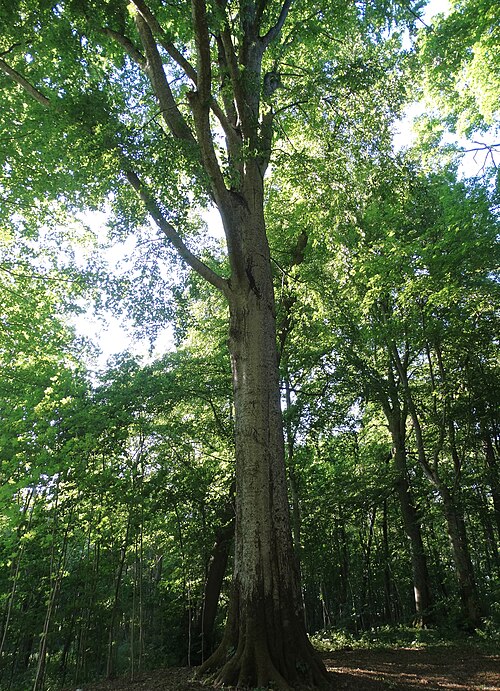
European Beech (Fagus sylvatica) · Priekulė, Klaipėda district
At 37 metres this is one of the tallest trees on this list, on a trunk 4.27 metres round at chest height, and the local heritage trail claims the beeches in this old park run to the largest dimensions of their kind in Lithuania. It became a state-protected natural heritage object on 16 April 2018.
The park it grows in has quietly stopped being a park. Kliošai was a manor landscape park, laid out to be walked through and looked at; a feature on Lithuania's old estate parks describes what is there now as functioning like ordinary forest. Nobody sweeps it, nothing is mown, and a beech of these proportions turns up in what a visitor reads as plain woodland on the left bank of the Minija.
Getting to it takes a little navigation. From the Šilutė to Priekulė road, turn south at the town boundary marker; a signpost at the crossroads points the way; at the end of Parko gatvė an information stand beside the block of flats at number 6 gives the local history, and the tree stands about 120 metres further along a footpath. The park's protected silver fir is another 150 to 200 metres on, so the pair make one walk.
No age is recorded anywhere we looked. If somebody has dated this beech, tell us and we will put the number on the page.
Photo: Vilensija (CC BY-SA 3.0)
Silver Fir (Abies alba) · Priekulė, Klaipėda district
A signpost at a crossroads outside Priekulė points down a side road and reads Europinis kėnis, one kilometre. A town that signposts a single fir is telling you something about the fir. This one measures 3.85 metres round at chest height and became a state-protected natural heritage object on 16 April 2018, under the same ministerial order as the beech a couple of hundred metres away.
Its height is disputed, and we would rather say so than choose. The Lithuanian entry's infobox gives 32.8 metres. The body of the same article says the state cadastre and the information board on site both record 37 metres, which is exactly the figure recorded for the neighbouring beech, and that coincidence looks like a number that has wandered from one record into the other. The girth is the same in every source, so the tree is not in doubt, only the top of it. If you are standing at the board, read the number and tell us.
No age has been recorded either.
It grows at the edge of the old manor park near the end of Parko gatvė, by house number 11 and a farm building. The footpath alongside carries on to a small forest cemetery and a suspension bridge across to the village of Gropiškiai, so the fir is a stop on a walk rather than the end of one.