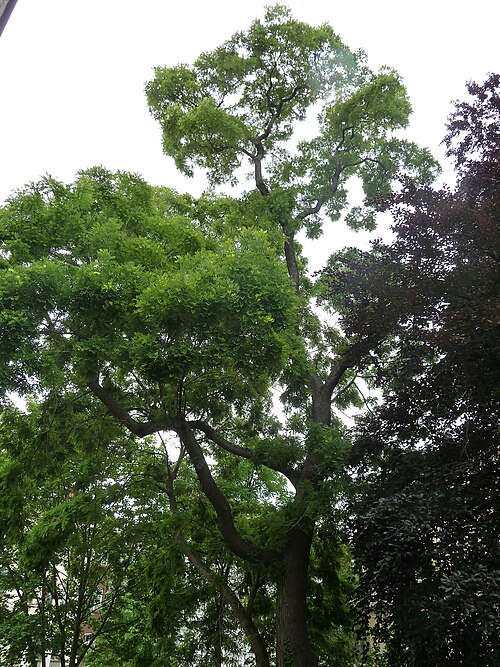
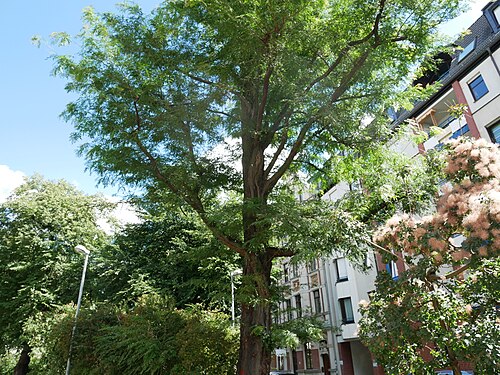
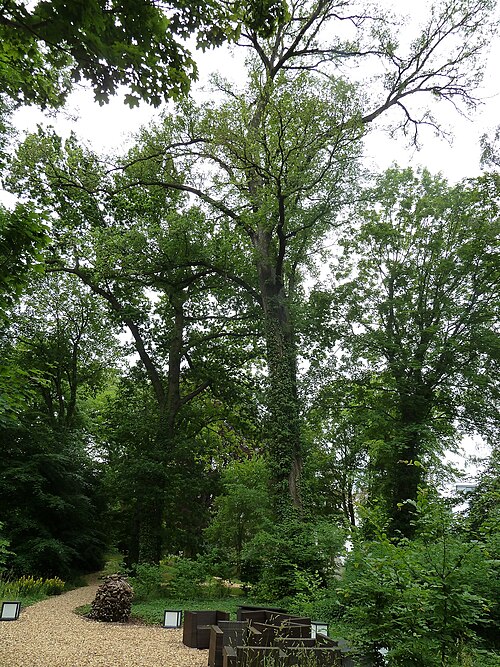
Copper beeches were a fashionable planting across nineteenth century Europe, their near-black foliage a deliberate contrast to the ordinary green beech beside them, and this one has grown large enough on Karl-Heine-Strasse to earn Leipzig's Naturdenkmal protection in its own right. The colour comes from anthocyanin pigments masking the leaf's green chlorophyll, strongest in spring and fading toward a duller bronze by late summer as the pigment breaks down faster than the tree replaces it. It is the same genetic trait behind every copper beech anywhere, a single mutation propagated by grafting and cutting for centuries rather than a distinct species. It stands a few doors from a Japanese pagoda tree under the same 1996 protection order, one of five Naturdenkmal trees within about 150 metres of each other on this stretch of street. Like any beech it carries smooth grey bark its whole life rather than developing the deep furrows of an oak or a plane, which is part of why beech trunks end up carved with initials more than most other species: the bark simply shows the cut and keeps it.
Autumn colour
The line is our estimate of how much there is to see, not a measurement. Typical for this species where this tree stands; exact weeks shift with the year.
Karl-Heine-Strasse 24, 04229 LeipzigYou can recognise it by its near-black foliage and smooth grey bark, a few doors from the street's Japanese pagoda tree. It stands at Karl-Heine-Strasse 24.
Visible from Karl-Heine-Strasse; the Wagner-Nietzsche-Villa grounds it stands in now operate as a private guesthouse, not open to casual visitors
Karl-Heine-Strasse tram (lines 3/N3) or S-Bahn Leipzig MDR, then a short walk
Sources
Where the facts on this page come from.
- In the official register: Naturdenkmale der Stadt Leipzig (Verordnung 1142/98), no. ND 125
- wikidata.org