Three of these trees make a short walk in central Funchal: an araucaria in the grounds of Quinta Vigia, the president's official residence, free and open on weekdays, and an ombu and a camphor tree a few streets away in the Jardim Municipal. Five more are spread around the city, from the botanical garden to the dragon trees at Neves and the hillside estate at Palheiro. Only two are real drives, Queimadas above Santana and the til grove at Fanal, an hour or more in opposite directions. Eight of the ten carry no recorded age at all.
0 of 10 visited in Madeira
Ginkgo (Ginkgo biloba) · Santa Maria Maior, Funchal
Madeira's official register of monumental trees records this ginkgo for exactly one reason, size, and where the age should go it says sem referencia, no reference. Nobody has dated it. What the surveyors did measure is 18 metres of height and a trunk 1.62 metres round, which is a substantial specimen of a tree that has no obvious business thriving at this latitude and manages it anyway.
Ginkgo biloba is the last species left of an entire lineage, with no close living relative anywhere, and it reached European gardens only in the eighteenth century. This one grows in the Jardim Botanico da Madeira on the slope above Funchal, among roughly 3,000 species pulled in from every continent the garden could reach, ten minutes out of the city by bus or a cable car ride down from Monte.
The garden opened to the public in 1960, which dates the garden and not the tree. Nobody has recorded when this ginkgo went in. If you have a planting record, or a girth measured more recently than the survey, send it to us.
And then in November the crown turns butter gold and drops the lot inside a few days, which is the week to be standing under it.
Mexican Cypress (Cupressus lusitanica) · São Martinho, Funchal
Madeirans call this species cedro-das-barracas, the shed cedar, because the young leading shoot was traditionally cut off so the crown would thicken outward into a roof of shade. Nobody did that to this one. It went up instead: 29.5 metres tall on a trunk 6.06 metres around, more than a metre of solid diameter, which the island's register singles out as exceptional for a Cupressus lusitanica and enough to make it one of the largest of its kind on Madeira.
The species is not Portuguese, whatever the name says. It comes from Mexico and Central America, and it took its Latin name from trees already growing in Portugal rather than from anywhere near its actual origin.
Its age is not recorded. The register gives its condition as bom, good, and notes that it is under permanent technical monitoring, which is what the island does with trees it has no intention of losing. Nobody has dated it, and if you know when it was planted, tell us.
It stands in Quinta Magnolia, a public park of some 40,000 square metres in the middle of Funchal, free and open from eight in the morning until eight at night, which makes this the easiest tree on the list to go and see.
Copper Beech (Fagus sylvatica var. purpurea) · Monte, Funchal
The last Emperor of Austria died in this garden. Karl I, deposed in 1918 and exiled to Madeira, spent his final months at what was then Quinta do Monte and died there in 1922, which is why the estate is now the Jardins do Imperador, the Emperor's Garden.
The tree that dominates it is a copper beech, 36 metres tall on a trunk 3.52 metres round. That is an odd thing to find here. Fagus sylvatica is a northern European forest tree and this is a subtropical island in the Atlantic; what makes it possible is Monte itself, high on the slope above Funchal in the belt of cloud that the trade winds push up against the mountain. The parish is permanently damp and several degrees cooler than the seafront, and the beech behaves accordingly.
Madeira's monumental tree register lists it for size, records its condition as good, and gives its age as sem referencia, no reference. Nobody has dated it, and the estate's own history does not settle it. If you know when this beech was planted, tell us.
Entry costs around a euro, often nothing on Sundays, and the Monte cable car from Funchal stops a short walk away.
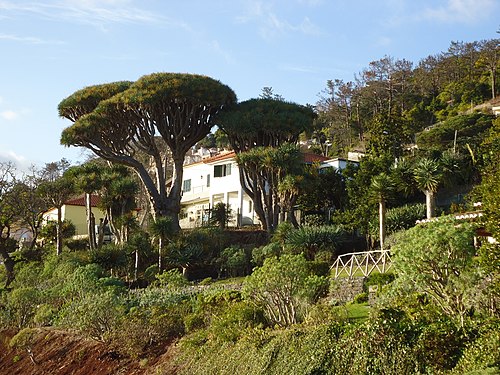
Dragon Tree (Dracaena draco) · 100 years · Sao Goncalo, Funchal
The Regional Government of Madeira bought this piece of land for one reason: the trees standing on it. The Nucleo dos Dragoeiros das Neves is a small purpose-built garden in Sao Goncalo, five kilometres out of central Funchal, laid out around what the island's register calls a notable group of centenary dragon trees. It has an information centre, opening hours, a phone number and guided visits available on request, which is remarkable treatment for a garden you can cross in a minute, and it tells you how little of Madeira's original dragon tree population is left.
Dracaena draco is native here and to the Canaries and almost nowhere else, and it grows slowly enough to make the register's word centenarios mean something: roughly ten years to reach two or three metres. The thickest trunk in the group measures 4.77 metres around and the stand reaches 13 metres. The register gives no age beyond centenary, and this page invents none.
Its sap runs red. That is dragon's blood, imported into Europe for centuries as a dye, a varnish and a medicine, and the trees were tapped hard for it. Entry is free, the information centre keeps weekday hours, and the whole visit takes twenty minutes.
Photo: Paulo SP/ Wikimedia (CC BY-SA 4.0)
Araucaria (Araucaria sp.) · Se, Funchal
To see this one you walk into the official residence of the President of the Regional Government of Madeira, and nobody asks you anything at the gate. Quinta Vigia has been the president's house since 1984, and its grounds, about a hectare of them above the seafront on Avenida do Infante, stay open free of charge on weekdays, roughly half past eight until half past five. Monday to Friday only, so this one is a weekday errand.
The araucaria in those grounds sits on Funchal's own list of monumental trees, entered as code 292 in a table the city drew from a 2008 regional survey that recorded 118 remarkable specimens across the municipality, 111 of them classed monumental. What the table does not say is which araucaria it is. It gives the genus and stops there.
So we cannot tell you either, and we would rather say so than guess. One database files it as a Cook pine and cites nothing whatsoever for the claim; the garden's own description mentions Norfolk Island pine among the exotics growing here. The two are separable from below: a Norfolk Island pine stacks its branches in even tiers, a Cook pine leans in a narrower column. If you are standing under it and you know your araucarias, tell us which one this is.
Nobody has recorded its age or its girth either.
Ombu (Phytolacca dioica) · Se, Funchal
The fattest thing in this garden is not a tree. Phytolacca dioica, which Madeirans call bela-sombra, beautiful shade, is a giant herb out of the South American pampas: the swollen grey base that makes one look ancient is soft water-storing tissue rather than timber, it folds outward into what look like roots halfway up, and it grows fast enough that bulk says very little about years.
Funchal's list of monumental trees carries this one as code 305, from a table the municipality drew off a 2008 regional survey of the island's remarkable trees. No age, no girth, no height.
The garden around it earns the detour on its own. The Jardim Municipal opened in 1885 as the Jardim Dona Amelia on the ground of the old Convento de Sao Francisco, and those 8,300 square metres of former Franciscan enclosure are now a free public park in the middle of the city, gates reported open round the clock. Rua Ivens runs along the top of it.
One warning. The same garden holds a second monumental tree, a camphor, and both come through on the same map point, so you may meet the wrong one first. The soft grey non-wood is how you know you have the ombu. Nobody has dated either of them, and if you know when this one went in, tell us.
Camphor Tree (Cinnamomum camphora) · Se, Funchal
Crush a leaf and you will know whether you have found the right tree. Cinnamomum camphora carries camphor in its leaves and its wood, and the smell is the giveaway, which matters here more than it usually would: this garden holds two monumental trees and both sit on the same map point.
The other is an ombu, a soft grey South American thing that is not really a tree in the botanical sense at all. This one is its opposite, an evergreen with a proper woody trunk that keeps its crown through the winter. Camphor is no more native to Madeira than the ombu is; Cinnamomum camphora comes from East Asia. It stands in a garden that mixes native and imported freely: Madeiran barbusano, til, pau-branco and dragon trees growing alongside kigelia, garcinia, plumeria and pandanus.
Funchal's monumental list has it as code 312, canforeira, in the table the municipality took from a 2008 regional survey of the island's remarkable trees. Nothing is recorded against it: no age, no girth, no height.
It grows in the Jardim Municipal, 8,300 square metres of public garden opened in 1885 on the ground of the old Convento de Sao Francisco, free and reported open at any hour, with Rua Conselheiro Jose Silvestre Ribeiro running down its western side. If you know when this one was planted, tell us.
Pohutukawa (Metrosideros excelsa) · Sao Goncalo, Funchal
Funchal's list of monumental trees names nine more entries inside this one garden: a tulip tree, a til, a Queensland araucaria, an oak, an Atlas cedar, a camphor tree, a sequoia, a Canary pine and groups of planes. The one this page picks is the New Zealander.
Metrosideros excelsa, the pohutukawa, grows wild on sea cliffs at the top of New Zealand's North Island and almost nowhere else, gripping rock with the aerial roots that hang off its older limbs. At home it flowers scarlet through the southern December, which is how it became New Zealand's Christmas tree. In Portugal it does the same thing in May and June, half a year out of step with its own name.
This specimen is code 192 on the municipal table, entered as Metrosidero under Quinta do Palheiro Ferreiro, from the same 2008 regional survey that supplies the rest of Funchal's list. It carries no age and no measurement of any kind.
Palheiro Gardens sits about 500 metres up in the hills east of the city, fifteen to twenty minutes by car or taxi, so this is the tree you plan a morning around rather than pass on a walk. Entry is 11 euros, six for residents and for anyone between fifteen and seventeen, free for children, and the gates open every day of the year except Christmas Day. If somebody has put a tape around this trunk, send us the number.
A day trip away
Santana, 14 km north
Douglas Fir (Pseudotsuga menziesii) · Santana
A Douglas fir has no business in a laurel forest, and this one is 39 metres tall. It is the tallest tree on this list, a North American conifer planted inside Parque Florestal das Queimadas, which sits in the laurisilva that UNESCO listed as World Heritage: the largest surviving remnant of the laurel forest that once covered much of southern Europe. Madeira's register lists it for size at 3.61 metres round, condition good, age no reference.
Worth being straight about what it is. Nothing here is native, and it is on this page because it is a genuinely large specimen at a place people already come to, not because it belongs to the forest around it.
That place is the trailhead for PR9, the Levada do Caldeirao Verde, one of the walks that brings people to Madeira in the first place, and the register calls Queimadas one of the most visited sites on the island. The park is free and open, with the levada path running off into the laurel.
Nobody has dated the fir, and there is a reason not to guess from its height: Douglas firs grow fast, so a big one need not be an old one. If you find a planting record, send it.
Fanal, 28 km north-west
Til / Stinkwood (Ocotea foetens) · 200-600 years · Fanal, Porto Moniz
The grove these trees belong to was already standing when the Portuguese found Madeira uninhabited in 1419. Fanal is a protected 20-hectare nucleus of til, Ocotea foetens, on the Paul da Serra plateau inside the UNESCO laurel forest, and the island's register dates it only as centenas de anos, hundreds of years, referencing a stand that predates settlement. The eight trunks the surveyors measured run from 0.68 to 2.28 metres round.
One tree in it has become the one everybody photographs. Travel and photography sources call it the Witch Tree, arvore da bruxa, for a trunk that twists hard and limbs that read as outstretched arms under a coat of moss. Tourist literature puts it at 500 or 600 years; the register will say no more than hundreds, and neither figure rests on a measurement, so this page does not sharpen it.
Nothing on the ground names it. There is no sign, no arrow and no path to the trunk, and visitors regularly report hunting around the grove before they find it, which is why our pin marks the area rather than the tree. Come in the morning fog if you can. That is when Fanal looks the way it does in the photographs, and when the tis stop reading as trees.