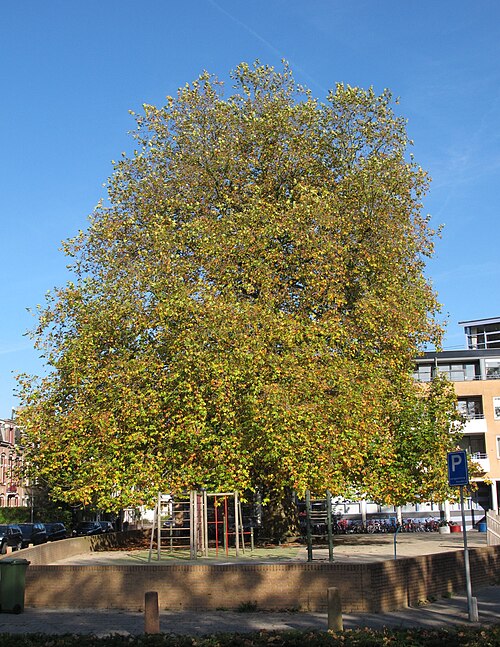
The Copper Beech of the Xaverius Church
NetherlandsAmersfoort't Zand
The church went up between 1881 and 1883. The beech was already about fifty years old when the first stone was laid. That is worth pausing on, because the natural assumption at any church with a big tree beside it is that somebody planted the tree to go with the building. Here the register is explicit that the order runs the other way: banded 1830 to 1840, the beech predates the church by half a century, and whoever chose this plot chose a plot with a mature beech on it. The register also gives it a health note, which is the sort of thing worth passing on. It calls the tree reasonably good for its age and for its position in an urban area, which is faint praise and honest. City copper beeches have a hard time of it: shallow feeding roots under paving, salt, and no leaf litter left to rot back into the soil. Copper beech is not a species. It is a purple-leaved mutation of the common beech that turns up occasionally in the wild and is then propagated by grafting, so almost every one you meet was chosen by somebody. In October the purple burns through to copper, and it is the best week to come.
Autumn colour
October, when the purple turns copper
The line is our estimate of how much there is to see, not a measurement. Typical for this species where this tree stands; exact weeks shift with the year.
By the St Franciscus Xavierius church, 't Zand 31The large dark purple-leaved beech beside the church.
Free. Stands in the church grounds on 't Zand, reachable in daylight.
About 900 m east of Amersfoort station, on 't Zand.
Sources
Where the facts on this page come from.
- In the official register: Landelijk Register Monumentale Bomen (Bomenstichting), no. 1678833
- monumentalebomen.nl
- services-eu1.arcgis.com