Six of these thirteen stand on Mont-Royal, in the park or the two cemeteries sharing its flank, so Montreal arrives here as a mountain rather than a city. Six more cluster at the foot of the hill on McGill's downtown campus, led by a ginkgo a botanist who has spent twenty-five years looking picked as the city's most remarkable tree. The last stands apart, on the neighbouring summit of Westmount. Up on the mountain: an Austrian pine that grew eighteen metres wide instead of tall, and one of the last big American elms in Montreal.
0 of 13 visited in Montreal
Ginkgo (Ginkgo biloba) · 134 years · Downtown / McGill campus
Asked to name the most remarkable tree in Montreal, a botanist who has spent twenty-five years looking for them picked this one, on a lawn beside the McGill law faculty.
Suzanne Hardy believes it is likely the first ginkgo of its kind planted in Montreal, at the hands of the Olmsted family. Frederick Law Olmsted laid out Mont-Royal Park, the hill this ginkgo sits at the foot of, so tree and mountain share a designer. Six of the trees on this page are up on that hill; this one waits at the bottom, on the same McGill campus as three more.
The city's own heritage register for the mountain independently names the same tree: said to have been planted in 1892, the year Chancellor Day Hall itself, then a private house, went up beside it, putting the ginkgo at roughly 134 years rather than the round hundred-twenty a botanist once guessed. The register also measures what nobody had, a trunk 123 centimetres across, about 386 around. The pin marks the corner of Peel Street and Doctor Penfield Avenue, not the trunk; the grounds are open to walk through and it is not a large lawn.
Ginkgos are the last survivors of an order that otherwise ended with the dinosaurs, and they keep the habits: green leaves held into late autumn, a hard uniform yellow, then nearly the whole crown dropped inside a couple of days. Arrive in the wrong week and you get a green tree or a bare one.
Northern Red Oak (Quercus rubra) · 200 years · Mount Royal / Ville-Marie
In 1954 Mayor Jean Drapeau had much of Mont-Royal's undergrowth cut away, in a campaign remembered afterwards as the morality cuts. This oak came through it.
It is one of the ten largest oaks on the mountain: 118 centimetres across the trunk at chest height, 200 at the base, which the city's dendrological survey reads as roughly two hundred years. That measurement was taken in 2011, so the tree is somewhat wider now than the number says and the age band runs correspondingly wide. It seeded itself here rather than being planted, and it was already mature when the park was laid out around it in 1876.
You find it in a stand of white spruce about fifty years old, which makes the arithmetic obvious the moment you are standing there. Everything in sight arrived four generations after the oak did.
It is not in good health. A primary branch tore out and left a major cavity in the trunk, and the survey describes the tree as being in the twilight of its life, which is a formal way of saying go sooner rather than later. It stands off a secondary trail leading from the Olmsted Trail, and that trail is the practical instruction, because the pin is approximate. The city of Montreal's own heritage page for the mountain is the only published account of this tree; nobody else has written it up.
Japanese Yew (Taxus cuspidata) · 60 years · Outremont
A Japanese yew in this climate normally manages five or six metres. This one is fifteen.
It stands on its own on a gentle slope in Mount Royal Cemetery, in a stretch where the gravestones are thinly scattered, which is what makes it findable and also what makes it worth the walk: a yew given room to become a tree instead of a hedge. The city's survey calls it the largest of its species on the mountain, at 50 centimetres across the trunk, which for a yew is a great deal of wood.
Some specialists think it is not one plant at all. The bark is oddly reddish and the crown unusually round and compact, and the theory on the record is that a male and a female were grafted together and grew on as a single tree. Nobody has taken it apart to find out.
Its age is given as over sixty years, which makes it the youngest tree on this page and does nothing to explain the height.
One caution about the address, because two cemeteries adjoin on this flank of the mountain and there is a Japanese yew recorded in the other one as well. This is the Mount Royal Cemetery tree, not the Notre-Dame-des-Neiges one. Enter from the chemin de la Foret side. The city's heritage page for it is the only published description that exists.
Austrian Pine (Pinus nigra) · 140 years · Cote-des-Neiges
This pine is 7.5 metres tall and 18 metres wide. It has spent about 150 years growing sideways.
It sits in the middle of the open ground just inside the main gate of Notre-Dame-des-Neiges, which makes it the easiest tree on this page to find. Walk in and it is the thing in front of you, shaped rather more like a mushroom than a pine. The trunk is 85 centimetres across at chest height and 97 at the base.
It was planted deliberately, and early. Between about 1870 and 1872 the cemetery's administration bought thousands of trees to landscape the new pathways during its first phase of development, and this Austrian pine was one of them. That makes it part of the cemetery's opening gesture rather than something that turned up later, and it has been marking the entrance ever since, through every funeral that has come through the gate behind it.
Look at the trunk closely and it is punched with small round holes, the work of a woodpecker going after what lives under the bark. The tree does not appear to mind.
Everything known about it comes from one place, the city of Montreal's own dendrological page for this specimen. No outside source has published a word about it, which for a tree standing in plain sight at the gate of Canada's busiest cemetery is a strange gap.
American Elm (Ulmus americana) · 120 years · Mount Royal / Ville-Marie
Montreal once had roughly 22,000 American elms. Dutch elm disease took very nearly all of them. This is one of the few still standing.
It grows on the margin of the Smith House property in Parc du Mont-Royal, on the edge next to the Olmsted Trail, and at 110 centimetres across the trunk and 128 at the base it is the largest American elm documented anywhere in the park. The city's survey reads those measurements as roughly 120 years, and the measuring was done some years ago, so add what it has grown since. It appears to have seeded itself rather than been planted, which is now an unusual biography for an elm: the ones that were planted were mostly along streets, and the streets are where the disease moved fastest.
What nobody can promise is that it will still be here. The disease has not gone anywhere, it travels between elms through root grafts and beetles, and a tree this size is a target rather than a fortress. The city's own heritage page is the only published record of this elm, and it has not been marked as lost, which is the most recent evidence there is that the tree is alive.
Treat that as a reason to go this season rather than next. If you get there and it is gone, tell us and we will take it down.
Silver Maple (Acer saccharinum) · 150 years · Cote-des-Neiges
This tree was here before the cemetery was. It grew on a florist's private grounds, and the graves came later.
Patrick McKenna arrived in Montreal from Ireland in 1847 and by 1851 had founded what is described as Canada's oldest florist house. The silver maple stood as an ornamental on his own horticultural property while that ground was still his field. Notre-Dame-des-Neiges incorporated in 1907, five years before he died, and the burial sections were laid out around the trunk.
Nobody wrote down the year he planted it, so the honest range is somewhere inside his sixty years on the land, which comes out at roughly 150 years. What is measured rather than inferred is the trunk: 185 centimetres across at chest height, 191 at the base, a girth of 5.8 metres. That is the second-thickest tree in the cemetery and comfortably the largest on this page.
It is in the southeast section, plot ND 7002-9030, near where chemin de la Cote-des-Neiges meets chemin Remembrance, on the edge of a burial island. The plot number is the useful part of that address: the map pin will get you to the right corner of a very large cemetery, and the number gets you the rest of the way.
The city of Montreal's survey of the mountain is the only published account of this maple.
Honey Locust (Gleditsia triacanthos) · 100 years · Cote-des-Neiges
The way this tree's age was worked out is that somebody read the gravestone beside it. The planting matches a death date inscribed there, which makes it a private act of commemoration by one family, and a lovely but slightly shaky way to date a tree.
Taken at face value it puts the honey locust at roughly a hundred years, give or take a decade either way. The city's survey recorded it at eighty to ninety years in 2011, so add the years since. The trunk is 65 centimetres across and 81 at the base, which made it the largest of the eleven honey locusts scattered through Notre-Dame-des-Neiges when the count was taken.
The crown is the odd part. It is displaced and asymmetrical, the whole weight of it thrown off to one side toward the dome of Saint-Joseph's Oratory on the horizon, and a long scar runs where a large branch came away. Honey locust resists rot and tolerates city air better than most trees, which is why it turns up on so many streets and why one can carry an injury like that for decades.
The address is section B, and that is as precise as the record gets, so allow time. The city's dendrological page for it is the only published description of this tree anywhere.
Northern Red Oak (Quercus rubra) · 160 years · Westmount
When McGill University bought the top of Westmount hill in 1895 to keep it from being built on, this oak was already about thirty years old.
The observatory the university had in mind never went up. In 1940 it sold the hill to the City of Westmount on the condition that the land stay a park or playground in perpetuity, and that deed is why the summit carries hardwood forest instead of houses.
The city's heritage survey measured the tree in 2011 at 114 centimetres through the trunk, roughly 3.6 metres round, and put it at over 145 years then, so over 160 now. It ranked as the second-largest oak in Summit Woods. The wood around it is a red oak, sugar maple and white ash mix that the city calls rare in the Montreal area today, surviving almost nowhere but this mountain.
It stands along the main trail near the summit and can be seen from the path without leaving it. Two more thick red oaks are recorded here, further down a steep unmaintained slope, which is a different kind of walk altogether. A late black cherry grows on the same easy stretch.
The tree's own figures come from that single official survey, which is why the age here is a band rather than a date, and why the pin marks the stretch of trail rather than the exact trunk.
Tulip Tree (Liriodendron tulipifera) · 77 years · Downtown / McGill campus
McGill's graduating class of 1949 left a tree behind, and it is still standing beside the Redpath Museum.
That makes it unusual company on this map. Almost every tree here carries an estimated age, worked back from a trunk measurement or a register's planting band. This one has a documented year, so the count is simply 77.
A tulip tree is an odd thing to find growing this far north. The species is rare in Quebec and close to the limit of the cold it will take, which is most of the reason the city put this specimen on its remarkable-tree list at all. The survey measured it at 64 centimetres through the trunk, about two metres round. Elsewhere the species reaches three times that thickness, so this is not a giant of its kind; it is a good one in a place where good ones are scarce.
It grows in an oval of mixed species planted around a sunken island of grass on the lower campus, which means it has spent its whole life watching students cut the corner across the same lawn. The black walnut at the Roddick Gates and the ginkgo further into the campus are both a few minutes away, so the three of them make one short errand.
One source documents this tree, the city's own heritage register, and the pin is approximate.
Black Walnut (Juglans nigra) · 110 years · Downtown / McGill campus
McGill's own alumni magazine once described this tree as peering in the windows of the Redpath Museum. That was in 2001, and it is still doing it.
The black walnut stands just inside the Roddick Gates, in the line of trees along Sherbrooke Street West at the front of the lower campus. The city's heritage survey puts its trunk at 82 centimetres across at chest height, about 2.6 metres round, and rates both its physiological and its structural health as excellent, which is a generous report card for a tree that has spent its life on the edge of a downtown street.
The age needs a caveat. The survey says it was planted at the turn of the century, a phrase that in French can point at either end of the nineteenth. Read against the same page's own note that the tree is more than a hundred years old, it lands at roughly 1900 to 1910, so over 110 years now. Nobody has narrowed it further, and the band here stays wide because of it.
That is more than a century of students coming through the gates underneath it. Black walnut is not a common street tree in Montreal, and while the species can grow half as thick again as this one, a trunk this size on Sherbrooke Street is worth the two minutes it takes to stop.
Copper Beech (Fagus sylvatica 'Purpurea') · 75 years · Downtown / McGill campus
At roughly 75 years old this is one of the youngest trees on this map, and the city still counts it among the largest purple beeches on Mont-Royal.
That says as much about purple beeches here as it does about this one. It went in around the middle of the twentieth century, part of a mixed row planted along the terrace between the Redpath and McLennan library pavilions, and by the city's own description it matches its neighbours in size and shape. The one thing that separates it from the line is colour: dark purple foliage in a row of ordinary green.
It sits on the axis facing Redpath Hall, finished in 1893 and one of the oldest buildings on the campus, which makes the building comfortably older than the tree looking at it. Generations of students have crossed that terrace between lectures without registering that the odd-coloured one in the row is on a heritage list.
The survey measured it at 56 centimetres through the trunk, about 1.8 metres round, and called it around 60 years old when the work was done in 2011, which is where the 75 comes from. No other source names this tree, so both numbers rest on that single page.
The black walnut at the Roddick Gates, the tulip tree by the Redpath Museum and the ginkgo further up are all a few minutes away.
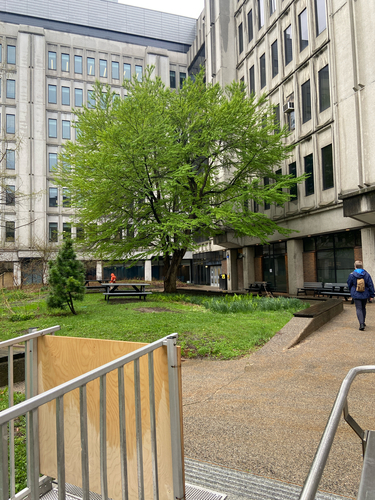
Katsura (Cercidiphyllum japonicum) · 60 years · McGill downtown campus / Golden Square Mile
Every October the fallen leaves of this katsura smell of burnt sugar, a scent so distinctive that visitors to the Stewart Biology Building courtyard use it to find the tree before they see it.
Planted in 1965 by C. Darnley Gibbs, the McGill botany professor who oversaw the building's opening, it has grown three trunks from one base rather than one, the widest just under a metre round. Montreal's own remarkable-tree register calls it among the largest katsuras in the region, ahead even of the specimen at College Notre-Dame across town.
Gibbs used the sheltered courtyard as a private trial ground, filling raised beds with unusual specimen trees, each given its own microclimate by the surrounding wings of the building. The katsura's companion from that same planting, a dawn redwood, still grows a few metres away.
John Watson, who manages forest operations at the nearby Morgan Arboretum, once pointed out what most passersby miss: the underside of a katsura leaf is magnificent, turning purple in autumn while the top goes from green to yellow to pinkish beige. Then the leaves drop, and the courtyard fills with the smell of caramel.
At about sixty years old this is one of the younger trees on this list, and it earns its place on one specific kind of afternoon: step into the courtyard in October and follow your nose.
Photo: Alex Baxter (CC BY)
Dawn Redwood (Metasequoia glyptostroboides) · 60 years · McGill downtown campus / Golden Square Mile
The dawn redwood was known only from fossils until 1941, when foresters in western China found a living grove that nobody in the West believed still existed. Seeds went out to botanical gardens and universities worldwide starting in 1948, and this tree is one result of that shipment.
It was planted in 1965 in the courtyard of McGill's newly-opened Stewart Biology Building by C. Darnley Gibbs, the botany professor who filled the sheltered space with specimen trees. The tree beside it, a katsura from the same planting, is on this list too. Montreal's own remarkable-tree register calls this one probably the largest dawn redwood in Quebec, its trunk forking into two stems, the wider more than a metre round.
It should not be confused with an older dawn redwood across town at Mount Royal Cemetery, planted in 1949 as a memorial and stunted by the local climate into a low, sprawling shrub barely three metres tall. This one, in a sheltered courtyard and sixteen years younger, has grown into a proper tree with real height.
Only one source has been found for this specimen so far, Montreal's own register. A second is still being looked for, and if you know more about it, tell us.