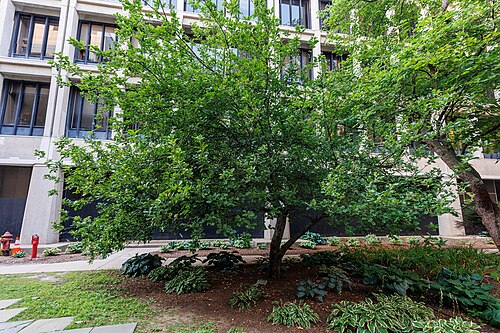
This is Cambridge's only living Historic Landmark, and it was made one in 1985 to stop a building. A developer's plans for the site would have taken a third of the copper beech's crown and finished it off, so about thirty neighbours formed a group called the Friends of the Beech Tree and petitioned the city; the Historical Commission designated the tree itself, the legal instrument normally reserved for buildings. The Harvard Crimson, reporting from the October 1985 hearing, called it 203 years old, which puts its planting around 1782 and makes it roughly 240 now. That figure carries more weight than the biography printed around it in the same article, which has Henry O. Houghton serving as mayor decades before he founded the Riverside Press. A 2018 local survey of Cambridge trees offers a looser "planted 150+ years ago", a lower bound rather than a contradiction. Houghton planted three beeches on his family estate here. This is the one left. MIT bought the property in the 1970s and took down the buildings, and the tree stayed, which is how a private estate specimen ended up standing on a public sidewalk on Massachusetts Avenue between Central and Harvard. Most of Boston's notable trees sit inside curated collections. This one you walk past on the way to the bus.
From people who stood here
No notes yet
Did you visit the tree? Leave a note for the next visitor.
Getting there
1000-1008 Massachusetts Avenue, Cambridge, MA (between Harvard Square and Central Square, on the site of the former Houghton estate, now part of MIT/University Park land)
You can recognise it by the copper leaves, the last of three beeches planted on the old Houghton estate. It stands right on the Massachusetts Avenue sidewalk between Central and Harvard Square, on ground MIT cleared of its buildings.
MBTA Red Line to Central Square, then about 8 minutes on foot along Mass Ave toward Harvard Square
Fresh leavesAutumn colour
May, when the new leaves open translucent red before they darken to purple-black
The line is our estimate of how much there is to see, not a measurement. Typical for this species where this tree stands; exact weeks shift with the year.
Sources
Where the facts on this page come from. The story was written with AI from these sources, and readers who know the tree correct it.