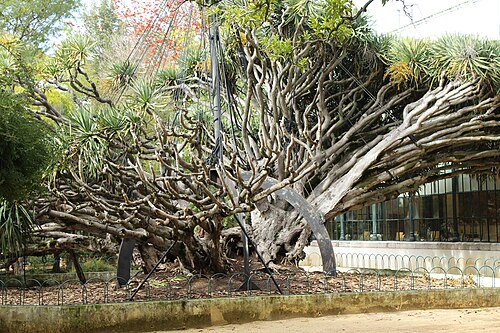
Four olive trees outside a small round chapel in Alcântara have outlived every Portuguese king since before the Braganza dynasty existed. By the city's own classification records they are about 457 years old, the oldest documented trees in Lisbon, planted well before the Capela de Santo Amaro beside them took its current circular form in 1549. The chapel has been rebuilt and restored more than once since; the olives outside it have simply kept growing. None of the four is tall, barely six metres at most, but their trunks have hollowed and twisted with age into shapes closer to driftwood than farmland olive stock. City foresters classified them for their cultural, pedagogical and landscape interest, bureaucratic language for what amounts to old age handled well. Olive trees usually mark farmland, not clifftop chapels with river views, and these four have quietly ignored the fact that a working port and, eventually, a 25 de Abril Bridge grew up around them. The hilltop they share is one of the better free viewpoints over the Tagus, and on a typical afternoon the view gets most of the attention, while four of the oldest living things in the city stand a few steps away, propped, gnarled, and largely unbothered.
In fruit
the harvest, when the fruit turns from green to black
The line is our estimate of how much there is to see, not a measurement. Typical for this species where this tree stands; exact weeks shift with the year.
Capela de Santo Amaro, Rua de Santo Amaro, Alcântara, 1300 LisboaYou can recognise them by four gnarled, driftwood-like olive trunks barely six metres tall. They stand outside the round Capela de Santo Amaro, on the hilltop above the Tagus in Alcantara.
Free, open access, public garden around the chapel
11 min walk from Alcântara-Terra station (Linha de Cascais), or tram 15E to Calvário then 9 min walk
Sources
Where the facts on this page come from.
- In the official register: Arvoredo de Interesse Público (ICNF), no. KNJ1/515
- florestas.pt
- dn.pt
- pt.wikipedia.org